Description
VIP (vasoactive intestinal peptide) is a linear 28-residue neuropeptide of the secretin/glucagon peptide family with a free N-terminus and a C-terminal amide (HSDAVFTDNYTRLRKQMAVKKYLNSILN-NH₂); several of the cited clinical studies use it under the name aviptadil. The sequence contains no cysteine and no disulfide bridge but one methionine (Met17), which is oxidation sensitive — keep vials sealed, cold and away from light, and avoid oxidising buffers.
VIP: what the published research shows
Compiled by NADA-Labs from the peer-reviewed literature cited below. No own study data.
VIP is an endogenous 28-amino-acid peptide that was first isolated from hog small intestine and described as chemically distinct from the kinins, substance P, glucagon and secretin (Said 1970, PMID 5450698); aviptadil, the name used in four of the cited studies, is synthetic VIP2. The research literature attributes its effects mainly to the class B G-protein-coupled receptors VPAC1 and VPAC2, which respond to VIP and to PACAP with high affinity, whereas the PAC1 receptor is selective for PACAP (Harmar 2012 review, PMID 22289055); VIP bound a cloned VIP receptor expressed in mouse COP cells and stimulated adenylate cyclase through it (Ishihara 1992, PMID 1314625). VIP has been studied as an intravenous infusion and as an inhaled aerosol in randomised trials in hospitalised patients with COVID-19 respiratory illness, in provocation studies in migraine, in open studies in pulmonary hypertension and sarcoidosis and in healthy volunteers1,2,3,4,5,6,7,8, with supporting animal work (Abad 2003, PMID 12671893) and in-vitro T-cell experiments7.
Evidence base: All eight numbered references are human studies: three randomised placebo-controlled trials in hospitalised patients with COVID-19 — two with intravenous infusion (n = 461 and n = 196)1,2 and one with inhalation (n = 80)3 — two randomised double-blind crossover provocation studies in migraine without aura (n = 21 and n = 12)4,5, two open, uncontrolled inhalation studies in pulmonary hypertension and sarcoidosis (n = 20 each)6,7 and a pharmacokinetic infusion study in four healthy volunteers8. The largest trial was funded by the National Institutes of Health1; the smaller intravenous trial was industry-funded2, as was the inhalation trial3. Further small human studies describe bronchodilatation with tachycardia and flushing in seven asthmatic volunteers (Morice 1983, PMID 6139572), cluster-like attacks in a crossover study of 44 cluster-headache patients (Vollesen 2020, PMID 32962406) and haemodynamic changes in eight patients with primary pulmonary hypertension (Petkov 2003, PMID 12727925). Animal work (arthritis, colitis, VIP-gene knockout mice) is cited only as context. No dedicated toxicology study was identified.
Key studies at a glance
| Study | Model | Design | Main result |
|---|---|---|---|
| Brown 20231 | Human, adults with COVID-19 acute hypoxaemic respiratory failure (94 % in intensive care) | Randomised, placebo-controlled (TESICO); intravenous infusion on 3 days; n = 461; 90 days | Ordinal recovery outcome at day 90 OR 1.11 (95 % CI 0.80-1.55; p = 0.54); deaths to day 90 38 % vs. 36 %; stopped for futility |
| Youssef 20222 | Human, adults with critical COVID-19 respiratory failure, 10 US hospitals | Randomised 2:1, placebo-controlled; intravenous infusion on 3 days; n = 196; 60 days | Primary end point not significant (OR 1.6); survival at day 60 OR 2.0 (p = 0.035, secondary); lower IL-6 release by day 3 (p = 0.02) |
| Esendagli 20253 | Human, hospitalised adults with COVID-19 pneumonia, 9 centres | Randomised 1:1, double-blind, placebo-controlled; inhaled, on top of standard care; n = 80; follow-up 180 days | Time to discharge 7.8 vs. 10 days (p = 0.049); greater CT-score improvement at day 28 (p = 0.028); mortality 5.1 % vs. 12.2 % (p = 0.433) |
| Pellesi 20214 | Human, patients with migraine without aura (17 women, 4 men) | Randomised, double-blind, placebo-controlled crossover; 2-hour intravenous infusion; n = 21 | Migraine attacks in 71 % vs. 5 % (P < 0.001); greater area under the curve for headache intensity, temporal artery diameter and heart rate |
| Rahmann 20085 | Human, patients with migraine without aura | Randomised, double-blind, placebo-controlled crossover; intravenous infusion; n = 12 | No migraine attacks; middle cerebral artery flow velocity -16.3 %, superficial temporal artery diameter +45.9 %; mild immediate headache (P = 0.005) |
| Leuchte 20086 | Human, patients with pulmonary hypertension (PAH 9, PH in lung disease 8, chronic thromboembolic PH 3) | Open, single inhalation during right-heart catheterisation; n = 20; no control group | Small, short-lived selective pulmonary vasodilation; vascular resistance reduced by more than 20 % in 6 of 20; no effect sizes in abstract |
| Prasse 20107 | Human, patients with active pulmonary sarcoidosis; bronchoalveolar lavage (BAL) cells; T cells in vitro | Open phase II, nebulised for 4 weeks; n = 20; no control group | Lower TNF-α production by BAL cells; more T cells with regulatory activity; in vitro induction of regulatory T cells; no effect sizes in abstract |
| Domschke 19788 | Human, healthy volunteers | Graded intravenous infusions over 30-minute periods, plasma VIP by radioimmunoassay; n = 4; no control described in the abstract | Disappearance half-time about one minute; clearance about 9 ml/kg/min; flushing and higher pulse rate at the highest infusion rate |
Placebo-controlled trials in hospitalised patients with COVID-19
| Study | Population (n) | Route and control | Primary end point | Mortality | Tolerability |
|---|---|---|---|---|---|
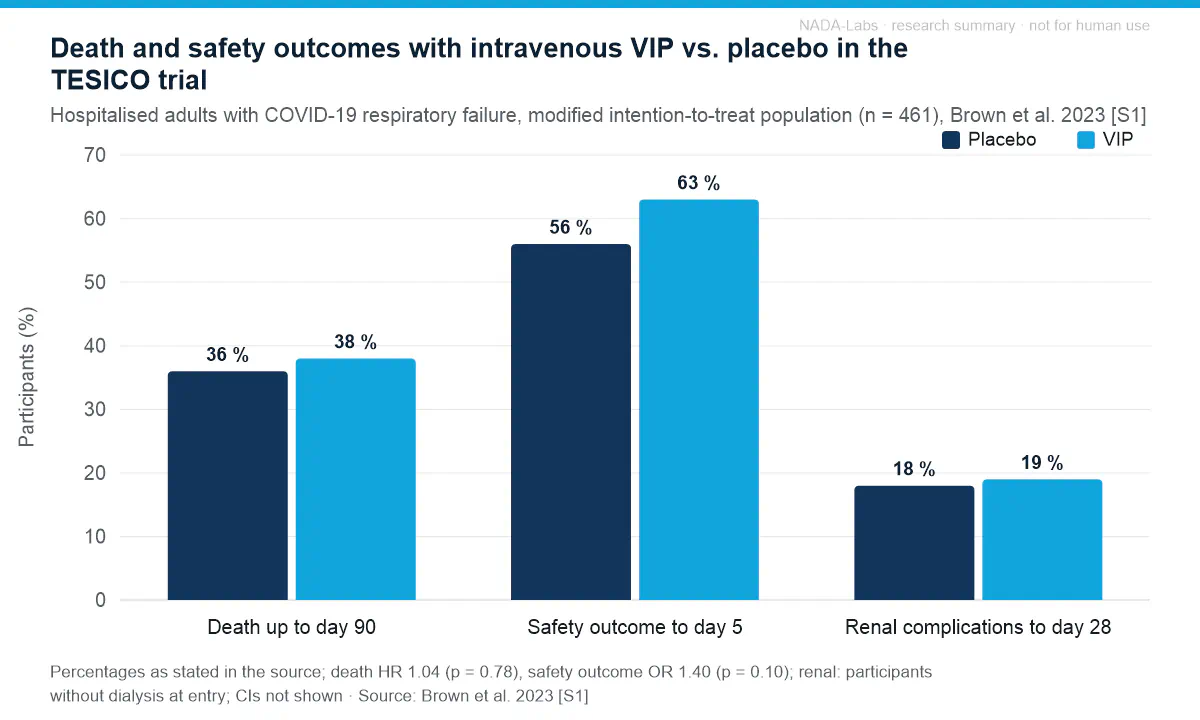
| Brown 20231 | Acute hypoxaemic respiratory failure, 28 US sites (n = 461; 231 vs. 230) | Intravenous vs. matched saline placebo | Ordinal recovery scale at day 90: OR 1.11 (95 % CI 0.80-1.55; p = 0.54); stopped for futility | 38 % vs. 36 % up to day 90 (HR 1.04; p = 0.78) | Safety composite to day 5: 63 % vs. 56 % (p = 0.10); diarrhoea, facial flushing, tachycardia and hypotension more frequent with VIP |
| Youssef 20222 | Critical respiratory failure, 10 US hospitals (n = 196; 131 vs. 65) | Intravenous vs. placebo (2:1) | Alive and free of respiratory failure at day 60: OR 1.6 (95 % CI 0.86-3.11), not significant | Survival at day 60: OR 2.0 (95 % CI 1.05-3.87; p = 0.035; secondary end point) | Diarrhoea 32.8 % vs. 1.5 % (p < 0.0001); hypotension 26.0 % vs. 21.5 % (p = 0.6) |
| Esendagli 20253 | COVID-19 pneumonia, 9 centres (n = 80) | Inhaled vs. placebo, double-blind | Time to discharge 7.8 vs. 10 days (p = 0.049) | 5.1 % vs. 12.2 % up to day 180 (p = 0.433) | No drop-out due to side effects; 51 adverse events in both groups together |
Effects reported in the studies
- Clinical outcomes in COVID-19 respiratory failure (intravenous). In TESICO (n = 461, 94 % in intensive care at baseline) the day-90 ordinal recovery outcome did not differ (OR 1.11, 95 % CI 0.80-1.55; p = 0.54), 38 % vs. 36 % of participants had died by day 90 (hazard ratio 1.04; p = 0.78), and the independent monitoring board recommended stopping for futility after 471 of 640 planned participants had been randomised1. In a smaller trial (n = 196) the primary end point was not significant (OR 1.6, 95 % CI 0.86-3.11), while survival at day 60, a secondary end point, was higher with VIP (OR 2.0; p = 0.035)2.
- Respiratory and inflammatory markers in critical COVID-19. The smaller intravenous trial reported a significant improvement in the respiratory distress ratio and reduced interleukin-6 release by day 3 (p = 0.02); subgroup results were also reported for participants on high-flow nasal oxygen at baseline (primary end point p = 0.039) and on mechanical ventilation (survival OR 10.4, 95 % CI 1.23-87.2; p = 0.031), the latter with a very wide confidence interval2.
- Inhaled VIP in COVID-19 pneumonia. In a double-blind trial (n = 80, 9 centres) mean time to discharge was 7.8 ± 4.0 vs. 10 ± 5.0 days (p = 0.049); modified Borg scale scores did not differ on day 3 (p = 0.090) but were lower on day 7 (p = 0.033), and the CT lung-damage score, similar on day 1 (p = 0.962), improved more by day 28 (p = 0.028); 180-day mortality did not differ significantly (5.1 % vs. 12.2 %; p = 0.433)3.
- Cranial vasodilation. In 12 patients with migraine without aura, intravenous VIP decreased the mean blood-flow velocity in the middle cerebral artery by 16.3 ± 5.9 % and increased the diameter of the superficial temporal artery by 45.9 ± 13.9 %5; after a 2-hour infusion in 21 patients the area under the curve of superficial temporal artery diameter (0-180 min) and of heart rate (0-200 min) was greater than with placebo (both P < 0.001)4.
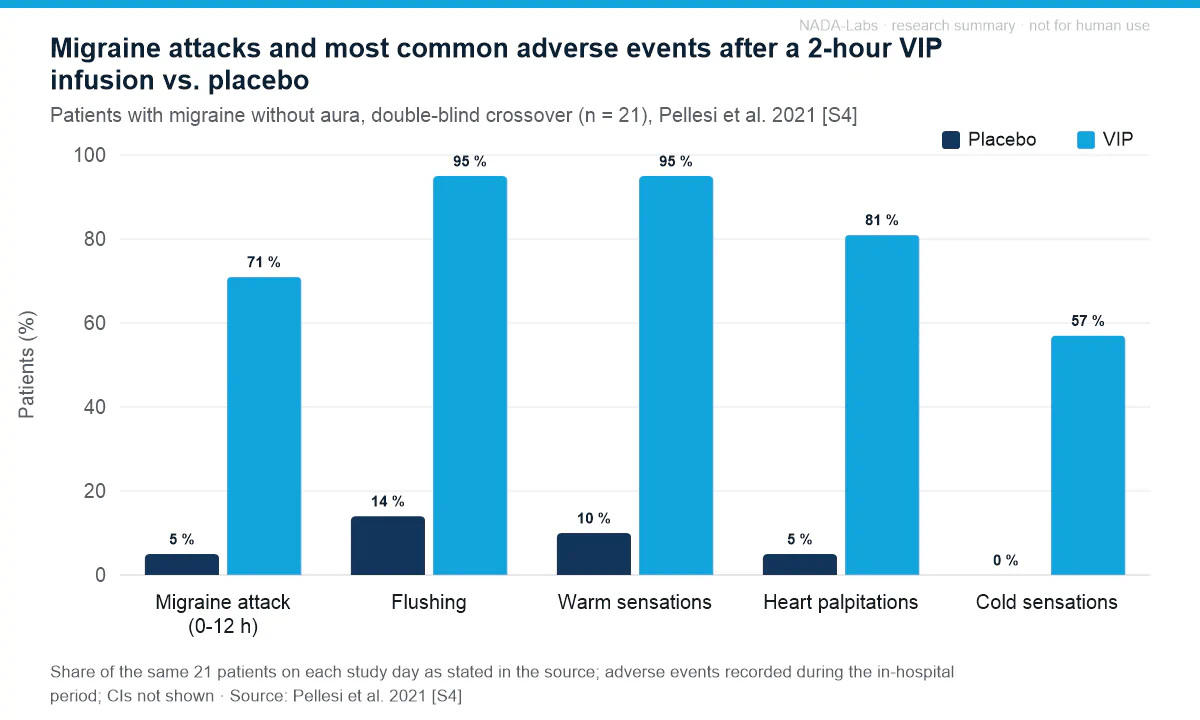
- Migraine and cluster-headache provocation. A 2-hour infusion provoked migraine attacks in 15 of 21 patients (71 %; 95 % CI 48-89 %) vs. 1 of 21 after placebo (5 %; P < 0.001), with a median time to onset of 1 hour 40 minutes; the study was designed to test whether the lack of migraine induction after a 20-minute infusion reflected its only transient vasodilatory response4, and in an earlier crossover study none of 12 patients reported a migraine attack after VIP5. In cluster headache, VIP induced cluster-like attacks in 5 of 14 episodic patients in the active phase and 7 of 15 chronic patients, and none in the remission phase (Vollesen 2020, PMID 32962406).
- Pulmonary haemodynamics. A single inhalation during right-heart catheterisation (n = 20) caused a small, short-lived but significant selective pulmonary vasodilation and improved stroke volume and mixed venous oxygen saturation; pulmonary vascular resistance fell by more than 20 % in six patients, and oxygenation tended to improve in patients with significant lung disease6. An uncontrolled study in eight patients reported lower mean pulmonary artery pressure (Petkov 2003, PMID 12727925); in mice lacking the VIP gene, which develop moderate pulmonary hypertension, vascular and right-ventricular remodelling was attenuated after 4 weeks of VIP (Said 2007, PMID 17309917).
- Immunoregulatory findings. After 4 weeks of nebulised VIP in 20 patients with active sarcoidosis, TNF-α production by bronchoalveolar lavage cells was significantly lower and CD4+CD127-CD25+ T cells with regulatory activity were more numerous; in vitro, VIP converted naive CD4+CD25- T cells into CD4+CD25+FoxP3+ regulatory T cells (no effect sizes in the abstract)7. VIP reduced the incidence and severity of arthritis in an experimental model (Delgado 2001, PMID 11329057) and the clinical and histopathological severity of TNBS-induced colitis in mice (Abad 2003, PMID 12671893).
- Pharmacokinetics and metabolic effects in healthy volunteers. After graded 30-minute infusions in four volunteers, plasma VIP fell by first-order kinetics with an average disappearance half-time of one minute; the apparent metabolic clearance rate was about 9 ml/kg/min and the apparent volume of distribution about 14 ml/kg, and at the highest infusion rate plasma glucose, free fatty acids and calcium were slightly but significantly raised8.
Adverse effects and tolerability reported
- Flushing, warm and cold sensations, palpitations. In the 2-hour infusion crossover (n = 21): flushing 95 % vs. 14 %, warm sensations 95 % vs. 10 %, heart palpitations 81 % vs. 5 % (all P < 0.001) and cold sensations 57 % vs. 0 % (P = 0.02); abdominal discomfort, back pain, tiredness and diarrhoea were also reported4. Cutaneous flushing and a higher pulse rate also occurred in healthy volunteers at the highest infusion rate8, and tachycardia and cutaneous flushing during infusion in seven asthmatic volunteers (Morice 1983, PMID 6139572).
- Diarrhoea with intravenous infusion. Mild-to-moderate diarrhoea occurred in 32.8 % vs. 1.5 % (p < 0.0001), the only system organ class that differed significantly, and 19 participants needed dose adjustments, primarily for diarrhoea2; in TESICO diarrhoea was more frequent with VIP than with placebo, especially on the second and third infusion days, when higher amounts were targeted1.
- Hypotension. Hypotension was common in both arms of the smaller trial (26.0 % vs. 21.5 %; p = 0.6), was managed with pressors per intensive-care protocol and led to no discontinuation2; in TESICO hypotension was more common with VIP during the infusion, while potentially serious renal complications of hypotension up to day 28 were similar (19 % vs. 18 % among participants without dialysis at entry)1.
- Serious adverse events in critically ill populations. TESICO primary safety outcome (death, serious adverse events, organ failure, serious infection or grade 3/4 adverse events up to day 5): 63 % vs. 56 % (OR 1.40, 95 % CI 0.94-2.08; p = 0.10)1; the smaller trial recorded no unanticipated drug-related serious adverse events, including mortality2.
- Headache and migraine as provoked events. Migraine attacks in 71 % vs. 5 % of patients after the 2-hour infusion4; after the shorter infusion a mild immediate headache (maximum 2 on the verbal rating scale; P = 0.005 vs. placebo) and delayed headache 3-11 h after infusion in three vs. two patients (P = 0.89), with no migraine attack5.
- Inhaled administration. The single inhalation in pulmonary hypertension caused no side effects and did not affect systemic blood pressure (n = 20)6; 4 weeks of inhalation in sarcoidosis were described as safe and well tolerated, without adverse-event counts in the abstract (n = 20, open study)7; in the inhalation trial in COVID-19 pneumonia no participant dropped out because of side effects, 51 adverse events were reported in both groups together (most often raised liver enzymes and C-reactive protein), and hypoxia, frequently reported as a severe adverse event (11 cases in total), was more common with placebo3.
Limitations of the evidence. The two largest randomised trials enrolled critically ill COVID-19 patients: the larger, publicly funded TESICO trial found no difference from placebo and was stopped for futility1, while the smaller trial missed its primary end point and reports a positive secondary survival result and subgroup results, one of them with a very wide confidence interval2. The smaller intravenous trial and the inhalation trial report industry funding2,3. The pulmonary hypertension and sarcoidosis studies are small, open and uncontrolled, with no effect sizes in the abstracts6,7, and the migraine studies are provocation models in small crossover samples in which the same patients contribute to both arms4,5. Pharmacokinetic data come from four volunteers measured by radioimmunoassay8. For four references only the abstract was available5,6,7,8, so variance, blinding details and adverse-event counts beyond the abstracts are not reported here. Animal and in-vitro findings stay bound to their models, and findings with PACAP, receptor-selective analogues or modified VIP derivatives are not findings with VIP itself. None of the findings summarised here establish efficacy or safety for any use outside the described research models.
References
- Brown SM, Barkauskas CE, Grund B, Sharma S, Phillips AN, Leither L, Peltan ID, Lanspa M, Gilstrap DL, Mourad A, Lane K, Beitler JR, Serra AL, Garcia I, Almasri E, Fayed M, Hubel K, Harris ES, Middleton EA, Barrios MAG, Mathews KS, Goel NN, Acquah S, Mosier J, Hypes C, Salvagio Campbell E, Khan A, Hough CL, Wilson JG, Levitt JE, Duggal A, Dugar S, Goodwin AJ, Terry C, Chen P, Torbati S, Iyer N, Sandkovsky US, Johnson NJ, Robinson BRH, Matthay MA, Aggarwal NR, Douglas IS, Casey JD, Hache-Marliere M, Georges Youssef J, Nkemdirim W, Leshnower B, Awan O, Pannu S, O’Mahony DS, Manian P, Awori Hayanga JW, Wortmann GW, Tomazini BM, Miller RF, Jensen JU, Murray DD, Bickell NA, Zatakia J, Burris S, Higgs ES, Natarajan V, Dewar RL, Schechner A, Kang N, Arenas-Pinto A, Hudson F, Ginde AA, Self WH, Rogers AJ, Oldmixon CF, Morin H, Sanchez A, Weintrob AC, Cavalcanti AB, Davis-Karim A, Engen N, Denning E, Taylor Thompson B, Gelijns AC, Kan V, Davey VJ, Lundgren JD, Babiker AG, Neaton JD, Lane HC; ACTIV-3b/Therapeutics for Severely Ill Inpatients with COVID-19 (TESICO) Study Group (2023). Intravenous aviptadil and remdesivir for treatment of COVID-19-associated hypoxaemic respiratory failure in the USA (TESICO): a randomised, placebo-controlled trial. The Lancet Respiratory Medicine. PMID 37348524 DOI human study
- Youssef JG, Lavin P, Schoenfeld DA, Lee RA, Lenhardt R, Park DJ, Fernandez JP, Morganroth ML, Javitt JC, Jayaweera D (2022). The Use of IV Vasoactive Intestinal Peptide (Aviptadil) in Patients With Critical COVID-19 Respiratory Failure: Results of a 60-Day Randomized Controlled Trial. Critical Care Medicine. PMID 36044317 DOI human study
- Esendagli D, Sarı N, Akhan S, Arslan S, Doğan Öntaş İA, Yılmaz G, Aksoy F, Kant A, Yaşar KK, Ünlü EC, Akıllı IK, Çelen MK, Mermutluoğlu Ç, Dayan S, Kara E, Durhan G, Ünal S, Demirkol B, Arafat L, Çetinkaya E, Çörtük M, Durmuş Koçak N, Parmaksız ET, İnkaya AÇ (2025). Inhaled Aviptadil Is a New Hope for Recovery of Lung Damage due to COVID-19. Medical Principles and Practice. PMID 39870064 DOI human study
- Pellesi L, Al-Karagholi MA, De Icco R, Coskun H, Elbahi FA, Lopez-Lopez C, Snellman J, Hannibal J, Amin FM, Ashina M (2021). Effect of Vasoactive Intestinal Polypeptide on Development of Migraine Headaches: A Randomized Clinical Trial. JAMA Network Open. PMID 34357396 DOI human study
- Rahmann A, Wienecke T, Hansen JM, Fahrenkrug J, Olesen J, Ashina M (2008). Vasoactive intestinal peptide causes marked cephalic vasodilation, but does not induce migraine. Cephalalgia. PMID 18254893 DOI human study
- Leuchte HH, Baezner C, Baumgartner RA, Bevec D, Bacher G, Neurohr C, Behr J (2008). Inhalation of vasoactive intestinal peptide in pulmonary hypertension. The European Respiratory Journal. PMID 18978135 DOI human study
- Prasse A, Zissel G, Lützen N, Schupp J, Schmiedlin R, Gonzalez-Rey E, Rensing-Ehl A, Bacher G, Cavalli V, Bevec D, Delgado M, Müller-Quernheim J (2010). Inhaled vasoactive intestinal peptide exerts immunoregulatory effects in sarcoidosis. American Journal of Respiratory and Critical Care Medicine. PMID 20442436 DOI human study
- Domschke S, Domschke W, Bloom SR, Mitznegg P, Mitchell SJ, Lux G, Strunz U (1978). Vasoactive intestinal peptide in man: pharmacokinetics, metabolic and circulatory effects. Gut. PMID 730072 DOI human study
This section summarises findings published in the cited peer-reviewed literature for informational purposes. It is not a claim of efficacy or safety, contains no dosing or administration information by design, and does not constitute medical, veterinary or scientific advice. Results in cell cultures or animal models do not predict effects in humans.