Description
Selank is a synthetic heptapeptide based on the tuftsin sequence with the same Pro-Gly-Pro stabilising extension used in Semax. It is highly water soluble and carries a net positive charge at neutral pH.
Selank: what the published research shows
Compiled by NADA-Labs from the peer-reviewed literature cited below. No own study data.
Selank (Thr-Lys-Pro-Arg-Pro-Gly-Pro; TP-7) is a synthetic heptapeptide consisting of the endogenous immunomodulatory tetrapeptide tuftsin (Thr-Lys-Pro-Arg, a fragment of the immunoglobulin G heavy chain) extended by a Pro-Gly-Pro tail. It was developed at the Institute of Molecular Genetics of the Russian Academy of Sciences, and almost the entire literature originates from Russian groups. Mechanisms proposed in the published work include changes in serum leu-enkephalin half-life, allosteric modulation of the GABAergic system, and broad, transient changes in the expression of neurotransmission- and inflammation-related genes. The substance has mainly been studied in rodent models of anxiety, stress, withdrawal and cognition, with a small number of open or comparator-controlled clinical studies in anxiety disorders.
Evidence base: Predominantly rodent models (rats, mice) and molecular work; three comparator-controlled clinical studies in anxiety disorders (n = 60–70 each, not placebo-controlled, published in Russian) and one placebo-controlled resting-state fMRI study in 52 healthy volunteers with qualitative reporting. Nearly all publications come from a small network of Russian institutes, frequently with the peptide’s developers as co-authors; no independent replication outside Russia was identified.
Key studies at a glance
| Study | Model | Design | Main result |
|---|---|---|---|
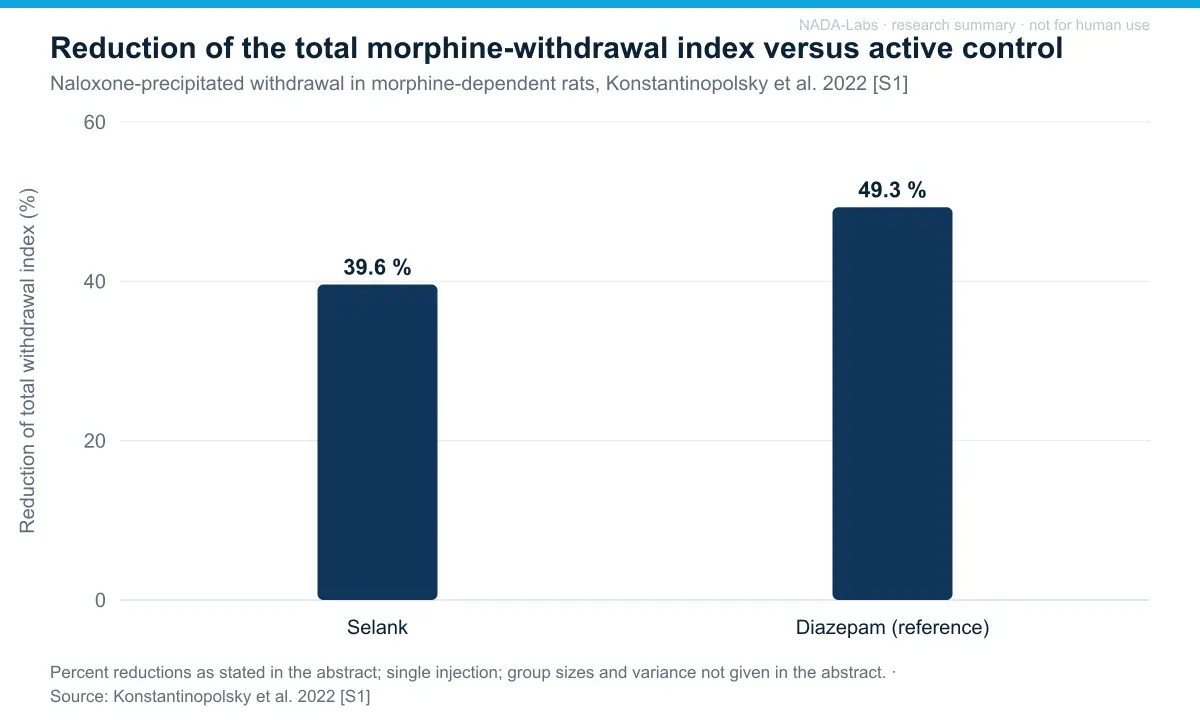
| Konstantinopolsky 20221 | Rats, naloxone-precipitated morphine withdrawal | Controlled, single injection; diazepam as reference | Total withdrawal index −39.6 % (diazepam −49.3 %); tactile threshold 9-fold up; convulsions, ptosis, posture disorders reduced (p < 0.0001) |
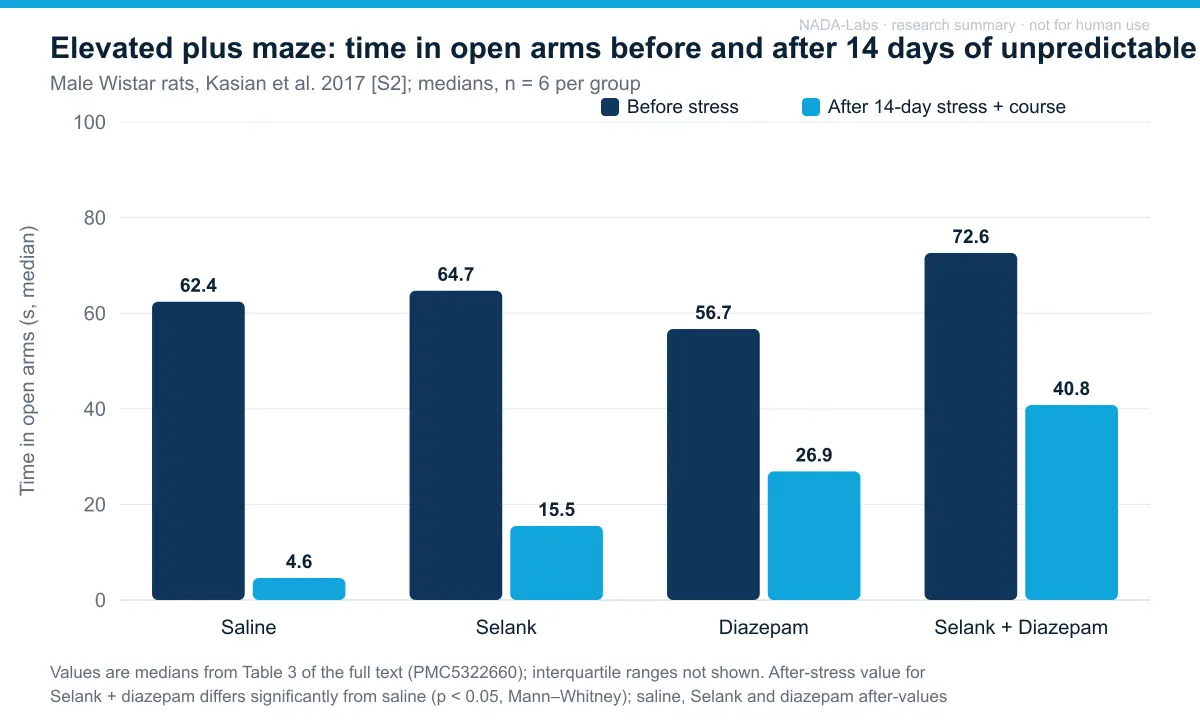
| Kasian 20172 | Wistar rats, 14-day unpredictable chronic mild stress | Controlled, 8 groups, n = 6 each, EPM before/after | Open-arm time after stress: saline 4.6 s, Selank 15.5 s, Selank + diazepam 40.8 s (8.9-fold vs. saline, p < 0.05) |
| Volkova 20163 | Rat frontal cortex, 84-gene qPCR array, n = 10 per group | Controlled, Selank vs. GABA, 1 h and 3 h | 29/77 genes altered at 1 h (mostly down), 17/77 at 3 h (mostly up); r = 0.86 with GABA profile at 1 h |
| Kolomin 20144 | Mouse spleen, inflammation genes | Controlled time course, Selank vs. Gly-Pro fragment | C3 mRNA 3-fold lower at 30 min; Xcr1 reduced at 90 min; Casp1 wave-like |
| Semenova 20085 | Adult rats after antenatal hypoxia | Controlled behavioural and neurochemical study | Sensory attention 2–3-fold and learning 1.5-fold improved (p < 0.01); monoamine balance normalized |
| Zozulya 20086 | Human, GAD and neurasthenia, n = 62 | Comparator-controlled vs. medazepam; Hamilton, Zung, CGI | Anxiolytic effect similar to medazepam plus anti-asthenic component; serum leu-enkephalin half-life increased |
| Medvedev 20157 | Human, anxiety-spectrum disorders, n = 70 | Comparator-controlled: phenazepam vs. phenazepam + Selank; HDRS, CGI, UKU, SF-36 | Earlier HDRS response and fewer benzodiazepine side effects with add-on Selank; SF-36 improved |
Number of frontal-cortex genes with significantly altered mRNA (of 77 evaluable), Volkova 2016 [S3]
| Compound | 1 h after administration | 3 h after administration | Direction of change |
|---|---|---|---|
| Selank | 29 (38 %) | 17 (22 %) | mostly decreased at 1 h; increased at 3 h |
| GABA (comparator) | 41 (53 %) | 9 (12 %) | mostly decreased at 1 h; increased at 3 h |
| Either compound | 45 | 22 | 76 % decreased at 1 h; 95 % increased at 3 h |
Effects reported in the studies
- Anxiety-like behaviour under chronic stress (rodent). In rats exposed to 14 days of unpredictable chronic mild stress, median open-arm time in the elevated plus maze fell from 62.4 to 4.6 s with saline; with Selank alone it fell from 64.7 to 15.5 s (significant vs. baseline, not significantly different from saline), whereas Selank combined with diazepam kept values close to pre-stress levels (72.6 → 40.8 s; 8.9-fold higher than saline, p < 0.05)2.
- Opioid-withdrawal signs (rodent). A single injection reduced the total naloxone-precipitated morphine-withdrawal index by 39.6 % (diazepam: 49.3 %), significantly attenuated convulsions, ptosis and posture disturbances (p < 0.0001) and raised the tactile sensitivity threshold 9-fold (diazepam: 13-fold)1.
- Neurotransmission-related gene expression (rat frontal cortex). One hour after administration, 29 of 77 evaluable genes changed mRNA level (GABA: 41 of 77), mostly downward, with a strong positive correlation to the GABA profile (r = 0.86); at 3 h, 17 genes were altered, mostly upward (r = −0.39 vs. GABA). The largest shifts were in Gabre, Gabrq and Hcrt (20- to 25-fold down at 1 h; 13- to 128-fold up at 3 h)3.
- Inflammation-related gene expression (mouse spleen). Selank produced a 3-fold decrease in complement C3 mRNA 30 min after injection, wave-like changes in Casp1 and reductions in Xcr1 at 90 min; the Gly-Pro fragment largely reproduced the profile4.
- Cognitive measures after developmental brain injury (rat). In adult rats subjected to antenatal hypoxia, Selank improved sensory attention 2–3-fold and learning 1.5-fold (both p < 0.01) and normalized exploratory activity and the serotonin/noradrenaline balance5.
- Clinical anxiety scales (human, comparator-controlled). In 62 patients with GAD or neurasthenia, anxiolytic effects on Hamilton, Zung and CGI scales were reported as similar to medazepam, with an additional anti-asthenic component6. In 70 patients with anxiety-spectrum disorders, adding Selank to phenazepam accelerated the HDRS response and reduced benzodiazepine side effects on the UKU scale7. Neither abstract reports numeric scale changes.
Adverse effects and tolerability reported
- No treatment-attributed adverse events described. Clinical comparator studies in anxiety disorders (n = 62 and n = 70); tolerability was assessed with the UKU scale in 7, and the add-on group showed fewer benzodiazepine-type side effects (sedation, memory impairment, orthostatism) than phenazepam alone. Detailed adverse-event tables are not available in the abstracts.
- Deterioration of anxiety indicators after a repeated course in unstressed rats. All 14-day treatment arms including saline showed reduced open-arm time at re-test; the shift after Selank was smallest and non-significant, and locomotion was unaffected, whereas Selank + diazepam reduced squares crossed 2.6-fold (p < 0.05).
- Broad transient transcriptional effects (immune and neurotransmission genes). Rodent spleen and frontal cortex: dozens of genes changed within 1–3 h, including complement C3 (3-fold down) and GABA-receptor subunit and orexin genes (up to 128-fold at 3 h). The physiological consequences of these shifts, and any long-term immunological effects of a tuftsin analogue, were not characterized in these studies.
- No long-term safety, toxicology or pharmacovigilance data in the studies reviewed. Neither the animal nor the clinical studies retrieved report systematic toxicity endpoints, laboratory safety values or follow-up beyond the treatment course.
Limitations of the evidence. The evidence base is almost entirely Russian and largely co-authored by the peptide’s developers (Institute of Molecular Genetics RAS, Zakusov Institute, Mental Health Research Center), with no independent replication identified. Clinical studies are small (n = 60–70), comparator-controlled rather than placebo-controlled, published in Russian, and report outcomes qualitatively in their abstracts. Most animal findings come from single studies with unstated or small group sizes (n = 6 per group in 2, n = 10 per group in 3), and quantitative results for anxiety, withdrawal and cognition rest on behavioural scores rather than mechanistic endpoints. Reported mechanisms (enkephalin half-life, GABA-A modulation, gene-expression shifts) have not been linked causally to the behavioural effects, and the studies reviewed contain no systematic toxicology or long-term safety data.
References
- Konstantinopolsky MA, Chernyakova IV, Kolik LG (2022). Selank, a Peptide Analog of Tuftsin, Attenuates Aversive Signs of Morphine Withdrawal in Rats. Bulletin of Experimental Biology and Medicine. PMID 36322304 DOI
- Kasian A, Kolomin T, Andreeva L, Bondarenko E, Myasoedov N, Slominsky P, Shadrina M (2017). Peptide Selank Enhances the Effect of Diazepam in Reducing Anxiety in Unpredictable Chronic Mild Stress Conditions in Rats. Behavioural Neurology. PMID 28280289 DOI
- Volkova A, Shadrina M, Kolomin T, Andreeva L, Limborska S, Myasoedov N, Slominsky P (2016). Selank Administration Affects the Expression of Some Genes Involved in GABAergic Neurotransmission. Frontiers in Pharmacology. PMID 26924987 DOI
- Kolomin T, Morozova M, Volkova A, Shadrina M, Andreeva L, Slominsky P, Limborska S, Myasoedov N (2014). The temporary dynamics of inflammation-related genes expression under tuftsin analog Selank action. Molecular Immunology. PMID 24291245 DOI
- Semenova TP, Kozlovskaya MM, Zuikov AV, Kozlovskii II, Zakharova NM, Andreeva LA (2008). Use of Selank to correct measures of integrative brain activity and biogenic amine levels in adult rats resulting from antenatal hypoxia. Neuroscience and Behavioral Physiology. PMID 18197389 DOI
- Zozulia AA, Neznamov GG, Siuniakov TS, Kost NV, Gabaeva MV, Sokolov OIu, Serebriakova EV, Siranchieva OA, Andriushenko AV, Telesheva ES, Siuniakov SA, Smulevich AB, Miasoedov NF, Seredenin SB (2008). Efficacy and possible mechanisms of action of a new peptide anxiolytic selank in the therapy of generalized anxiety disorders and neurasthenia [Article in Russian]. Zhurnal Nevrologii i Psikhiatrii imeni S.S. Korsakova. PMID 18454096 human study
- Medvedev VE, Tereshchenko ON, Kost NV, Ter-Israelyan AY, Gushanskaya EV, Chobanu IK, Sokolov OY, Myasoedov NF (2015). Optimization of the treatment of anxiety disorders with selank [Article in Russian]. Zhurnal Nevrologii i Psikhiatrii imeni S.S. Korsakova. PMID 26356395 DOI human study
This section summarises findings published in the cited peer-reviewed literature for informational purposes. It is not a claim of efficacy or safety, contains no dosing or administration information by design, and does not constitute medical, veterinary or scientific advice. Results in cell cultures or animal models do not predict effects in humans.