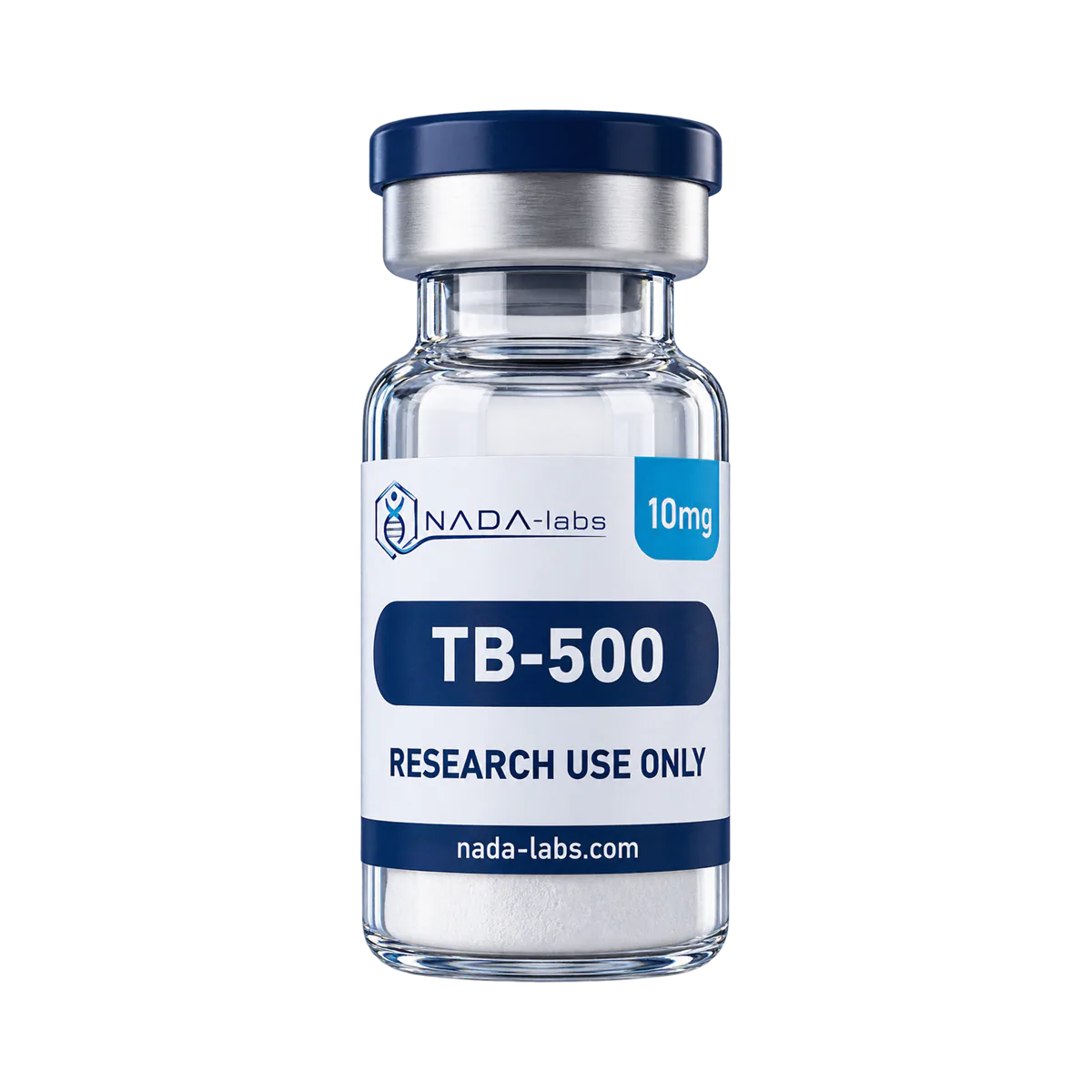
Description
TB-500 is the acetylated seven-residue fragment corresponding to positions 17–23 of thymosin beta-4. It is highly water soluble and supplied lyophilised. Purity is determined by reversed-phase HPLC on every batch, and the certificate reports the measured peptide and water content alongside the chromatographic purity.
TB-500: what the published research shows
Compiled by NADA-Labs from the peer-reviewed literature cited below. No own study data.
TB-500 is a synthetic peptide product derived from thymosin beta-4 (Tβ4), a 43-amino-acid G-actin-sequestering peptide. Doping-control work has identified the ingredient of the commercial product as N-terminally acetylated LKKTETQ, i.e. residues 17–23 of Tβ4, the segment associated with actin binding (Ho et al. 2012, PMID 23084823). Apart from one exploratory rat tendon study of a product labelled TB-5008, the peer-reviewed literature summarized here concerns full-length synthetic or recombinant Tβ4 (ophthalmic research name RGN-259); its applicability to the fragment product is assumed rather than demonstrated. Investigated mechanisms include keratinocyte, endothelial and cardiomyocyte migration, angiogenesis with VEGF induction, integrin-linked kinase/Akt survival signalling and ErbB2/Raf1 signalling. Most work has been done in rodent dermal-wound, myocardial-infarction and tumour models, with a small number of phase 1–2 human trials (dry eye, healthy-volunteer safety, STEMI).
Evidence base: Predominantly rodent models (dermal wound, tendon, myocardial infarction, syngeneic melanoma) and in vitro work; several small randomized human trials of full-length thymosin beta-4 (n = 9 to 96) for dry eye, safety in healthy volunteers and STEMI. Only one controlled animal study of a product named TB-500 was identified (rat Achilles tendon, n = 32, exploratory)8. A large share of the preclinical dermal and tumour work originates from the NIH Kleinman/Goldstein group; the ophthalmic trials are sponsor-affiliated (RegeneRx/Ora), the healthy-volunteer study was run by a contract research organisation, and the 2025 cardiac trial includes sponsor employees (Beijing Northland Biotechnology) as authors.
Key studies at a glance
| Study | Model | Design | Main result |
|---|---|---|---|
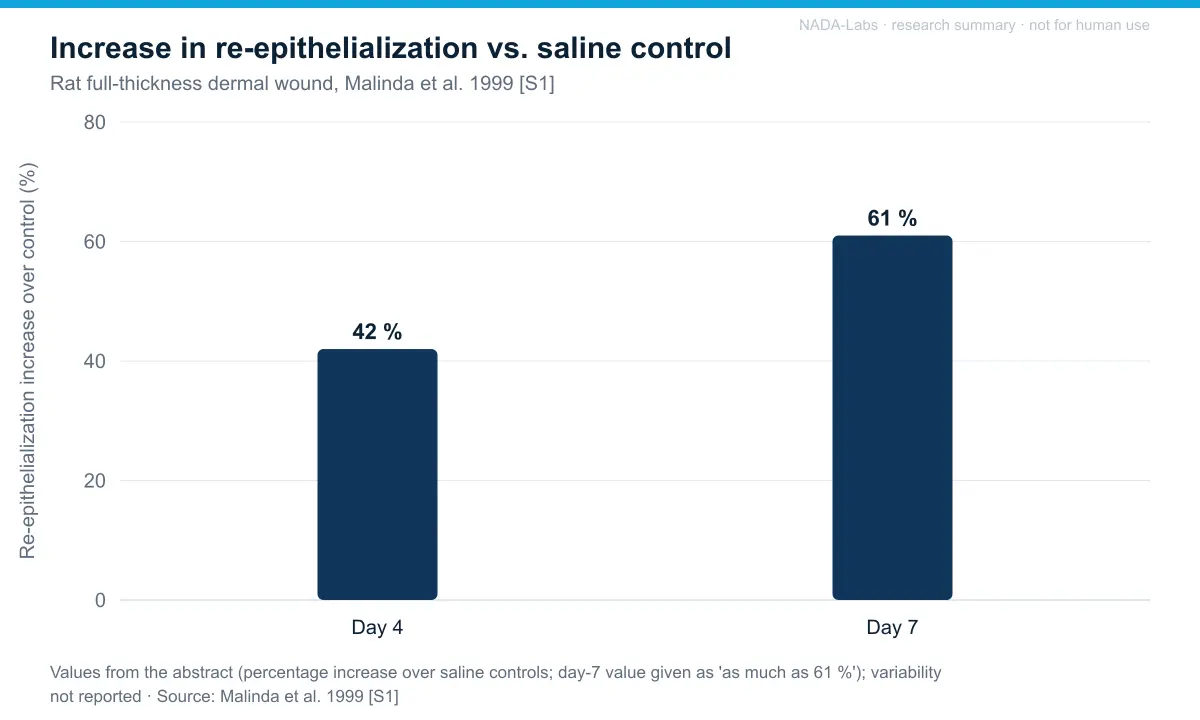
| Malinda 19991 | Rat full-thickness dermal wound; keratinocytes in vitro | Controlled, topical or intraperitoneal vs. saline | Re-epithelialization +42 % (day 4), up to +61 % (day 7); contraction ≥ 11 % greater; keratinocyte migration 2–3-fold |
| Bock-Marquette 20042 | Mouse coronary ligation; cardiomyocyte culture | Controlled | ILK/Akt activation, enhanced early myocyte survival, improved cardiac function (numbers in full text) |
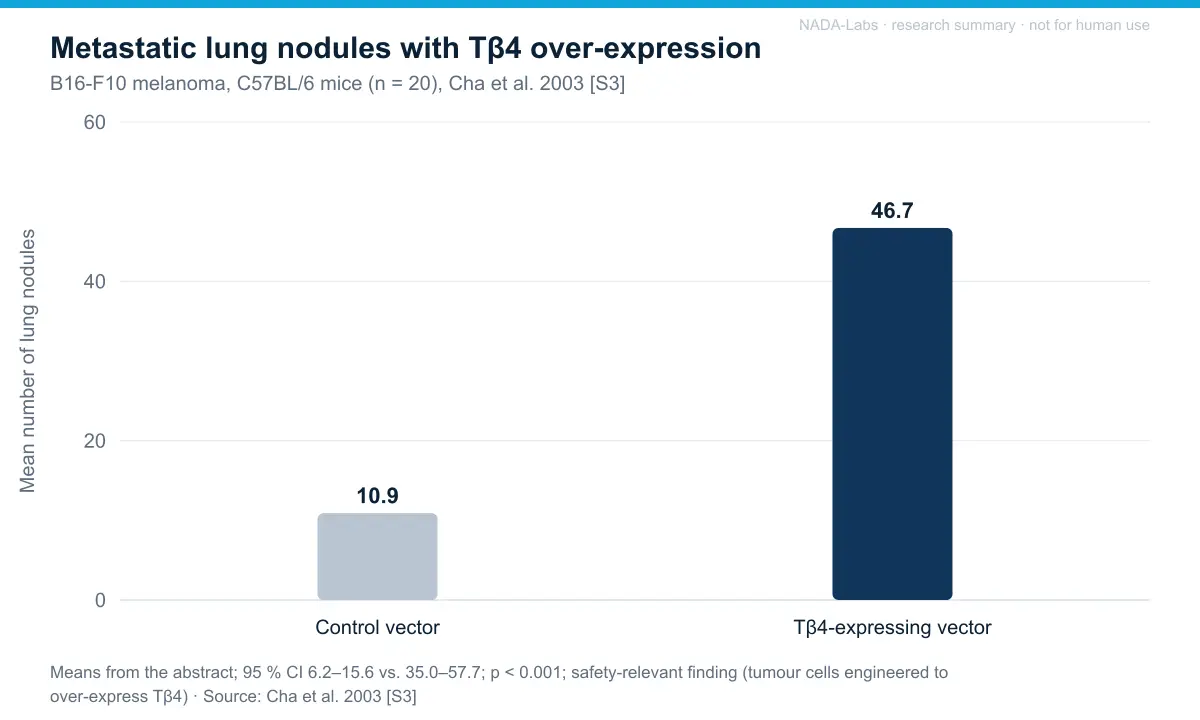
| Cha 20033 | Mouse B16-F10 melanoma, Tβ4 over-expression | Controlled, n = 20 (metastasis experiment) | Tumour size 21.7 vs. 13.3 mm (p = 0.036); lung nodules 46.7 vs. 10.9 (p < 0.001); tumour vessels 4.4-fold |
| Ruff 20104 | Healthy volunteers, intravenous | Randomized, placebo-controlled, n = 40, 14 days | No serious adverse events, no dose-limiting toxicity; adverse events infrequent, mild/moderate |
| Sosne 20155 | Severe dry eye, topical | Randomized, double-masked, vehicle-controlled, n = 9 | Discomfort −35.1 % (p = 0.0141), corneal staining −59.1 % (p = 0.0108) vs. vehicle at day 56 |
| Sosne & Ousler 20156 | Moderate–severe dry eye, CAE model, topical | Randomized, double-masked, placebo-controlled, n = 72 | Primary endpoints not met; CAE discomfort −27 % (p = 0.0244); central/superior staining improved; no adverse events |
| Zhang 20257 | Mouse I/R and ligation; STEMI patients after PCI | Randomized, double-blind, placebo-controlled, n = 96, 90 days | Overall infarct area not significantly different; reduced in early-treatment subgroup (n = 43); ErbB2-dependent cardioprotection in mice |
| Biçer 20268 | Rat Achilles tendon transection and repair (product labelled TB-500) | Randomized, controlled, exploratory, n = 32 (8/group), 4 weeks intraperitoneal | Load to failure higher vs. control (p < 0.05); Bonar score lower (p = 0.016); Movin score lower (p = 0.017); no additive effect with BPC-157 |
Human trial outcomes reported for thymosin beta-4
| Study | n | Endpoint | Result vs. control | p-value |
|---|---|---|---|---|
| Sosne 20155 | 9 (12 vs. 6 eyes) | Ocular discomfort (OSDI), day 56 | −35.1 % | 0.0141 |
| Sosne 20155 | 9 (12 vs. 6 eyes) | Total corneal fluorescein staining, day 56 | −59.1 % | 0.0108 |
| Sosne & Ousler 20156 | 72 | Ocular discomfort / inferior staining, day 29 (primary) | no significant difference | n.s. |
| Sosne & Ousler 20156 | 72 | Discomfort during CAE challenge, day 28 | −27 % | 0.0244 |
| Zhang 20257 | 96 | Infarct area at 90 days (all patients) | no significant difference | n.s. |
| Zhang 20257 | 43 (subgroup) | Infarct area at 90 days (early treatment after PCI) | significantly reduced | reported significant |
| Ruff 20104 | 40 | Serious adverse events, 14 days intravenous | 0 events | — |
Effects reported in the studies
- Dermal wound closure (rodent). In rat full-thickness wounds, Tβ4 increased re-epithelialization by 42 % at day 4 and up to 61 % at day 7 versus saline, with at least 11 % greater wound contraction and increased collagen deposition and angiogenesis on histology1.
- Tendon repair (rodent, product labelled TB-500). In a rat Achilles tendon transection model (n = 32), TB-500 was associated with higher maximum load to failure (p < 0.05) and lower total Bonar (p = 0.016) and Movin (p = 0.017) scores than control at four weeks; absolute values are not given in the abstract8.
- Cell migration in vitro. Keratinocyte migration was stimulated 2–3-fold within 4–5 h1; Tβ4 also promoted migration of embryonic cardiomyocytes and endothelial cells2 and its over-expression increased B16-F10 melanoma cell migration 2.3-fold3.
- Cardiomyocyte survival and post-infarction function (mouse). Tβ4 formed a complex with PINCH and ILK, activated Akt, enhanced early myocyte survival and improved cardiac function after coronary ligation2. Recombinant Tβ4 prevented dysfunction and fibrosis 28 days after ischemia/reperfusion and reduced infarct size at 8 weeks after permanent ligation, in an ErbB2-dependent manner7.
- Ocular surface signs and symptoms (human). In a 9-patient trial, topical Tβ4 reduced ocular discomfort by 35.1 % and total corneal staining by 59.1 % versus vehicle at day 56 (p = 0.0141 and 0.0108)5. In a 72-subject trial, primary endpoints were not met, while discomfort during environmental challenge fell 27 % (p = 0.0244) and central/superior corneal staining improved (p = 0.0075/0.0210)6.
- Infarct size after STEMI (human). In 96 STEMI patients, 90-day infarct area did not differ significantly from placebo overall; a significant reduction was reported only in the subgroup treated early after PCI (n = 43)7.
- Angiogenesis. Angiogenesis was increased in treated rat wounds1; Tβ4 over-expression raised tumour vessel counts 4.4-fold with VEGF induction3.
Adverse effects and tolerability reported
- Tumour growth and metastasis (safety signal). Mouse melanoma model with Tβ4 over-expression: primary tumours 21.7 mm vs. 13.3 mm (p = 0.036) and 46.7 vs. 10.9 metastatic lung nodules (p < 0.001), with a 4.4-fold increase in tumour vessels. Note: genetic over-expression in tumour cells, not exogenous peptide administration.
- Systemic tolerability in healthy volunteers. Intravenous synthetic Tβ4, single and repeated administration over 14 days, n = 40: adverse events infrequent and mild to moderate; no dose-limiting toxicity, no serious adverse events.
- Ocular tolerability. Topical Tβ4 in dry eye: no adverse events observed in any of 72 subjects, with safety monitoring of visual acuity, intraocular pressure, funduscopy and corneal sensitivity6; described as safe and well tolerated in 9 severe-dry-eye patients5.
- Adverse-effect reporting in preclinical studies. The rodent wound, tendon and cardiac studies did not report tolerability or adverse effects.
Limitations of the evidence. Only one exploratory controlled animal study of a product labelled TB-500 was found (rat tendon, n = 32, four-week endpoint, abstract without absolute values)8; all other data concern full-length synthetic or recombinant thymosin beta-4, and equivalence of the acetylated 17–23 fragment to Tβ4 is assumed rather than demonstrated. The wound-healing and tumour evidence is from rodent models produced largely by one NIH group, with sample sizes often unreported in abstracts; the human trials are small (n = 9–96), several are sponsor- or CRO-affiliated, and the two largest randomized trials6,7 did not meet their primary endpoints. Tβ4 promotes angiogenesis and cell migration, and its over-expression increased tumour growth and metastasis in a mouse melanoma model3, a safety consideration that has not been addressed in human data.
References
- Malinda KM, Sidhu GS, Mani H, Banaudha K, Maheshwari RK, Goldstein AL, Kleinman HK (1999). Thymosin beta4 accelerates wound healing. Journal of Investigative Dermatology. PMID 10469335 DOI
- Bock-Marquette I, Saxena A, White MD, DiMaio JM, Srivastava D (2004). Thymosin beta4 activates integrin-linked kinase and promotes cardiac cell migration, survival and cardiac repair. Nature. PMID 15565145 DOI
- Cha HJ, Jeong MJ, Kleinman HK (2003). Role of thymosin beta4 in tumor metastasis and angiogenesis. Journal of the National Cancer Institute. PMID 14625258 DOI
- Ruff D, Crockford D, Girardi G, Zhang Y (2010). A randomized, placebo-controlled, single and multiple dose study of intravenous thymosin beta4 in healthy volunteers. Annals of the New York Academy of Sciences. PMID 20536472 DOI human study
- Sosne G, Dunn SP, Kim C (2015). Thymosin β4 significantly improves signs and symptoms of severe dry eye in a phase 2 randomized trial. Cornea. PMID 25826322 DOI human study
- Sosne G, Ousler GW (2015). Thymosin beta 4 ophthalmic solution for dry eye: a randomized, placebo-controlled, Phase II clinical trial conducted using the controlled adverse environment (CAE) model. Clinical Ophthalmology. PMID 26056426 DOI human study
- Zhang Y, Dong Q, Bian X, Qiao Z, Cui C, Yang N, Liu J, Fu R, et al.; Dou K (2025). Recombinant human thymosin beta 4 improves ischemic cardiac dysfunction in mice and patients with acute ST-segment elevation myocardial infarction after reperfusion. Cardiovascular Research. PMID 41229390 DOI human study
- Biçer O, Adanir O, Güleryüz Y, Balci EC, Dinçel YM, Yenigün MY, Aydin C, Bayrak BY (2026). Effects of BPC-157 and TB-500 on Achilles tendon healing in rats: A histopathological and biomechanical study. Joint Diseases and Related Surgery. PMID 42542926 DOI
This section summarises findings published in the cited peer-reviewed literature for informational purposes. It is not a claim of efficacy or safety, contains no dosing or administration information by design, and does not constitute medical, veterinary or scientific advice. Results in cell cultures or animal models do not predict effects in humans.