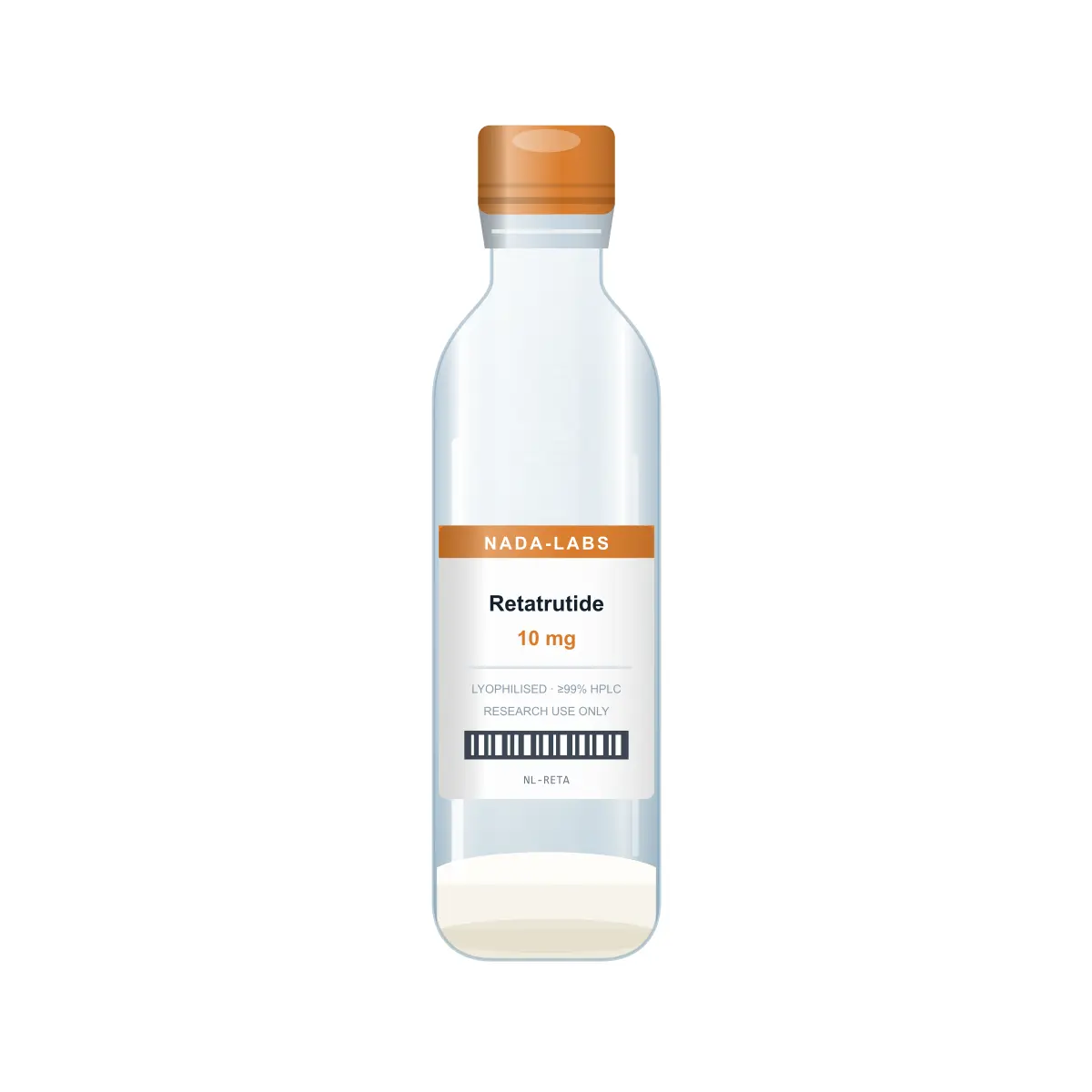
Description
Retatrutide (LY3437943) is a synthetic 39-residue peptide carrying a C20 fatty diacid side chain, which gives the lyophilised cake a slightly waxy appearance and slows dissolution compared with short unmodified sequences. Let the vial stand after adding sterile water and swirl gently rather than shaking; the acylated peptide foams easily and is sensitive to repeated freeze–thaw cycles. Each lot is released after reversed-phase HPLC purity determination and mass-spectrometric identity confirmation.
What the published research shows
Retatrutide (LY3437943) is a synthetic single-molecule peptide developed by Eli Lilly that acts as an agonist at the glucose-dependent insulinotropic polypeptide (GIP), glucagon-like peptide-1 (GLP-1) and glucagon receptors. In vitro it shows balanced glucagon- and GLP-1-receptor activity with comparatively greater GIP-receptor activity; in obese mice the GLP-1R/GIPR-mediated reduction in calorie intake is augmented by a glucagon-receptor-mediated increase in energy expenditure. The published literature is predominantly clinical: a phase 1 single-ascending-dose study, a phase 1b multiple-ascending-dose study in type 2 diabetes, two phase 2 trials in adults with obesity or type 2 diabetes (with liver-fat and body-composition substudies), and phase 3 trials of the TRIUMPH programme (obesity with and without type 2 diabetes, including knee osteoarthritis and obstructive sleep apnoea subgroups) plus a phase 3 monotherapy trial in type 2 diabetes. Preclinical rodent data are summarised mainly in the manufacturer’s discovery paper.
Evidence base: Randomised, double-blind, placebo-controlled phase 2 trials (n = 281 and 338) and phase 3 trials (n = 1152 and 2339), all sponsored by the manufacturer (Eli Lilly) with Lilly employees among the authors and recurring academic investigators (Jastreboff, Kaplan, Frias, Coskun, Hartman, Milicevic); two substudies and the discovery paper are authored entirely or predominantly by manufacturer employees. Preclinical pharmacology (receptor activity, obese-mouse studies) comes from the discovery paper and is reported only qualitatively in its abstract; independent animal data are sparse. The phase 3 publications (2026) are online ahead of print.
Key studies at a glance
| Study | Model | Design | Main result |
|---|---|---|---|
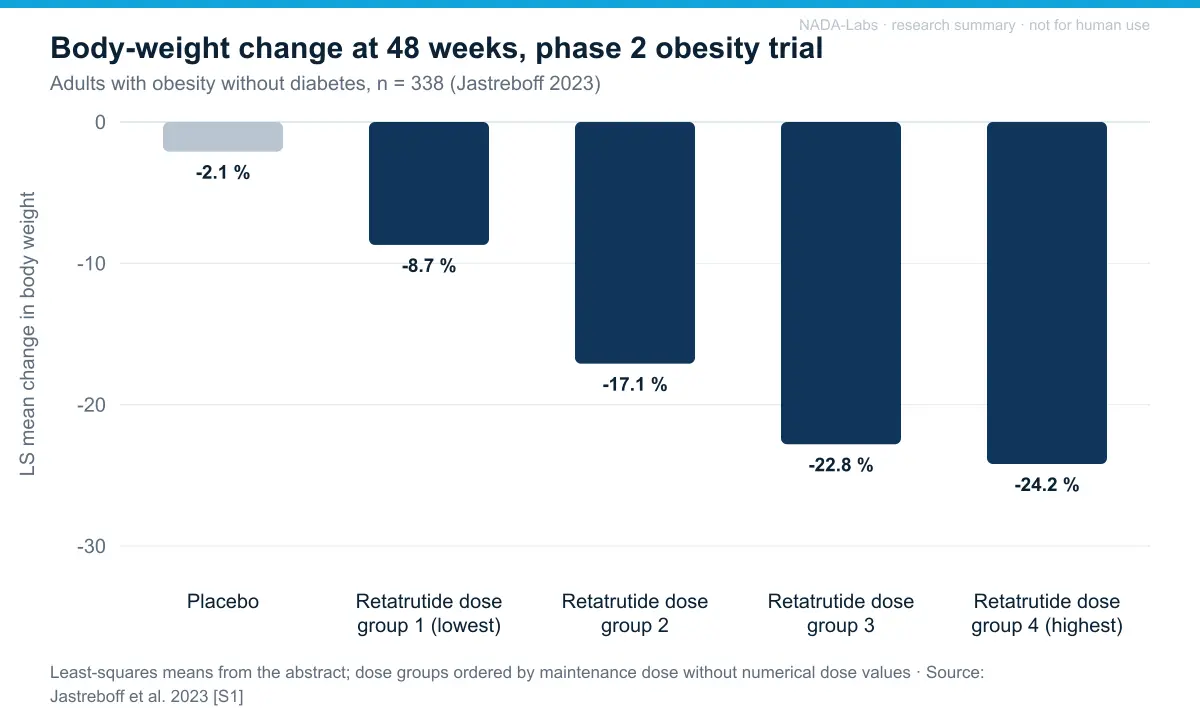
| Jastreboff 20231 | Adults with obesity, no diabetes (n = 338) | Phase 2, randomised, double-blind, placebo-controlled, 48 weeks | Body weight -24.2 % (highest dose group) vs -2.1 % placebo at 48 weeks; ≥ 15 % loss in 83 % vs 2 % |
| Rosenstock 20232 | Adults with type 2 diabetes (n = 281) | Phase 2, randomised, double-blind, placebo- and dulaglutide-controlled, 36 weeks | HbA1c -2.02 % vs -0.01 % placebo at 24 weeks; weight -16.94 % vs -3.00 % at 36 weeks |
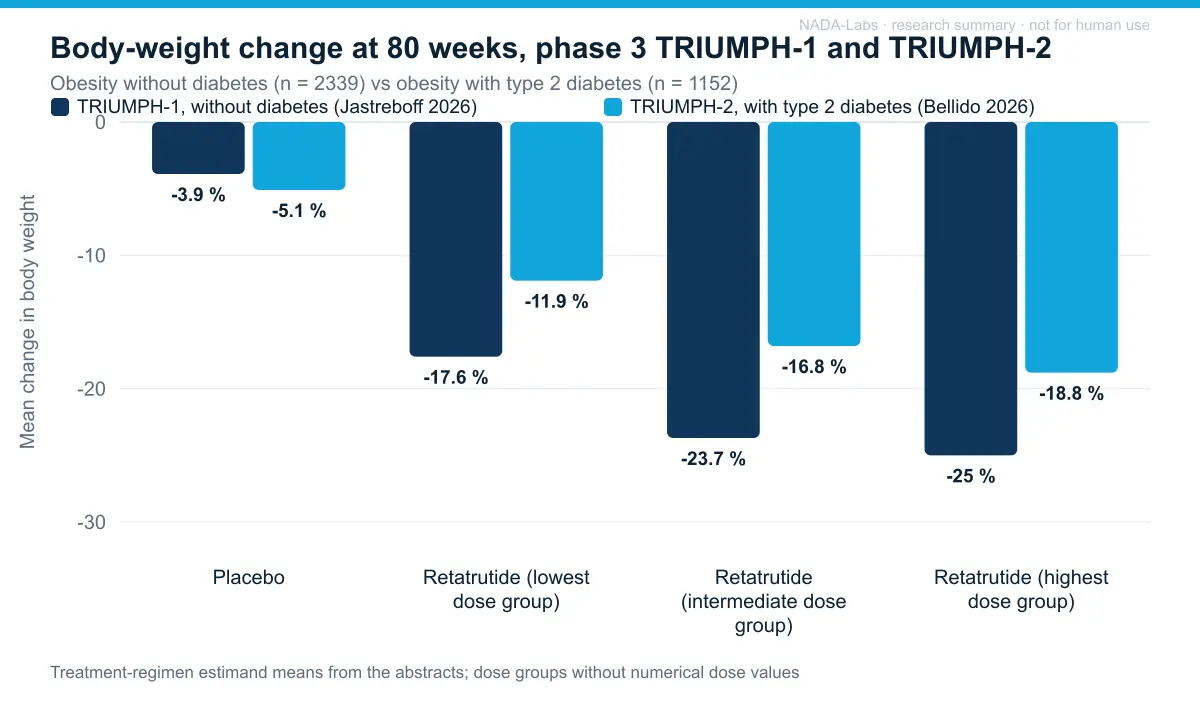
| Jastreboff 20263 | Adults with obesity, no diabetes (n = 2339) | Phase 3 TRIUMPH-1, randomised, double-blind, placebo-controlled, 80 weeks | Weight -25.0 % vs -3.9 %; WOMAC pain -3.6 vs -1.9; AHI -31.7 vs -9.9 events/h |
| Bellido 20264 | Adults with obesity and type 2 diabetes (n = 1152) | Phase 3 TRIUMPH-2, randomised, double-blind, placebo-controlled, 80 weeks | Weight -18.8 % vs -5.1 % (difference -13.8 %); diarrhoea up to 34 % vs 13 % |
| Sanyal 20245 | Phase 2 participants with MASLD, liver fat ≥ 10 % (n = 98) | Randomised, double-blind, placebo-controlled substudy, 48 weeks | Liver fat -82.4 % vs +0.3 % at 24 weeks; normal liver fat in 86 % vs 0 % |
| Coskun 20226 | In vitro receptors, obese mice, healthy volunteers | Discovery paper plus phase 1 single-ascending-dose study | Balanced GCGR/GLP-1R, greater GIPR activity; weight loss in mice; single-dose effect persisted to day 43 |
| Coskun 20257 | Type 2 diabetes, DXA substudy (n = 189) | Prespecified substudy of phase 2 trial, 36 weeks | Total fat mass -26.1 % and -23.2 % (two highest dose groups) vs -4.5 % placebo, p < 0.0001 |
Adverse events reported in TRIUMPH-2 (Bellido 2026 [S4])
| Event | Placebo | Retatrutide lowest dose group | Retatrutide intermediate dose group | Retatrutide highest dose group |
|---|---|---|---|---|
| Diarrhoea | 13 % | 27 % | 34 % | 34 % |
| Nausea | 8 % | 14 % | 21 % | 28 % |
| Hypotension | < 1 % | 1 % | 5 % | 6 % |
| Dysesthesia | 1 % | 4 % | 6 % | 7 % |
| Discontinuation due to AE or death | 5 % | 4 % | 12 % | 8 % |
Effects reported in the studies
- Body-weight reduction in obesity without diabetes. Phase 2: LS mean -24.2 % at 48 weeks in the highest dose group vs -2.1 % with placebo; ≥ 15 % weight reduction in 83 % vs 2 %1. Phase 3 (80 weeks, n = 2339): -25.0 % vs -3.9 %, difference -21.0 percentage points, p < 0.0013.
- Body-weight reduction in type 2 diabetes. Phase 2: -16.94 % at 36 weeks (highest dose group) vs -3.00 % placebo and -2.02 % dulaglutide2. Phase 3 TRIUMPH-2 (80 weeks, n = 1152): -18.8 % vs -5.1 %, treatment difference -13.8 % (95 % CI -15.8 to -11.8)4. Weight reduction is smaller than in participants without diabetes3,4.
- Glycaemic control (HbA1c). HbA1c fell by up to -2.02 % (SE 0.11) at 24 weeks vs -0.01 % placebo and -1.41 % with dulaglutide; superior to dulaglutide in the two highest dose groups (p = 0.0019, p = 0.0002)2.
- Liver fat (MASLD). Relative liver-fat reduction of -81.4 % and -82.4 % in the two highest dose groups at 24 weeks vs +0.3 % placebo (p < 0.001); 86 % of the highest dose group reached normal liver fat (< 5 %) vs 0 % with placebo5.
- Body composition (fat mass). DXA total fat mass fell by -26.1 % and -23.2 % in the two highest dose groups at 36 weeks vs -4.5 % placebo (LS mean differences -21.6 and -18.7, p < 0.0001); the share of lean-mass loss was described as similar to other obesity treatments7.
- Knee osteoarthritis pain and obstructive sleep apnoea. In TRIUMPH-1 subgroups, WOMAC pain fell by -3.5 and -3.6 points vs -1.9 with placebo (hybrid estimand), and the apnoea-hypopnoea index by -34.3 and -31.7 events/h vs -9.9 (all p < 0.001)3.
- Mechanism (receptor pharmacology, preclinical). In vitro: balanced glucagon- and GLP-1-receptor activity with greater GIP-receptor activity. In obese mice, weight loss combined GIPR/GLP-1R-driven intake reduction with GCGR-mediated energy-expenditure increase; a single dose in humans reduced body weight for up to 43 days6.
Adverse effects and tolerability reported
- Gastrointestinal events (nausea, diarrhoea, vomiting, constipation). Most common adverse events in all trials, dose-related, mostly mild to moderate. Phase 2 T2D: 35 % retatrutide vs 13 % placebo2. TRIUMPH-2: diarrhoea 27-34 % vs 13 %, nausea 14-28 % vs 8 %4. A lower starting dose partially mitigated GI events1.
- Heart-rate increase. Dose-dependent increase in heart rate that peaked at 24 weeks and declined thereafter in the phase 2 obesity trial; magnitude not reported in the abstract1. Heart-rate increase is a known class effect of GLP-1-receptor agonists.
- Hypotension and dysesthesia. TRIUMPH-2: hypotension 1-6 % vs < 1 % placebo; dysesthesia 4-7 % vs 1 % placebo4.
- Treatment discontinuation. TRIUMPH-2: permanent discontinuation due to adverse events or death 4 %, 12 %, 8 % (lowest to highest dose group) vs 5 % placebo4. Phase 2 T2D: 79 % completed study treatment2.
- Serious adverse events and deaths. Phase 2 substudy: SAEs 0-9 % across groups without dose trend, no deaths7. Phase 2 T2D: no deaths, no severe hypoglycaemia2. TRIUMPH-2: seven deaths (six retatrutide, one placebo), all judged unrelated to study drug by the investigator4.
- Hypoglycaemia. No severe hypoglycaemia reported in the phase 2 type 2 diabetes trial2.
Limitations of the evidence. All clinical trials were designed, funded and co-authored by the manufacturer, with a recurring group of academic investigators; no independent randomised trials exist. The phase 3 publications are from 2026 and online ahead of print, so full safety tables, long-term cardiovascular outcomes and effects after treatment cessation are not yet available. Preclinical quantitative data (receptor potencies, rodent weight loss) are only summarised qualitatively in the discovery abstract, and independent animal pharmacology is scarce. Retatrutide is an investigational compound without marketing authorisation; results refer to controlled trial populations under medical supervision.
References
- Jastreboff AM, Kaplan LM, Frías JP, Wu Q, Du Y, Gurbuz S, Coskun T, Haupt A, Milicevic Z, Hartman ML; Retatrutide Phase 2 Obesity Trial Investigators (2023). Triple-Hormone-Receptor Agonist Retatrutide for Obesity – A Phase 2 Trial. N Engl J Med. PMID 37366315 DOI human study
- Rosenstock J, Frias J, Jastreboff AM, Du Y, Lou J, Gurbuz S, Thomas MK, Hartman ML, Haupt A, Milicevic Z, Coskun T (2023). Retatrutide, a GIP, GLP-1 and glucagon receptor agonist, for people with type 2 diabetes: a randomised, double-blind, placebo and active-controlled, parallel-group, phase 2 trial conducted in the USA. Lancet. PMID 37385280 DOI human study
- Jastreboff AM, Kaplan LM, Davies MJ, Wilding JPH, Ahmad NN, Murray M, Du Y, Makarova N, Giblin K, Schloot NC, Wang Y; TRIUMPH-1 Investigators (2026). Retatrutide, a Triple Hormone Receptor Agonist, for Treatment of Obesity. N Engl J Med. PMID 42814954 DOI human study
- Bellido V, le Roux CW, Ekinci EI, Bjornstad P, Frias JP, Giblin K, Eyde S, Park SY, Ferro J, Johnson C, Taylor A (2026). Retatrutide in adults with obesity and type 2 diabetes (TRIUMPH-2): a double-blind, parallel-group, randomised, placebo-controlled, phase 3 trial. Lancet. PMID 42810372 DOI human study
- Sanyal AJ, Kaplan LM, Frias JP, Brouwers B, Wu Q, Thomas MK, Harris C, Schloot NC, Du Y, Mather KJ, Haupt A, Hartman ML (2024). Triple hormone receptor agonist retatrutide for metabolic dysfunction-associated steatotic liver disease: a randomized phase 2a trial. Nat Med. PMID 38858523 DOI human study
- Coskun T, Urva S, Roell WC, Qu H, Loghin C, Moyers JS, O’Farrell LS, Briere DA, Sloop KW, Thomas MK, Pirro V, Wainscott DB, Willard FS, Abernathy M, Morford L, Du Y, Benson C, Gimeno RE, Haupt A, Milicevic Z (2022). LY3437943, a novel triple glucagon, GIP, and GLP-1 receptor agonist for glycemic control and weight loss: From discovery to clinical proof of concept. Cell Metab. PMID 35985340 DOI human study
- Coskun T, Wu Q, Schloot NC, Haupt A, Milicevic Z, Khouli C, Harris C (2025). Effects of retatrutide on body composition in people with type 2 diabetes: a substudy of a phase 2, double-blind, parallel-group, placebo-controlled, randomised trial. Lancet Diabetes Endocrinol. PMID 40609566 DOI human study
This section summarises findings published in the cited peer-reviewed literature for informational purposes. It is not a claim of efficacy or safety, contains no dosing or administration information by design, and does not constitute medical, veterinary or scientific advice. Results in cell cultures or animal models do not predict effects in humans.