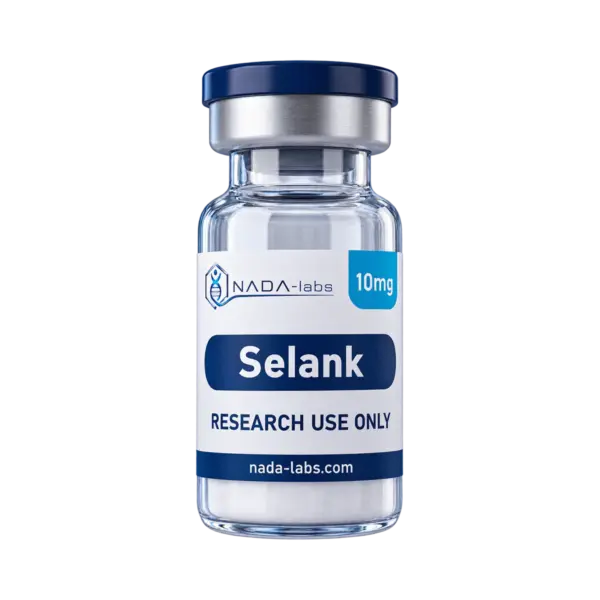
Description
Semax is a heptapeptide combining the ACTH(4-7) fragment with a C-terminal Pro-Gly-Pro extension that slows enzymatic cleavage. The methionine residue is oxidation sensitive — keep vials sealed, cold and away from light, and avoid oxidising buffers.
Semax: what the published research shows
Compiled by NADA-Labs from the peer-reviewed literature cited below. No own study data.
Semax (Met-Glu-His-Phe-Pro-Gly-Pro) is a synthetic heptapeptide built from the ACTH(4-7) fragment with a C-terminal Pro-Gly-Pro extension, developed in Russia as a non-corticotropic melanocortin derivative. The research literature attributes its effects mainly to induction of neurotrophins (BDNF, NGF) and their receptor TrkB, modulation of striatal serotonergic and dopaminergic transmission, and suppression of inflammatory and cell-death signalling after cerebral ischaemia. It has been studied predominantly in rat models of cerebral ischaemia-reperfusion, chronic stress and learning, in primary neuronal and glial cultures, and in Russian clinical series of ischaemic stroke, motor neuron disease and other neurological conditions.
Evidence base: Predominantly rodent in vivo studies and in vitro cell-culture work, most of it from one cluster of Moscow institutes (Institute of Molecular Genetics RAS / Kurchatov Institute, Myasoedov group). Human data consist of Russian-language open-label or non-placebo-controlled clinical series (n = 27 to 187) and one small placebo-controlled resting-state fMRI study in healthy volunteers (n = 24; 14 peptide, 10 placebo; Lebedeva 2018, PMID 30225715) that reports only a qualitative topographic difference. No independent randomised placebo-controlled trials with published quantitative outcomes were identified.
Key studies at a glance
| Study | Model | Design | Main result |
|---|---|---|---|
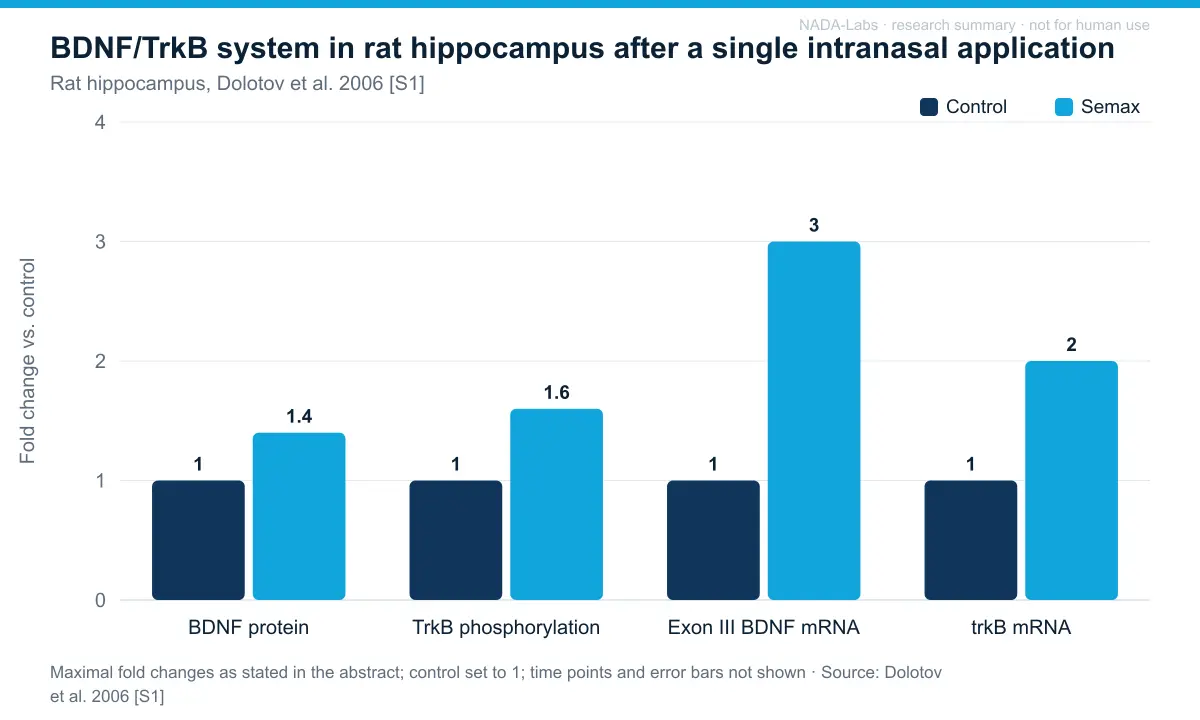
| Dolotov 20061 | Rat hippocampus, in vivo (intranasal) | Controlled, single application; ELISA/RT-PCR; avoidance test | BDNF protein 1.4x, pTrkB 1.6x, exon III BDNF mRNA 3x, trkB mRNA 2x; more conditioned avoidance reactions |
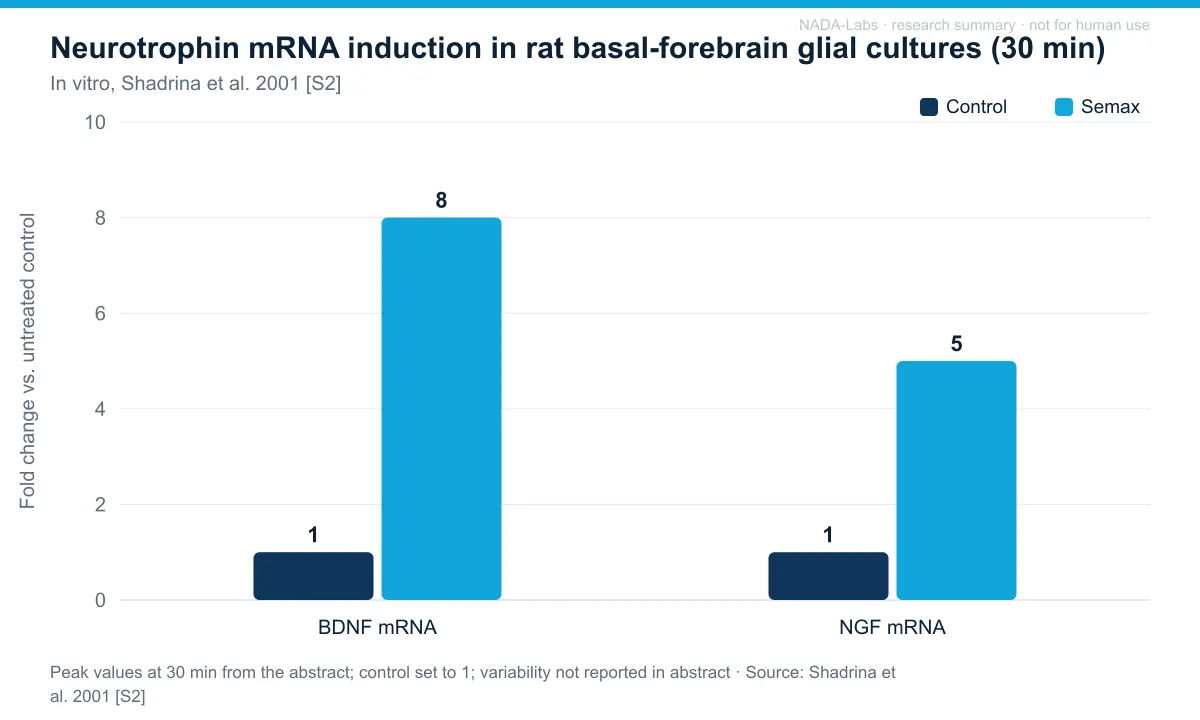
| Shadrina 20012 | Rat basal-forebrain glia, in vitro | Controlled time course of mRNA | BDNF mRNA 8x and NGF mRNA 5x at 30 min |
| Grivennikov 20083 | Rat basal-forebrain neurons, in vitro | Controlled; survival and ChAT activity | Cholinergic neuron survival 1.5-1.7x; no effect on GABAergic neurons or glia |
| Sudarkina 20214 | Rat tMCAO ischaemia-reperfusion, in vivo | Sham vs. ischaemia vs. ischaemia + Semax; n = 5-7/group; 24 h | pJNK, MMP-9, c-Fos lowered > 1.5x; pCREB restored > 1.5x vs. untreated ischaemia (p < 0.05) |
| Eremin 20055 | Rodent striatum, in vivo microdialysis | Controlled; time course; amphetamine challenge | Tissue 5-HIAA +25 %; extracellular 5-HIAA to 180 %; dopamine unchanged; amphetamine effects potentiated |
| Inozemtseva 20246 | Rat chronic unpredictable stress, in vivo | Controlled; repeated injections; sucrose preference, BDNF, FST | Anhedonia, weight-gain suppression, adrenal hypertrophy and BDNF loss attenuated; FST unchanged |
| Gusev 20187 | Human, post-stroke rehabilitation | Open, non-randomised; n = 110; 5 months | Plasma BDNF increased; faster Barthel-index recovery; no effect sizes in abstract |
Ischaemia-related markers 24 h after tMCAO (Sudarkina 2021 [S4])
| Marker | Brain region | Ischaemia-reperfusion vs. sham | Semax vs. untreated ischaemia | Significance |
|---|---|---|---|---|
| Phospho-JNK | Subcortex and cortex | > 2-fold increase | > 1.5-fold decrease | significant (p < 0.05) |
| Phospho-CREB | Subcortex (lesion area) | > 1.4-fold decrease | > 1.5-fold increase | significant (p < 0.05) |
| Phospho-CREB | Cortex | no change | increase | not significant |
| MMP-9 protein | Cortex | about 2-fold increase | > 1.5-fold decrease | significant (p < 0.05) |
| MMP-9 protein | Subcortex | about 1.7-fold increase | decrease | not significant |
| c-Fos protein | Cortex | about 2-fold increase | > 1.5-fold decrease | significant (p < 0.05) |
| c-Fos protein | Subcortex | no significant change | no effect | not significant |
| Mmp9 mRNA | Cortex | > 2-fold increase | about 1.7-fold decrease | reported as significant (p < 0.05) |
| Fos mRNA | Cortex | > 2-fold increase | 2.6-fold decrease | reported as significant (p < 0.05) |
Effects reported in the studies
- Neurotrophin induction (BDNF, NGF, TrkB). In rat hippocampus a single intranasal application raised BDNF protein maximally 1.4-fold, TrkB phosphorylation 1.6-fold, exon III BDNF mRNA 3-fold and trkB mRNA 2-fold1. In cultured basal-forebrain glia BDNF mRNA rose 8-fold and NGF mRNA 5-fold at 30 min2. In stroke patients plasma BDNF increased and stayed elevated over the 5-month observation (magnitude not reported)7.
- Neuronal survival in vitro. Survival of cholinergic basal-forebrain neurons in primary culture increased approximately 1.5- to 1.7-fold, with no effect on GABAergic or NSE-positive neuron counts or on glial proliferation3.
- Modulation of ischaemia-related signalling. At 24 h after transient MCAO in rats, Semax lowered phospho-JNK by more than 1.5-fold in cortex and subcortex, restored phospho-CREB in the lesion-containing subcortex (more than 1.5-fold increase), and reduced MMP-9 and c-Fos protein in the adjacent cortex by more than 1.5-fold versus untreated ischaemia-reperfusion (all p < 0.05); Mmp9 and Fos mRNA in the cortex fell approximately 1.7-fold and 2.6-fold4.
- Serotonergic and dopaminergic modulation. Striatal tissue 5-HIAA rose by 25 % at 2 h and extracellular 5-HIAA to 180 % of baseline within 1-4 h; dopamine and its metabolites were unchanged by the peptide alone, but amphetamine-evoked extracellular dopamine and locomotion were markedly enhanced5.
- Attenuation of chronic-stress phenotype. In a chronic unpredictable stress model, repeated systemic Semax reversed or substantially attenuated anhedonia, suppressed body-weight gain, adrenal hypertrophy and the decrease in hippocampal BDNF; forced-swim immobility was unaffected (qualitative, no numbers in abstract)6.
- Learning and functional recovery. Treated rats showed a distinct increase in conditioned avoidance reactions1. In 110 post-stroke patients, Semax was associated with faster and better Barthel-index recovery and a smaller effect on paresis; the study was open and non-randomised and reports no effect sizes in the abstract7.
Adverse effects and tolerability reported
- Adverse effects not systematically reported in rodent studies. The chronic unpredictable stress study does not mention adverse events in its abstract6; the ischaemia-reperfusion study did not measure tolerability, but its introduction describes the peptide as lacking hormonal and toxic side effects in animals4.
- Potentiation of amphetamine effects. In rodents the peptide dramatically enhanced D-amphetamine-induced extracellular striatal dopamine and locomotor activity; this pharmacodynamic interaction is a relevant safety observation5.
- Human tolerability (Russian clinical series). A series of 187 patients with chronic cerebrovascular insufficiency describes a ‘minor percent of side-effects’ and good tolerability including in older age groups (Gusev 2005, PMID 15792140; open-label, no placebo, no adverse-event counts in abstract). A 27-patient open-label motor neuron disease study found no effect on denervation course or clinical scores but reported improved total quality-of-life score, attributed to emotional state and motivation (Serdiuk 2007, PMID 18379501). Adverse events were not reported in the 110-patient stroke series7.
- EEG paroxysmal activity. In a follow-up series of 73 patients with post-hypoxic encephalopathy (14 in persistent vegetative state), EEG showed episodes of paroxysmal activity after the peptide in some cases; the authors recommend monitoring brain bioelectric activity at first administration (Alekseeva 1999, PMID 10199046; uncontrolled, no incidence given).
- Selectivity in vitro. No effect on GABAergic or total NSE-positive neuron counts and no effect on glial proliferation across the tested concentration range3.
Limitations of the evidence. Nearly all mechanistic and behavioural data originate from a single network of Moscow laboratories associated with the peptide’s developers, and most abstracts report fold changes or directions without variance, sample size or exact p-values. Human evidence is limited to Russian-language, open-label or non-randomised clinical series that do not report effect sizes or systematic adverse-event data; the single placebo-controlled human study is a 24-volunteer resting-state fMRI experiment with a qualitative endpoint (Lebedeva 2018, PMID 30225715). Several rodent findings (chronic-stress endpoints, conditioned avoidance) are qualitative in the abstract. None of the findings summarised here establish efficacy or safety for any use outside the described research models.
References
- Dolotov OV, Karpenko EA, Inozemtseva LS, Seredenina TS, Levitskaya NG, Rozyczka J, Dubynina EV, Novosadova EV, Andreeva LA, Alfeeva LY, Kamensky AA, Grivennikov IA, Myasoedov NF, Engele J (2006). Semax, an analog of ACTH(4-10) with cognitive effects, regulates BDNF and trkB expression in the rat hippocampus. Brain Research. PMID 16996037 DOI
- Shadrina MI, Dolotov OV, Grivennikov IA, Slominsky PA, Andreeva LA, Inozemtseva LS, Limborska SA, Myasoedov NF (2001). Rapid induction of neurotrophin mRNAs in rat glial cell cultures by Semax, an adrenocorticotropic hormone analog. Neuroscience Letters. PMID 11457573 DOI
- Grivennikov IA, Dolotov OV, Zolotarev YA, Andreeva LA, Myasoedov NF, Leacher L, Black IB, Dreyfus CF (2008). Effects of behaviorally active ACTH (4-10) analogue – Semax on rat basal forebrain cholinergic neurons. Restorative Neurology and Neuroscience. PMID 18431004
- Sudarkina OY, Filippenkov IB, Stavchansky VV, Denisova AE, Yuzhakov VV, Sevan’kaeva LE, Valieva LV, Remizova JA, Dmitrieva VG, Gubsky LV, Myasoedov NF, Limborska SA, Dergunova LV (2021). Brain Protein Expression Profile Confirms the Protective Effect of the ACTH(4-7)PGP Peptide (Semax) in a Rat Model of Cerebral Ischemia-Reperfusion. International Journal of Molecular Sciences. PMID 34201112 DOI
- Eremin KO, Kudrin VS, Saransaari P, Oja SS, Grivennikov IA, Myasoedov NF, Rayevsky KS (2005). Semax, an ACTH(4-10) analogue with nootropic properties, activates dopaminergic and serotoninergic brain systems in rodents. Neurochemical Research. PMID 16362768 DOI
- Inozemtseva LS, Yatsenko KA, Glazova NY, Kamensky AA, Myasoedov NF, Levitskaya NG, Grivennikov IA, Dolotov OV (2024). Antidepressant-like and antistress effects of the ACTH(4-10) synthetic analogs Semax and Melanotan II on male rats in a model of chronic unpredictable stress. European Journal of Pharmacology. PMID 39442746 DOI
- Gusev EI, Martynov MY, Kostenko EV, Petrova LV, Bobyreva SN (2018). The efficacy of semax in the treatment of patients at different stages of ischemic stroke [article in Russian]. Zhurnal Nevrologii i Psikhiatrii imeni S.S. Korsakova. PMID 29798983 DOI human study
This section summarises findings published in the cited peer-reviewed literature for informational purposes. It is not a claim of efficacy or safety, contains no dosing or administration information by design, and does not constitute medical, veterinary or scientific advice. Results in cell cultures or animal models do not predict effects in humans.