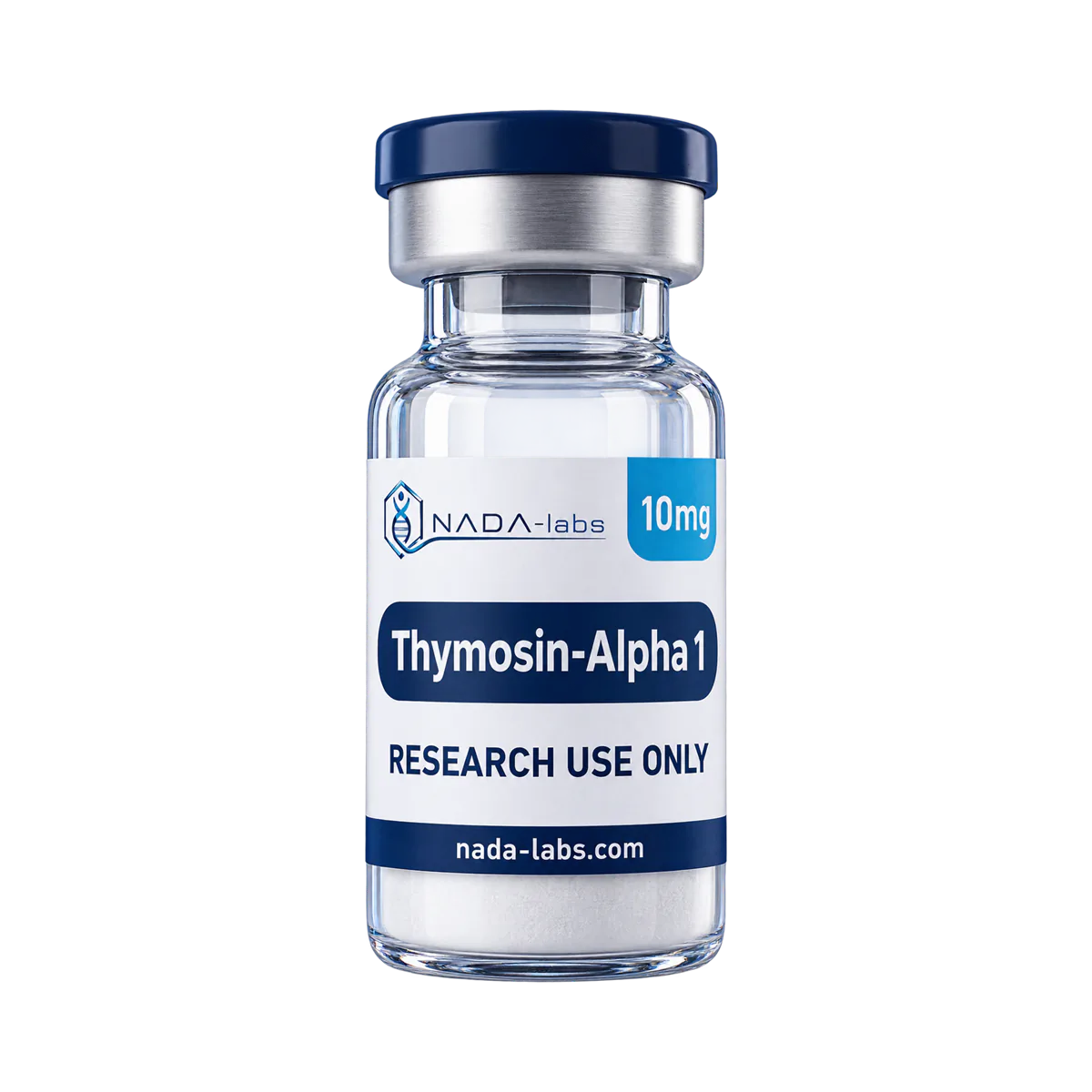
Description
Thymosin alpha-1 is a 28-residue, N-terminally acetylated peptide with a strongly acidic character. It is freely soluble in water. Because of the high proportion of acidic residues, avoid low-pH buffers when preparing stock solutions.
Thymosin Alpha-1: what the published research shows
Compiled by NADA-Labs from the peer-reviewed literature cited below. No own study data.
Thymosin α-1 (thymalfasin; CAS 62304-98-7) is a synthetic 28-amino-acid acetylated peptide originally isolated from thymic tissue (thymosin fraction 5). Its investigated mechanism is immunomodulation: activation of dendritic cells through Toll-like-receptor/MyD88 signalling with interleukin-12 production and promotion of T-helper-1 responses (murine and in vitro work, Romani 2004), increased monocyte HLA-DR expression in sepsis1 and restoration of circulating T-cell numbers in lymphocytopenic states3. It has been studied mainly in human randomized trials — sepsis, chronic hepatitis B and C, metastatic melanoma — in retrospective COVID-19 cohorts, and in murine infection and tumour models.
Evidence base: Predominantly human randomized controlled trials of varying size (sepsis n=361 and n=1,089; chronic hepatitis C n=109; chronic hepatitis B n=33; metastatic melanoma n=488), one retrospective COVID-19 cohort (n=76), and murine tumour/sepsis pilot models authored by the manufacturer. The largest and best-blinded trial (TESTS, 2025) was negative on its primary endpoint; several positive trials are small, open-label or single-blind, and manufacturer (SciClone) funding, drug supply or authorship is common.
Key studies at a glance
| Study | Model | Design | Main result |
|---|---|---|---|
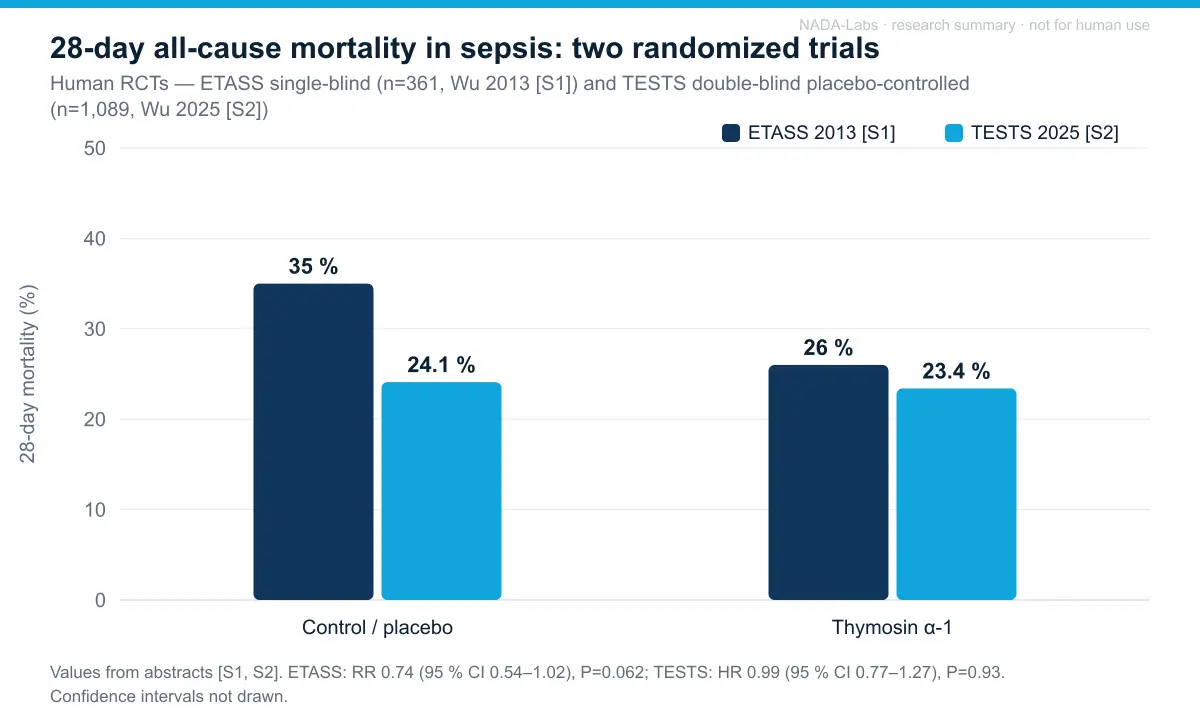
| Wu 20131 | Human, severe sepsis (ICU) | Multicentre single-blind RCT, n=361 | 28-day mortality 26.0 % vs. 35.0 % (RR 0.74, 95 % CI 0.54–1.02; P=0.062); mHLA-DR change +5.8 % vs. control at day 7 |
| Wu 20252 | Human, sepsis (Sepsis-3) | Multicentre double-blind placebo-controlled phase 3 RCT, n=1,089 | 28-day mortality 23.4 % vs. 24.1 % (HR 0.99; P=0.93); no effect on primary endpoint |
| Liu 20203 | Human, severe COVID-19 | Retrospective cohort, n=76 | Mortality 11.11 % vs. 30.00 % (P=0.044); T-cell counts restored, PD-1/Tim-3 reduced |
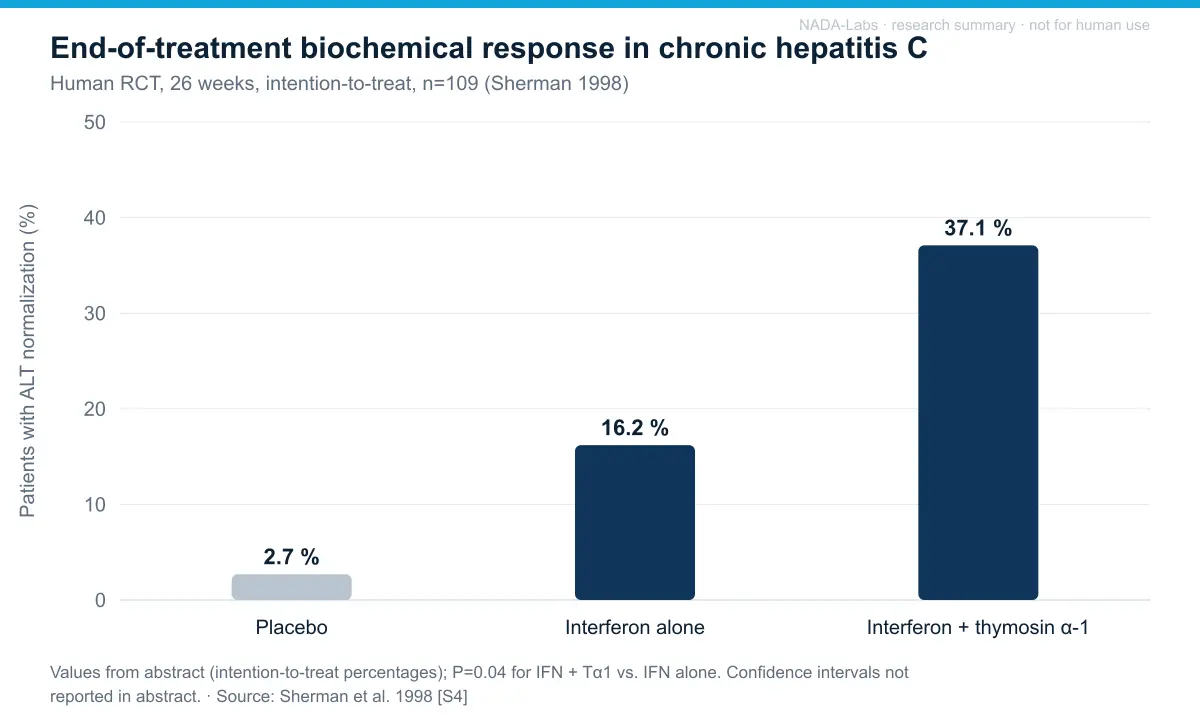
| Sherman 19984 | Human, chronic hepatitis C | Double-blind placebo-controlled RCT, 3 arms, n=109 | ALT normalization 37.1 % (IFN + Tα1) vs. 16.2 % (IFN) vs. 2.7 % (placebo), P=0.04 |
| Andreone 19965 | Human, anti-HBe-positive chronic hepatitis B | RCT vs. interferon alfa, n=33 (+15 untreated) | Complete response 41.2 % vs. 25 % (IFN) at follow-up, n.s.; 41.2 % vs. 6.7 % untreated, P<0.05 |
| Maio 20106 | Human, metastatic melanoma | Five-arm RCT with dacarbazine ± interferon, n=488 | Median OS 9.4 vs. 6.6 months (HR 0.80, P=0.08); no added toxicity |
| King 20157 | Mice, B16 melanoma and CLP sepsis | Vehicle-controlled pilot studies (manufacturer) | Lung metastases −32 % (p<0.05); tumour growth −34 % to −46 %; sepsis survival trend only |
Chronic viral hepatitis: response rates reported
| Study | Endpoint | Thymosin α-1 arm | Comparator | Statistics |
|---|---|---|---|---|
| Sherman 19984 | End-of-treatment ALT normalization | 37.1 % (IFN + Tα1) | 16.2 % (IFN alone); 2.7 % (placebo) | χ²=4.05, P=0.04 (vs. IFN alone) |
| Sherman 19984 | HCV RNA clearance at end of treatment | 37.1 % | 18.9 % (IFN alone) | not stated |
| Sherman 19984 | Sustained biochemical response | 14.2 % | 8.1 % (IFN alone) | not stated |
| Andreone 19965 | Complete response, end of 6-month treatment | 29.4 % (5/17) | 43.8 % (7/16, IFN alfa); 6.7 % (1/15, untreated) | n.s. vs. IFN; IFN vs. untreated P<0.05 |
| Andreone 19965 | Complete response, 6 months after treatment | 41.2 % (7/17) | 25 % (4/16, IFN alfa); 6.7 % (1/15, untreated) | n.s. vs. IFN; P<0.05 vs. untreated |
Effects reported in the studies
- Mortality in sepsis: inconsistent. A single-blind RCT (n=361) reported 28-day mortality of 26.0 % vs. 35.0 % (RR 0.74, 95 % CI 0.54–1.02; P=0.062)1; the subsequent double-blind, placebo-controlled phase 3 trial (n=1,089) found 23.4 % vs. 24.1 % (HR 0.99, 95 % CI 0.77–1.27; P=0.93), i.e. no effect2.
- Monocyte HLA-DR and T-cell restoration. Greater increase in monocyte HLA-DR vs. control (+3.9 % day 3, +5.8 % day 7) in severe sepsis1; in severe COVID-19, treated patients showed increased CD4+/CD8+ counts in lymphocytopenic cases and reduced PD-1/Tim-3 expression on CD8+ cells, roughly paralleling rising TRECs3.
- Mortality in severe COVID-19 (retrospective). 11.11 % vs. 30.00 % in treated vs. untreated patients (P=0.044) in a retrospective cohort of 76 patients; authors report greater benefit in patients with low baseline CD8+ or CD4+ counts3.
- Chronic hepatitis C: added to interferon. End-of-treatment ALT normalization 37.1 % (IFN + Tα1) vs. 16.2 % (IFN) vs. 2.7 % (placebo), P=0.04 for the IFN comparison; HCV RNA clearance 37.1 % vs. 18.9 %; sustained biochemical response 14.2 % vs. 8.1 % (no statistics stated)4.
- Chronic hepatitis B: comparable to interferon alfa at follow-up. Complete response 29.4 % vs. 43.8 % (IFN) at end of treatment and 41.2 % vs. 25 % after 6 months follow-up (both n.s.); 41.2 % vs. 6.7 % in untreated comparators at follow-up (P<0.05)5.
- Metastatic melanoma: response and survival trends. 10 and 12 tumour responses in two Tα1 arms vs. 4 in control; median OS 9.4 vs. 6.6 months (HR 0.80, 95 % CI 0.63–1.02; P=0.08); PFS HR 0.80 (P=0.06)6.
- Murine tumour models. B16 lung metastases −32 % (p<0.05) and subcutaneous tumour growth −34 % to −46 % vs. vehicle; only a positive trend in CLP sepsis survival7.
Adverse effects and tolerability reported
- Local injection-site discomfort. Reported by some patients in a chronic hepatitis B RCT (n=17 on thymosin α-1); otherwise well tolerated by all patients
- No serious drug-related adverse events. Severe sepsis RCT (n=361)1; no safety outcome differed from placebo in the phase 3 sepsis trial (n=1,089)2; no additional toxicity when added to dacarbazine + interferon in melanoma (n=488)6
- Possible higher mortality in younger sepsis patients (subgroup signal). Prespecified subgroup of the phase 3 trial: age <60 years HR 1.67 (95 % CI 1.04–2.67) vs. ≥60 years HR 0.81 (0.61–1.09); P for interaction 0.01 — hypothesis-generating, not confirmed
- No evidence of toxicity in mice. B16 melanoma and CLP sepsis models (manufacturer-authored pilot studies)
- Adverse-event rates comparable to placebo in HCV retreatment. In a 552-patient placebo-controlled RCT of thymosin α-1 added to peginterferon/ribavirin for 48 weeks, no significant difference in adverse-event incidence was observed between groups; intention-to-treat SVR was also similar (12.7 % vs. 10.5 %, P=0.407) (Ciancio 2012, PMID 22233415; abstract verified, not a keyed study)
Limitations of the evidence. The evidence base is dominated by human trials in specific disease settings (sepsis, chronic viral hepatitis, melanoma, COVID-19), several of which are small, open-label or single-blind, or use interferon rather than placebo as comparator; the only large double-blind placebo-controlled trial (n=1,089) showed no mortality benefit and a possible harm signal in patients under 60. Manufacturer involvement (SciClone: funding and author grants in the phase 3 sepsis trial, drug supply in the 2013 sepsis trial, authorship of the murine work) is common, and the COVID-19 data are retrospective. Hepatitis findings date from the interferon era and predate direct-acting antivirals. Mouse data are pilot-scale with group sizes not stated in the abstract, and none of the results transfer to any non-clinical or research-use context.
References
- Wu J, Zhou L, Liu J, Ma G, Kou Q, He Z, et al. (2013). The efficacy of thymosin alpha 1 for severe sepsis (ETASS): a multicenter, single-blind, randomized and controlled trial. Critical Care. PMID 23327199 DOI human study
- Wu J, Pei F, Zhou L, Li W, Sun R, Li Y, et al.; TESTS study collaborator group (2025). The efficacy and safety of thymosin α1 for sepsis (TESTS): multicentre, double blinded, randomised, placebo controlled, phase 3 trial. BMJ. PMID 39814420 DOI human study
- Liu Y, Pan Y, Hu Z, Wu M, Wang C, Feng Z, et al. (2020). Thymosin Alpha 1 Reduces the Mortality of Severe Coronavirus Disease 2019 by Restoration of Lymphocytopenia and Reversion of Exhausted T Cells. Clinical Infectious Diseases. PMID 32442287 DOI human study
- Sherman KE, Sjogren M, Creager RL, Damiano MA, Freeman S, Lewey S, et al. (1998). Combination therapy with thymosin alpha1 and interferon for the treatment of chronic hepatitis C infection: a randomized, placebo-controlled double-blind trial. Hepatology. PMID 9537454 DOI human study
- Andreone P, Cursaro C, Gramenzi A, Zavagliz C, Rezakovic I, Altomare E, et al. (1996). A randomized controlled trial of thymosin-alpha1 versus interferon alfa treatment in patients with hepatitis B e antigen antibody- and hepatitis B virus DNA-positive chronic hepatitis B. Hepatology. PMID 8855175 DOI human study
- Maio M, Mackiewicz A, Testori A, Trefzer U, Ferraresi V, Jassem J, et al.; Thymosin Melanoma Investigation Group (2010). Large randomized study of thymosin alpha 1, interferon alfa, or both in combination with dacarbazine in patients with metastatic melanoma. Journal of Clinical Oncology. PMID 20194853 DOI human study
- King RS, Tuthill C (2015). Evaluation of thymosin α 1 in nonclinical models of the immune-suppressing indications melanoma and sepsis. Expert Opinion on Biological Therapy. PMID 25643200 DOI
This section summarises findings published in the cited peer-reviewed literature for informational purposes. It is not a claim of efficacy or safety, contains no dosing or administration information by design, and does not constitute medical, veterinary or scientific advice. Results in cell cultures or animal models do not predict effects in humans.