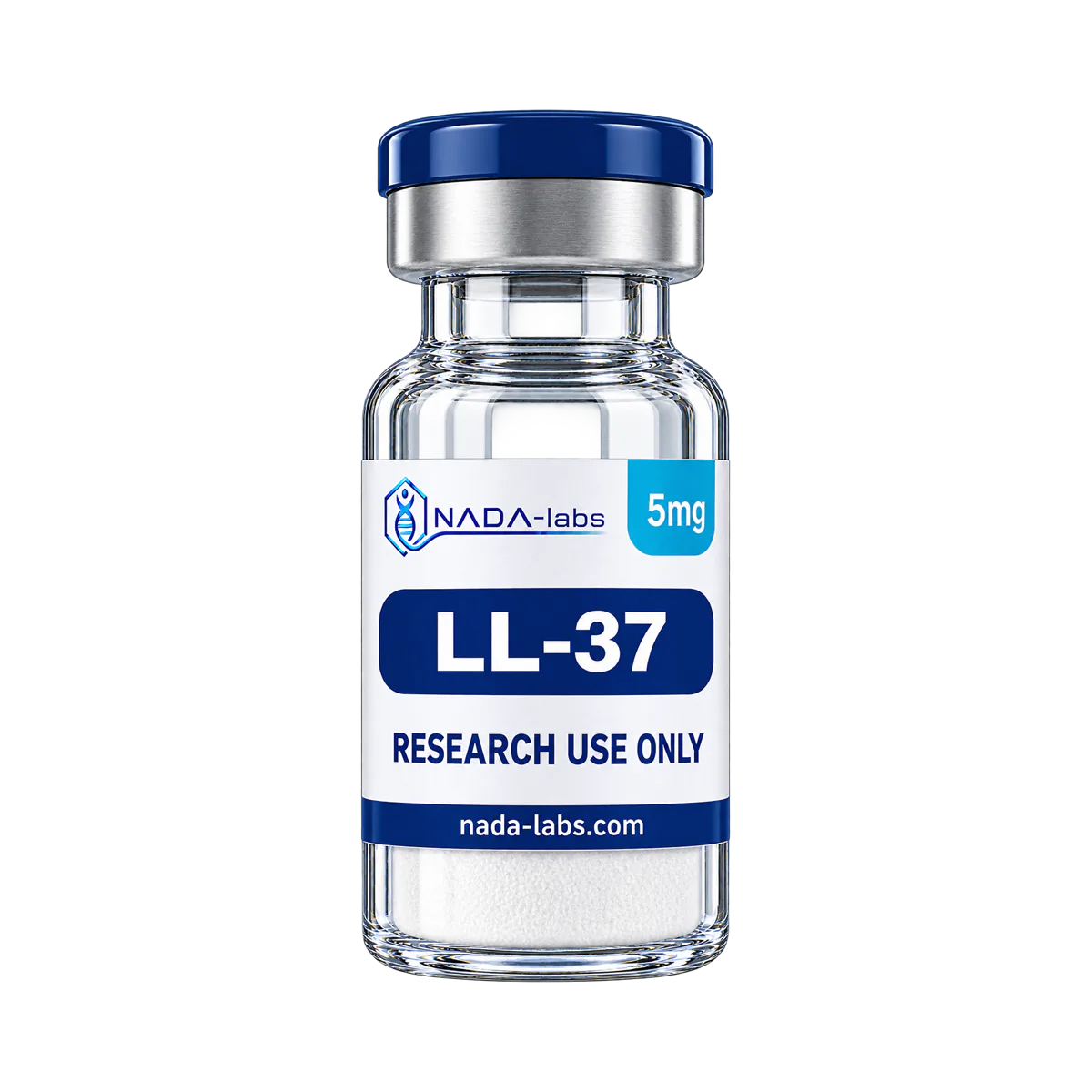
Description
LL-37 is a synthetic linear peptide of 37 amino acids corresponding to the C-terminal fragment of the human cathelicidin precursor hCAP18, with a free N-terminus and a free C-terminal acid. The sequence contains no cysteine, methionine or tryptophan, so no disulfide bridges form; its conformation depends on ions, pH and peptide concentration. As with all lyophilised peptides, keep vials sealed, cold and away from light.
LL-37: what the published research shows
Compiled by NADA-Labs from the peer-reviewed literature cited below. No own study data.
LL-37 is the 37-residue C-terminal peptide of hCAP18, the only cathelicidin identified in humans (Yang 2000, PMID 11015447); its developer uses the non-proprietary name ropocamptide2. A 39-residue form, FALL-39, was described first (Agerberth 1995, PMID 7529412), the mature peptide in granulocytes was then identified as LL-37 (Gudmundsson 1996, PMID 8681941), and in neutrophils it is released from hCAP18 by extracellular cleavage with proteinase 3 (Sørensen 2001, PMID 11389039). The research literature attributes its effects mainly to direct antimicrobial activity with membrane permeabilisation and lipopolysaccharide binding5, inhibition of bacterial biofilm formation6, activation of endothelial cells and angiogenesis via formyl peptide receptor-like 1 (FPRL1)4, chemotaxis of immune cells via the same receptor (Yang 2000, PMID 11015447) and the conversion of self-DNA into a trigger of interferon production in plasmacytoid dendritic cells8. It has been studied in bacterial and mammalian cell cultures, chick embryos, rabbits and mice, and in three randomised, double-blind, placebo-controlled topical trials in chronic leg and foot ulcers1,2,3,4,5,6,7,8.
Evidence base: Three randomised, double-blind, placebo-controlled trials of topical application in chronic wounds — a first-in-man trial in hard-to-heal venous leg ulcers (n = 34, 4 weeks)1, a multicentre phase IIb trial in the same condition (n = 148 treated, 13 weeks) whose full study population showed no significant difference from placebo2, and a small trial by a different research group in diabetic foot ulcers (n = 25, 4 weeks)3. The two venous leg ulcer trials share an author, and the phase IIb trial was financed by the developer with three employees among the authors2. Mechanistic data come from cultured cells, the chick chorioallantoic membrane, rabbit and mouse models4,5,6,7 and human immune cells8. Several animal and human-tissue studies concern the body’s own cathelicidin rather than applied peptide, such as protection of mice against necrotic Group A Streptococcus skin infection (Nizet 2001, PMID 11719807). The only further human exposure found is a case report from a phase 1 trial of intratumoral injections in melanoma (Dolkar 2018, PMID 29665030). No pharmacokinetic data and no independent replication in venous leg ulcers were identified among the cited records.
Key studies at a glance
| Study | Model | Design | Main result |
|---|---|---|---|
| Grönberg 20141 | Human, hard-to-heal venous leg ulcers (n = 34) | First-in-man, randomised, double-blind, placebo-controlled; 3-week placebo run-in, 4 weeks of twice-weekly topical application at three concentrations, 4-week follow-up | Healing rate constant about 6x (p = 0.003) and 3x (p = 0.088) that of placebo in the lowest and middle concentration groups; highest concentration no difference from placebo |
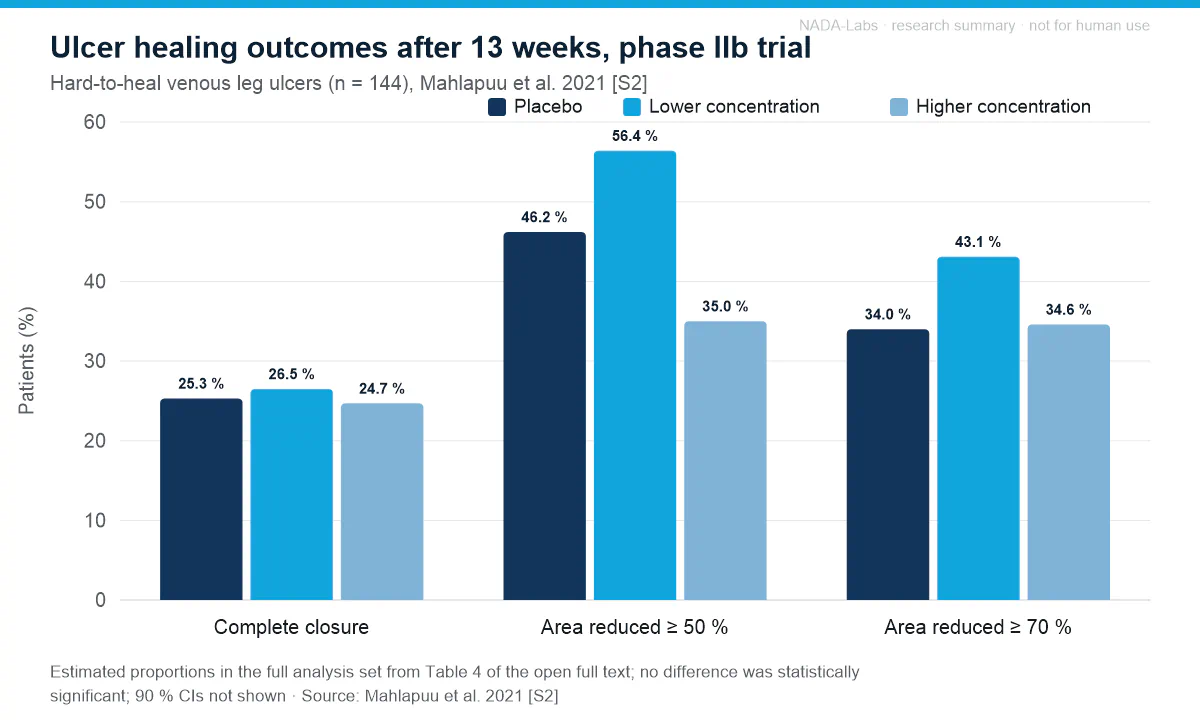
| Mahlapuu 20212 | Human, hard-to-heal venous leg ulcers (n = 148 treated) | Phase IIb, multicentre, randomised, double-blind, placebo-controlled; 13 weeks topical at two concentrations with compression therapy, 4-month follow-up | Full population: no significant difference (complete closure 26.5 % and 24.7 % vs 25.3 % placebo); post hoc subgroup with ulcers ≥ 10 cm² favoured the lower concentration |
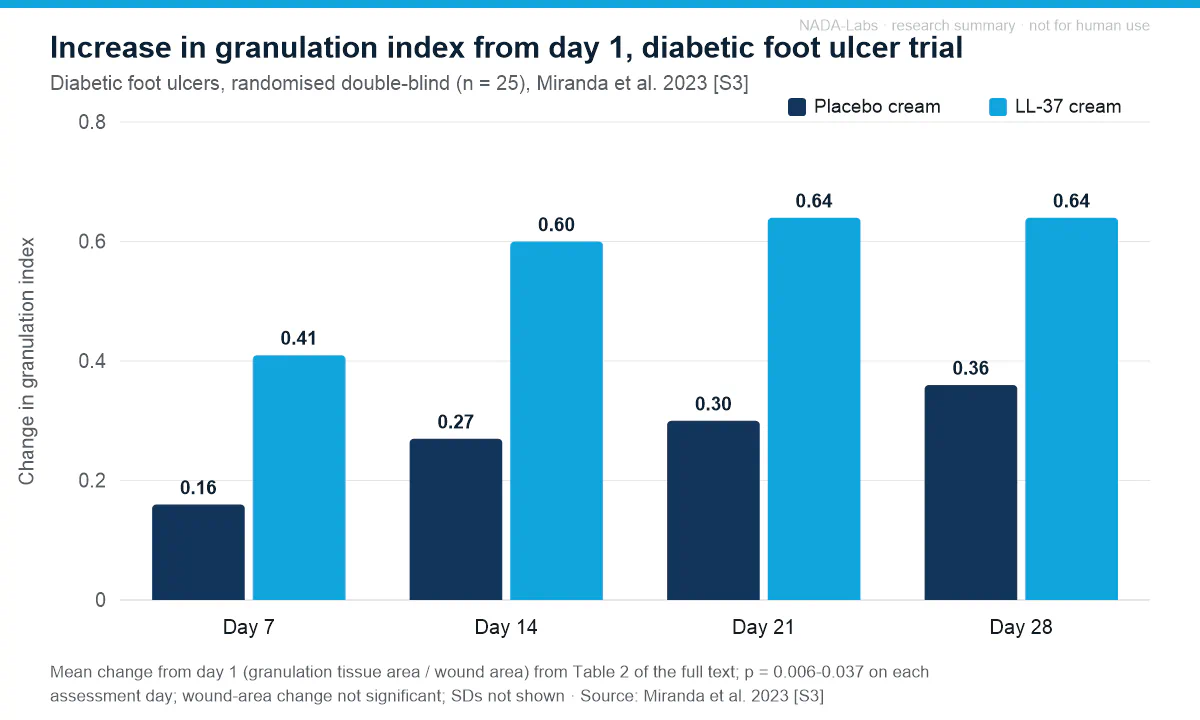
| Miranda 20233 | Human, diabetic foot ulcers (n = 25) | Randomised, double-blind, placebo cream; twice weekly for 4 weeks with standard care | Greater increase in granulation index at every visit (p = 0.006-0.037); wound area, IL-1α/TNF-α and bacterial counts not significantly different |
| Koczulla 20034 | Endothelial cells in vitro, chick embryo, rabbit, CRAMP-deficient mice | Angiogenesis assays, rabbit hind-limb ischaemia model, knockout comparison | Neovascularisation in the chorioallantoic membrane and in hind-limb ischaemia; endothelial proliferation via FPRL1; less wound vascularisation without CRAMP; no effect sizes in abstract |
| Turner 19985 | In vitro, bacterial and fungal strains | Radial diffusion and broth microdilution in low-salt and 100 mM NaCl media; comparison with protegrin-1 and HNP-1 | MIC < 10 µg/ml against seven species incl. vancomycin-resistant enterococci, also at 100 mM NaCl; MRSA, P. mirabilis and C. albicans resistant only at high salt |
| Overhage 20086 | In vitro, Pseudomonas aeruginosa biofilms | Biofilm formation and pre-grown biofilm assays at sub-inhibitory concentrations; microarrays | Biofilm formation inhibited at 0.5 µg/ml vs a planktonic MIC of 64 µg/ml; less attachment, more twitching motility, Las/Rhl quorum sensing influenced, biofilm-development genes downregulated |
| Johansson 19987 | In vitro, bacteria, eukaryotic cells, human serum | Circular dichroism, antibacterial and cytotoxicity assays; N-terminally truncated analogues | α-Helicity correlated with antibacterial activity; MIC against E. coli 5 µM, cytotoxic to eukaryotic cells at 13-25 µM; both activities inhibited by human serum |
| Lande 20078 | Human plasmacytoid dendritic cells, psoriatic skin | Mechanistic cell study (self-DNA complexes, Toll-like receptor 9, interferon) | LL-37 turned self-DNA into a trigger of interferon production via Toll-like receptor 9; identified as the key factor of dendritic-cell activation in psoriasis; qualitative abstract |
Results after 13 weeks in post hoc subgroups by ulcer size at randomisation, phase IIb venous leg ulcer trial (Mahlapuu 2021 [S2])
| Outcome | Ulcer size at randomisation | Placebo | Lower concentration | Higher concentration |
|---|---|---|---|---|
| Confirmed complete closure | ≥ 10 cm² (n = 24 / 21 / 21) | 8.1 % | 28.1 % (P = 0.0458) | 19.6 % (P = 0.1393) |
| Healing rate per day | ≥ 10 cm² | 0.0093 | 0.0367 (P = 0.0439) | 0.0159 (P = 0.3430) |
| Area reduction ≥ 50 % | ≥ 10 cm² | 33.3 % | 61.9 % (P = 0.0294) | 38.2 % (P = 0.3669) |
| Area reduction ≥ 70 % | ≥ 10 cm² | 16.2 % | 47.2 % (P = 0.0149) | 39.0 % (P = 0.0493) |
| Confirmed complete closure | < 10 cm² (n = 26 / 25 / 27) | 44.2 % | 26.0 % (P = 0.9062) | 31.4 % (P = 0.8252) |
| Healing rate per day | < 10 cm² | 0.0324 | 0.0138 (P = 0.9693) | 0.0076 (P = 0.9939) |
| Area reduction ≥ 50 % | < 10 cm² | 58.7 % | 51.6 % (P = 0.6920) | 32.8 % (P = 0.9669) |
| Area reduction ≥ 70 % | < 10 cm² | 51.9 % | 38.7 % (P = 0.8205) | 32.1 % (P = 0.9223) |
Effects reported in the studies
- Venous leg ulcers, first-in-man trial. In 34 patients with hard-to-heal venous leg ulcers (3-week placebo run-in, then 4 weeks of randomised double-blind topical application twice weekly), the healing rate constants in the lowest and middle concentration groups were about 6x and 3x those with placebo (p = 0.003 and p = 0.088); the square-root-transformed wound area improved against pretreatment values in these two groups (p < 0.001 and p = 0.011) and the mean ulcer area decreased by 68 % and 50 %, whereas the highest concentration did not differ from placebo1.
- Venous leg ulcers, phase IIb trial. In the full analysis set (n = 144, 13 weeks on top of compression therapy) no healing parameter differed significantly from placebo: confirmed complete closure 26.5 % and 24.7 % (lower and higher concentration) vs 25.3 %, mean healing rate 0.0261 and 0.0112 vs 0.0204 per day, mean decrease in wound area 35.63 % and 4.02 % vs 51.69 %2. A post hoc analysis of ulcers of at least 10 cm² at randomisation found higher closure (28.1 % vs 8.1 %, P = 0.0458) and a higher healing rate (0.0367 vs 0.0093 per day, P = 0.0439) with the lower concentration, while ulcers below 10 cm² showed no advantage over placebo (table above)2.
- Diabetic foot ulcers. In 25 patients (13 with LL-37 cream, 12 with placebo cream, twice weekly for 4 weeks with standard care) the increase in granulation index from day 1 was greater with LL-37 on days 7, 14, 21 and 28 (from 0.41 vs 0.16 to 0.64 vs 0.36; p = 0.031, 0.009, 0.006 and 0.037), and the index reached 100 % on day 14 vs day 28 with placebo; the reduction in wound area (day 28: -2.35 vs -1.54 cm²), wound-fluid IL-1α and TNF-α and aerobic bacterial counts did not differ significantly3.
- Angiogenesis (in vitro, chick embryo, rabbit, mouse). Applied LL-37 caused neovascularisation in the chick chorioallantoic membrane assay and in a rabbit model of hind-limb ischaemia and directly activated cultured endothelial cells, with increased proliferation and formation of vessel-like structures, via FPRL1; mice lacking CRAMP, the murine homologue, showed decreased vascularisation during wound repair4. In organ-cultured human skin, antibodies against LL-37 inhibited re-epithelialisation in a concentration-dependent manner (Heilborn 2003, PMID 12603850).
- Antimicrobial activity (in vitro). LL-37 had MICs below 10 µg/ml against Pseudomonas aeruginosa, Salmonella typhimurium, Escherichia coli, Listeria monocytogenes, Staphylococcus epidermidis, Staphylococcus aureus and vancomycin-resistant enterococci, also in media with 100 mM NaCl, but was generally less potent than protegrin-1; methicillin-resistant S. aureus, Proteus mirabilis and Candida albicans were susceptible only in low-salt media, and Burkholderia cepacia was resistant under both conditions. It permeabilised the outer and inner membrane of E. coli and bound E. coli lipopolysaccharide with high affinity, and the binding showed positive cooperativity (Hill coefficient 2.02)5. Its α-helical content, induced by anions such as bicarbonate or sulphate, correlated with antibacterial activity, and the MIC against E. coli was 5 µM7.
- Anti-biofilm activity (in vitro). LL-37 inhibited Pseudomonas aeruginosa biofilm formation at 0.5 µg/ml, far below the planktonic MIC of 64 µg/ml, and also affected pre-grown biofilms; it reduced bacterial attachment, stimulated twitching motility and influenced the Las and Rhl quorum-sensing systems, leading to downregulation of genes essential for biofilm development. The mouse peptide CRAMP (67 % identity), polymyxin B and Bac2A did not inhibit biofilm formation at sub-inhibitory concentrations6.
- Immune-cell recruitment and innate immune signalling. LL-37 was chemotactic for human monocytes, neutrophils and T lymphocytes and induced calcium mobilisation in monocytes via FPRL1 (Yang 2000, PMID 11015447). In human plasmacytoid dendritic cells, LL-37 bound self-DNA into aggregated, condensed structures that were retained in early endocytic compartments and triggered interferon production through Toll-like receptor 98. In mice with caecal ligation and puncture sepsis, intravenous LL-37 improved survival and inhibited pyroptosis of peritoneal macrophages (Hu 2016, PMID 26746575).
Adverse effects and tolerability reported
- Adverse events in the phase IIb trial. 122 adverse events were reported by 64 of 148 treated patients (43.2 %): at least one event in 20 of 48 (lower concentration), 24 of 49 (higher concentration) and 20 of 51 patients (placebo), with 49, 45 and 28 events in total. The higher totals in the active groups were attributed largely to recorded deviations of the applied amount from the plan (generally less than 30 %) and to erysipelas in five patients, none of them at the target wound2.
- Relatedness, serious events and deaths. Six events in four patients (2.7 %) were judged possibly related to the study drug — wound infection (two reports, one patient) and dermatitis (two reports, one patient) with the lower concentration, peripheral swelling with the higher concentration and deep phlebitis with placebo — and none probably related. There were no deaths; 12 non-fatal serious adverse events occurred in 11 patients (7.4 %), none assessed as related to the study drug (4, 7 and 1 serious events with the lower concentration, the higher concentration and placebo)2. Five patients in the higher-concentration group withdrew from treatment or from the study because of adverse or serious adverse events (femur fracture, lower-limb fracture, deep vein thrombosis, cerebrovascular accident, increased blood creatinine), all assessed as unlikely related to the study drug2.
- Local reactions and infections at the ulcer. Redness, oedema and raised temperature at the target ulcer were reported in 42.6 %, 39.2 % and 20.3 % of all patients, mostly mild or moderate and without consistent differences between groups; target-ulcer infections occurred in 1 (2.1 %), 2 (4.1 %) and 3 patients (5.9 %) with the lower concentration, the higher concentration and placebo, and vital signs showed no consistent group-related changes; haematology and clinical-chemistry values showed no clinically important differences between groups, but four patients in the active groups had clinically significant deviations in these values in association with adverse events2.
- Smaller topical trials. In the first-in-man trial (n = 34) there were no safety concerns regarding local or systemic adverse events; the abstract gives no event counts1. In the diabetic foot ulcer trial (n = 25) no side effect directly caused by the cream was observed; one of 13 patients in the LL-37 group had mild irritant contact dermatitis attributed to excessive wound exudate, which resolved after an absorbent foam dressing was added3.
- Cytotoxicity (in vitro). At 13-25 µM, LL-37 was cytotoxic to several eukaryotic cell types, compared with an MIC of 5 µM against E. coli; in the presence of human serum both its antibacterial and its cytotoxic activity were inhibited7.
- Pro-inflammatory and autoimmunity-related mechanisms. In psoriasis, LL-37 was identified as the key factor in the activation of plasmacytoid dendritic cells by self-DNA, and the authors suggest that this pathway may drive autoimmunity8. In mice, injection of the cathelicidin peptides found in rosacea increased skin inflammation (Yamasaki 2007, PMID 17676051).
- Intratumoral injection and cell growth. A case report from a phase 1 trial of intratumoral LL-37 injections in melanoma describes multiple verrucous papules and a vesiculo-bullous lesion on the trunk and extremities in one patient about 45 days after the start of 8 weekly injections; 11 of 12 biopsies showed a lichenoid inflammatory infiltrate with an overlying atypical squamous epithelial proliferation with verrucous and keratoacanthoma-like features; all lesions resolved within 2 months after the injections were stopped (Dolkar 2018, PMID 29665030). In vitro, exogenous LL-37 at 5 ng/ml increased the proliferation and anchorage-independent colony growth of lung cancer cell lines (von Haussen 2008, PMID 17764778), and synthetic LL-37 increased the proliferation of human epithelial cell lines (Heilborn 2005, PMID 15609314). In nude mice, subcutaneously injected lung cancer cells that overexpressed the peptide showed increased tumourigenicity and formed significantly larger tumours (von Haussen 2008, PMID 17764778). No long-term safety data and no safety data after systemic administration were identified among the cited records.
Limitations of the evidence. The controlled human data consist of three small to moderate topical trials in chronic wounds (n = 34, 148 and 25)1,2,3; the largest showed no significant difference from placebo in its full population, and its positive results come from a post hoc subgroup; only 63.5 % of patients attended at least one of the two follow-up visits after treatment (COVID-19 restrictions), so no conclusion on group differences in re-opening of healed ulcers was possible2. The phase IIb trial was developer-funded2; the first-in-man trial could be checked only against its abstract (no full text in PubMed Central), which gives no per-group n or event counts, and its highest concentration did not differ from placebo1. The diabetic foot ulcer trial was very small, lasted 4 weeks and had a higher baseline IL-1α level in the LL-37 group, and its significant end point was the granulation index, not the wound area3. In vitro activity depends strongly on salt, ions and serum, and MICs differ between assays5,6,7; parts of the mechanistic evidence concern the body’s own cathelicidin in knockout mice or disease tissue rather than applied peptide, and their abstracts give few effect sizes4,8. None of the findings summarised here establish efficacy or safety for any use outside the described research models.
References
- Grönberg A, Mahlapuu M, Ståhle M, Whately-Smith C, Rollman O (2014). Treatment with LL-37 is safe and effective in enhancing healing of hard-to-heal venous leg ulcers: a randomized, placebo-controlled clinical trial. Wound Repair and Regeneration. PMID 25041740 DOI human study
- Mahlapuu M, Sidorowicz A, Mikosinski J, Krzyżanowski M, Orleanski J, Twardowska-Saucha K, Nykaza A, Dyaczynski M, Belz-Lagoda B, Dziwiszek G, Kujawiak M, Karczewski M, Sjöberg F, Grzela T, Wegrzynowski A, Thunarf F, Björk J, Ekblom J, Jawien A, Apelqvist J (2021). Evaluation of LL-37 in healing of hard-to-heal venous leg ulcers: A multicentric prospective randomized placebo-controlled clinical trial. Wound Repair and Regeneration. PMID 34687253 DOI human study
- Miranda E, Bramono K, Yunir E, Reksodiputro MH, Suwarsa O, Rengganis I, Harahap AR, Subekti D, Suwarto S, Hayun H, Bardosono S, Baskoro JC (2023). Efficacy of LL-37 cream in enhancing healing of diabetic foot ulcer: a randomized double-blind controlled trial. Archives of Dermatological Research. PMID 37480520 DOI human study
- Koczulla R, von Degenfeld G, Kupatt C, Krötz F, Zahler S, Gloe T, Issbrücker K, Unterberger P, Zaiou M, Lebherz C, Karl A, Raake P, Pfosser A, Boekstegers P, Welsch U, Hiemstra PS, Vogelmeier C, Gallo RL, Clauss M, Bals R (2003). An angiogenic role for the human peptide antibiotic LL-37/hCAP-18. The Journal of Clinical Investigation. PMID 12782669 DOI
- Turner J, Cho Y, Dinh NN, Waring AJ, Lehrer RI (1998). Activities of LL-37, a cathelin-associated antimicrobial peptide of human neutrophils. Antimicrobial Agents and Chemotherapy. PMID 9736536 DOI
- Overhage J, Campisano A, Bains M, Torfs EC, Rehm BH, Hancock RE (2008). Human host defense peptide LL-37 prevents bacterial biofilm formation. Infection and Immunity. PMID 18591225 DOI
- Johansson J, Gudmundsson GH, Rottenberg ME, Berndt KD, Agerberth B (1998). Conformation-dependent antibacterial activity of the naturally occurring human peptide LL-37. The Journal of Biological Chemistry. PMID 9452503 DOI
- Lande R, Gregorio J, Facchinetti V, Chatterjee B, Wang YH, Homey B, Cao W, Wang YH, Su B, Nestle FO, Zal T, Mellman I, Schröder JM, Liu YJ, Gilliet M (2007). Plasmacytoid dendritic cells sense self-DNA coupled with antimicrobial peptide. Nature. PMID 17873860 DOI
This section summarises findings published in the cited peer-reviewed literature for informational purposes. It is not a claim of efficacy or safety, contains no dosing or administration information by design, and does not constitute medical, veterinary or scientific advice. Results in cell cultures or animal models do not predict effects in humans.