Description
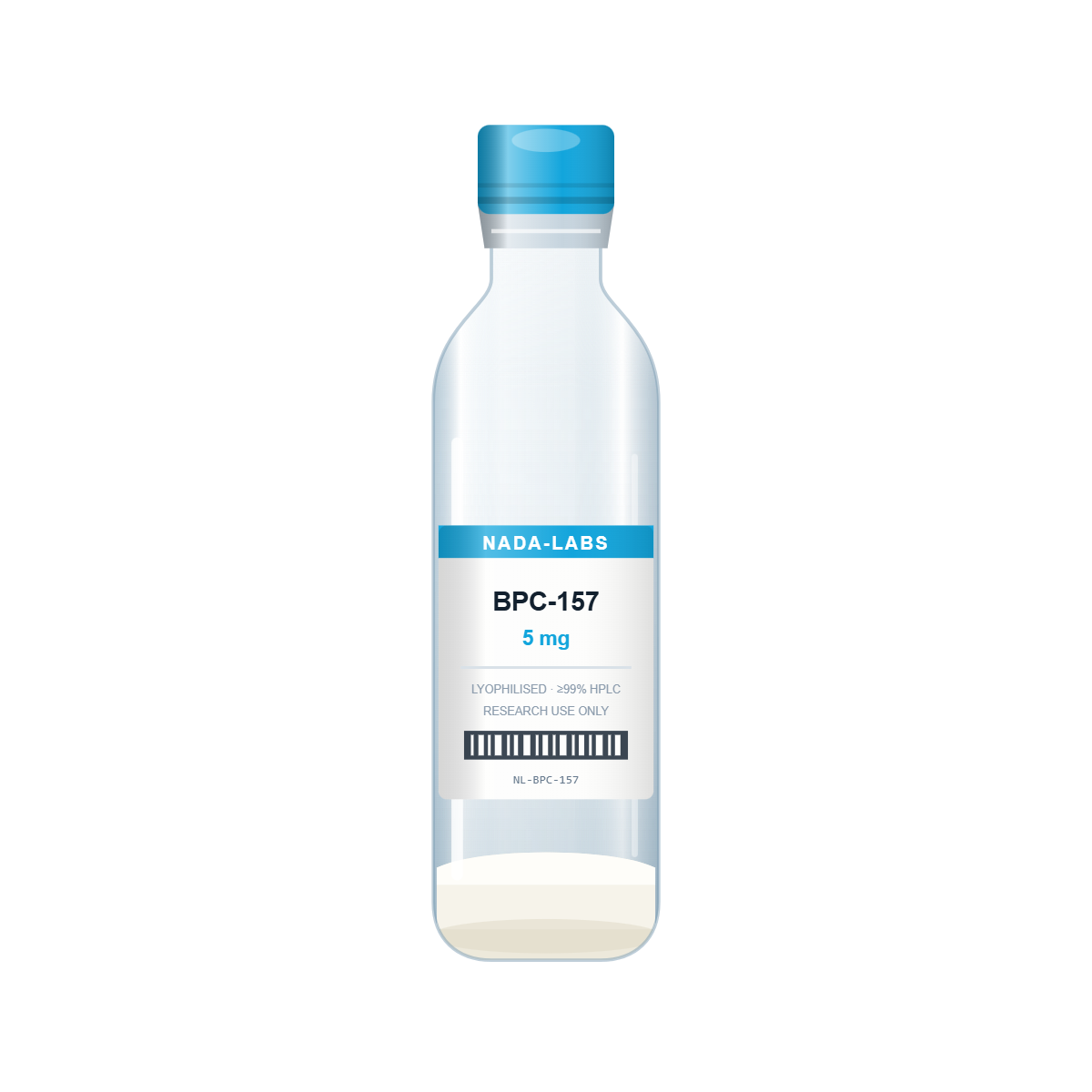
BPC-157 is a synthetic 15-residue peptide derived from a sequence found in gastric juice. It is supplied as a white lyophilised powder under vacuum, sealed with a tamper-evident crimp cap. The material is stable at 2–8 °C in its lyophilised state and dissolves readily in bacteriostatic water. Each lot is released after reversed-phase HPLC purity determination and mass-spectrometric identity confirmation.
What the published research shows
BPC 157 (Body Protection Compound 157; development codes PL 14736 / PLD-116) is a synthetic pentadecapeptide (GEPPPGKPADDAGLV, MW 1419) whose sequence is a partial sequence of a protein isolated from human gastric juice. Published work investigates it mainly as a cytoprotective and pro-healing agent; proposed mechanisms include activation of the FAK-paxillin pathway in tendon fibroblasts, ERK1/2 signalling in endothelial cells, and up-regulation and internalisation of VEGFR2 with downstream Akt-eNOS signalling. The large majority of studies are rat injury models (tendon, skin, gastric mucosa, ischaemic muscle) and in vitro cell work; human data are limited to three small uncontrolled pilot reports.
Evidence base: Predominantly rat models and in vitro assays. Most publications originate from one research group (University of Zagreb, which developed the peptide); independent controlled animal data exist from groups in Taiwan and China. A 2025 systematic review identified 36 eligible studies, 35 preclinical and 1 clinical (PMID 40756949). Human evidence consists of three small, uncontrolled pilot reports from a single private clinic (retrospective knee-pain survey, n = 16 followed up; interstitial cystitis, n = 12; intravenous tolerability, n = 2). No randomised controlled trial in humans has been published.
Key studies at a glance
| Study | Model | Design | Main result |
|---|---|---|---|
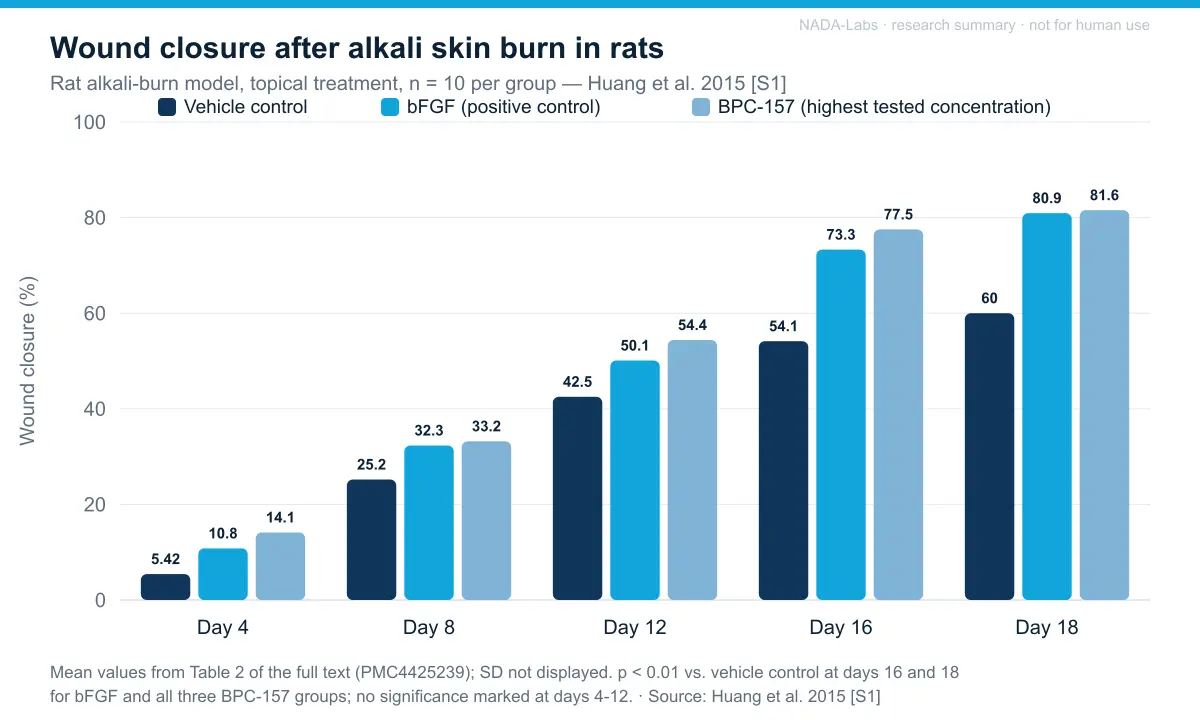
| Huang 20151 | Rat alkali skin burn; HUVEC in vitro | Controlled, 5 groups, n = 10/group, topical, 18 days | Wound closure 81.6 % vs. 60.0 % control at day 18 (p < 0.01); ERK1/2-dependent endothelial proliferation, migration, tube formation |
| Chang 20112 | Rat Achilles tendon explants and fibroblasts | Controlled in vitro assays | Accelerated explant outgrowth, increased survival under H2O2, concentration-dependent migration; FAK/paxillin phosphorylation |
| Staresinic 20033 | Rat Achilles tendon transection | Controlled, intraperitoneal, assessed days 1-14 | Higher load to failure, Young’s modulus and functional index vs. saline; smaller defect, more collagen (numbers not in abstract) |
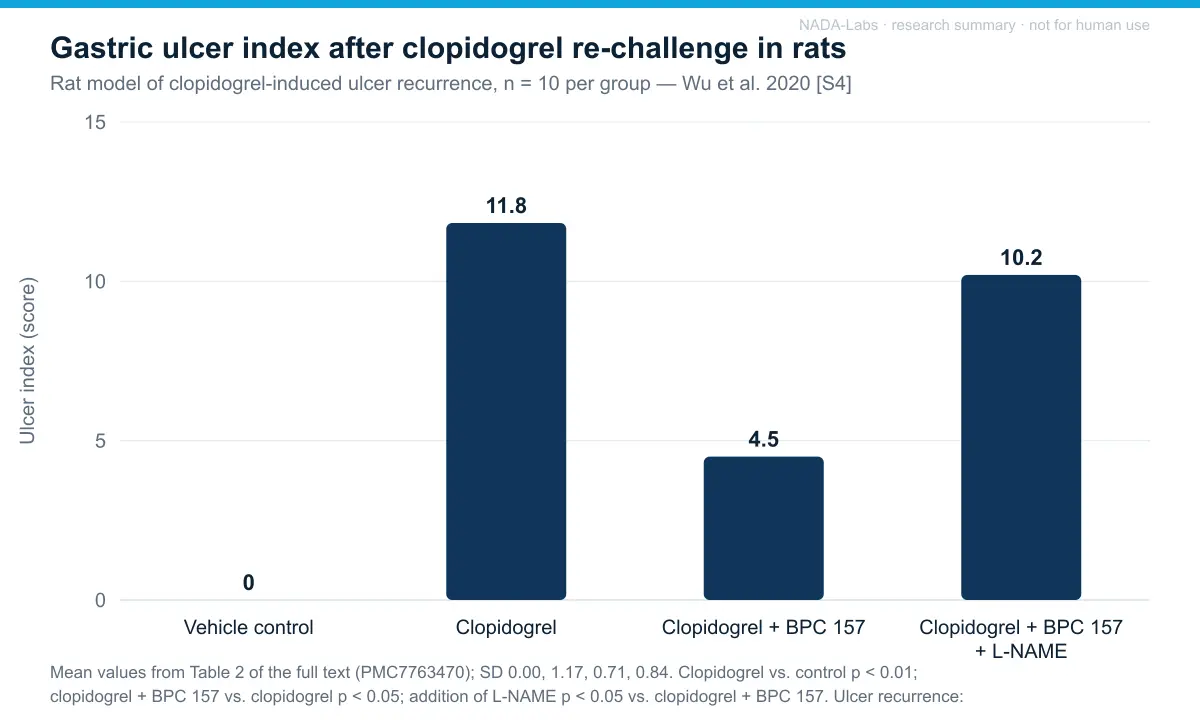
| Wu 20204 | Rat clopidogrel-induced ulcer recurrence | Controlled, 4 groups, n = 10/group, 30 days | Recurrence 2/10 vs. 6/10; ulcer index 4.50 vs. 11.83 (p < 0.05); effect weakened by L-NAME |
| Hsieh 20175 | CAM assay, endothelial cells, rat hind-limb ischaemia | Controlled in vitro/in vivo mechanism study | Increased vessel density, tube formation and blood-flow recovery; VEGFR2 up-regulation and Akt-eNOS activation |
| Lee 20216 | Human, chronic knee pain | Retrospective survey, n = 16, no control, 6-12 months | 14/16 (87.5 %) self-reported relief; 11/12 (91.6 %) with BPC 157 alone |
| Xu 20207 | Mice, rats, rabbits, dogs | Preclinical toxicology with solvent controls | No test-article-related toxicity; reversible creatinine decrease in dogs at highest repeated-dose level; mild local irritation; no genotoxicity |
Ulcer recurrence and ulcer index — Wu et al. 2020 [S4]
| Group (n = 10 each) | Ulcer recurrence | Ulcer index (mean ± SD) | Statistics |
|---|---|---|---|
| Vehicle control | 0/10 | 0.00 ± 0.00 | — |
| Clopidogrel | 6/10 | 11.83 ± 1.17 | p < 0.01 vs. control |
| Clopidogrel + BPC 157 | 2/10 | 4.50 ± 0.71 | p < 0.05 vs. clopidogrel |
| Clopidogrel + BPC 157 + L-NAME | 5/10 | 10.20 ± 0.84 | p < 0.05 vs. clopidogrel + BPC 157 |
Effects reported in the studies
- Skin wound closure (rat alkali burn). Topical BPC-157 increased wound closure to 77.5 % (day 16) and 81.6 % (day 18) vs. 54.1 % and 60.0 % in vehicle controls (p < 0.01), comparable to the bFGF positive control (73.3 % / 80.9 %); differences before day 16 were not marked as significant1.
- Tendon healing (rat Achilles transection) and tendon-cell behaviour. In transected rat Achilles tendon, load to failure, Young’s modulus and the Achilles functional index were higher than in saline controls over 14 days, with smaller tendon defects and more collagen on histology; numbers are not given in the abstract3. In vitro, BPC 157 accelerated fibroblast outgrowth from tendon explants, increased survival under oxidative stress and concentration-dependently increased migration and FAK/paxillin phosphorylation, without directly increasing proliferation2.
- Gastric mucosal protection (rat, clopidogrel-induced ulcer recurrence). Ulcer recurrence was 2/10 rats with co-administered BPC 157 vs. 6/10 with clopidogrel alone, and the ulcer index 4.50 vs. 11.83 (p < 0.05); NO-synthase blockade (L-NAME) largely reversed the effect (5/10; index 10.20, p < 0.05 vs. clopidogrel + BPC 157)4.
- Angiogenesis and blood-flow recovery. BPC 157 increased vessel density in the CAM assay, endothelial tube formation, and blood-flow recovery and vessel number in ischaemic rat hind limb, associated with VEGFR2 up-regulation/internalisation and Akt-eNOS activation5; in wound tissue and HUVECs it raised VEGF expression and ERK1/2-dependent proliferation, migration and tube formation1.
- Human symptom reports (uncontrolled). In a retrospective telephone survey of 16 knee-pain patients after intra-articular injection, 14/16 (87.5 %) reported relief, 11/12 (91.6 %) in the BPC 157-only subgroup; no control group or validated outcome measures6. A 2025 systematic review summarises the same series as 7 of 12 patients reporting relief for more than 6 months (PMID 40756949).
Adverse effects and tolerability reported
- No adverse findings in animal efficacy studies. Rat alkali-burn study: no changes in general condition, behaviour or organ pathology at autopsy in any cohort1; adverse effects not reported in the rat gastric model4 or the rat tendon study3.
- Preclinical toxicology: no serious toxicity in four species. Mice, rats, rabbits, dogs: single-dose study without test-article-related effects; repeated-dose study in dogs with only a reversible creatinine decrease at the highest tested level; mild local irritation; negative genotoxicity and embryo-fetal toxicity7. A 2025 systematic review notes that no preclinical study assessed adverse events beyond 6 weeks after single or repeated administration (PMID 40756949).
- Human tolerability data are minimal. Retrospective knee-pain survey (n = 16): adverse effects not reported6. Separate pilot reports from the same clinic: interstitial cystitis (n = 12, ‘no adverse events were reported’, PMID 39325560) and intravenous infusion in 2 adults with no measurable changes in cardiac, hepatic, renal, thyroid or blood-glucose biomarkers and no side effects reported (PMID 40131143). None of these was controlled or blinded; a systematic review found no clinical safety data (PMID 40756949).
- Theoretical concern: pro-angiogenic / VEGFR2 signalling. Because BPC 157 up-regulates VEGFR2 and VEGF-dependent angiogenesis5,1, a 2025 narrative review lists pathological angiogenesis as a theoretical concern; the same review states that no tumour-promoting effect has been demonstrated and cites reports of VEGF down-regulation in tumour models (PMID 40789979).
- Theoretical concern: nitric-oxide system effects. Effects are partly NO-dependent4; a narrative review names excessive nitric-oxide production as a theoretical concern (PMID 40789979), and the Zagreb group describes interactions of the peptide with both L-arginine and L-NAME effects on the NO system in rats (review, PMID 21548867). These actions are unstudied in humans.
- Regulatory and product-quality issues. Not approved by FDA or other regulators. WADA listed it under S0 (unapproved substances) in 2022 (PMID 40789979); a 2025 review states this listing was temporary and it is not currently named on the WADA list (PMID 40005999). In September 2023 the FDA placed it in Category 2 of bulk drug substances for compounding (PMID 40789979). A 2025 systematic review lists anecdotal reports (injection-site pain and swelling, joint pain, anxiety, panic attacks, palpitations, insomnia, drowsiness, fatigue, loss of appetite, depression) and notes that adverse effects may arise from unregulated manufacturing or contamination (PMID 40756949).
Limitations of the evidence. The evidence base is almost entirely preclinical (rat models, cell culture), and most publications come from the group that developed the peptide, often with qualitative or score-based outcomes and unstated group sizes; independent controlled quantitative data exist from only a few groups. Human data are three small, open-label, uncontrolled pilot reports from a single private clinic without validated outcome measures or long-term safety follow-up. Preclinical toxicology found no serious toxicity within the ranges tested, but no study assessed adverse events beyond six weeks, and theoretical concerns around pro-angiogenic (VEGFR2) and nitric-oxide-dependent actions remain untested in humans. Findings in rodent injury models must not be extrapolated to humans; this material is provided for research and educational purposes only.
References
- Huang T, Zhang K, Sun L, Xue X, Zhang C, Shu Z, Mu N, Gu J, Zhang W, Wang Y, Zhang Y, Zhang W (2015). Body protective compound-157 enhances alkali-burn wound healing in vivo and promotes proliferation, migration, and angiogenesis in vitro. Drug Design, Development and Therapy. PMID 25995620 DOI
- Chang CH, Tsai WC, Lin MS, Hsu YH, Pang JH (2011). The promoting effect of pentadecapeptide BPC 157 on tendon healing involves tendon outgrowth, cell survival, and cell migration. Journal of Applied Physiology. PMID 21030672 DOI
- Staresinic M, Sebecic B, Patrlj L, Jadrijevic S, Suknaic S, Perovic D, Aralica G, Zarkovic N, Borovic S, Srdjak M, Hajdarevic K, Kopljar M, Batelja L, Boban-Blagaic A, Turcic I, Anic T, Seiwerth S, Sikiric P (2003). Gastric pentadecapeptide BPC 157 accelerates healing of transected rat Achilles tendon and in vitro stimulates tendocytes growth. Journal of Orthopaedic Research. PMID 14554208 DOI
- Wu H, Wei M, Li N, Lu Q, Shrestha SM, Tan J, Zhang Z, Wu G, Shi R (2020). Clopidogrel-induced gastric injury in rats is attenuated by stable gastric pentadecapeptide BPC 157. Drug Design, Development and Therapy. PMID 33376304 DOI
- Hsieh MJ, Liu HT, Wang CN, Huang HY, Lin Y, Ko YS, Wang JS, Chang VH, Pang JS (2017). Therapeutic potential of pro-angiogenic BPC157 is associated with VEGFR2 activation and up-regulation. Journal of Molecular Medicine (Berlin). PMID 27847966 DOI
- Lee E, Padgett B (2021). Intra-articular injection of BPC 157 for multiple types of knee pain. Alternative Therapies in Health and Medicine. PMID 34324435 human study
- Xu C, Sun L, Ren F, Huang P, Tian Z, Cui J, Zhang W, Wang S, Zhang K, He L, Zhang W, Zhang C, Hao Q, Zhang Y, Li M, Li W (2020). Preclinical safety evaluation of body protective compound-157, a potential drug for treating various wounds. Regulatory Toxicology and Pharmacology. PMID 32334036 DOI
This section summarises findings published in the cited peer-reviewed literature for informational purposes. It is not a claim of efficacy or safety, contains no dosing or administration information by design, and does not constitute medical, veterinary or scientific advice. Results in cell cultures or animal models do not predict effects in humans.