Description
AHK-Cu is the copper(II) complex of the tripeptide L-alanyl-L-histidyl-L-lysine. It differs from GHK-Cu only in the first residue — alanine instead of glycine — and keeps the histidine in position 2 through which GHK-type peptides bind copper. Solutions are prepared in sterile water; avoid chelating buffers and additives such as glycine, histidine or HEPES, which bind copper(II) themselves.
AHK-Cu: what the published research shows
Compiled by NADA-Labs from the peer-reviewed literature cited below. No own study data.
AHK-Cu is the copper(II) complex of the tripeptide L-alanyl-L-histidyl-L-lysine (Ala-His-Lys)1, a structural analogue of GHK-Cu with alanine instead of glycine at the N-terminus. Both carry histidine in position 2, the N-terminal Xxx-His arrangement through which GHK binds copper(II) via three nitrogen atoms6,8. The only primary study of the complex that was identified used isolated human hair follicles cultured ex vivo and cultured dermal papilla cells; its authors propose that the follicle elongation they observed may result from stimulated proliferation and reduced apoptosis of dermal papilla cells1. No measurement of copper binding by AHK itself was identified. The other cited studies concern related compounds: a copper-free vitamin C conjugate of AHK in mouse myoblasts2 and the comparator peptides GHK, DAHK and Ala-His-His.
Evidence base: One peer-reviewed primary study of AHK-Cu from a single group, in isolated human hair follicles (ex vivo) and cultured dermal papilla cells (in vitro); only its abstract is openly accessible, and it reports directions without sample sizes, effect sizes or variance1. No animal, human, pharmacokinetic or toxicology study of AHK-Cu and no independent replication were identified. One in vitro study tested a different, copper-free molecule, vitamin C-linker-conjugated AHK, in mouse C2C12 myoblasts2. All other references are comparator studies of GHK, DAHK or Ala-His-His that do not name AHK among the compounds tested3,4,5,6,7,8.
Key studies at a glance
| Study | Model | Design | Main result |
|---|---|---|---|
| Pyo 20071 | Isolated human hair follicles, ex vivo; dermal papilla cells, in vitro | Concentration series; elongation, proliferation, apoptosis markers | Follicle elongation and cell proliferation increased; Bcl-2/Bax up, cleaved caspase-3 and PARP down; fewer apoptotic cells, not significant; no effect sizes in abstract |
| Jung 20182 | Mouse C2C12 myoblasts, in vitro; copper-free Vit C-AHK | BMP-2-induced osteoblast differentiation; signalling and gene expression | Proliferation and alkaline phosphatase up; Smad1/5/8, ERK1/2 and p38 activated; osteogenic genes up; no significant cytotoxicity; no effect sizes in abstract |
| Pickart 19803 | Comparator GHK; hepatoma cells (HTC4), in vitro | Copper complexation and cellular uptake; structure-function comparison of tripeptides | GHK binds Cu(II) and enhances copper uptake into cells; several His-Lys tripeptides nearly as active (not named in abstract) |
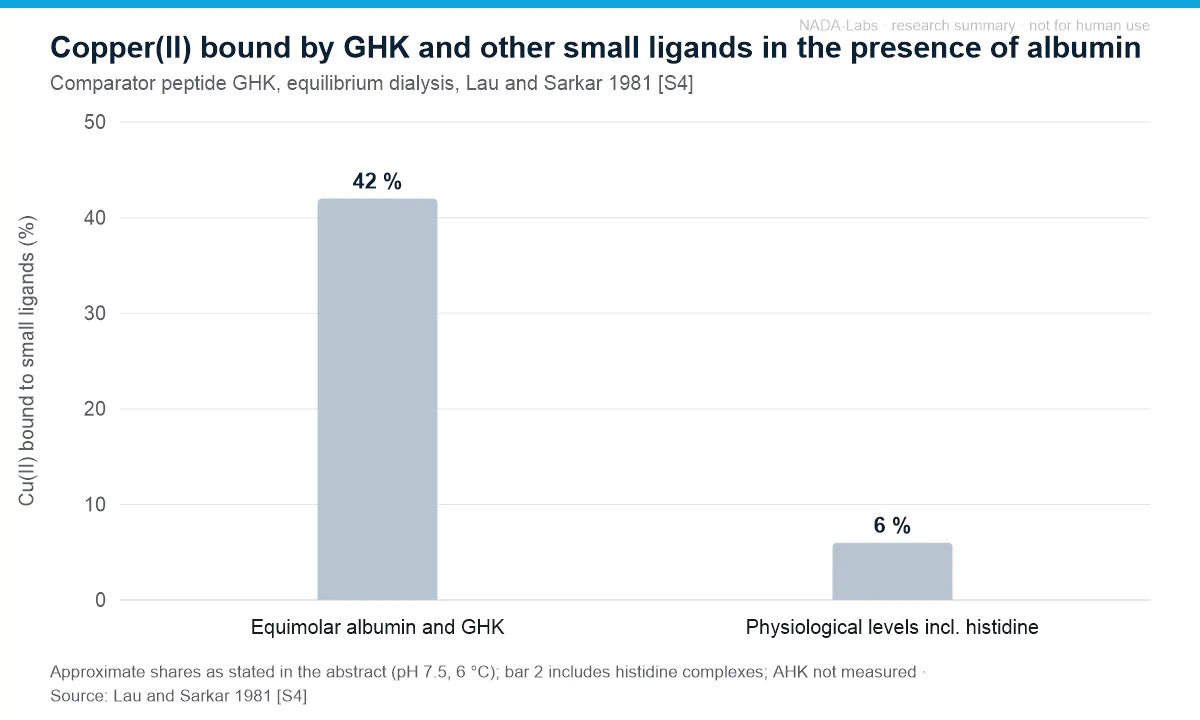
| Lau 19814 | Comparator GHK; Cu(II) solution chemistry with histidine and albumin | Potentiometry, spectrophotometry; equilibrium dialysis vs. albumin (pH 7.5, 6 °C) | Lysine ε-amino group raises stability constants; about 42 % of Cu(II) on GHK at equimolar albumin, about 6 % on small ligands at physiological levels |
| Conato 20015 | Comparator GHK and two analogues with histidine replaced; human serum; cell culture | Copper-complex equilibria, serum stability, growth-factor assay | Copper complexation via residue 1 appears necessary, free lysine side chain appears of fundamental importance; analogues stable in serum for at least 3 h and as active as GHK or more; no numbers in abstract |
| Hureau 20116 | Comparator Cu(II)-GHK and Cu(II)-DAHK, solid state and solution | X-ray structures, spectroscopy, cyclic voltammetry | GHK: three nitrogen ligands, fast copper exchange; DAHK: four, very slow exchange; both redox-inert at moderate potentials |
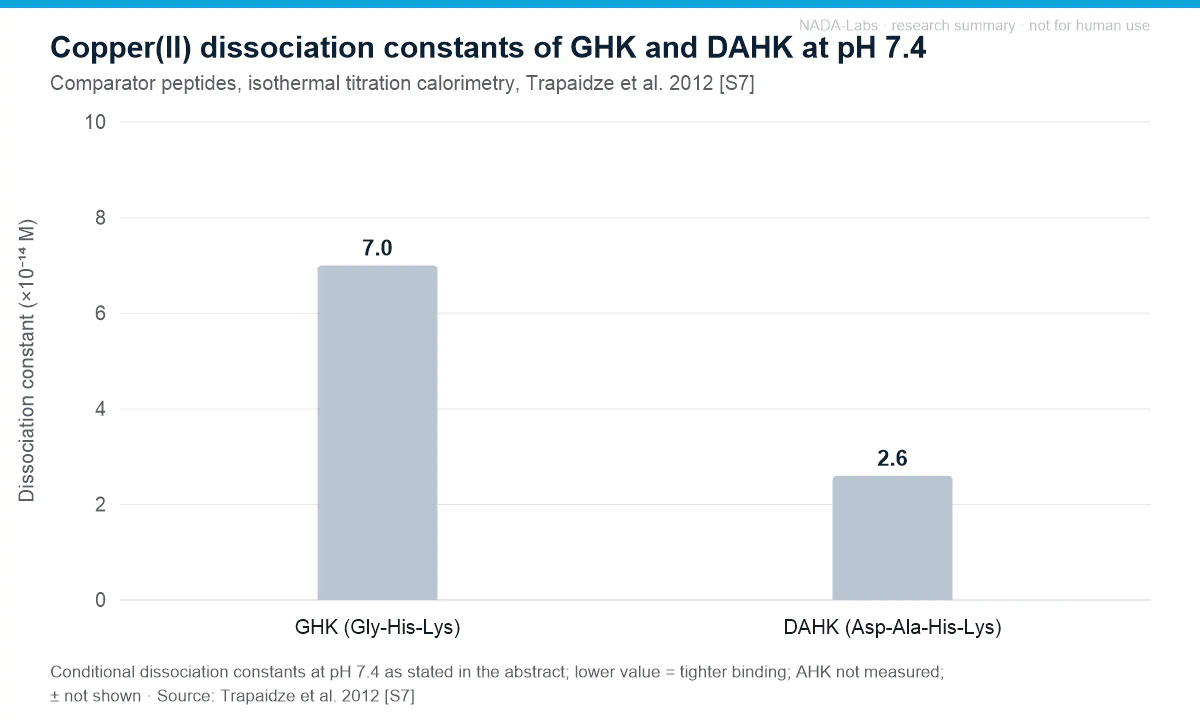
| Trapaidze 20127 | Comparator GHK and DAHK; Cu(II) binding at pH 7.4 | Isothermal titration calorimetry with glycine as competitor | Predominantly 1:1 binding; conditional dissociation constants 7.0 ± 1.0 × 10⁻¹⁴ M (GHK) and 2.6 ± 0.4 × 10⁻¹⁴ M (DAHK) |
| Gonzalez 20178 | Comparator Ala-His-His and Ala-Ala-His; Cu(II) coordination | Multispectroscopic pH series; NMR copper exchange | Xxx-His (GHK type) binds Cu(II) via three peptide nitrogens, Xxx-Zzz-His (albumin type) via four; Ala-His-His switches between both with pH, fast exchange |
AHK-Cu and GHK-Cu compared: what has been studied
| Aspect | AHK-Cu | GHK-Cu |
|---|---|---|
| Tripeptide | Ala-His-Lys1 | Gly-His-Lys4 |
| Residue 1 | Alanine, the only difference | Glycine; drives copper-complex formation in GHK5 |
| Copper-binding motif | Xxx-His, inferred from the sequence; not measured | Xxx-His, the canonical example8 |
| Cu(II) coordination | Not determined | Three nitrogens (amine, amide, imidazole), labile fourth position, fast copper exchange6 |
| Cu(II) affinity, pH 7.4 | Not measured | Conditional dissociation constant 7.0 × 10⁻¹⁴ M7 |
| Competition with albumin | Not measured | About 42 % of Cu(II) on GHK at equimolar albumin4 |
| Occurrence | Not described as naturally occurring in the cited literature; sequence matches residues 2-4 of the albumin motif DAHK8 | Human plasma constituent, complexed with copper and iron (Pickart and Thaler 1980, PMID 6246126) |
| Cell and tissue studies | One identified study: hair follicles ex vivo, dermal papilla cells in vitro1 | Cell-culture studies, e.g. collagen synthesis in fibroblasts (Maquart 1988, PMID 3169264) and growth-factor production by fibroblasts (Pollard 2005, PMID 15655171) |
| Animal studies | None identified | Studied, e.g. in ischaemic rat wounds (n = 24): wound area reduced by 64.5 % vs. 45.6 % (vehicle) and 28.2 % (untreated) at day 13 (Canapp 2003, PMID 14648529) |
| Human studies | None identified | Small randomised topical trial (n = 13): no objective difference between groups; patient-rated improvement greater (p = 0.04) (Miller 2006, PMID 16847171) |
Effects reported in the studies
- Follicle elongation and dermal papilla cell proliferation. AHK-Cu stimulated the elongation of isolated human hair follicles cultured ex vivo and the proliferation of cultured dermal papilla cells within the concentration range stated in the abstract; the abstract gives no follicle or donor numbers and no effect sizes1.
- Apoptosis-related markers. In dermal papilla cells the Bcl-2/Bax ratio was elevated and cleaved caspase-3 and PARP were reduced, but the reduction in apoptotic cells measured by annexin V/propidium iodide flow cytometry was not statistically significant; the authors propose that stimulated proliferation and reduced apoptosis of these cells may underlie the follicle effect1.
- Copper-free AHK derivative in myoblasts. Vitamin C-linker-conjugated AHK, a different molecule without copper, increased proliferation and BMP-2-induced alkaline phosphatase in mouse C2C12 myoblasts, activated Smad1/5/8, ERK1/2 and p38 signalling and raised the mRNA of osteoblast differentiation genes (ALP, BMP-2, osteocalcin, Runx2); no effect sizes in abstract2.
- Structure-activity of GHK-type tripeptides (comparator). Several tripeptides with a histidyl-lysyl linkage, which AHK also contains, were nearly as active as GHK in structure-function studies, but the abstract does not name them3. For GHK and two analogues with the histidine replaced, copper-complex formation driven by the first residue appeared necessary for growth-factor activity and the free lysine side chain of fundamental importance5.
- Copper binding by the shared Xxx-His motif (comparator chemistry; not measured for AHK). Xxx-His peptides such as GHK bind Cu(II) via three peptide nitrogens plus an external ligand, albumin-type Xxx-Zzz-His peptides such as DAHK via four nitrogens8. Cu(II)-GHK is monomeric in solution and exchanges copper fast6. The lysine ε-amino group enhances the stability constants of the GHK complexes4 but is suggested to be protonated at physiological pH and to take part in complex formation only at alkaline pH5.
- Copper competition with albumin (comparator; not studied for AHK). In equilibrium dialysis about 42 % of the Cu(II) was bound to GHK at equimolar albumin and peptide, and about 6 % was associated with the low-molecular-weight components at physiologically relevant concentrations of Cu(II), albumin, L-histidine and peptide4.
Adverse effects and tolerability reported
- No toxicology, pharmacokinetic or human data. No such study of AHK-Cu was identified, so the systemic tolerability and any copper-related toxicity of the complex are unknown; the only identified study of the complex used isolated tissue and cultured cells1.
- Cytotoxicity not reported. The abstract of that study gives no cytotoxicity data1; a 2026 review states that AHK-Cu treatment increased cell viability in the MTT assay (Fan 2026, PMID 42072405; secondary source).
- Copper-free derivative. For vitamin C-linker-conjugated AHK, a different molecule, the authors report no significant cytotoxicity in C2C12 myoblasts, without data in the abstract2.
- Copper redox chemistry (GHK comparator; not studied for AHK-Cu). Cu(II)-GHK was inert under moderate redox potentials but could be reduced to Cu(I) at around -0.62 V (versus AgCl/Ag), with subsequent release of the copper ion6; with ascorbate, Cu-GHK produced more hydroxyl radical than the copper complexes of amyloid-β and DAHK (Guilloreau 2007, PMID 17577900).
- Variable responses in cell culture (GHK comparator; no data for AHK-Cu). Across a wide range of culture systems GHK produced responses ranging from stimulation of growth and differentiation to outright toxicity3.
Limitations of the evidence. All primary data on AHK-Cu itself that were identified come from one study by a single group in isolated tissue and cells, with no independent replication identified1. Its abstract gives no sample sizes, effect sizes or variance, the reduction in apoptotic cells measured by flow cytometry was not significant, and the full text is not openly accessible. No animal, human, pharmacokinetic or toxicology data were identified. All copper-binding data are comparator data for GHK, DAHK and Ala-His-His4,6,7,8; no measurement of the copper binding of AHK itself was identified, so these data cannot be assumed to apply to AHK. The vitamin C-AHK study concerns a different, copper-free molecule from a compound family developed as a product component2. Secondary literature overstates the evidence: one review attributes reduced TGF-β1 and increased VEGF expression to AHK-Cu (Sadgrove 2021, PMID 34377956), although the primary abstract mentions these only as background on ‘the tripeptide-copper complex’1, and another presents the non-significant apoptosis result as confirmed (Fan 2026, PMID 42072405). None of the findings summarised here establish efficacy or safety for any use outside the described research models.
References
- Pyo HK, Yoo HG, Won CH, Lee SH, Kang YJ, Eun HC, Cho KH, Kim KH (2007). The effect of tripeptide-copper complex on human hair growth in vitro. Archives of Pharmacal Research. PMID 17703734 DOI
- Jung JI, Park KY, Lee Y, Park M, Kim J (2018). Vitamin C-linker-conjugated tripeptide AHK stimulates BMP-2-induced osteogenic differentiation of mouse myoblast C2C12 cells. Differentiation. PMID 29567599 DOI
- Pickart L, Freedman JH, Loker WJ, Peisach J, Perkins CM, Stenkamp RE, Weinstein B (1980). Growth-modulating plasma tripeptide may function by facilitating copper uptake into cells. Nature. PMID 7453802 DOI
- Lau SJ, Sarkar B (1981). The interaction of copper(II) and glycyl-L-histidyl-L-lysine, a growth-modulating tripeptide from plasma. Biochemical Journal. PMID 7340824 DOI
- Conato C, Gavioli R, Guerrini R, Kozlowski H, Mlynarz P, Pasti C, Pulidori F, Remelli M (2001). Copper complexes of glycyl-histidyl-lysine and two of its synthetic analogues: chemical behaviour and biological activity. Biochimica et Biophysica Acta. PMID 11325542 DOI
- Hureau C, Eury H, Guillot R, Bijani C, Sayen S, Solari PL, Guillon E, Faller P, Dorlet P (2011). X-ray and solution structures of Cu(II) GHK and Cu(II) DAHK complexes: influence on their redox properties. Chemistry – A European Journal. PMID 21780203 DOI
- Trapaidze A, Hureau C, Bal W, Winterhalter M, Faller P (2012). Thermodynamic study of Cu2+ binding to the DAHK and GHK peptides by isothermal titration calorimetry (ITC) with the weaker competitor glycine. Journal of Biological Inorganic Chemistry. PMID 21898044 DOI
- Gonzalez P, Vileno B, Bossak K, El Khoury Y, Hellwig P, Bal W, Hureau C, Faller P (2017). Cu(II) Binding to the Peptide Ala-His-His, a Chimera of the Canonical Cu(II)-Binding Motifs Xxx-His and Xxx-Zzz-His. Inorganic Chemistry. PMID 29190078 DOI
This section summarises findings published in the cited peer-reviewed literature for informational purposes. It is not a claim of efficacy or safety, contains no dosing or administration information by design, and does not constitute medical, veterinary or scientific advice. Results in cell cultures or animal models do not predict effects in humans.