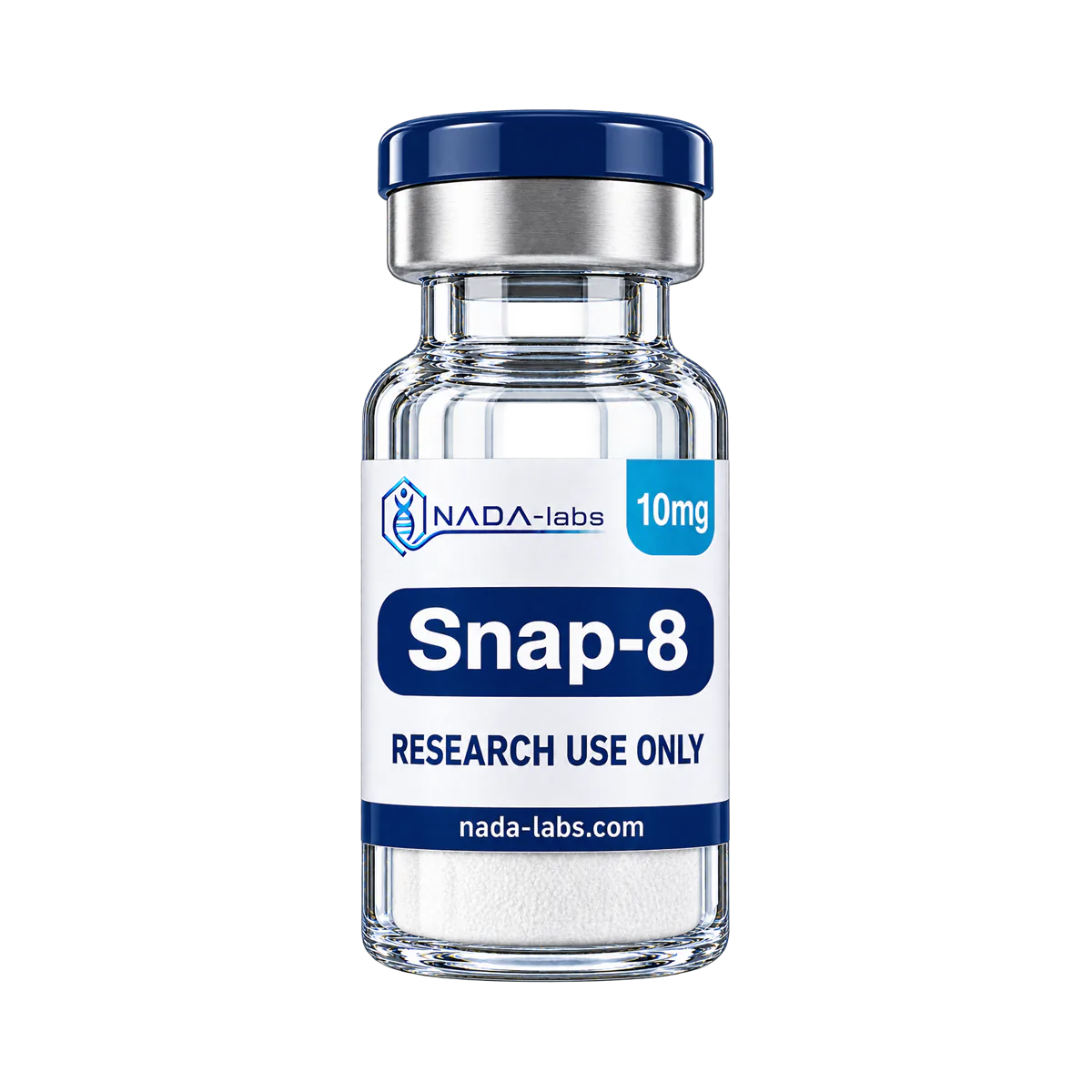
Description
Snap-8 (acetyl octapeptide-3) is the synthetic linear octapeptide Ac-Glu-Glu-Met-Gln-Arg-Arg-Ala-Asp-NH₂ with an N-terminal acetyl group and a C-terminal amide; its first six residues are identical to the SNAP-25-derived hexapeptide Ac-Glu-Glu-Met-Gln-Arg-Arg-NH₂ (acetyl hexapeptide-8). The methionine residue is oxidation sensitive — keep vials sealed, cold and away from light, and avoid oxidising buffers.
Snap-8: what the published research shows
Compiled by NADA-Labs from the peer-reviewed literature cited below. No own study data.
Snap-8 (acetyl octapeptide-3, also listed as acetyl glutamyl heptapeptide-3; Ac-Glu-Glu-Met-Gln-Arg-Arg-Ala-Asp-NH₂) is a synthetic octapeptide that extends the hexapeptide Ac-Glu-Glu-Met-Gln-Arg-Arg-NH₂ (acetyl hexapeptide-8, called Argireline in several of the cited papers) by Ala-Asp at the C-terminal side (sequences as given by Errante 2020, PMID 33195061). The hexapeptide was patterned after the N-terminal end of SNAP-254, the synaptic protein that botulinum neurotoxin A cleaves (Blasi 1993, PMID 8103915), and was identified in a rational design programme3. The research literature attributes its activity mainly to interference with the formation and/or stability of the SNARE complex that drives Ca²⁺-dependent exocytosis, and thereby to an inhibition of neurotransmitter release in vitro3. For acetyl octapeptide-3 itself, only two human studies were identified, both of multi-ingredient microneedle patches1,2; the other numbered studies concern the related hexapeptide in cell assays, excised skin, rats and small human trials3,4,5,6,7,8.
Evidence base: Very thin and mostly indirect. Only two records with acetyl octapeptide-3 were identified, both human studies of dissolving microneedle patches in which it was one of several actives: a split-face study against a hyaluronic-acid-only placebo patch (n = 24 enrolled, 21 completed, 28 days)1 and a single-centre 12-week study without a control group (n not stated in the abstract)2. No in vitro, animal or human study of acetyl octapeptide-3 as a single substance was found in PubMed. The remaining six references concern the related hexapeptide: the design paper of the group that developed it, with in vitro mechanism data and a skin-topography test in volunteers3, two small randomised placebo-controlled human trials (n = 60 over 4 weeks; n = 24 as a pilot in blepharospasm)4,5, one controlled rat study (n = 10/group)6, an in vitro skin-penetration study7 and a cell cytotoxicity study8. Potency figures for Snap-8 quoted in a review (Errante 2020, PMID 33195061) refer to non-peer-reviewed technical documentation, not to a published experiment. Six of the eight records were available only as abstracts.
Key studies at a glance
| Study | Model | Design | Main result |
|---|---|---|---|
| Shin 20241 | Human, adults with eye wrinkles aged 30-65 (n = 24 enrolled, 21 completed) | Split-face, placebo-patch-controlled, 28 days; dissolving microneedle patch with acetyl octapeptide-3 and two other actives vs hyaluronic-acid-only patch | All roughness parameters R1-R5 different from placebo on day 28 (p < 0.05); TEWL different on days 7 and 14 (p < 0.05); elasticity not different; values only in figures |
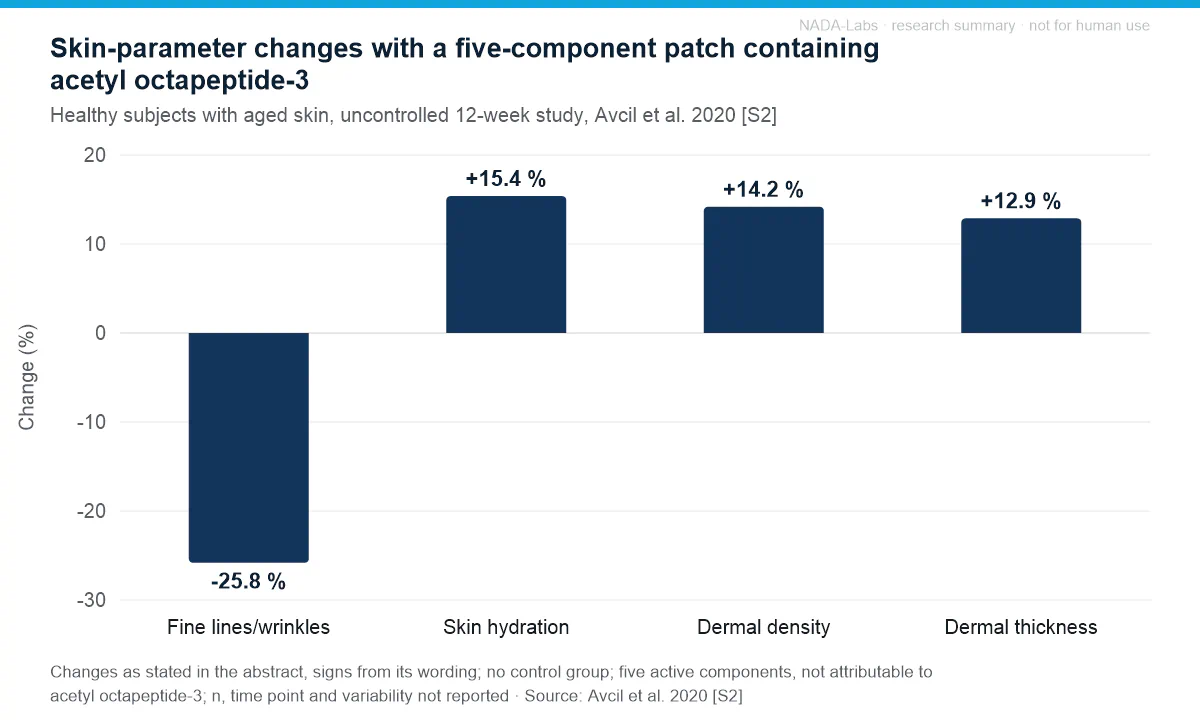
| Avcil 20202 | Human, healthy subjects with aged skin (n not stated in the abstract) | Single-centre, uncontrolled, 12 weeks; microneedle patch with five components including acetyl octapeptide-3 | Fine lines/wrinkles -25.8 %, hydration +15.4 %, dermal density +14.2 %, dermal thickness +12.9 %; no skin reactions reported; no control group |
| Blanes-Mira 20023 | In vitro and healthy women volunteers (n not stated); related hexapeptide | Rational design; neurotransmitter-release and SNARE-complex assays; 30-day skin-topography test; oral toxicity and primary irritation tests | Neurotransmitter release inhibited with a potency similar to botulinum neurotoxin A but much lower efficacy; wrinkle depth reduced by up to 30 % after 30 days; no oral toxicity or primary irritation reported (test models not stated in the abstract) |
| Wang 20134 | Human, Chinese adults with periorbital wrinkles (n = 60); related hexapeptide | Randomised 3:1, placebo-controlled, topical, 4 weeks | Subjective global efficacy rating 48.9 % vs 0 % with placebo; roughness parameters decreased (p < 0.01), no obvious decrease with placebo (p > 0.05) |
| Lungu 20135 | Human, patients with blepharospasm receiving botulinum toxin (n = 24, 12 per group); related hexapeptide | Double-blind, randomised, placebo-controlled pilot, topical eyelid cream | Trend only: time to return to baseline JBRS 3.7 vs 3.0 months; no significant group differences at 3 months; no severe adverse events |
| Acuner 20266 | Rat, female Wistar, dorsal skin flap, in vivo (n = 10 per group); related hexapeptide | Controlled, four groups (saline, botulinum toxin A, hexapeptide, combination), subdermal injection, flap survival on day 10 | Hexapeptide alone: collagen profile indistinguishable from control, no detectable tissue-level effect; flap survival not different (p = 0.327) |
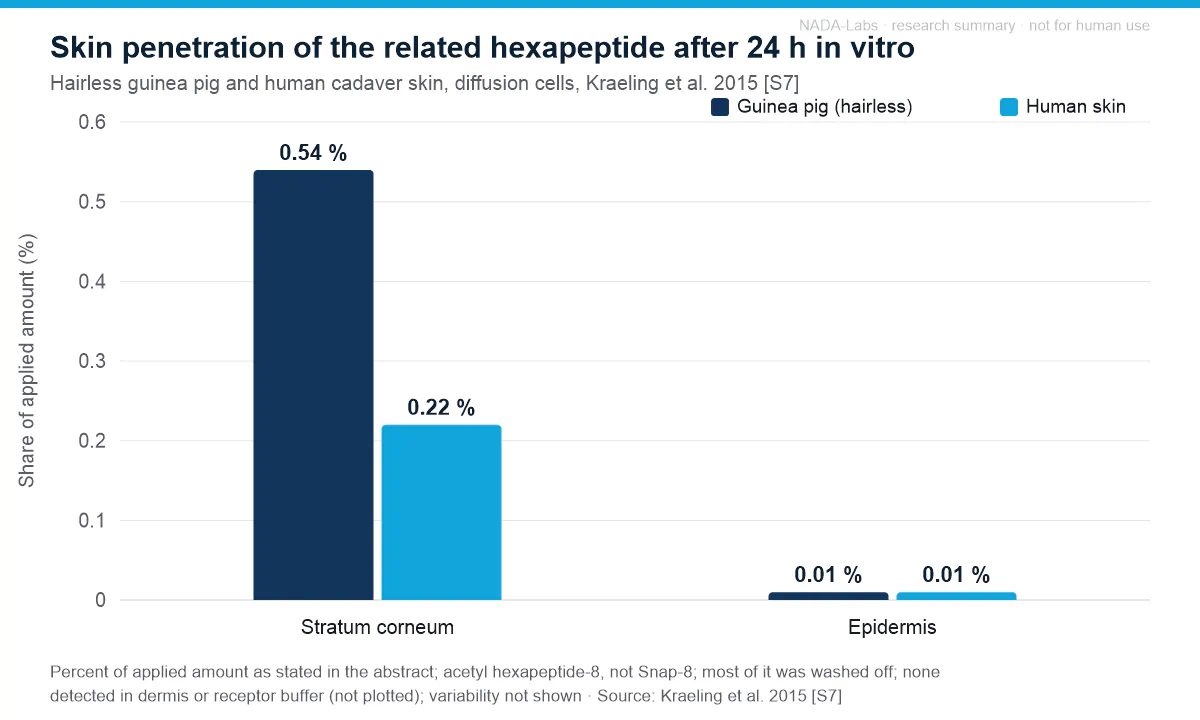
| Kraeling 20157 | Hairless guinea pig and human cadaver skin in diffusion cells, in vitro; related hexapeptide | 24-h exposure to an oil-in-water emulsion, tape stripping, layer separation, HILIC-MS/MS | Most of the applied amount washed off; stratum corneum 0.54 % (guinea pig) and 0.22 % (human), epidermis 0.01 %; none detected in dermis or receptor buffer |
| Grosicki 20148 | Human HEK-293 kidney cells, IMR-32 neuroblastoma cells and primary skin fibroblasts, in vitro; related hexapeptide | Formazan-based proliferation assay, concentration series, IC50 vs doxorubicin | Dose-dependent antiproliferative effect; significant cytotoxicity only at 18- to 10,000-fold higher concentrations than doxorubicin; IC50 values not in the abstract |
Human studies of preparations with acetyl octapeptide-3 or the related hexapeptide
| Study | Peptide and preparation | Population (n) | Control | Reported outcome and tolerability |
|---|---|---|---|---|
| Shin 20241 | Acetyl octapeptide-3 with two other actives, dissolving microneedle patch | Adults with eye wrinkles (24 enrolled, 21 completed) | Hyaluronic-acid-only patch on the other eye area | R1-R5 different from placebo on day 28 (p < 0.05); elasticity not different; no adverse effects observed over 28 days |
| Avcil 20202 | Acetyl octapeptide-3 with four other components, microneedle patch | Healthy subjects with aged skin (n not stated) | None | Fine lines/wrinkles -25.8 %, hydration +15.4 %; no primary or cumulative skin reactions reported |
| Blanes-Mira 20023 | Related hexapeptide, oil-in-water emulsion | Healthy women volunteers (n not stated) | Not stated in the abstract | Wrinkle depth reduced by up to 30 % after 30 days (skin topography); no primary irritation reported (test model not stated in the abstract) |
| Wang 20134 | Related hexapeptide, topical | Adults with periorbital wrinkles (n = 60, randomised 3:1) | Placebo | Global efficacy rating 48.9 % vs 0 %; roughness parameters decreased (p < 0.01); adverse events not reported in the abstract |
| Lungu 20135 | Related hexapeptide, eyelid cream, together with botulinum toxin | Patients with blepharospasm (n = 24, 12 per group) | Placebo cream of the same formulation | Trend only, 3.7 vs 3.0 months to baseline JBRS; no severe adverse events; minor eyelid irritation in 2 vs 2 subjects |
Effects reported in the studies
- Patch containing acetyl octapeptide-3, placebo-controlled split-face study. In adults with eye wrinkles aged 30-65 (24 enrolled, 21 completed), a dissolving microneedle patch containing acetyl octapeptide-3, an ascorbic acid glucoside and a cyclic lysophosphatidic acid salt was applied to one eye area and a hyaluronic-acid-only placebo patch to the other over 28 days. All skin-roughness parameters R1-R5 differed between the two sides on day 28 (p < 0.05); on the active side, R1 and R3 decreased on days 14 and 28 (p < 0.025) and Rz on days 7, 14 and 28 (p < 0.01). Trans-epidermal water loss differed from placebo on days 7 and 14 (p < 0.05) and the eye-lifting test on day 14, whereas skin elasticity did not differ; the measured values are given only in figures1.
- Five-component patch, uncontrolled 12-week study. In healthy subjects with aged skin (n not stated in the abstract), hyaluronic-acid microneedle patches containing an arginine/lysine polypeptide, acetyl octapeptide-3, palmitoyl tripeptide-5, adenosine and seaweed extracts were applied to the outer eye corners and a volar forearm area. The abstract reports a 25.8 % decrease in fine lines/wrinkles, a 15.4 % improvement in skin hydration and increases of 14.2 % in dermal density and 12.9 % in dermal thickness, without a control group, a time point or variability; the authors discuss a possible combined action of all ingredients2.
- Mechanism of the related hexapeptide (in vitro). The hexapeptide inhibited neurotransmitter release with a potency similar to that of botulinum neurotoxin A but with much lower efficacy than the toxin; the inhibition was attributed to interference with the formation and/or stability of the SNARE complex required for Ca²⁺-dependent exocytosis3. Peptides patterned after the segment 22Ala-44Ile at the N-terminus of SNAP-25 disrupted the binary complex of SNAP-25 and syntaxin and inhibited Ca²⁺-dependent exocytosis from detergent-permeabilised excitable cells (Blanes-Mira 2004, PMID 14675156); the abstract does not state that the hexapeptide or acetyl octapeptide-3 was among them. No mechanistic study of acetyl octapeptide-3 itself was identified.
- Related hexapeptide, randomised placebo-controlled 4-week trial. In 60 Chinese adults with periorbital wrinkles randomised 3:1 to the hexapeptide or placebo, the subjective global assessment (Daniell’s classification and Seeman’s standard) gave a total efficacy rate of 48.9 % vs 0 % with placebo, and all roughness parameters of silicone skin replicas decreased with the hexapeptide (p < 0.01), while no obvious decrease was seen with placebo (p > 0.05)4.
- Related hexapeptide added to botulinum toxin in blepharospasm. In a double-blind, randomised, placebo-controlled pilot trial (n = 24, 12 per group) in patients receiving regular botulinum toxin injections, the topical eyelid cream was started together with an injection. The time to return to the baseline Jankovic Blepharospasm Rating Scale (JBRS) showed only a trend towards a longer interval, 3.7 vs 3.0 months; 4 of 12 patients in the active group had a longer interval of symptom control (3.3-7.1 months), and JBRS and Blepharospasm Disability Scale scores did not differ significantly between the groups at 3 months5.
- Related hexapeptide injected in a rat skin-flap model. In 40 female Wistar rats (four groups of 10: saline, botulinum toxin A, hexapeptide, combination) given subdermal injections one week before a dorsal McFarlane flap was raised, flap survival on day 10 did not differ among the groups (p = 0.327). The hexapeptide alone produced a collagen profile indistinguishable from control, whereas the groups with botulinum toxin A showed lower type I and higher type III collagen (p < 0.001) and the combination group a higher substance P expression (p = 0.002); the authors report no detectable tissue-level effect of the injected hexapeptide under the tested conditions6.
- Skin penetration of the related hexapeptide (in vitro). After a 24-h exposure of hairless guinea pig and human cadaver skin to an oil-in-water emulsion in diffusion cells, most of the hexapeptide was washed off the surface; the penetrated fraction remained mostly in the stratum corneum (0.54 % and 0.22 % of the applied amount), 0.01 % was found in the epidermis of both skin types, and no peptide was detected in the dermis or in the buffer below the skin; the metabolite H2N-EEMQRR-amide was not detected in any layer7.
Adverse effects and tolerability reported
- Patch containing acetyl octapeptide-3, 28 days. No adverse effects were observed despite repeated use on the same skin area over 28 days, and the text lists itching, stinging and burning as not reported; 3 of the 24 enrolled subjects dropped out, with no reason given in the text1.
- Five-component patch, 12 weeks. The abstract states that none of the subjects reported primary or cumulative skin reactions; further safety data, the number of subjects and dropouts are not given2.
- Related hexapeptide in the blepharospasm pilot trial. No severe adverse events were recorded; one patient in the placebo arm discontinued before the endpoint for unrelated family reasons and was included in the safety analysis; 4 subjects (2 on the hexapeptide, 2 on placebo) had minor, self-limiting eyelid irritation, and the discussion section describes mild discomfort with a feeling of heaviness of the eyelids in 4 subjects, which an ophthalmologic evaluation found to be mild non-septic blepharitis associated with the thick cream base, seen with both active and placebo cream and resolving spontaneously5.
- Toxicity and irritation tests of the related hexapeptide. The design paper reports no in vivo oral toxicity and no primary irritation at the high levels tested; species, numbers and amounts are not given in the abstract, and the tests come from the group that designed the peptide3.
- Cytotoxicity of the related hexapeptide in human cells (in vitro). In HEK-293 kidney cells, IMR-32 neuroblastoma cells and primary human skin fibroblasts the hexapeptide had a dose-dependent antiproliferative effect; significant cytotoxicity occurred only at 18- to 10,000-fold higher concentrations than with the reference compound doxorubicin, depending on the cell type; IC50 values are not given in the abstract8.
- Missing safety data. No toxicology, pharmacokinetic, stability or systemic-exposure data for acetyl octapeptide-3 itself were identified. The randomised hexapeptide trial names safety as an objective but reports no adverse-event data in its abstract4, the rat study gives none in its abstract6, and skin-penetration data exist only for the hexapeptide7.
Limitations of the evidence. No peer-reviewed study of acetyl octapeptide-3 as a single substance was identified; the only two records that contain it tested multi-ingredient patches with three and five active components, one against a hyaluronic-acid-only placebo patch and one without any control, so no result can be attributed to the octapeptide1,2. Most of the data concern the related hexapeptide, which lacks the two C-terminal residues Ala-Asp, and no study comparing the two peptides was found3,4,5,6,7,8. The human studies are small where n is stated (n = 21 to 60) and short (28 days to 12 weeks for the skin measurements); randomisation and blinding are not described for the placebo-patch study1, and several abstracts give incomplete information on sample size, variability or adverse events2,3,4. The design paper and its toxicity data come from the group that developed the hexapeptide3. The endpoints are mostly instrumental skin-surface measurements or subjective ratings; the blepharospasm pilot showed only a non-significant trend5, the injected hexapeptide had no detectable tissue-level effect in rats6, and in vitro only 0.01 % of the applied hexapeptide was found in the epidermis and none was detected in the dermis7. None of the findings summarised here establish efficacy or safety for any use outside the described research models.
References
- Shin JY, Han D, Yoon KY, Jeong DH, Park YI (2024). Clinical Safety and Efficacy Evaluation of a Dissolving Microneedle Patch Having Dual Anti-Wrinkle Effects With Safe and Long-Term Activities. Annals of Dermatology. PMID 39082657 DOI human study
- Avcil M, Akman G, Klokkers J, Jeong D, Çelik A (2020). Efficacy of bioactive peptides loaded on hyaluronic acid microneedle patches: A monocentric clinical study. Journal of Cosmetic Dermatology. PMID 31134751 DOI human study
- Blanes-Mira C, Clemente J, Jodas G, Gil A, Fernández-Ballester G, Ponsati B, Gutierrez L, Pérez-Payá E, Ferrer-Montiel A (2002). A synthetic hexapeptide (Argireline) with antiwrinkle activity. International Journal of Cosmetic Science. PMID 18498523 DOI
- Wang Y, Wang M, Xiao S, Pan P, Li P, Huo J (2013). The anti-wrinkle efficacy of argireline, a synthetic hexapeptide, in Chinese subjects: a randomized, placebo-controlled study. American Journal of Clinical Dermatology. PMID 23417317 DOI human study
- Lungu C, Considine E, Zahir S, Ponsati B, Arrastia S, Hallett M (2013). Pilot study of topical acetyl hexapeptide-8 in the treatment for blepharospasm in patients receiving botulinum toxin therapy. European Journal of Neurology. PMID 23146065 DOI human study
- Acuner B, Görgülü T, Işıktekin E, Kaymaz Morkoç E, Kargı AE (2026). Effects of Botulinum Toxin Type A and Argireline on Dermal Collagen Remodeling and Skin Biology in a Flap Model. Aesthetic Plastic Surgery. PMID 42675285 DOI
- Kraeling ME, Zhou W, Wang P, Ogunsola OA (2015). In vitro skin penetration of acetyl hexapeptide-8 from a cosmetic formulation. Cutaneous and Ocular Toxicology. PMID 24754410 DOI
- Grosicki M, Latacz G, Szopa A, Cukier A, Kieć-Kononowicz K (2014). The study of cellular cytotoxicity of argireline – an anti-aging peptide. Acta Biochimica Polonica. PMID 24644551
This section summarises findings published in the cited peer-reviewed literature for informational purposes. It is not a claim of efficacy or safety, contains no dosing or administration information by design, and does not constitute medical, veterinary or scientific advice. Results in cell cultures or animal models do not predict effects in humans.