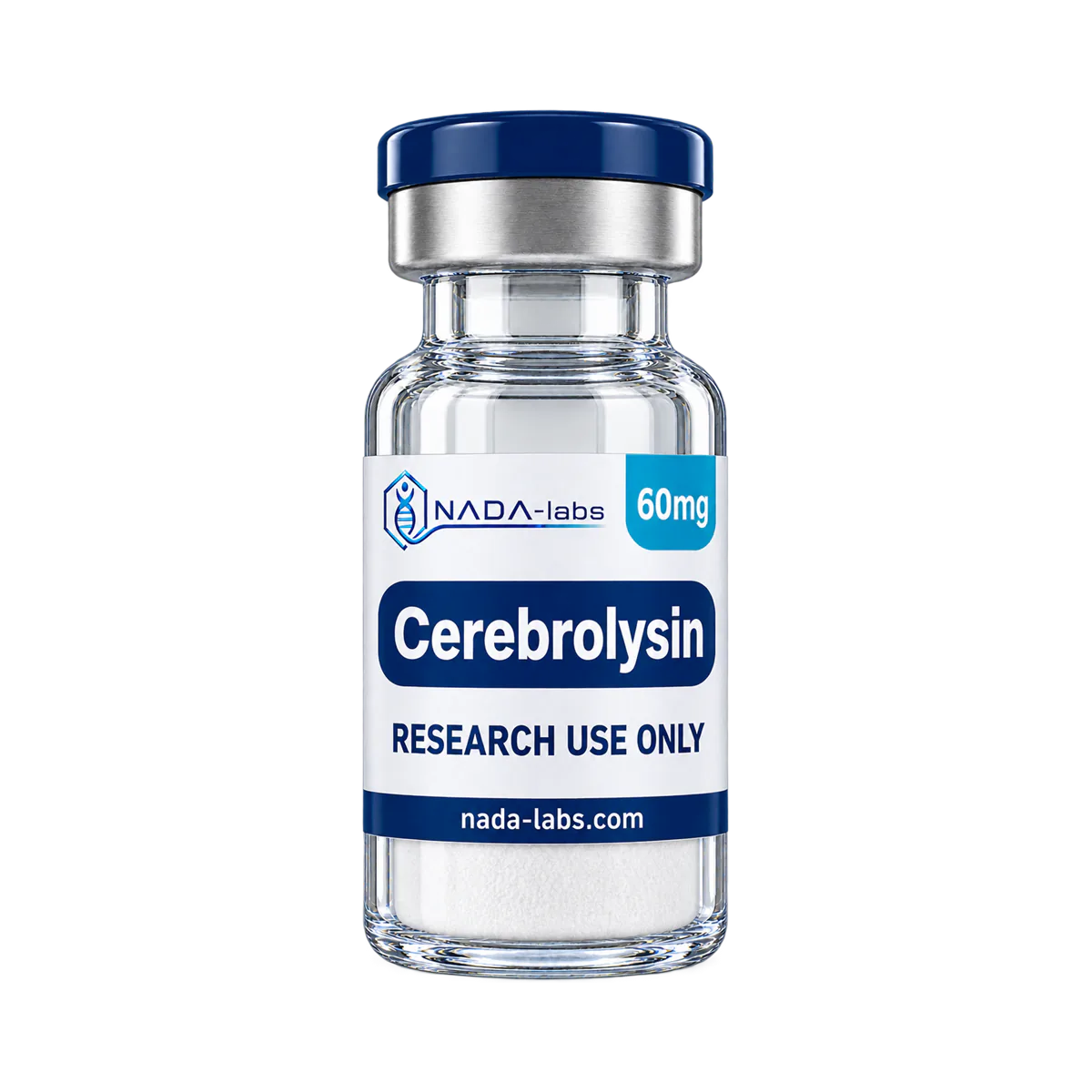
Description
Cerebrolysin is a preparation obtained by enzymatic breakdown of purified porcine brain proteins and consists of low-molecular-weight peptides (< 10 kDa) and free amino acids; as a multicomponent mixture it has no single amino-acid sequence, molecular formula or molecular weight. As with all lyophilised peptide materials, keep vials sealed, cold and away from light.
Cerebrolysin: what the published research shows
Compiled by NADA-Labs from the peer-reviewed literature cited below. No own study data.
Cerebrolysin is not a single peptide but a preparation produced by enzymatic breakdown of purified porcine brain proteins (Ladurner 2005, PMID 15583955; Ziganshina 2023, PMID 37818733); based on total nitrogen content it consists of about 25 % low-molecular-weight peptides (< 10 kDa) and about 75 % free amino acids7. The research literature attributes its effects mainly to an activity resembling that of neurotrophic factors6 — reduced apoptosis of cultured neurons, which the authors assign to the peptide fraction7, neurite outgrowth in sensory and sympathetic neurons (Satou 2000, PMID 11145001) and increased neurogenesis after experimental stroke, with progenitor-cell proliferation depending on the PI3K/Akt pathway6. It has been studied in chick neuron cultures7, in rats with embolic stroke and in their neural progenitor cells6, and in randomised, double-blind, placebo-controlled trials in acute ischaemic stroke2,5, early rehabilitation after stroke1, vascular dementia3 and Alzheimer’s disease4.
Evidence base: Five randomised, double-blind, placebo-controlled human trials (n = 119 to 1070) — three in stroke1,2,5 and two in dementia3,4 — plus one study in rats and rat progenitor cells6 and one in chick neuron cultures7. Further randomised trials cover acute stroke (Ladurner 2005, PMID 15583955) and mild to moderate Alzheimer’s disease (Ruether 2001, PMID 11552768; Alvarez 2006, PMID 16420392). A 2023 Cochrane review included seven randomised trials in acute ischaemic stroke with 1773 participants, one of which tested a different peptide mixture (Ziganshina 2023, PMID 37818733). CARS was funded by the manufacturer of the studied preparation1; the other trial abstracts contain no funding statement. The preclinical data summarised here come from one rat study6 and two chick cell-culture studies7 (Satou 2000, PMID 11145001).
Key studies at a glance
| Study | Model | Design | Main result |
|---|---|---|---|
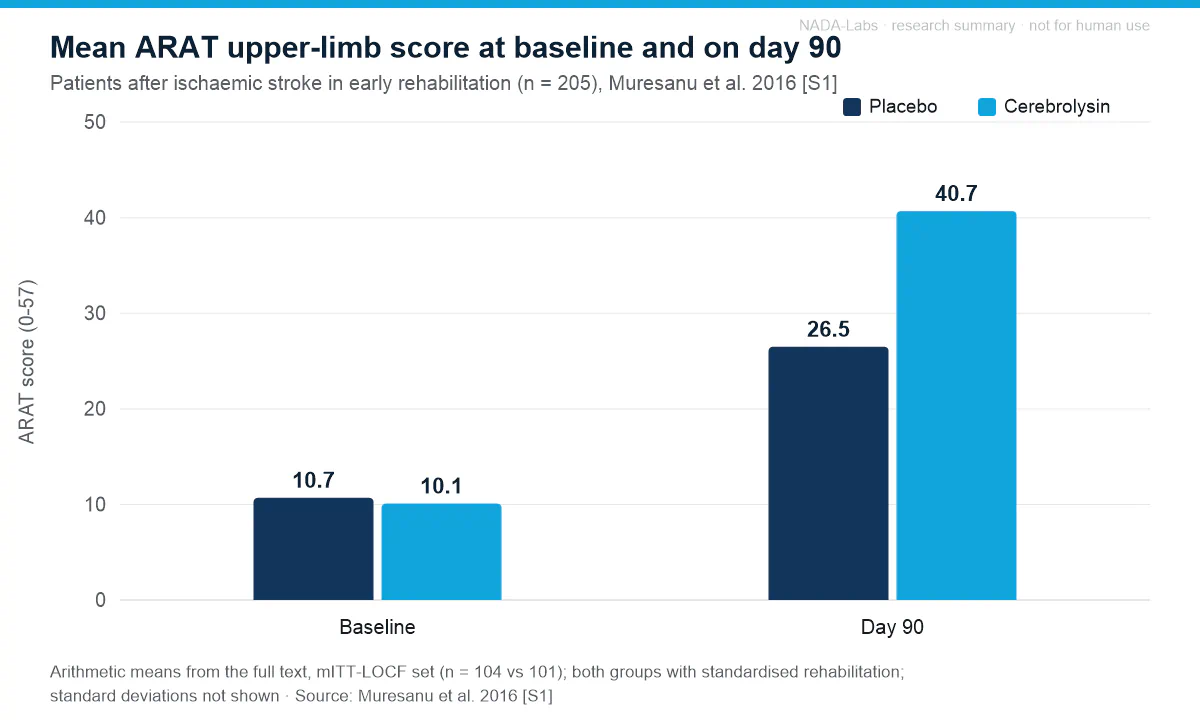
| Muresanu 20161 | Human, patients after acute ischaemic stroke in early rehabilitation (n = 208) | CARS, phase II, randomised, double-blind, placebo-controlled, multicentre; 21-day treatment period from 24-72 h after stroke onset, standardised rehabilitation in both groups; follow-up to day 90 | ARAT on day 90: Mann-Whitney estimator 0.71 (95 % CI 0.63-0.79) vs placebo; mean ARAT 10.1 -> 40.7 vs 10.7 -> 26.5 |
| Heiss 20122 | Human, acute ischaemic stroke (n = 1070) | CASTA, randomised, double-blind, placebo-controlled, multicentre; started within 12 h, 10-day intravenous treatment period on top of aspirin; follow-up to day 90 | Combined primary end point (mRS, Barthel Index, NIHSS) neutral; post hoc subgroup NIHSS > 12: 90-day mortality 10.5 % vs 20.2 % with placebo |
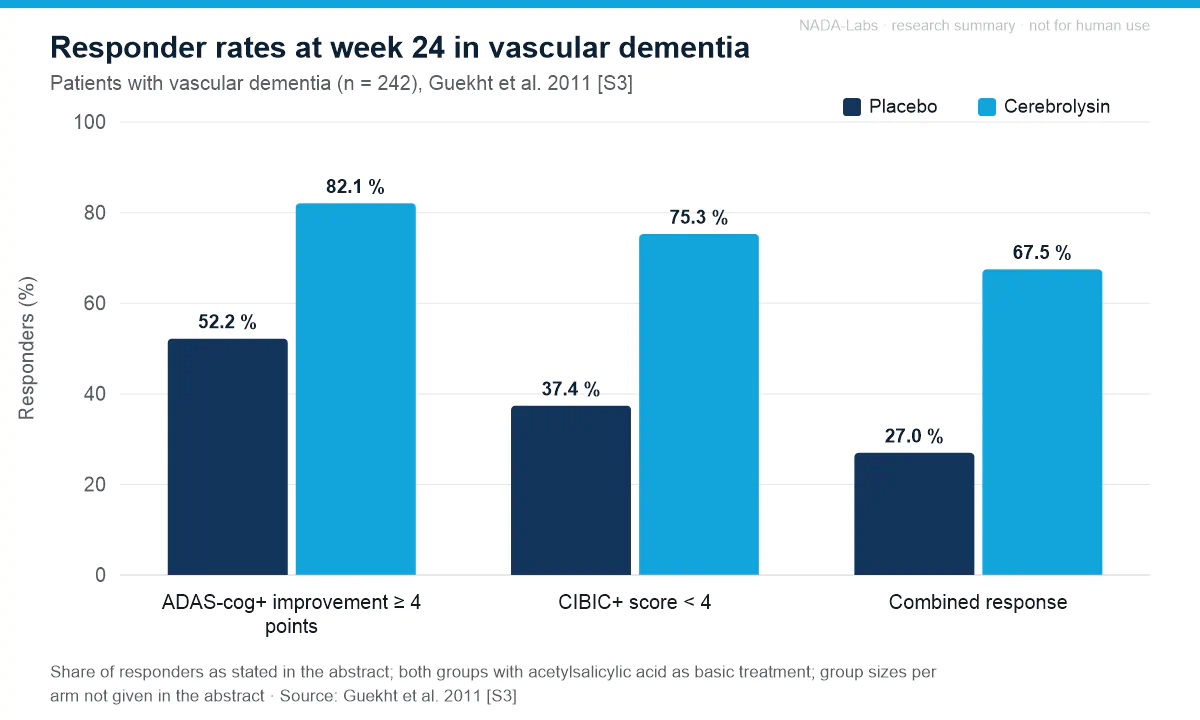
| Guekht 20113 | Human, vascular dementia (n = 242) | Randomised, double-blind, placebo-controlled, multicentre; two treatment cycles added to acetylsalicylic acid; primary end point at week 24 | ADAS-cog+ improved by 10.6 vs 4.4 points (least-squares mean difference -6.17, p < 0.0001); combined responders 67.5 % vs 27.0 % |
| Panisset 20024 | Human, Alzheimer’s disease (n = 192) | Randomised, double-blind, placebo-controlled, multicentre, parallel-group; 4-week intravenous treatment period; assessments at weeks 4, 12 and 24 | CIBIC+ at week 12 in favour of Cerebrolysin (p = 0.033); responders 76 % vs 57 % (p = 0.007); adverse events 64 % vs 73 % |
| Lang 20135 | Human, acute ischaemic stroke treated with alteplase (n = 119) | Randomised, double-blind, placebo-controlled; started 1 h after thrombolysis, 10-day treatment period; sequential design with interim analyses | Stopped after the third interim analysis: no benefit on mRS at day 90; more NIHSS responders on days 2, 5, 10 and 30 |
| Zhang 20106 | Rat, embolic middle cerebral artery occlusion in vivo; SVZ neural progenitor cells in vitro | Controlled; treatment from 24 h after stroke, cell counts at day 28 (n = 10/group); behavioural tests up to day 28; in vitro n = 6 | More BrdU+ progenitor cells and DCX+ neuroblasts, TUNEL+ cells about -50 % in the ischaemic boundary, infarct volume not significantly reduced; in vitro BrdU+ 43.6 % vs 27.1 %, abolished by PI3K blockade |
| Hartbauer 20017 | In vitro, embryonic chick cortical neurons under low-serum stress | Controlled; MTT viability after 4 and 8 days in vitro, apoptotic chromatin staining; artificial amino-acid mixture as control | Apoptotic nuclei reduced (p < 0.01) and viability improved after 8 days; amino-acid mixture alone did neither; no effect sizes in abstract |
Safety outcomes reported in CARS (Muresanu 2016 [S1])
| Outcome | Cerebrolysin | Placebo |
|---|---|---|
| Patients in the safety analysis set | n = 104 | n = 104 |
| At least one adverse event | 69.2 % | 71.2 % |
| Adverse events rated mild (share of all events) | 76.1 % | 69.8 % |
| Patients with serious adverse events | 3 (2.9 %) | 7 (6.7 %) |
| Deaths | 0 | 4 (3.8 %) |
| Discontinued because of adverse events | 2 | 5 |
Effects reported in the studies
- Upper-limb motor recovery after stroke. In CARS (n = 208; 205 analysed on day 90), patients in early rehabilitation after ischaemic stroke reached a mean ARAT score of 40.7 on day 90 with Cerebrolysin vs 26.5 with placebo (baseline 10.1 vs 10.7), a mean change of 30.7 vs 15.9 points; the Mann-Whitney estimator for ARAT on day 90 was 0.71 (95 % CI 0.63-0.79; p < 0.0001) and 0.62 (95 % CI 0.58-0.65) for global status across 12 outcome scales1.
- Acute ischaemic stroke: primary and subgroup results. In CASTA (n = 1070; 529 vs 541) the combined primary end point showed no significant difference between groups; in a post hoc analysis of patients with NIHSS > 12 there was a trend in favour of Cerebrolysin (odds ratio 1.27 for NIHSS and for mRS, lower confidence bounds 0.97 and 0.90) and a cumulative 90-day mortality of 20.2 % with placebo vs 10.5 % with Cerebrolysin (hazard ratio 1.9661, lower confidence bound 1.0013)2. In a further trial (n = 146), the Canadian Neurological Scale, Barthel Index and Clinical Global Impressions did not differ significantly, while the Syndrome Short Test of cognitive function did (Ladurner 2005, PMID 15583955).
- Neurological response with thrombolysis. In 119 patients treated with alteplase within 3 h of symptom onset, the third interim analysis showed no benefit on the mRS at day 90 and the trial was stopped; in the secondary NIHSS responder analysis, significantly more patients in the Cerebrolysin group improved by 6 or more points (or reached a total score of 0 or 1) on days 2, 5, 10 and 30, and mRS responder trends were not significant5.
- Cognition and global function in vascular dementia. In 242 patients, ADAS-cog+ improved by 10.6 points with Cerebrolysin vs 4.4 points with placebo at week 24 (least-squares mean difference -6.17, p < 0.0001) and the mean CIBIC+ score was 2.84 vs 3.68 (treatment difference 0.84, p < 0.0001); responder rates were 82.1 % vs 52.2 % (ADAS-cog+ improvement of at least 4 points), 75.3 % vs 37.4 % (CIBIC+ score below 4) and 67.5 % vs 27.0 % (combined), with odds ratios of 5.08 and 5.63 for a favourable CIBIC+ and combined response3.
- Global function and cognition in Alzheimer’s disease. In 192 patients, CIBIC+ at week 12 differed significantly in favour of Cerebrolysin (p = 0.033), with 76 % vs 57 % responders (score of 4 or lower, p = 0.007), while the Disability Assessment in Dementia and the Cornell Depression Scale showed trends only; the groups differed at baseline in age, age at onset of dementia and hallucinations4. A 28-week trial (n = 149) reported CGI responders of 63.5 % vs 41.4 % at week 16 and an ADAS-cog difference of 3.2 points (Ruether 2001, PMID 11552768); a 24-week trial with three dose groups (n = 279) reported significant global improvement in all three but a significant ADAS-cog effect only in the lowest dose group, which the authors describe as a reversed U-shaped dose-response (Alvarez 2006, PMID 16420392).
- Neurogenesis and apoptosis after experimental stroke (rat). In rats with embolic middle cerebral artery occlusion, treatment started 24 h after stroke increased BrdU+ progenitor cells and DCX+ migrating neuroblasts in the ipsilateral SVZ and the striatal ischaemic boundary at day 28 in the two higher dose groups and reduced TUNEL+ cells by about 50 % in the ischaemic boundary but not in the SVZ; infarct volume was not significantly reduced, while performance in a battery of behavioural tests improved on days 21 and 286.
- Progenitor-cell proliferation via PI3K/Akt (in vitro). SVZ neural progenitor cells from ischaemic rats showed 43.6 % vs 27.1 % BrdU+ cells with Cerebrolysin vs control (n = 6), an increase abolished by the PI3K inhibitor LY294002 (29.7 %); the preparation also increased Tuj1+ immature neurons and promoted progenitor-cell migration6.
- Neuronal survival and neurite outgrowth (cell culture). In embryonic chick cortical neurons under low-serum stress, Cerebrolysin reduced the share of cells with apoptotic chromatin changes (p < 0.01) and improved viability after 8 days in vitro, whereas an artificial mixture of the free amino acids did neither; after 4 days both increased viability to a similar extent7. In chick embryo explants it promoted neurite outgrowth in dorsal root ganglion and sympathetic neurons, less markedly than nerve growth factor and with an inverted-U concentration relationship, but not in ciliary ganglion neurons (Satou 2000, PMID 11145001).
Adverse effects and tolerability reported
- Adverse events in CARS. At least one adverse event was reported by 69.2 % with Cerebrolysin vs 71.2 % with placebo, most of them mild (76.1 % vs 69.8 % of events); serious adverse events occurred in 3 (2.9 %) vs 7 (6.7 %) patients, none of which appeared related to the study medications; no patient died in the Cerebrolysin group vs 4 (3.8 %) in the placebo group, and 2 vs 5 patients discontinued because of adverse events1.
- Pooled stroke trials (Cochrane review). Cerebrolysin or a similar peptide mixture probably made little to no difference in all-cause death (risk ratio 0.96, 95 % CI 0.65-1.41; 6 trials, 1689 participants) and Cerebrolysin in the total number of people with serious adverse events (risk ratio 1.16, 95 % CI 0.81-1.66; 3 trials, 1335 participants), but the number of people with non-fatal serious adverse events increased (risk ratio 2.39, 95 % CI 1.10-5.23; moderate-certainty evidence); the total number of people with adverse events showed little to no difference (risk ratio 1.03, 95 % CI 0.92-1.14; 4 trials, low-certainty evidence) (Ziganshina 2023, PMID 37818733).
- Adverse events in the Alzheimer’s trials. Adverse events were recorded in 64 % with Cerebrolysin vs 73 % with placebo, most commonly headache, dizziness, weight loss and anxiety4; a 28-week trial reported 43 % vs 38 % (Ruether 2001, PMID 11552768), and a trial with three dose groups reported similar rates across all groups (Alvarez 2006, PMID 16420392).
- Combination with thrombolysis. In 119 patients treated with alteplase, adverse events did not differ between the treatment groups; the abstract gives no event rates5.
- Trials without adverse-event figures in the abstract. CASTA documented adverse events but reports no frequencies in its abstract2, and the vascular dementia trial gives only the summary statement that the preparation was well tolerated3; in a further acute-stroke trial adverse events occurred with similar frequency in both groups (Ladurner 2005, PMID 15583955).
- Preclinical studies and research material. The rat and cell-culture studies report no toxicology or safety end points6,7; none of the cited studies examined lyophilised research material.
Limitations of the evidence. Cerebrolysin is a multicomponent mixture of peptides and free amino acids7, and all human trials gave the studied preparation intravenously1,2,3,4,5; none of the cited studies examined lyophilised research material or established that other preparations are equivalent. Results in stroke are mixed: the primary end points of CASTA and of the alteplase trial were not met, the CASTA mortality difference comes from a post hoc subgroup without stated subgroup size in the abstract2,5, and CARS was an exploratory phase II trial whose authors call for confirmation in a large-scale trial1. Besides the funding of CARS described above1, the Cochrane review reports manufacturer support for three multicentre trials, a high risk of bias for incomplete outcome data in four trials and an unclear risk of selective outcome reporting across the Cerebrolysin trials (Ziganshina 2023, PMID 37818733). The dementia results cited here come from single trials with rating-scale end points, one with baseline differences between groups4 and one with a reversed U-shaped pattern across dose groups (Alvarez 2006, PMID 16420392). The preclinical findings cited here come from single studies in rats and chick neurons6,7. None of the findings summarised here establish efficacy or safety for any use outside the described research models.
References
- Muresanu DF, Heiss WD, Hoemberg V, Bajenaru O, Popescu CD, Vester JC, Rahlfs VW, Doppler E, Meier D, Moessler H, Guekht A (2016). Cerebrolysin and Recovery After Stroke (CARS): A Randomized, Placebo-Controlled, Double-Blind, Multicenter Trial. Stroke. PMID 26564102 DOI human study
- Heiss WD, Brainin M, Bornstein NM, Tuomilehto J, Hong Z; Cerebrolysin Acute Stroke Treatment in Asia (CASTA) Investigators (2012). Cerebrolysin in patients with acute ischemic stroke in Asia: results of a double-blind, placebo-controlled randomized trial. Stroke. PMID 22282884 DOI human study
- Guekht AB, Moessler H, Novak PH, Gusev EI; Cerebrolysin Investigators (2011). Cerebrolysin in vascular dementia: improvement of clinical outcome in a randomized, double-blind, placebo-controlled multicenter trial. Journal of Stroke and Cerebrovascular Diseases. PMID 20656516 DOI human study
- Panisset M, Gauthier S, Moessler H, Windisch M; Cerebrolysin Study Group (2002). Cerebrolysin in Alzheimer’s disease: a randomized, double-blind, placebo-controlled trial with a neurotrophic agent. Journal of Neural Transmission. PMID 12111446 DOI human study
- Lang W, Stadler CH, Poljakovic Z, Fleet D; Lyse Study Group (2013). A prospective, randomized, placebo-controlled, double-blind trial about safety and efficacy of combined treatment with alteplase (rt-PA) and Cerebrolysin in acute ischaemic hemispheric stroke. International Journal of Stroke. PMID 23009193 DOI human study
- Zhang C, Chopp M, Cui Y, Wang L, Zhang R, Zhang L, Lu M, Szalad A, Doppler E, Hitzl M, Zhang ZG (2010). Cerebrolysin enhances neurogenesis in the ischemic brain and improves functional outcome after stroke. Journal of Neuroscience Research. PMID 20857512 DOI
- Hartbauer M, Hutter-Paier B, Skofitsch G, Windisch M (2001). Antiapoptotic effects of the peptidergic drug cerebrolysin on primary cultures of embryonic chick cortical neurons. Journal of Neural Transmission. PMID 11475013 DOI
This section summarises findings published in the cited peer-reviewed literature for informational purposes. It is not a claim of efficacy or safety, contains no dosing or administration information by design, and does not constitute medical, veterinary or scientific advice. Results in cell cultures or animal models do not predict effects in humans.