Description
KPV is the C-terminal tripeptide fragment of alpha-melanocyte-stimulating hormone. Its small size makes it unusually stable in solution compared with longer sequences, and it dissolves rapidly in sterile or bacteriostatic water.
KPV: what the published research shows
Compiled by NADA-Labs from the peer-reviewed literature cited below. No own study data.
KPV (Lys-Pro-Val) is the C-terminal tripeptide of the endogenous neuropeptide alpha-melanocyte-stimulating hormone (alpha-MSH 11-13). It has been studied as a minimal anti-inflammatory fragment of alpha-MSH: reported mechanisms include inhibition of NF-kappaB activation (via IkappaB-alpha stabilisation and blocked nuclear import of p65), cellular uptake through the di/tripeptide transporter PepT1, and effects that appear largely independent of melanocortin-receptor/cAMP signalling. The published work is almost entirely preclinical: murine chemically induced colitis (DSS, TNBS), T-cell transfer colitis, colitis-associated cancer, crystal-induced peritonitis, controlled cortical impact (traumatic brain injury) in mice, corneal epithelial wounds in rabbits, and human epithelial/immune cell lines in vitro.
Evidence base: Exclusively preclinical: rodent models (mouse colitis, peritonitis, traumatic brain injury), rabbit corneal wound model, and in vitro human cell lines. No controlled human studies of KPV were identified. Group sizes are small (n = 5-10 per arm where stated). A large share of the colitis/PepT1 literature comes from a single laboratory (Merlin group, Emory/Georgia State).
Key studies at a glance
| Study | Model | Design | Main result |
|---|---|---|---|
| Dalmasso 20081 | Mouse DSS and TNBS colitis; human intestinal and T-cell lines | Controlled, oral KPV vs. colitis alone; n = 5-10/group | Colonic MPO -50 % (DSS) and -30 % (TNBS); cytokine mRNA reduced (p < 0.05); uptake via PepT1 (Km ~160 uM) |
| Kannengiesser 20082 | Mouse DSS, transfer colitis, MC1R-deficient mice | Controlled, KPV vs. untreated | Earlier recovery, reduced infiltrates and MPO; all treated MC1R-deficient mice survived |
| Getting 20033 | Mouse crystal-/IL-1beta-induced peritonitis | Controlled, systemic KPV vs. vehicle and other MSH peptides | Significant reduction of PMN accumulation; effect MC-receptor independent, no cAMP rise |
| Schaible 20134 | Mouse traumatic brain injury | Randomised, blinded; n = 10/group; explorative | Lesion volume -24 % (21.0 vs. 27.7 mm3, p = 0.016); apoptotic neurons 26 vs. 55 per ROI (p = 0.002) |
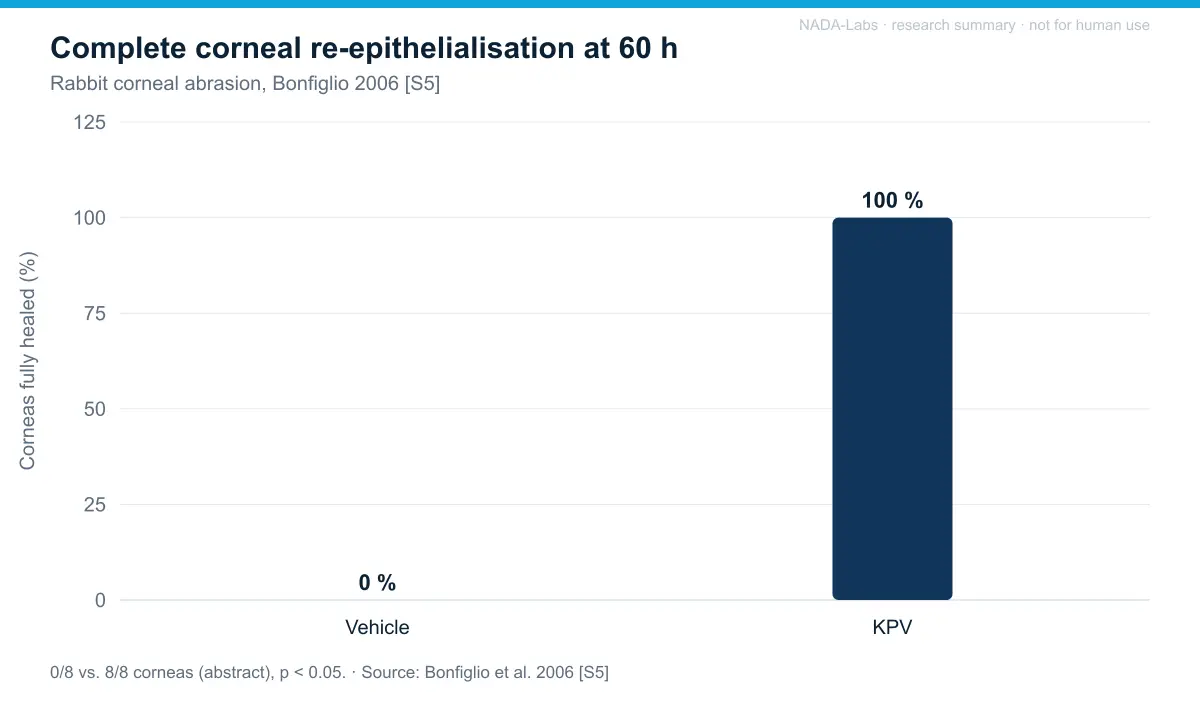
| Bonfiglio 20065 | Rabbit corneal epithelial wound | Controlled, topical KPV vs. PBS; 8 corneas/group | 8/8 healed at 60 h vs. 0/8 (p < 0.05); inhibited by NOS inhibitor |
| Viennois 20166 | Mouse AOM/DSS colitis-associated cancer; APC(Min/+) | Controlled; WT vs. PepT1-KO; n = 5-6/group | Tumour number/size/burden decreased in WT (p < 0.05), not in PepT1-KO or APC(Min/+) |
| Land 20127 | Human bronchial epithelial cells in vitro | Controlled, TNF-alpha with/without KPV; n = 4-5 experiments | Concentration-dependent NF-kappaB, IL-8, eotaxin, MMP-9 suppression; IkappaB-alpha stabilised (half-maximal 65.8 min) |
Quantitative outcomes in the mouse TBI model (Schaible 2013 [S4], 24 h after injury)
| Outcome | Vehicle | KPV | p-value |
|---|---|---|---|
| Secondary lesion volume (mm3) | 27.7 +/- 4.8 | 21.0 +/- 3.4 | 0.016 |
| Apoptotic neurons (caspase-3+/NeuN+ per ROI, dentate gyrus; n = 9) | 54.8 +/- 19.4 | 26.0 +/- 10.3 | 0.002 |
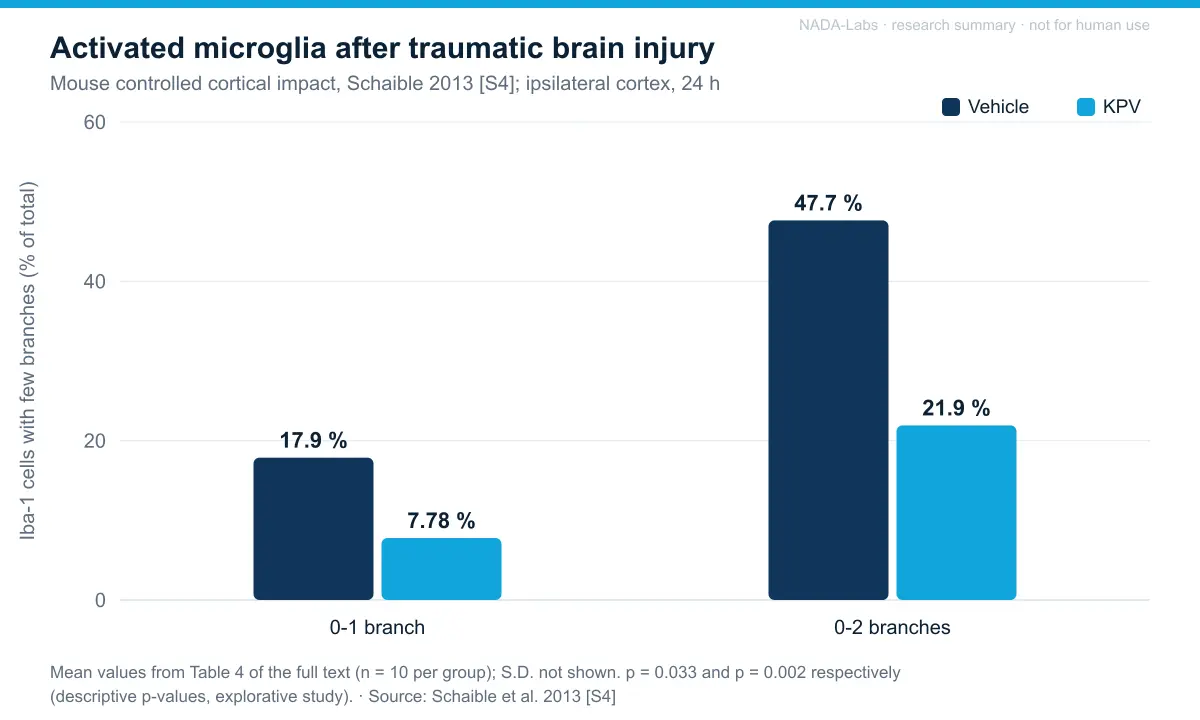
| Iba-1 cells with 0-1 branch (%) | 17.9 +/- 9.7 | 7.8 +/- 8.8 | 0.033 |
| Iba-1 cells with 0-2 branches (%) | 47.7 +/- 14.1 | 21.9 +/- 13.1 | 0.002 |
| Total Iba-1 cells, ipsilateral (cells/mm3) | 27.9 +/- 6.3 | 25.4 +/- 4.9 | 0.711 (n.s.) |
| Neurological severity score (points) | 3.6 +/- 2.3 | 2.0 +/- 1.1 | 0.139 (n.s.) |
Effects reported in the studies
- Reduced chemically induced colitis in mice. Oral KPV lowered colonic MPO activity by ~50 % in DSS colitis and ~30 % in TNBS colitis, with significant reductions in IL-6 and IL-12 (DSS) and IL-1beta, IL-6, TNF-alpha and IFN-gamma mRNA (TNBS) and less weight loss1. An independent group reported earlier recovery, stronger weight regain, reduced infiltrates and MPO in DSS and T-cell transfer colitis, and survival of all KPV-treated MC1R-deficient mice2.
- NF-kappaB inhibition in epithelial and immune cells. KPV blunted a ~6-fold IL-1beta-induced NF-kappaB reporter signal and cut IL-8 mRNA by ~35 % in Caco2-BBE cells; no effect in PepT1-negative HT29-Cl.19A cells1. In bronchial epithelium KPV stabilised IkappaB-alpha (half-maximal at 65.8 min) and suppressed nuclear import of p657.
- Reduced secondary brain damage after traumatic brain injury (mouse). A single post-injury injection reduced secondary lesion volume from 27.7 to 21.0 mm3 (-24 %, p = 0.016), lowered apoptotic neurons from 54.8 to 26.0 cells/ROI (p = 0.002) and reduced the share of activated microglia from 47.7 % to 21.9 % (p = 0.002), without changing TNF-alpha/IL-1beta mRNA or the neurological score4.
- Accelerated corneal epithelial wound closure (rabbit). Topical KPV led to complete re-epithelialisation in 8/8 corneas at 60 h vs. 0/8 with vehicle (p < 0.05); the effect was inhibited by NOS inhibition5.
- Reduced leukocyte recruitment independent of melanocortin receptors. Systemic KPV significantly reduced PMN accumulation in crystal- and IL-1beta-induced peritonitis; the effect persisted in MC1R-deficient mice, was not blocked by SHU9119 and was not accompanied by cAMP elevation3. Consistent with this, the colitis effect was at least partly MC1R-independent2.
- Lower tumour burden in inflammation-driven colon carcinogenesis (mouse). KPV significantly reduced tumour number, size and burden and Ki67+ proliferation in the AOM/DSS model in wild-type but not PepT1-knockout mice; it did not reduce adenomas in the genetic APC(Min/+) model6.
Adverse effects and tolerability reported
- No adverse effects reported in animal studies. Mouse colitis (KPV alone had no effect on basal MPO or inflammatory parameters)1; mouse TBI (no melanotropic side effects noted; not formally measured)4; colitis-associated cancer (similar weight loss with or without KPV)6. Tolerability was not a formal endpoint in any study.
- No cytotoxicity in vitro. Human bronchial epithelial cells: S-phase fraction unchanged, TNF-alpha-induced growth inhibition reversed7; rabbit corneal epithelial cell viability increased rather than reduced5.
- Absence of melanocortin-receptor/cAMP signalling. KPV did not raise macrophage cAMP and acted in MC1R-deficient mice3; this argues against pigmentary effects seen with full-length alpha-MSH, but direct pigmentation data for KPV were not reported4.
- Dependence on PepT1, a transporter over-expressed in colorectal tumours. Anti-tumour effect in AOM/DSS mice was lost in PepT1-knockout animals; transgenic PepT1 over-expression itself increased tumour burden. KPV did not reduce adenomas in a genetic (non-inflammatory) model6.
- Immunomodulation without cytokine-transcript reduction in brain. In the TBI model TNF-alpha and IL-1beta mRNA and total microglia counts were not reduced; effects were limited to microglial morphology and neuronal apoptosis4.
Limitations of the evidence. All KPV data come from animal models and cell culture; no controlled human trials were identified, so tolerability and effect sizes in humans are unknown. Group sizes are small (n = 5-10 where stated), several outcomes are reported only graphically or qualitatively, and one study describes itself as explorative with descriptive p-values4. Much of the colitis and PepT1 literature originates from one laboratory1,6, limiting independent replication. Effects appear to depend on PepT1 expression, which is itself up-regulated in inflamed colon and colorectal tumours6.
References
- Dalmasso G, Charrier-Hisamuddin L, Nguyen HT, Yan Y, Sitaraman S, Merlin D (2008). PepT1-mediated tripeptide KPV uptake reduces intestinal inflammation. Gastroenterology. PMID 18061177 DOI
- Kannengiesser K, Maaser C, Heidemann J, Luegering A, Ross M, Brzoska T, Bohm M, Luger TA, Domschke W, Kucharzik T (2008). Melanocortin-derived tripeptide KPV has anti-inflammatory potential in murine models of inflammatory bowel disease. Inflammatory Bowel Diseases. PMID 18092346 DOI
- Getting SJ, Schioth HB, Perretti M (2003). Dissection of the anti-inflammatory effect of the core and C-terminal (KPV) alpha-melanocyte-stimulating hormone peptides. Journal of Pharmacology and Experimental Therapeutics. PMID 12750433 DOI
- Schaible EV, Steinstrasser A, Jahn-Eimermacher A, Luh C, Sebastiani A, Kornes F, Pieter D, Schafer MK, Engelhard K, Thal SC (2013). Single administration of tripeptide alpha-MSH(11-13) attenuates brain damage by reduced inflammation and apoptosis after experimental traumatic brain injury in mice. PLoS One. PMID 23940690 DOI
- Bonfiglio V, Camillieri G, Avitabile T, Leggio GM, Drago F (2006). Effects of the COOH-terminal tripeptide alpha-MSH(11-13) on corneal epithelial wound healing: role of nitric oxide. Experimental Eye Research. PMID 16965771 DOI
- Viennois E, Ingersoll SA, Ayyadurai S, Zhao Y, Wang L, Zhang M, Han MK, Garg P, Xiao B, Merlin D (2016). Critical role of PepT1 in promoting colitis-associated cancer and therapeutic benefits of the anti-inflammatory PepT1-mediated tripeptide KPV in a murine model. Cellular and Molecular Gastroenterology and Hepatology. PMID 27458604 DOI
- Land SC (2012). Inhibition of cellular and systemic inflammation cues in human bronchial epithelial cells by melanocortin-related peptides: mechanism of KPV action and a role for MC3R agonists. International Journal of Physiology, Pathophysiology and Pharmacology. PMID 22837805
This section summarises findings published in the cited peer-reviewed literature for informational purposes. It is not a claim of efficacy or safety, contains no dosing or administration information by design, and does not constitute medical, veterinary or scientific advice. Results in cell cultures or animal models do not predict effects in humans.