Description
Epithalon is a short synthetic tetrapeptide with two acidic residues, highly soluble in aqueous media. Short sequences like this reconstitute almost instantly; there is no need to warm or agitate the vial beyond gentle swirling.
Epithalon: what the published research shows
Compiled by NADA-Labs from the peer-reviewed literature cited below. No own study data.
Epithalon (Epitalon, Epithalone; Ala-Glu-Asp-Gly, AEDG) is a synthetic tetrapeptide designed on the basis of the amino-acid analysis of Epithalamin, a pineal-gland peptide extract. The mechanisms studied in the literature are induction of hTERT expression and telomere elongation, antioxidant and mitochondrial effects, modulation of pineal melatonin output and, in transgenic and carcinogen models, reduced tumour multiplicity. The primary work consists mainly of rodent lifespan and carcinogenesis experiments and in vitro cell-culture studies; most of it originates from the Khavinson/Anisimov group (St. Petersburg), with a small number of independent in vitro studies published since 2022.
Evidence base: Predominantly rodent lifespan/carcinogenesis models (mice, rats) and in vitro cell culture (human cell lines, mouse oocytes, Drosophila); no randomised controlled human trial. One uncontrolled human case series (retinal degeneration) with a qualitative outcome only. Most in vivo work comes from a single research group (Khavinson/Anisimov, St. Petersburg); two independent in vitro studies (UK 2025, China 2022) exist.
Key studies at a glance
| Study | Model | Design | Main result | Group |
|---|---|---|---|---|
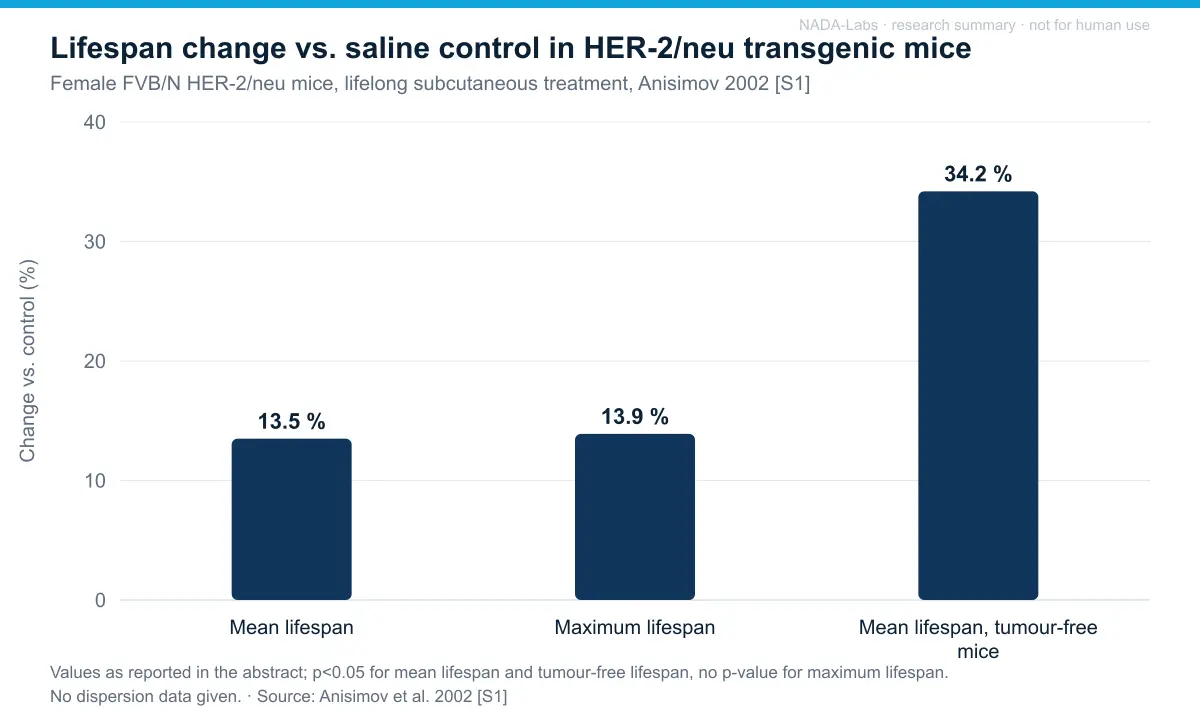
| Anisimov 20021 | HER-2/neu transgenic mice | Saline vs. peptide, lifelong s.c. | Mean lifespan +13.5 %, max +13.9 %; tumour-free mice 3.7-fold more; lung metastases 1.6-fold fewer | Khavinson/Anisimov |
| Anisimov 20032 | SHR mice, normal ageing, n = 54/group | Saline vs. peptide, lifelong s.c. | Mean lifespan unchanged; last-10 % survivors +13.3 %; chromosome aberrations -17.1 %; total tumours unchanged | Khavinson/Anisimov |
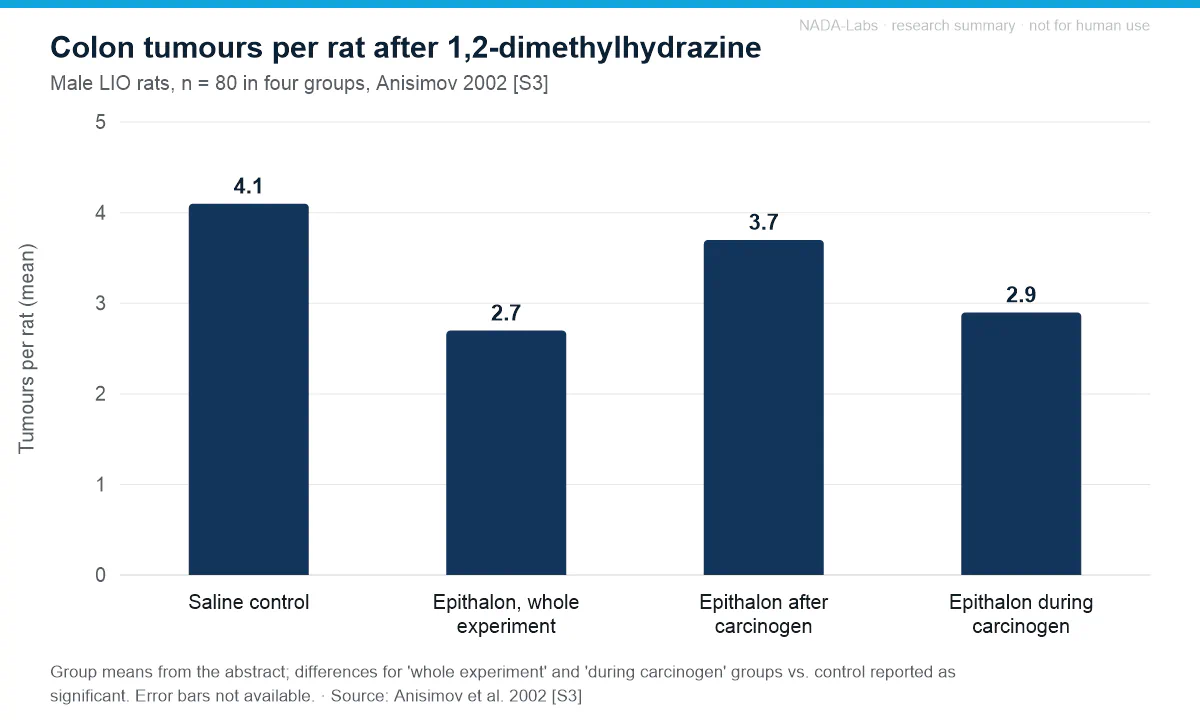
| Anisimov 20023 | DMH colon carcinogenesis, rats, n = 80 | Four groups by treatment window | Tumours per rat 4.1 to 2.7 (continuous); carcinoma incidence still 90-100 % | Khavinson/Anisimov |
| Khavinson 20004 | Drosophila melanogaster | Developmental exposure via medium | Imago lifespan +11-16 % | Khavinson |
| Al-Dulaimi 20255 | Human breast cancer and normal cell lines | Untreated vs. treated, 4 days / 3 weeks | Telomerase 4- to 26-fold in normal cells; telomeres 2.4 to 4 kb in 21NT via ALT (10-fold) | Independent (Brunel, UK) |
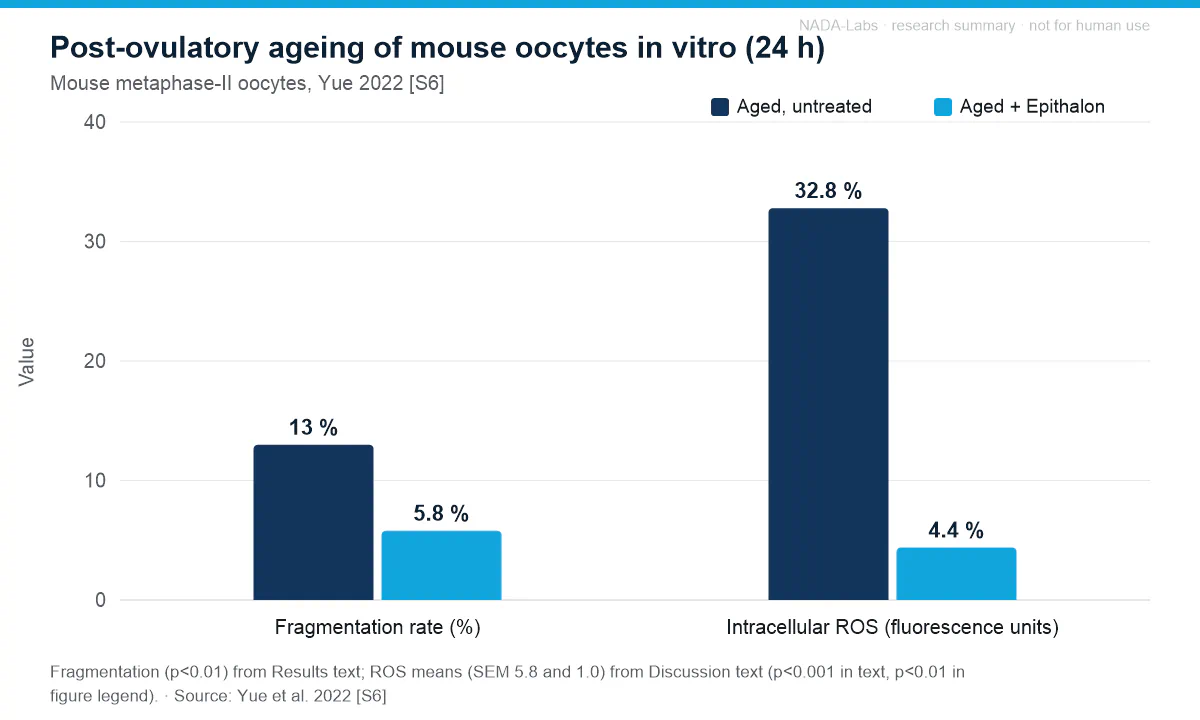
| Yue 20226 | Mouse oocytes aged in vitro | Fresh / aged / aged + peptide | Fragmentation 13 % to 5.8 %; ROS 32.8 to 4.4 units | Independent (China) |
| Khavinson 20027 | Campbell rats + human retinal degeneration | Uncontrolled case series (human) | ‘Positive clinical effect’ in 90 % of patients; no n, no control | Khavinson |
Telomere biology readouts by cell type (Al-Dulaimi 2025 [S5])
| Cell line | Cell type | Exposure | Telomere length | hTERT mRNA | Telomerase activity | ALT activity |
|---|---|---|---|---|---|---|
| 21NT | Breast cancer (telomerase-positive) | 4 days | 2.4 kb to 4 kb | 12-fold up | no significant change | 10-fold up |
| BT474 | Breast cancer (telomerase-positive) | 4 days | up to 8 kb | 5-fold up | no significant change | 3-fold up |
| IBR.3 | Normal fibroblast | 3 weeks | significant increase (none at 4 days) | increased (less than cancer lines) | 4-fold up | no increase |
| HMEC | Normal mammary epithelium | 3 weeks | significant increase | increased (less than cancer lines) | 26-fold up | non-significant increase |
Effects reported in the studies
- Lifespan in rodent and insect models. In HER-2/neu transgenic mice mean lifespan rose 13.5 % (p<0.05) and maximum lifespan 13.9 % vs. saline1. In normally ageing SHR mice mean lifespan was unchanged, but the last 10 % of survivors lived 13.3 % longer (p<0.01) and maximum lifespan was 12.3 % higher2. In Drosophila, developmental exposure increased imago lifespan by 11-16 %4.
- Tumour multiplicity and metastasis in carcinogenesis models. Mammary tumour-free HER-2/neu mice increased 3.7-fold and lung metastases fell 1.6-fold (both p<0.05)1. In DMH-treated rats colon tumours per animal fell from 4.1 to 2.7 with continuous treatment, although 90-100 % of animals still developed carcinomas3. In SHR mice total spontaneous tumour incidence was unchanged, with a 6-fold lower leukaemia incidence2.
- Telomere length and telomerase in human cells. In normal fibroblasts and mammary epithelial cells telomerase activity rose 4-fold and 26-fold with a significant telomere-length increase after 3 weeks; in breast cancer lines telomeres lengthened from 2.4 to 4 kb (21NT) within 4 days via ALT activation (10-fold) rather than telomerase5.
- Oxidative stress and oocyte quality in vitro. In mouse oocytes aged 24 h in vitro, ROS fell from 32.8 to 4.4 fluorescence units, fragmentation from 13 % to 5.8 % (p<0.01), with higher mitochondrial membrane potential (p<0.01) and lower early apoptosis (p<0.05)6.
- Genomic stability marker. Chromosome aberrations in bone-marrow cells of SHR mice were 17.1 % lower than in controls (p<0.05)2.
- Retinal degeneration. Retinal function was reported as preserved in Campbell rats, and a ‘positive clinical effect’ was reported in 90 % of patients in an uncontrolled series without stated n or effect size7.
Adverse effects and tolerability reported
- No overt toxicity in lifelong rodent administration. SHR mice, n = 54 per group, injections from age 3 months to death: food intake, body weight and total tumour incidence unchanged; authors describe long-term use as safe2. Kossoy 2006 (female C3H/He mice, 6.5 months; PMID 16634527) likewise reported no toxic effect.
- Telomere lengthening in cancer cells (theoretical tumour-promotion concern). In telomerase-positive breast cancer lines 21NT and BT474 the peptide extended telomeres (2.4 to 4 kb; up to 8 kb) through 10-fold and 3-fold ALT activation; ALT was not activated in normal fibroblasts. Relevance in vivo is untested5.
- Tumour incidence not reduced in every model. Colon carcinoma incidence remained 90-100 % in DMH-treated rats3; total spontaneous tumour incidence in SHR mice was unchanged2; in female rats, lifespan and spontaneous-tumour effects depended on the lighting regimen and were absent under a standard day/night regimen (Vinogradova 2007, PMID 18856211).
- Human tolerability data. Only an uncontrolled retinal case series exists; adverse events were not systematically reported7. No published randomised trial provides safety data for this peptide.
- Neuroendocrine and CNS activity. Intranasal application in urethane-anaesthetised rats increased spontaneous cortical neuron discharge frequency 2-2.5-fold (Sibarov 2007, PMID 17955380); evening melatonin production was stimulated and the cortisol rhythm altered in old female rhesus monkeys (Goncharova 2001, PMID 11550036, qualitative abstract). The peptide is pharmacologically active in the CNS; clinical relevance unknown.
Limitations of the evidence. Almost all in vivo evidence comes from one St. Petersburg group (Khavinson/Anisimov), often published with abstracts that omit group sizes and dispersion; independent replication of the lifespan and carcinogenesis findings is lacking. Lifespan gains were modest and model-dependent (no mean-lifespan change in SHR mice; lighting-regimen-dependent effects in rats), and carcinoma incidence was not reduced in the DMH model. The only human data are an uncontrolled retinal case series with a qualitative endpoint and no systematic adverse-event reporting. The independent 2025 cell study shows telomere lengthening in breast cancer lines via ALT, a mechanism whose in vivo relevance is untested; both independent studies are 2D in vitro work.
References
- Anisimov VN, Khavinson VKh, Alimova IN, Semchenko AV, Yashin AI (2002). Epithalon decelerates aging and suppresses development of breast adenocarcinomas in transgenic her-2/neu mice. Bull Exp Biol Med. PMID 12459848 DOI
- Anisimov VN, Khavinson VKh, Popovich IG, Zabezhinski MA, Alimova IN, Rosenfeld SV, Zavarzina NY, Semenchenko AV, Yashin AI (2003). Effect of Epitalon on biomarkers of aging, life span and spontaneous tumor incidence in female Swiss-derived SHR mice. Biogerontology. PMID 14501183 DOI
- Anisimov VN, Khavinson VKh, Popovich IG, Zabezhinski MA (2002). Inhibitory effect of peptide Epitalon on colon carcinogenesis induced by 1,2-dimethylhydrazine in rats. Cancer Lett. PMID 12049808 DOI
- Khavinson VK, Izmaylov DM, Obukhova LK, Malinin VV (2000). Effect of epitalon on the lifespan increase in Drosophila melanogaster. Mech Ageing Dev. PMID 11087911 DOI
- Al-Dulaimi S, Thomas R, Matta S, Roberts T (2025). Epitalon increases telomere length in human cell lines through telomerase upregulation or ALT activity. Biogerontology. PMID 40908429 DOI
- Yue X, Liu SL, Guo JN, Meng TG, Zhang XR, Li HX, Song CY, Wang ZB, Schatten H, Sun QY, Guo XP (2022). Epitalon protects against post-ovulatory aging-related damage of mouse oocytes in vitro. Aging (Albany NY). PMID 35413689 DOI
- Khavinson V, Razumovsky M, Trofimova S, Grigorian R, Razumovskaya A (2002). Pineal-regulating tetrapeptide epitalon improves eye retina condition in retinitis pigmentosa. Neuro Endocrinol Lett. PMID 12195242 human study
This section summarises findings published in the cited peer-reviewed literature for informational purposes. It is not a claim of efficacy or safety, contains no dosing or administration information by design, and does not constitute medical, veterinary or scientific advice. Results in cell cultures or animal models do not predict effects in humans.