Description
DSIP (delta sleep-inducing peptide) is a linear nonapeptide (Trp-Ala-Gly-Gly-Asp-Ala-Ser-Gly-Glu) with free termini. The N-terminal tryptophan is light- and oxidation-sensitive and the main site of aminopeptidase cleavage, and the aspartyl residue can isomerise to a less active β-aspartyl form — keep vials sealed, cold and away from light.
DSIP: what the published research shows
Compiled by NADA-Labs from the peer-reviewed literature cited below. No own study data.
DSIP (Trp-Ala-Gly-Gly-Asp-Ala-Ser-Gly-Glu) is a nonapeptide isolated from cerebral venous blood of rabbits during sleep induced by thalamic stimulation and named after the slow-wave (delta) EEG activity it produced after intraventricular infusion1. No gene, precursor or receptor has been identified, and its role as an endogenous sleep factor is unresolved (Kovalzon 2006, PMID 16539679). Mechanisms discussed in the research literature include modulation of the pituitary-adrenal axis — lower plasma ACTH in healthy men5 and inhibition of CRF-stimulated ACTH release from rat pituitary tissue in vitro (Okajima 1986, PMID 3017833) — and changes in EEG and autonomic activity6. It has been studied in rabbit, rat and cat sleep models (see below), in rat models of stroke and myocardial ischaemia-reperfusion7,8 and in small controlled human studies2,5,6.
Evidence base: About ten small double-blind or placebo-controlled human studies from 1981-1995 (n = 6 to 20 where reported) and one randomised study under general anaesthesia (2009, n = 24)2,3,4,5,6, plus uncontrolled clinical series (Dick 1984, PMID 6548969; Larbig 1984, PMID 6548970). The positive sleep findings come mainly from investigators working with the group that isolated the peptide2,3; independent double-blind insomnia studies found weak effects or changes of little clinical significance4 (Monti 1987, PMID 3583493). Animal work covers sleep and EEG in rabbits, rats and cats with conflicting results, and ischaemia models, including two recent rat studies from one research group7,8. No controlled human study published after 2009 was identified.
Key studies at a glance
| Study | Model | Design | Main result |
|---|---|---|---|
| Schoenenberger 19781 | Rabbit, in vivo (intraventricular), EEG | Double-blind; DSIP vs. 8 related peptides and vehicle; 61 rabbits | EEG delta activity +35 % vs. controls; only the α-aspartyl form highly active |
| Schneider-Helmert 19812 | Human, healthy volunteers | Double-blind crossover vs. placebo; n = 6 | Total sleep time +59 % (median) in the 130 min after administration; better sleep efficiency the next night |
| Schneider-Helmert 19873 | Human, chronic insomnia | Placebo-controlled, double-blind; n = 14; 7 nights | Night sleep, daytime alertness and performance improved; no effect sizes in abstract |
| Bes 19924 | Human, chronic insomnia | Double-blind parallel groups vs. placebo; n = 16; 3 nights | Higher sleep efficiency, shorter latency, but effects weak and possibly partly due to a chance change in the placebo group |
| Bjartell 19895 | Human, healthy men | Randomised, double-blind crossover vs. saline; n = 11 | Plasma ACTH-like immunoreactivity lower for at least 3 h; cortisol unchanged |
| Pomfrett 20096 | Human, women under general anaesthesia | Randomised; saline (n = 12) vs. DSIP at one of three doses (n = 12 in total) | Heart rate up, heart-rate variability down; less EEG delta and higher BIS (lighter anaesthesia) at the lowest dose |
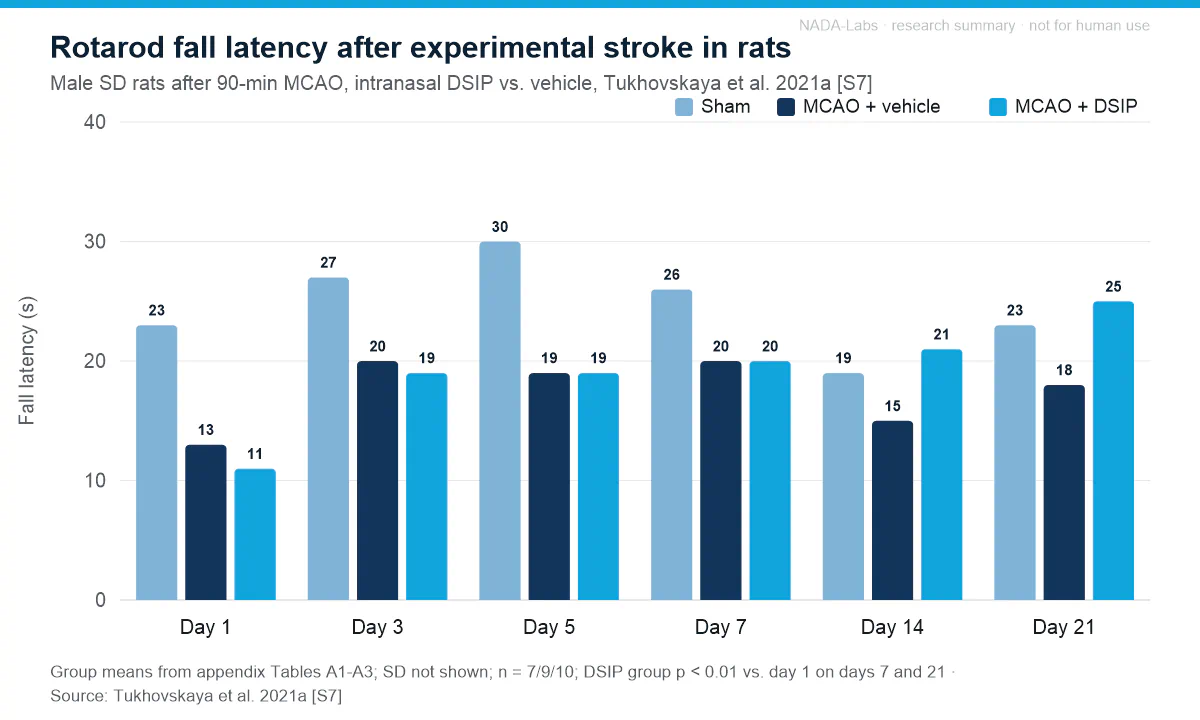
| Tukhovskaya 2021a7 | Rat, transient MCAO stroke model, in vivo | Vehicle (n = 9) vs. DSIP (n = 10) vs. sham (n = 7); intranasal, 8 days | Rotarod fall latency 11 -> 25 s with DSIP (p < 0.01 vs. day 1), 13 -> 18 s with vehicle; infarct volume not significantly different |
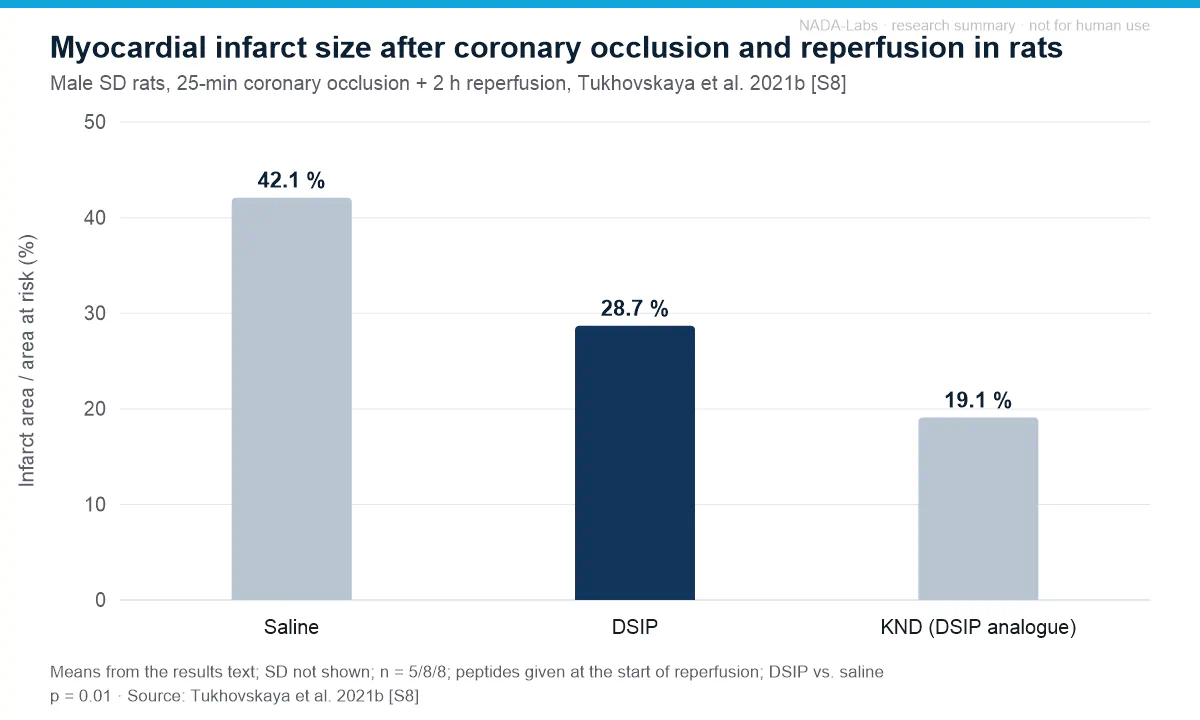
| Tukhovskaya 2021b8 | Rat, coronary occlusion-reperfusion, in vivo | Saline (n = 5) vs. DSIP (n = 8) vs. analogue KND (n = 8) at reperfusion; pilot (n = 10) during occlusion | Infarct area/area at risk 28.7 vs. 42.1 % (p = 0.01; KND 19.1 %); all 10 pilot rats died within 30 min |
Other controlled human studies: sleep and hormone secretion
| Study | Population (n) | Design | Reported outcome |
|---|---|---|---|
| Monti 1987 (PMID 3583493) | Chronic insomnia (not stated) | Double-blind crossover vs. placebo, 4 nights | Changes not significant vs. baseline or placebo, or already present at baseline; little clinical significance |
| Chiodera 1994 (PMID 7698722) | Healthy men (8, plus 7) | Saline placebo on separate occasions; osmotic and orthostatic tests | ACTH decreased significantly; basal and stimulated vasopressin unchanged |
| Späth-Schwalbe 1995 (PMID 7777652) | Healthy young men (5 per CRH condition, 10 in meal test) | Placebo-controlled; CRH stimulation and meal test | CRH-stimulated and meal-related ACTH and cortisol responses almost identical to placebo |
Effects reported in the studies
- EEG delta activity and sleep in animals. In rabbits, intraventricular DSIP raised EEG delta activity by a mean of 35 % versus vehicle or eight related peptides1. Total slow-wave sleep rose by 20 % in rats (Ursin 1983, PMID 6688864) and sleep increased after intraventricular injection in cats (Susić 1987, PMID 3620931), but other rat studies found no increase (Tobler 1980, PMID 7405185; Obál 1985, PMID 3841214) and intraperitoneal DSIP reduced sleep in cats (Sommerfelt 1985, PMID 3840239).
- Sleep in healthy volunteers. In six healthy volunteers (double-blind crossover), median total sleep time in the 130 min after administration was 59 % higher than with placebo; the next night showed shorter sleep onset and better sleep efficiency, and no classic pharmacological sedation was found2.
- Sleep in chronic insomnia (conflicting results). In 14 patients with chronic insomnia (placebo-controlled, double-blind, 7 nights), night sleep improved, also in the first placebo night afterwards, and daytime alertness and performance increased3. An independent study in 16 patients found higher sleep efficiency and shorter latency, but the effects were weak and possibly partly due to a chance change in the placebo group, and subjective sleep was unchanged4.
- Pituitary-adrenal axis. In 11 healthy men (randomised, double-blind crossover), plasma ACTH-like immunoreactivity was lower for at least 3 h while cortisol was unaffected5; further controlled studies found lower ACTH (Chiodera 1994, PMID 7698722) or no effect on stimulated ACTH and cortisol (Späth-Schwalbe 1995, PMID 7777652).
- EEG and autonomic effects under anaesthesia. In 24 women under general anaesthesia (randomised, saline-controlled), DSIP increased heart rate and reduced heart-rate variability and, contrary to the authors’ hypothesis, reduced EEG delta activity and raised the bispectral index at the lowest dose studied, i.e. it lightened anaesthesia6.
- Motor recovery after experimental stroke (rat). After 90-min middle cerebral artery occlusion, rotarod fall latency rose from 11 s (day 1) to 25 s (day 21) with DSIP (p < 0.01 vs. day 1 on days 7 and 21) and from 13 to 18 s with vehicle; infarct volume (20.9 vs. 24.1 %) and rotation asymmetry did not differ significantly7.
- Myocardial ischaemia-reperfusion (rat). Given once at the start of reperfusion, DSIP lowered infarct area relative to the area at risk to 28.7 % versus 42.1 % with saline (p = 0.01), and the analogue KND to 19.1 %; in a pilot experiment, all 10 rats given DSIP during the occlusion died within 30 min8.
Adverse effects and tolerability reported
- Tolerability in small human studies. No psychological, physiological or biochemical side effects were observed in six healthy volunteers2; an uncontrolled series of 107 inpatients in alcohol or opiate withdrawal reported good tolerance apart from headaches in a few patients (Dick 1984, PMID 6548969). No systematic adverse-event data were identified; the largest controlled study (n = 24) does not mention adverse events in its abstract6.
- Paradoxical arousal and autonomic effects. In women under isoflurane anaesthesia, DSIP raised heart rate and lightened anaesthesia instead of deepening it6; in six insomniacs a slight arousing effect was noted in the first hour after administration (Schneider-Helmert 1981, PMID 7028502).
- Deaths when given during acute ischaemia (rat). All 10 rats given DSIP during coronary artery occlusion died within 30 min; as all 4 mice given the analogue KND during middle cerebral artery occlusion also died, the authors regard use of these peptides during acute myocardial or cerebral ischaemia as dangerous8.
- Non-linear dose-response (animals). Experiments in rabbits, cats and mice gave indications of bell-shaped dose-response curves in most test situations (Scherschlicht 1984, PMID 6548967), and a review reports a U-shaped activity curve for both dose and time of infusion (Graf 1984, PMID 6145137).
- Endocrine activity. Besides lowering ACTH in healthy men5, DSIP injected into the third ventricle raised plasma LH and GH in ovariectomised rats (Iyer 1987, PMID 3121137; Iyer 1987, PMID 3575154); GH and prolactin were unchanged in healthy women (Giusti 1993, PMID 8475226).
- Interactions with centrally acting drugs (rodents). In rats, DSIP reversed d-amphetamine-induced hyperthermia to hypothermia at 22 °C (Yehuda 1980, PMID 6894196), and in morphine-dependent mice it attenuated naloxone-precipitated withdrawal jumping (Scherschlicht 1984, PMID 6548967).
Limitations of the evidence. Apart from the concentration of positive sleep data in one group2,3, the human studies are small (n = 6 to 24 where reported), mostly from 1981-1995, and rarely report effect sizes. In several rat studies DSIP itself, unlike some analogues, did not increase sleep, possibly because it is degraded quickly (Obál 1986, PMID 3754970); in vitro it was degraded in human and rat blood (Graf 1987, PMID 3628078) and by aminopeptidases of rat brain membranes (Nakamura 1993, PMID 8474631), and its plasma half-life was 2-4 min in dogs, rats and one monkey (Kato 1984, PMID 6379493). The two recent rat studies come from one research group and use 5-10 animals per group7,8; the stroke study found no significant change in infarct volume and reported rotarod significance only within groups (versus day 1, and for the regression slope over the 21 days), with no direct statistical comparison of DSIP versus vehicle7. None of the findings summarised here establish efficacy or safety for any use outside the described research models.
References
- Schoenenberger GA, Maier PF, Tobler HJ, Wilson K, Monnier M (1978). The delta EEG (sleep)-inducing peptide (DSIP). XI. Amino-acid analysis, sequence, synthesis and activity of the nonapeptide. Pflügers Archiv: European Journal of Physiology. PMID 568769 DOI
- Schneider-Helmert D, Gnirss F, Monnier M, Schenker J, Schoenenberger GA (1981). Acute and delayed effects of DSIP (delta sleep-inducing peptide) on human sleep behavior. International Journal of Clinical Pharmacology, Therapy, and Toxicology. PMID 6895513 human study
- Schneider-Helmert D (1987). Effects of delta-sleep-inducing peptide on 24-hour sleep-wake behaviour in severe chronic insomnia. European Neurology. PMID 3622582 DOI human study
- Bes F, Hofman W, Schuur J, Van Boxtel C (1992). Effects of delta sleep-inducing peptide on sleep of chronic insomniac patients. A double-blind study. Neuropsychobiology. PMID 1299794 DOI human study
- Bjartell A, Ekman R, Bergquist S, Widerlöv E (1989). Reduction of immunoreactive ACTH in plasma following intravenous injection of delta sleep-inducing peptide in man. Psychoneuroendocrinology. PMID 2554357 DOI human study
- Pomfrett CJ, Dolling S, Anders NR, Glover DG, Bryan A, Pollard BJ (2009). Delta sleep-inducing peptide alters bispectral index, the electroencephalogram and heart rate variability when used as an adjunct to isoflurane anaesthesia. European Journal of Anaesthesiology. PMID 19142086 DOI human study
- Tukhovskaya EA, Ismailova AM, Shaykhutdinova ER, Slashcheva GA, Prudchenko IA, Mikhaleva II, Khokhlova ON, Murashev AN, Ivanov VT (2021). Delta Sleep-Inducing Peptide Recovers Motor Function in SD Rats after Focal Stroke. Molecules. PMID 34500605 DOI
- Tukhovskaya EA, Shaykhutdinova ER, Ismailova AM, Slashcheva GA, Prudchenko IA, Mikhaleva II, Khokhlova ON, Murashev AN, Ivanov VT (2021). DSIP-Like KND Peptide Reduces Brain Infarction in C57Bl/6 and Reduces Myocardial Infarction in SD Rats When Administered during Reperfusion. Biomedicines. PMID 33918965 DOI
This section summarises findings published in the cited peer-reviewed literature for informational purposes. It is not a claim of efficacy or safety, contains no dosing or administration information by design, and does not constitute medical, veterinary or scientific advice. Results in cell cultures or animal models do not predict effects in humans.