Description
SemaCore is a synthetic 31-residue analogue of human GLP-1(7-37) with two substitutions (Aib at position 8, Arg at position 34) and a C18 fatty diacid attached to lysine 26 through a γ-glutamic acid and two 8-amino-3,6-dioxaoctanoic acid (OEG) spacers (C187H291N45O59, about 4.1 kDa). The sequence contains no cysteine or methionine but one tryptophan; as with all lyophilised peptides, keep vials sealed, cold and away from light.
Also available as a blend: CagriSema.
SemaCore: what the published research shows
Compiled by NADA-Labs from the peer-reviewed literature cited below. No own study data.
SemaCore is a synthetic acylated analogue of human glucagon-like peptide-1 (GLP-1) developed by Novo Nordisk. It has two amino-acid substitutions compared with human GLP-1 (Aib8, Arg34) and is derivatised at lysine 26; the fatty-acid moiety and its linking chemistry were the key features for high albumin affinity, GLP-1-receptor potency and prolonged exposure7. Its GLP-1-receptor affinity (0.38 nM) is three-fold lower than that of liraglutide, whereas its albumin affinity is higher7, and the SUSTAIN-6 report describes an extended half-life of approximately 1 week3. The research literature attributes its effects mainly to GLP-1-receptor agonism; in rodents SemaCore reached the brainstem, septal nucleus and hypothalamus through the circumventricular organs without crossing the blood-brain barrier8. It has been studied in vitro, in minipigs, mice and rats, and in large randomised human trials in adults with overweight or obesity, type 2 diabetes with high cardiovascular risk or chronic kidney disease, established cardiovascular disease and metabolic dysfunction-associated steatohepatitis (MASH).
Evidence base: Six randomised, placebo-controlled human trials (n = 304 to 17,604; 68 weeks to a median follow-up of 3.4 years), all funded by the developer, Novo Nordisk, with Novo Nordisk employees among the authors: two weight trials in adults with overweight or obesity without diabetes1,2, two cardiovascular outcome trials3,4, a kidney outcome trial5 and a liver-biopsy trial6. FLOW was stopped early after a prespecified interim analysis5, ESSENCE reports a planned interim analysis of an ongoing trial6, and SUSTAIN-6 was designed to test noninferiority3. Preclinical data come from the developer’s discovery paper7 and a rodent mechanism study most of whose authors are current or former Novo Nordisk employees8. No independent randomised trials are among the cited records.
Key studies at a glance
| Study | Model | Design | Main result |
|---|---|---|---|
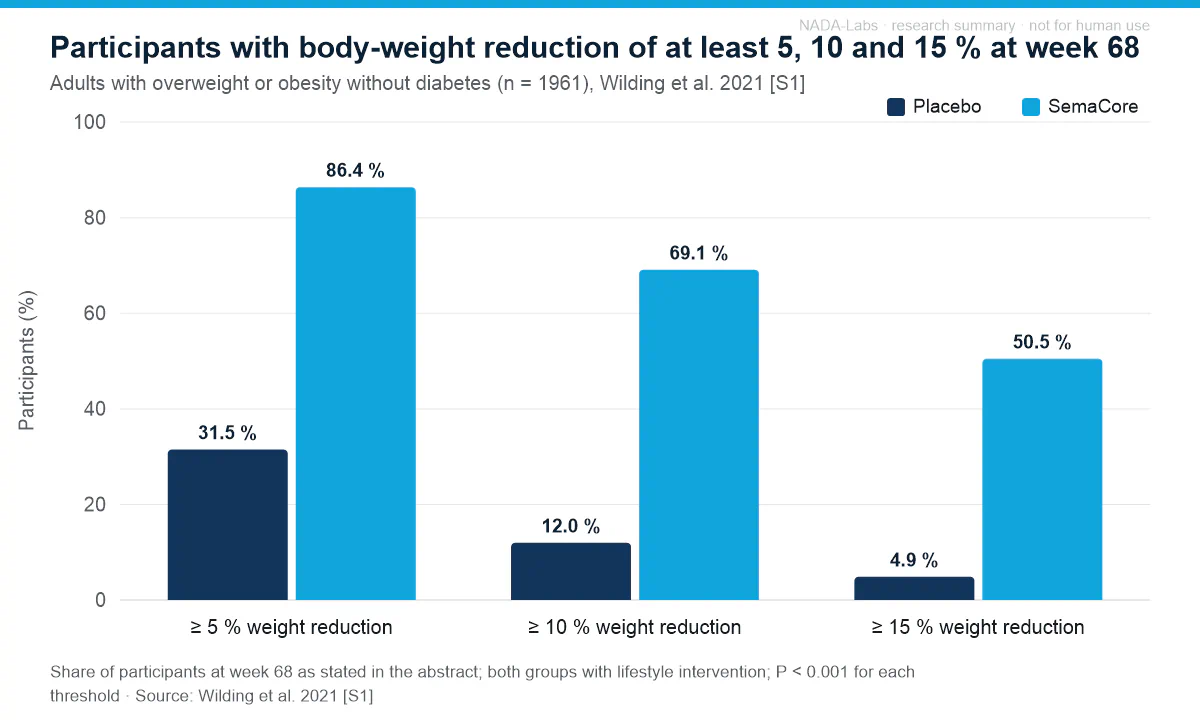
| Wilding 20211 | Adults with overweight or obesity, no diabetes (n = 1961) | STEP 1, randomised 2:1, double-blind, placebo-controlled, 68 weeks, both groups with lifestyle intervention | Body weight -14.9 % vs -2.4 % placebo at week 68; ≥ 15 % loss in 50.5 % vs 4.9 % |
| Garvey 20222 | Adults with overweight or obesity, no diabetes (n = 304) | Phase 3 STEP 5, randomised 1:1, double-blind, placebo-controlled, 104 weeks, both groups with behavioural intervention | Body weight -15.2 % vs -2.6 % at week 104; gastrointestinal adverse events 82.2 % vs 53.9 % |
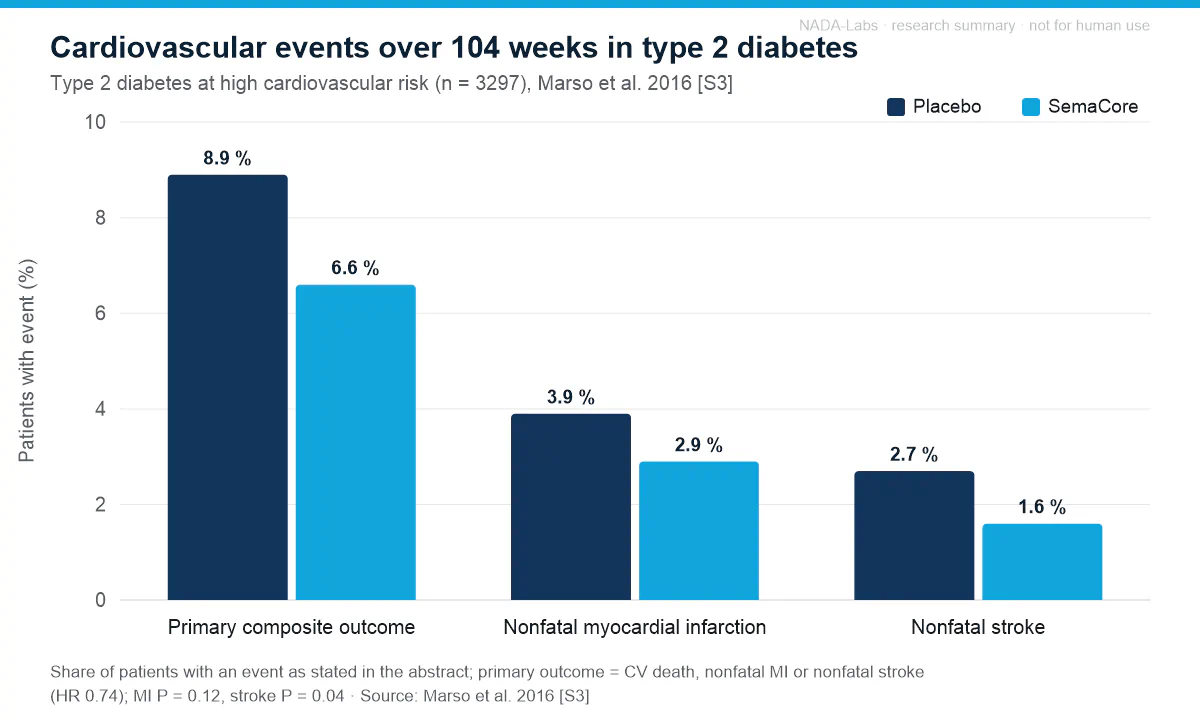
| Marso 20163 | Type 2 diabetes at high cardiovascular risk (n = 3297) | SUSTAIN-6, randomised, placebo-controlled, two dose groups, 104 weeks, noninferiority design | CV death, nonfatal MI or nonfatal stroke 6.6 % vs 8.9 % (HR 0.74); retinopathy complications HR 1.76 |
| Lincoff 20234 | Adults ≥ 45 years with cardiovascular disease and BMI ≥ 27, no diabetes (n = 17,604) | SELECT, randomised 1:1, double-blind, placebo-controlled, event-driven; mean follow-up 39.8 months | CV death, nonfatal MI or nonfatal stroke 6.5 % vs 8.0 % (HR 0.80); discontinuation due to adverse events 16.6 % vs 8.2 % |
| Perkovic 20245 | Type 2 diabetes with chronic kidney disease (n = 3533) | FLOW, randomised, placebo-controlled; median follow-up 3.4 years, stopped early after a prespecified interim analysis | Major kidney disease events HR 0.76 (331 vs 410 first events); annual eGFR slope less steep by 1.16 ml/min/1.73 m² |
| Sanyal 20256 | Biopsy-defined MASH with fibrosis stage 2 or 3 (first 800 of 1197 patients) | Phase 3 ESSENCE, randomised 2:1, double-blind, placebo-controlled; planned interim analysis at week 72 | Resolution of steatohepatitis 62.9 % vs 34.3 %; reduction in fibrosis 36.8 % vs 22.4 % |
| Lau 20157 | GLP-1 receptor and albumin binding (in vitro); minipigs (in vivo) | Discovery and structure-activity study (developer) | GLP-1R affinity 0.38 nM, three-fold below liraglutide, higher albumin affinity; plasma half-life 46.1 h in minipigs |
| Gabery 20208 | Mice and rats, in vivo | Preclinical mechanistic study: brain-access mapping, c-Fos activation, transcriptomics | Lower food intake and body weight without lower energy expenditure; brain access via circumventricular organs; no effect sizes in abstract |
Adverse events reported in STEP 5 (Garvey 2022 [S2])
| Event | Placebo (n = 152) | SemaCore (n = 152) |
|---|---|---|
| Gastrointestinal disorders (any) | 53.9 % | 82.2 % |
| Nausea | 21.7 % | 53.3 % |
| Diarrhoea | 23.7 % | 34.9 % |
| Constipation | 11.2 % | 30.9 % |
| Vomiting | 4.6 % | 30.3 % |
| Gallbladder-related disorders | 1.3 % | 2.6 % |
| Acute pancreatitis | 0 % | 0 % |
| Hypoglycaemia | 0 % | 2.6 % |
| Allergic reactions | 5.3 % | 15.1 % |
| Injection-site reactions | 9.9 % | 6.6 % |
| Malignant neoplasms | 2.6 % | 1.3 % |
| Serious adverse events | 11.8 % | 7.9 % |
| Discontinuation due to adverse events | 4.6 % | 5.9 % |
Effects reported in the studies
- Body-weight reduction in overweight or obesity without diabetes. STEP 1 (n = 1961, 68 weeks): -14.9 % vs -2.4 % with placebo (difference -12.4 percentage points; P < 0.001); weight reductions of ≥ 5 %, ≥ 10 % and ≥ 15 % in 86.4 %, 69.1 % and 50.5 % vs 31.5 %, 12.0 % and 4.9 % of participants1. STEP 5 (n = 304, 104 weeks): -15.2 % vs -2.6 % (difference -12.6 percentage points; P < 0.0001)2. In a randomised withdrawal trial (n = 803), body weight changed by -7.9 % with continued SemaCore vs +6.9 % after a switch to placebo between weeks 20 and 68 (Rubino 2021, PMID 33755728).
- Cardiovascular outcomes. SUSTAIN-6 (type 2 diabetes, n = 3297, 104 weeks): cardiovascular death, nonfatal myocardial infarction or nonfatal stroke in 6.6 % vs 8.9 % (HR 0.74; P < 0.001 for noninferiority); nonfatal stroke 1.6 % vs 2.7 % (P = 0.04), nonfatal myocardial infarction 2.9 % vs 3.9 % (P = 0.12), cardiovascular death similar3. SELECT (cardiovascular disease and BMI ≥ 27 without diabetes, n = 17,604, mean follow-up 39.8 months): same composite outcome in 6.5 % vs 8.0 % (HR 0.80; 95 % CI 0.72-0.90; P < 0.001)4.
- Kidney outcomes in type 2 diabetes with chronic kidney disease. FLOW (n = 3533, median follow-up 3.4 years): major kidney disease events 331 vs 410 first events (HR 0.76; 95 % CI 0.66-0.88; P = 0.0003); annual eGFR slope less steep by 1.16 ml/min/1.73 m² (P < 0.001); death from any cause HR 0.80 (P = 0.01)5. In SUSTAIN-6, new or worsening nephropathy was less frequent with SemaCore3.
- Liver histology in MASH. ESSENCE interim analysis (fibrosis stage 2 or 3, n = 800, week 72): resolution of steatohepatitis without worsening of fibrosis in 62.9 % vs 34.3 %, reduction in fibrosis without worsening of steatohepatitis in 36.8 % vs 22.4 % (both P < 0.001); body weight -10.5 % vs -2.0 %6. In a 72-week phase 2 trial in NASH (now MASH; n = 320, histology end points analysed in the 230 patients with fibrosis stage 2 or 3), NASH resolution without worsening of fibrosis was reported in 59 % of the highest dose group vs 17 % with placebo, while fibrosis improvement (43 % vs 33 %) did not differ significantly (P = 0.48) (Newsome 2021, PMID 33185364).
- Cardiometabolic markers (human). STEP 5 at week 104: waist circumference -14.4 vs -5.2 cm (P < 0.0001), systolic blood pressure -5.7 vs -1.6 mmHg (P = 0.01), C-reactive protein -56.7 % vs -7.8 %2. STEP 1 reported a greater improvement in cardiometabolic risk factors than with placebo, without numbers in the abstract1.
- Energy intake and appetite (human crossover trial). In 30 participants with obesity, total ad libitum energy intake was 24 % lower after 12 weeks of SemaCore than with placebo (-3036 kJ; P < 0.0001), with less hunger and food cravings; resting metabolic rate adjusted for lean body mass did not differ (Blundell 2017, PMID 28266779).
- Mechanism (receptor pharmacology, preclinical). GLP-1-receptor affinity 0.38 ± 0.06 nM, three-fold lower than liraglutide, with increased albumin affinity; plasma half-life 46.1 h after intravenous administration in minipigs7. In rodents SemaCore reduced food intake and body weight (diet-induced obese mice and rats) without decreasing energy expenditure (measured in mice) and induced c-Fos activation in 10 brain areas, including the lateral parabrachial nucleus8.
Adverse effects and tolerability reported
- Gastrointestinal events (nausea, diarrhoea, vomiting, constipation). Nausea and diarrhoea were the most common adverse events in STEP 1, typically transient and mild to moderate1. STEP 5: gastrointestinal disorders 82.2 % vs 53.9 %, mostly mild to moderate and transient (table above)2; ESSENCE: more common with SemaCore6.
- Treatment discontinuation. Discontinuation owing to gastrointestinal events 4.5 % vs 0.8 % in STEP 11 and 3.9 % vs 0.7 % in STEP 52; more discontinuations due to adverse events, mainly gastrointestinal, in SUSTAIN-63; permanent discontinuation due to adverse events 16.6 % vs 8.2 % in SELECT (P < 0.001)4.
- Retinopathy complications in type 2 diabetes. In SUSTAIN-6, retinopathy complications (vitreous haemorrhage, blindness or conditions requiring an intravitreal agent or photocoagulation) were significantly more frequent with SemaCore (HR 1.76; 95 % CI 1.11-2.78; P = 0.02)3.
- Gallbladder and biliary events. STEP 5: gallbladder-related disorders 2.6 % vs 1.3 %2. A meta-analysis of 76 randomised trials of the GLP-1-receptor-agonist class (not of SemaCore alone) reported a higher risk of gallbladder or biliary diseases (RR 1.37; 95 % CI 1.23-1.52) (He 2022, PMID 35344001).
- Pancreatitis and neoplasms. STEP 5: no pancreatitis in either group, malignant neoplasms 1.3 % vs 2.6 %2. In the phase 2 NASH trial, malignant neoplasms occurred in 3 patients on SemaCore (1 %) and none on placebo, neoplasms of any kind in 15 % vs 8 %, without an organ pattern (Newsome 2021, PMID 33185364).
- Serious adverse events. Less frequent with SemaCore in SUSTAIN-63, FLOW (49.6 % vs 53.8 %)5, STEP 5 (7.9 % vs 11.8 %; one death, judged unrelated to the trial product by the adjudication committee)2 and STEP-HFpEF (heart failure with preserved ejection fraction and obesity, n = 529; 13.3 % vs 26.7 %; Kosiborod 2023, PMID 37622681). The abstracts of STEP 1, SELECT and ESSENCE give no rates of serious adverse events1,4,6.
- Tolerability not reported in the preclinical abstracts. The discovery paper7 and the rodent study8 do not report adverse effects in their abstracts.
Limitations of the evidence. All six cited trials were funded by the developer, with Novo Nordisk employees among the authors1,2,3,4,5,6. FLOW was stopped early5, ESSENCE is an interim analysis of a trial planned for 240 weeks6 whose second part has cirrhosis-free survival at week 240 as its primary end point (Newsome 2024, PMID 39412509), so clinical liver outcomes are not yet available, and SUSTAIN-6 was designed to test noninferiority3. STEP 5 was small (n = 304; 77.6 % women, 93.1 % white)2. After a switch to placebo, body weight rose by 6.9 % between weeks 20 and 68 (Rubino 2021, PMID 33755728), and in the one-year off-treatment extension of STEP 1 (n = 327), participants who had received SemaCore had regained 11.6 percentage points of the lost weight by week 120 (placebo 1.9), with most cardiometabolic changes reverting towards baseline (Wilding 2022, PMID 35441470). The gallbladder meta-analysis covers the drug class, not SemaCore alone (He 2022, PMID 35344001), and the preclinical findings are reported largely qualitatively7,8. None of the findings summarised here establish efficacy or safety for any use outside the described research models.
References
- Wilding JPH, Batterham RL, Calanna S, Davies M, Van Gaal LF, Lingvay I, McGowan BM, Rosenstock J, Tran MTD, Wadden TA, Wharton S, Yokote K, Zeuthen N, Kushner RF; STEP 1 Study Group (2021). Once-Weekly Semaglutide in Adults with Overweight or Obesity. New England Journal of Medicine. PMID 33567185 DOI human study
- Garvey WT, Batterham RL, Bhatta M, Buscemi S, Christensen LN, Frias JP, Jódar E, Kandler K, Rigas G, Wadden TA, Wharton S; STEP 5 Study Group (2022). Two-year effects of semaglutide in adults with overweight or obesity: the STEP 5 trial. Nature Medicine. PMID 36216945 DOI human study
- Marso SP, Bain SC, Consoli A, Eliaschewitz FG, Jódar E, Leiter LA, Lingvay I, Rosenstock J, Seufert J, Warren ML, Woo V, Hansen O, Holst AG, Pettersson J, Vilsbøll T; SUSTAIN-6 Investigators (2016). Semaglutide and Cardiovascular Outcomes in Patients with Type 2 Diabetes. New England Journal of Medicine. PMID 27633186 DOI human study
- Lincoff AM, Brown-Frandsen K, Colhoun HM, Deanfield J, Emerson SS, Esbjerg S, Hardt-Lindberg S, Hovingh GK, Kahn SE, Kushner RF, Lingvay I, Oral TK, Michelsen MM, Plutzky J, Tornøe CW, Ryan DH; SELECT Trial Investigators (2023). Semaglutide and Cardiovascular Outcomes in Obesity without Diabetes. New England Journal of Medicine. PMID 37952131 DOI human study
- Perkovic V, Tuttle KR, Rossing P, Mahaffey KW, Mann JFE, Bakris G, Baeres FMM, Idorn T, Bosch-Traberg H, Lausvig NL, Pratley R; FLOW Trial Committees and Investigators (2024). Effects of Semaglutide on Chronic Kidney Disease in Patients with Type 2 Diabetes. New England Journal of Medicine. PMID 38785209 DOI human study
- Sanyal AJ, Newsome PN, Kliers I, Østergaard LH, Long MT, Kjær MS, Cali AMG, Bugianesi E, Rinella ME, Roden M, Ratziu V; ESSENCE Study Group (2025). Phase 3 Trial of Semaglutide in Metabolic Dysfunction-Associated Steatohepatitis. New England Journal of Medicine. PMID 40305708 DOI human study
- Lau J, Bloch P, Schäffer L, Pettersson I, Spetzler J, Kofoed J, Madsen K, Knudsen LB, McGuire J, Steensgaard DB, Strauss HM, Gram DX, Knudsen SM, Nielsen FS, Thygesen P, Reedtz-Runge S, Kruse T (2015). Discovery of the Once-Weekly Glucagon-Like Peptide-1 (GLP-1) Analogue Semaglutide. Journal of Medicinal Chemistry. PMID 26308095 DOI
- Gabery S, Salinas CG, Paulsen SJ, Ahnfelt-Rønne J, Alanentalo T, Baquero AF, Buckley ST, Farkas E, Fekete C, Frederiksen KS, Helms HCC, Jeppesen JF, John LM, Pyke C, Nøhr J, Lu TT, Polex-Wolf J, Prevot V, Raun K, Simonsen L, Sun G, Szilvásy-Szabó A, Willenbrock H, Secher A, Knudsen LB, Hogendorf WFJ (2020). Semaglutide lowers body weight in rodents via distributed neural pathways. JCI Insight. PMID 32213703 DOI
This section summarises findings published in the cited peer-reviewed literature for informational purposes. It is not a claim of efficacy or safety, contains no dosing or administration information by design, and does not constitute medical, veterinary or scientific advice. Results in cell cultures or animal models do not predict effects in humans.