Description
CagriCore is a synthetic, lipidated 37-residue analogue of the pancreatic hormone amylin (C194H312N54O59S2, about 4.4 kDa). Its N-terminus carries a C20 fatty diacid attached through a γ-glutamic acid linker, and the peptide has a disulfide bridge between Cys2 and Cys7 and an amidated C-terminal proline. The disulfide can be cleaved by thiol reagents — keep vials sealed, cold and away from light, and avoid reducing buffers.
Also available as a blend: CagriSema.
CagriCore: what the published research shows
Compiled by NADA-Labs from the peer-reviewed literature cited below. No own study data.
CagriCore is a synthetic, lipidated, long-acting analogue of the pancreatic hormone amylin. It was selected from structure-activity work on lipidated amylin analogues, because native amylin has a high propensity to form amyloid fibrils and the earlier analogue pramlintide has a short half-life6; its sequence shares 84 % homology with native human amylin4. The research literature attributes its effects mainly to nonselective agonism at the amylin receptors — heterodimers of the calcitonin receptor with receptor activity-modifying proteins 1, 2 or 3 — and at the calcitonin receptor itself (Fletcher 2021, PMID 33727283; Gu 2026, PMID 40847076); in knockout mice its effect on body weight depended on the amylin receptors AMY1R and AMY3R7. It has been studied in receptor assays and cryo-EM structures, in mice and rats, in phase 1 pharmacokinetic studies and a QT study as well as in randomised phase 2 and phase 3 trials in adults with overweight or obesity and in type 2 diabetes1,2,3,4,5.
Evidence base: Six human studies in five publications: a randomised, double-blind, placebo- and active-controlled phase 2 dose-finding trial in adults with overweight or obesity (n = 706, 26 weeks)1, a randomised, double-blind phase 2 trial in type 2 diabetes with a CagriCore-only arm (n = 92, of whom 30 in that arm; 32 weeks)2, the phase 3 trial REIMAGINE 2 in type 2 diabetes (n = 2,713, of whom 152 in the CagriCore-only arm; 68 weeks)3, two single-dose phase 1 pharmacokinetic studies in renal or hepatic impairment (n = 33 and 32)4 and a randomised, placebo-controlled thorough QT study in healthy participants (n = 105)5. The phase 2 and phase 3 trials and the two pharmacokinetic studies were funded by the developer1,2,3,4. Preclinical evidence comes from the development paper6 and one knockout-mouse study7, supported by in vitro receptor pharmacology across 25 end points (Fletcher 2021, PMID 33727283), two cryo-EM structure studies (Cao 2025, PMID 40204768; Gu 2026, PMID 40847076) and a head-to-head rat study against another dual amylin and calcitonin receptor agonist (Larsen 2022, PMID 36242844). No independent randomised trial of CagriCore alone was identified.
Key studies at a glance
| Study | Model | Design | Main result |
|---|---|---|---|
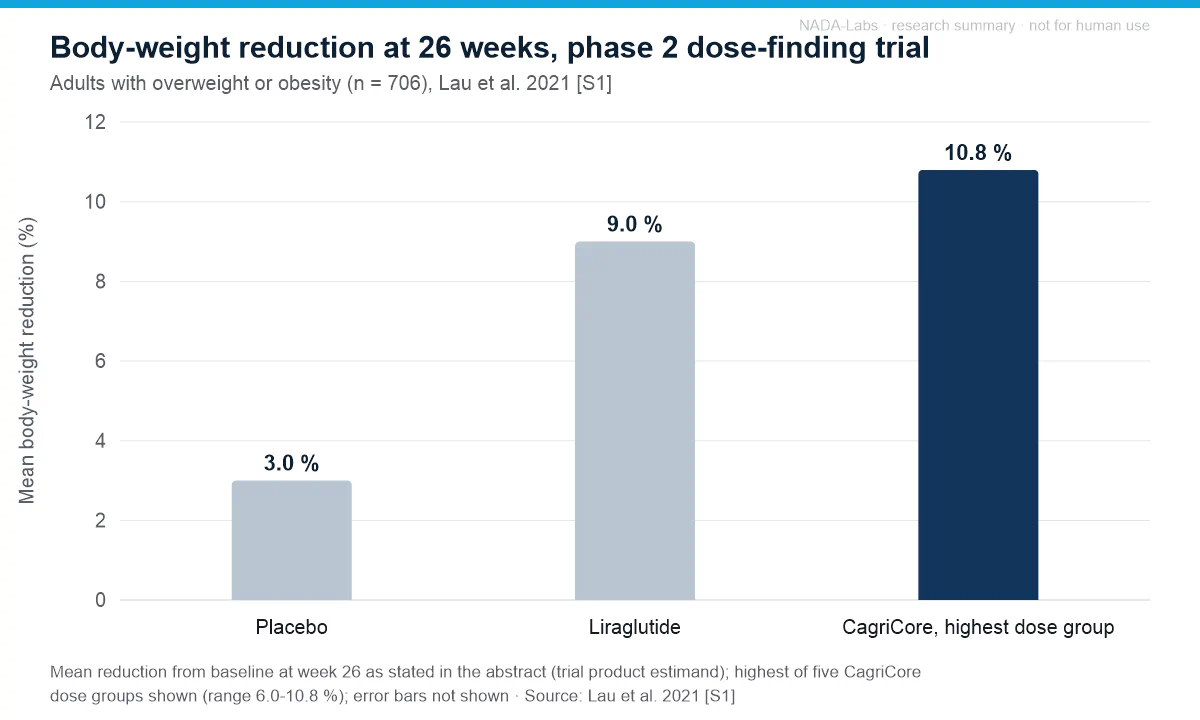
| Lau 20211 | Adults with overweight or obesity, no diabetes (n = 706) | Phase 2, randomised, double-blind, placebo- and liraglutide-controlled dose-finding trial, five dose groups, 26 weeks | Body weight -6.0 % to -10.8 % across the dose groups vs. -3.0 % with placebo (p < 0.001); highest dose group -10.8 % vs. -9.0 % with liraglutide (p = 0.03) |
| Frias 20232 | Adults with type 2 diabetes on metformin with or without an SGLT2 inhibitor (n = 92) | Phase 2, randomised 1:1:1, double-blind, three active arms (CagriCore, SemaCore, CagriCore + SemaCore), 32 weeks | CagriCore arm: HbA1c -0.9 percentage points, body weight -8.1 %; combination arm -2.2 points and -15.6 % |
| Buse 20263 | Adults with type 2 diabetes on metformin with or without an SGLT2 inhibitor, BMI ≥ 25 (n = 2,713; CagriCore-only arm n = 152) | Phase 3 REIMAGINE 2, randomised, double-blind, placebo- and active-controlled, 68 weeks | Adverse events in 82.2 % of the CagriCore-only arm vs. 70.5 % with placebo; no separate efficacy value for that arm in the abstract |
| Nielsen 20264 | Adults with normal or impaired renal (n = 33) or hepatic (n = 32) function | Two phase 1 studies, single subcutaneous administration, follow-up to day 36 or 39 | Total exposure (AUC0-∞) similar across groups, ratios 0.99-1.23 vs. normal function; no serious adverse events or deaths |
| Gabe 20245 | Healthy participants (n = 105; CagriCore 53, placebo 52) | Randomised, double-blind, placebo-controlled thorough QT study with moxifloxacin as positive control | Upper limit of the 90 % CI of the placebo-adjusted QTcF change below 10 ms at all four time points |
| Kruse 20216 | Lipidated amylin analogues (medicinal chemistry) | Structure-activity development study | Selection of the stable, lipidated long-acting analogue CagriCore (analogue 23) for clinical development; no effect sizes in abstract |
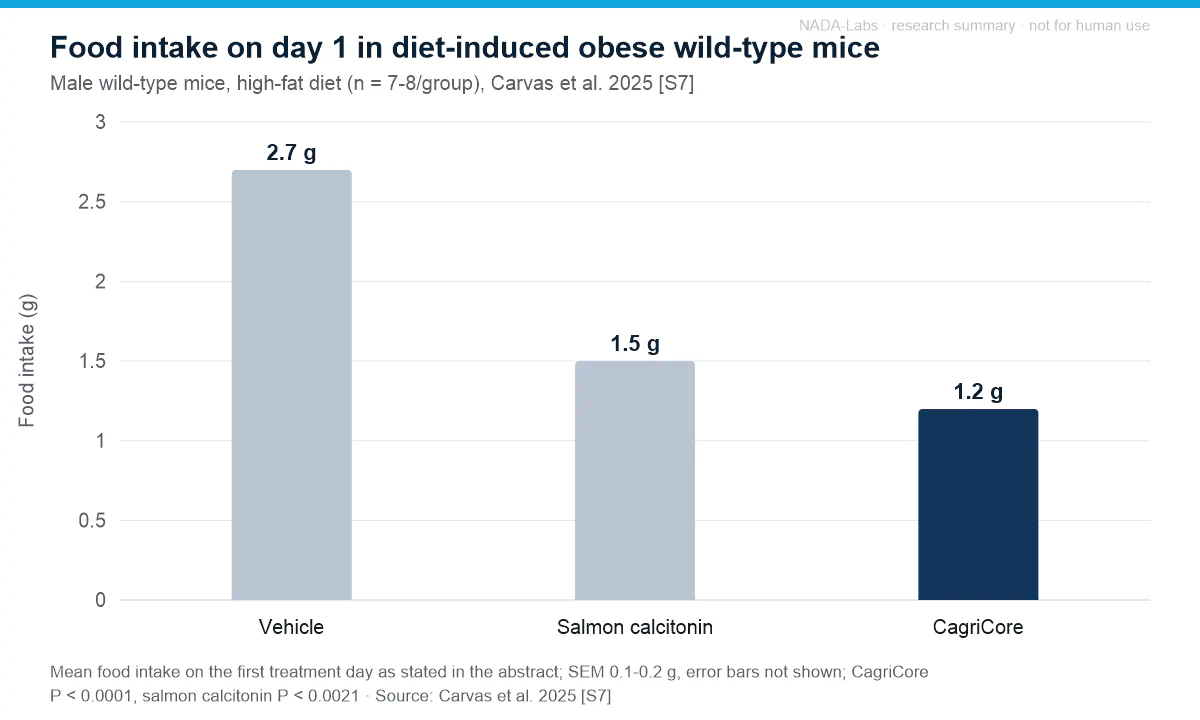
| Carvas 20257 | Male mice with diet-induced obesity, wild-type and RAMP1/3 knockout, in vivo | 3-week treatment vs. vehicle and salmon calcitonin; n = 5-8/group | Wild-type: body weight -3.4 g, day-1 food intake 1.2 vs. 2.7 g with vehicle; weaker effect on body weight without RAMP1/3 |
Outcomes by arm at week 32 in type 2 diabetes (Frias 2023 [S2])
| Outcome | CagriCore (n = 30) | SemaCore (n = 31) | CagriCore + SemaCore (n = 31) |
|---|---|---|---|
| HbA1c change (percentage points) | -0.9 | -1.8 | -2.2 |
| Body-weight change | -8.1 % | -5.1 % | -15.6 % |
| Fasting plasma glucose change (mmol/L) | -1.7 | -2.5 | -3.3 |
| Time in range 3.9-10.0 mmol/L, baseline | 56.9 % | 32.6 % | 45.9 % |
| Time in range 3.9-10.0 mmol/L, week 32 | 71.7 % | 76.2 % | 88.9 % |
| Participants with adverse events | 24 (80 %) | 22 (71 %) | 21 (68 %) |
| Level 2 or 3 hypoglycaemia | none reported | none reported | none reported |
| Fatal adverse events | none reported | none reported | none reported |
Effects reported in the studies
- Body-weight reduction in overweight and obesity without diabetes. In the phase 2 dose-finding trial (n = 706, 26 weeks), mean body weight fell by 6.0-10.8 % (6.4-11.5 kg) across the five CagriCore dose groups vs. 3.0 % (3.3 kg) with placebo (estimated treatment difference 3.0-7.8 %, p < 0.001); in the highest dose group the reduction was 10.8 % vs. 9.0 % with the comparator liraglutide (difference 1.8 %, p = 0.03), with similar results under the treatment policy estimand1.
- Glycaemic parameters in type 2 diabetes. In the 32-week phase 2 trial (n = 92), HbA1c changed by -0.9 percentage points in the CagriCore arm, -1.8 with SemaCore and -2.2 with CagriCore + SemaCore, and fasting plasma glucose by -1.7, -2.5 and -3.3 mmol/L; time in range (3.9-10.0 mmol/L) rose from 56.9 % to 71.7 % in the CagriCore arm. The combination lowered HbA1c more than CagriCore alone (difference -1.3 percentage points, 95 % CI -1.7 to -0.8, p < 0.0001), but not significantly more than SemaCore (p = 0.075)2.
- Body weight in type 2 diabetes. In the same trial body weight changed by -8.1 % with CagriCore, -5.1 % with SemaCore and -15.6 % with the combination at week 32; the combination differed from both single-agent arms (p < 0.0001)2.
- Phase 3 trials with a CagriCore-only arm. REIMAGINE 2 (type 2 diabetes, n = 2,713, 68 weeks, mean baseline HbA1c 8.2 %) randomised 152 participants to CagriCore alone; 95.7 % of all participants completed the study. Its primary end point compared the higher-dose combination with the higher-dose SemaCore arm (HbA1c -1.91 vs. -1.75 percentage points, p = 0.0035), and the abstract gives no efficacy value for the CagriCore-only arm3. The same applies to the CagriCore-only arm (n = 302) of the 68-week obesity trial REDEFINE 1 (Garvey 2025, PMID 40544433).
- Pharmacokinetics. After a single subcutaneous administration, total exposure (AUC0-∞), Cmax and other pharmacokinetic parameters were similar with normal function and with mild, moderate or severe renal or hepatic impairment; the mean AUC0-∞ ratios vs. normal function were 1.23, 1.18 and 1.21 (renal) and 0.99, 1.01 and 1.11 (hepatic). The same publication cites an elimination half-life of about 180 h (7.5 days)4. In the phase 1b study with SemaCore, CagriCore had a half-life of 159-195 h and a median tmax of 24-72 h, and exposure was proportional to the dose level (Enebo 2021, PMID 33894838).
- Molecular design and receptor binding. The development paper names the high propensity of amylin to form amyloid fibrils as a challenge for drug design and reports the selection of the stable, lipidated long-acting analogue 23, CagriCore6. Cryo-EM structures at the amylin receptors AMY1R, AMY2R and AMY3R and at the calcitonin receptor show an amylin-like binding mode with distinct conformational dynamics, to which, according to the authors, the proline at position 37 likely contributes (Cao 2025, PMID 40204768); a second structure study describes Phe23 as anchor in the transmembrane bundle, a helix-stabilising Glu14-Arg17 salt bridge and non-selective Gs activation through the calcitonin receptor and AMY1R (Gu 2026, PMID 40847076). In vitro, CagriCore showed a unique pharmacological profile as a nonselective amylin and calcitonin receptor agonist across 25 end points (Fletcher 2021, PMID 33727283).
- Body weight and food intake in rodents. In male wild-type mice with diet-induced obesity, 3 weeks of CagriCore lowered body weight by 3.4 ± 0.51 g (P < 0.005), whereas salmon calcitonin increased it (+0.60 ± 0.38 g); day-1 food intake was 1.2 g vs. 2.7 g with vehicle, and in the full text the changes in body composition vs. vehicle did not reach statistical significance (fat mass -7 %, P = 0.2; lean mass +5 %, P = 0.14). Without RAMP1 and RAMP3 the effect on body weight was weaker; in wild-type mice CagriCore activated cFos in the dorsal vagal complex and the lateral parabrachial nucleus, and area-postrema cFos after CagriCore was 57 % lower in knockout than in wild-type mice7. In obese rats CagriCore caused dose-dependent weight loss, and in diabetic ZDF rats it improved fasting glucose, HbA1c and insulin action, with the comparator KBP-336 superior in glucose control (Larsen 2022, PMID 36242844).
Adverse effects and tolerability reported
- Gastrointestinal events. In the phase 2 obesity trial, gastrointestinal disorders (e.g. nausea, constipation and diarrhoea) were among the most frequent adverse events and occurred in 41-63 % of the CagriCore groups vs. 32 % with placebo, primarily nausea (20-47 % vs. 18 %)1. In type 2 diabetes, mild or moderate gastrointestinal events were most common2, and in REIMAGINE 2 gastrointestinal disorders were the most common adverse events in the active treatment groups3.
- Administration-site reactions. Together with gastrointestinal disorders they were the most frequent adverse events in the phase 2 obesity trial1. In the renal-impairment study, injection-site reactions (4 participants) and injection-site erythema (3 participants) occurred only in the normal-function group; across both pharmacokinetic studies the most frequent treatment-emergent events were nausea, vomiting, decreased appetite and injection-site erythema4.
- Overall adverse-event rates in CagriCore-only arms. Phase 2 in type 2 diabetes: 24 of 30 participants (80 %) vs. 22 (71 %) with SemaCore and 21 (68 %) with the combination2. REIMAGINE 2: 125 of 152 (82.2 %) vs. 105 of 149 (70.5 %) with placebo and 78.5-86.9 % in the SemaCore and combination arms3.
- Treatment discontinuation. In the phase 2 obesity trial, 73 participants (10 %) permanently discontinued treatment, similarly across groups and mostly because of adverse events (30, 4 %); 29 participants (4 %) withdrew from the trial1.
- Serious events, hypoglycaemia and deaths. No level 2 or 3 hypoglycaemia and no fatal adverse events were reported in the 32-week type 2 diabetes trial2. In the two pharmacokinetic studies, 21 and 16 treatment-emergent adverse events occurred in 11 and 9 participants, with no serious or severe events, no withdrawals because of adverse events and no deaths; event numbers did not increase with the degree of renal or hepatic impairment4.
- Cardiac repolarisation. In the thorough QT study in healthy participants (n = 105), the upper limits of the two-sided 90 % CIs of the placebo-adjusted change in QTcF were below 10 ms at all four time points after the last administration, and assay sensitivity was shown with moxifloxacin as positive control; the abstract gives no adverse-event frequencies5.
- Combination and preclinical data. In the phase 1b study, in which all participants also received SemaCore, 566 adverse events were reported in 69 of 71 participants (97 %) with CagriCore and 23 of 24 (96 %) with placebo; 37 % of the events were gastrointestinal and most were mild to moderate (Enebo 2021, PMID 33894838). The abstract of the development paper6 and the mouse study7 report no adverse-effect data.
Limitations of the evidence. Human efficacy data for CagriCore alone come from two phase 2 trials of 26 and 32 weeks1,2; the phase 3 abstracts report no separate efficacy values for the CagriCore-only arms3 (Garvey 2025, PMID 40544433). The phase 2 and phase 3 trials and the pharmacokinetic studies were funded by the developer1,2,3,4, and the mouse study was supported in part by an investigator-led grant from the developer7. In the dose-finding trial participants and investigators were masked only to active vs. pooled placebo treatment, not to the different active treatments1; the type 2 diabetes phase 2 trial had about 30 participants per arm and no placebo arm2, the pharmacokinetic studies used a single administration in groups of 4-14 participants4, and the QT study included healthy participants only5. Several results come from arms that also received SemaCore and cannot be attributed to CagriCore alone2,3 (Enebo 2021, PMID 33894838). Most trial full texts are not openly accessible, so values of the intermediate dose groups and event rates beyond the abstracts are not reported here. Data from male mice7, rats (Larsen 2022, PMID 36242844) and receptor assays do not predict effects in humans. None of the findings summarised here establish efficacy or safety for any use outside the described research models.
References
- Lau DCW, Erichsen L, Francisco AM, Satylganova A, le Roux CW, McGowan B, Pedersen SD, Pietiläinen KH, Rubino D, Batterham RL (2021). Once-weekly cagrilintide for weight management in people with overweight and obesity: a multicentre, randomised, double-blind, placebo-controlled and active-controlled, dose-finding phase 2 trial. The Lancet. PMID 34798060 DOI human study
- Frias JP, Deenadayalan S, Erichsen L, Knop FK, Lingvay I, Macura S, Mathieu C, Pedersen SD, Davies M (2023). Efficacy and safety of co-administered once-weekly cagrilintide 2·4 mg with once-weekly semaglutide 2·4 mg in type 2 diabetes: a multicentre, randomised, double-blind, active-controlled, phase 2 trial. The Lancet. PMID 37364590 DOI human study
- Buse JB, Bajaj HS, Dalskov SM, Donaldson L, Hansen Duus HH, Fabricius TW, Haluzík M, Lingvay I, Pedersen SD, Pratley RE, Jain AB; REIMAGINE 2 study group (2026). Cagrilintide-semaglutide (CagriSema) versus semaglutide or cagrilintide in people with type 2 diabetes (REIMAGINE 2): a double-blind, randomised, controlled, phase 3 study. The Lancet Diabetes & Endocrinology. PMID 42251859 DOI human study
- Nielsen MJF, Becker NP, Duus HHH, Kirkeby K, Kupčová V, Lauenborg BW, Low B, Svolgaard O, Witten L (2026). Renal or Hepatic Impairment Does Not Affect Pharmacokinetics, Safety, or Tolerability of Subcutaneous Cagrilintide. Clinical Pharmacokinetics. PMID 42228334 DOI human study
- Gabe MBN, Fuhr R, Sinn A, Eliasen A, Berthelsen KK, Kuhlman AB, Bækdal TA, Nejad AB (2024). Cagrilintide is not associated with clinically relevant QTc prolongation: A thorough QT study in healthy participants. Diabetes, Obesity and Metabolism. PMID 39279639 DOI human study
- Kruse T, Hansen JL, Dahl K, Schäffer L, Sensfuss U, Poulsen C, Schlein M, Hansen AMK, Jeppesen CB, Dornonville de la Cour C, Clausen TR, Johansson E, Fulle S, Skyggebjerg RB, Raun K (2021). Development of Cagrilintide, a Long-Acting Amylin Analogue. Journal of Medicinal Chemistry. PMID 34288673 DOI
- Carvas AO, Leuthardt A, Kulka P, Lommi G, Hassan S, Coester B, Lundh S, Pers T, Secher A, Raun K, Lutz TA, Le Foll C (2025). Cagrilintide lowers bodyweight through brain amylin receptors 1 and 3. eBioMedicine. PMID 40609154 DOI
This section summarises findings published in the cited peer-reviewed literature for informational purposes. It is not a claim of efficacy or safety, contains no dosing or administration information by design, and does not constitute medical, veterinary or scientific advice. Results in cell cultures or animal models do not predict effects in humans.