Description
EloraCore (LY3841136) is a synthetic, lipidated 37-residue analogue of the pancreatic hormone amylin with an amidated C-terminus, a methylene thioacetal bridge between Cys2 and Cys7, three non-coded residues at positions 11, 15 and 22, and a C20 fatty diacid attached to Lys26 through two γ-glutamic acid residues; the acylation enables albumin binding. The sequence contains no methionine or tryptophan; as with all lyophilised peptides, keep vials sealed, cold and away from light.
EloraCore: what the published research shows
Compiled by NADA-Labs from the peer-reviewed literature cited below. No own study data.
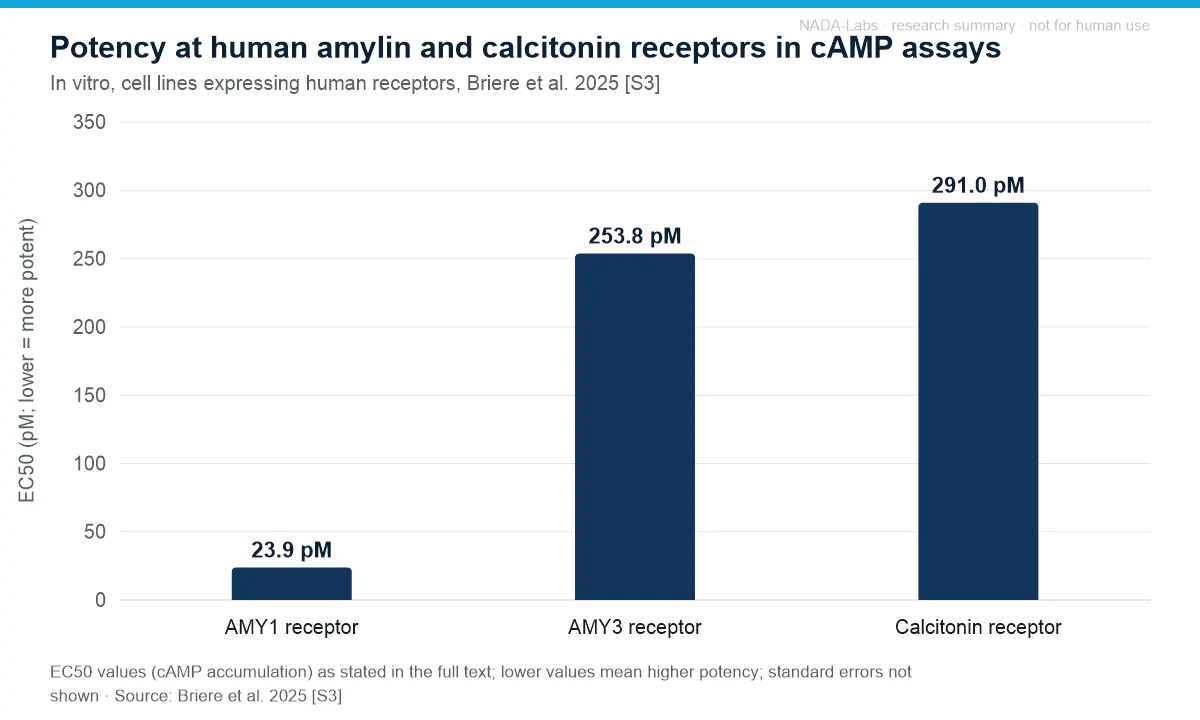
EloraCore (LY3841136) is a synthetic, lipidated, long-acting analogue of the pancreatic hormone amylin, described in its discovery paper as an amylin receptor agonist that preferentially activates the human AMY1 receptor3. Amylin receptors arise when the calcitonin receptor is co-expressed with receptor activity-modifying protein 1 or 3 (RAMP1, RAMP3)7. The research literature attributes its effects mainly to agonism at these receptors: in cAMP assays it was about 12-fold more potent at the human AMY1 receptor than at the calcitonin receptor and about 11-fold more potent than at the AMY3 receptor, and its C20 fatty diacid side chain binds albumin to extend the half-life3. Studies of related agonists showed that the weight effect of the amylin analogue CagriCore in mice depends on AMY1 and AMY3 receptors5 and that salmon calcitonin, but not native amylin, induces malaise-type behaviours in rodents and musk shrews6. EloraCore itself has been studied in receptor cell lines, in lean and diet-induced obese rats, in monkeys, in two phase 1 studies and in a 48-week phase 2 trial in adults with obesity or overweight1,2,3.
Evidence base: Three primary publications, all with authors from the developer: a translational paper with in vitro receptor pharmacology, rat and monkey studies and a single-ascending-dose phase 1 trial in 48 healthy participants3, a 12-week multiple-ascending-dose phase 1 study in 100 participants with obesity or overweight2 and a 48-week randomised, double-blind, placebo-controlled phase 2 trial in 263 adults at 46 US centres, funded by the developer1. A network meta-analysis of six trials (n = 4,642) includes EloraCore, but its EloraCore data come from the same phase 2 trial4. No phase 3 results and no independent trials of EloraCore were identified in PubMed. References 5-7 are class context — another amylin analogue, native amylin and the molecular basis of amylin receptors — not EloraCore studies5,6,7. A review lists EloraCore among several recently developed long-acting amylin analogues tested in clinical trials (Bailey 2026, PMID 41747885).
Key studies at a glance
| Study | Model | Design | Main result |
|---|---|---|---|
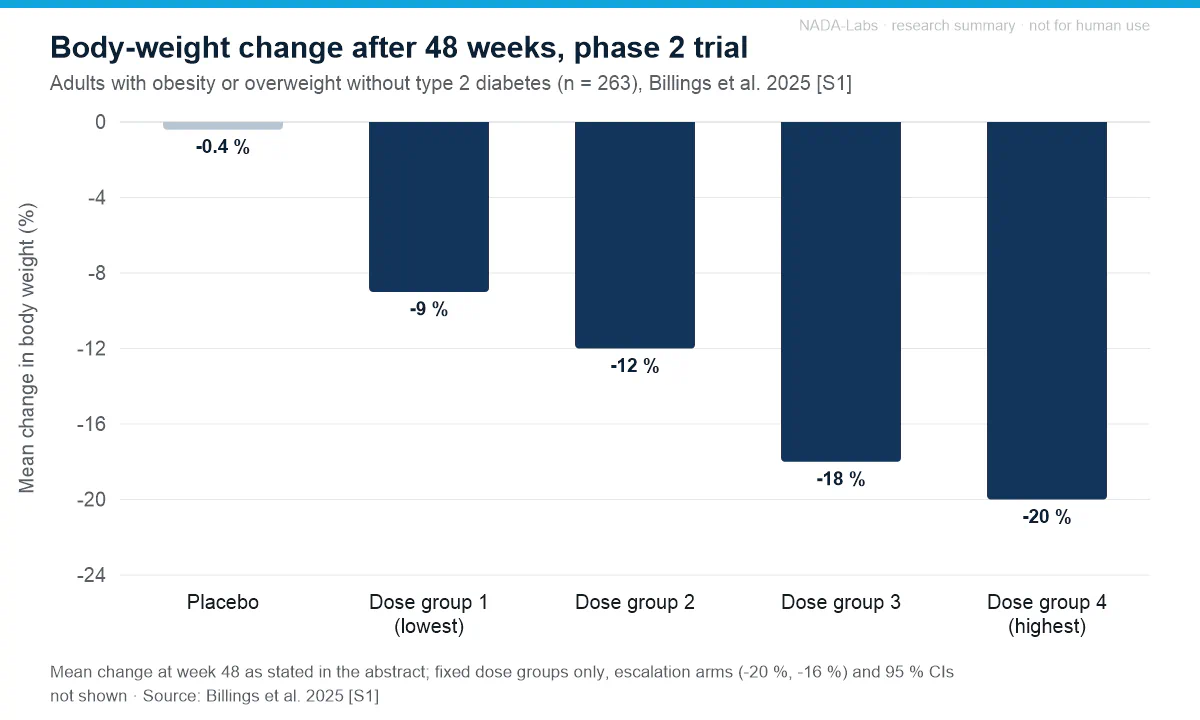
| Billings 20251 | Adults with obesity or overweight without type 2 diabetes (n = 263) | Phase 2, randomised, double-blind, placebo-controlled, 46 US centres, 48 weeks | Body weight -9 % to -20 % in four fixed dose groups and -20 % / -16 % in two dose-escalation arms vs. -0.4 % with placebo at week 48 |
| Bhattachar 20262 | Adults with obesity or overweight (n = 100) | Phase 1, randomised, placebo-controlled, participant- and investigator-blinded, five multiple-ascending-dose cohorts, 12 weeks | Placebo-adjusted body-weight reduction 2.6 % to 11.3 % at week 12; exposure (AUC, Cmax) dose-proportional |
| Briere 20253 | Human and rat receptor cell lines; lean and diet-induced obese rats; monkeys; healthy participants (n = 48) | Translational: in vitro cAMP assays, rat and monkey studies, randomised, placebo-controlled phase 1 single-ascending-dose trial (six cohorts) | Human AMY1R: EC50 23.9 pM vs. 253.8 pM (AMY3R) and 291.0 pM (CTR); terminal half-life 310-366 h; week-4 body weight -2.5 % and -4.4 % (two highest cohorts) vs. +0.6 % with placebo |
| Kamrul-Hasan 20264 | Six randomised trials of amylin-based therapies; adults with overweight or obesity without diabetes (n = 4,642) | Frequentist random-effects network meta-analysis, 12-68 weeks; EloraCore data from the phase 2 trial above | Higher-dose EloraCore stratum -18.01 % body weight vs. placebo (P score 0.89); certainty mostly low or very low |
| Carvas 20255 | Male wild-type and RAMP1/3 knockout mice after 23 weeks of high-fat diet (n = 5-8/group) | Class context, not EloraCore: 3-week treatment with the amylin analogue CagriCore or salmon calcitonin vs. vehicle | CagriCore body weight -3.4 g in wild-type mice; potency impeded without RAMP1 and RAMP3; area-postrema cFos signal 57 % lower in knockout mice |
| Boccia 20226 | Mice, rats and musk shrews; several malaise models | Class context: native amylin vs. salmon calcitonin; viral inhibition of CGRP neurons in the lateral parabrachial nucleus (mice) and site-specific knockdown (rats) | Salmon calcitonin, but not amylin, induced malaise-type behaviours; inhibiting CGRP neurons blunted calcitonin- but not amylin-induced anorexia |
| Christopoulos 19997 | COS-7 cells co-transfected with the human calcitonin receptor and RAMP1, 2 or 3 | Class context: in vitro amylin binding and cAMP assays | RAMP1 or RAMP3, but not RAMP2, induced specific amylin binding with two distinct receptor phenotypes |
Outcomes by group in the 48-week phase 2 trial (Billings 2025 [S1])
| Outcome | Placebo | Dose group 1 (lowest) | Dose group 2 | Dose group 3 | Dose group 4 (highest) | Escalation arm, higher start | Escalation arm, lower start |
|---|---|---|---|---|---|---|---|
| Randomised participants (n) | 53 | 28 | 24 | 28 | 54 | 24 | 52 |
| Body-weight change at week 48 | -0.4 % | -9 % | -12 % | -18 % | -20 % | -20 % | -16 % |
| Nausea | 14 % | 11 % | 13 % | 64 % | 33 % | 54 % | 25 % |
| Fatigue | 12 % | 0 % | 13 % | 29 % | 43 % | 46 % | 21 % |
Effects reported in the studies
- Body weight in the phase 2 trial. In 263 adults with obesity or overweight without type 2 diabetes, mean body weight changed by -9 %, -12 %, -18 % and -20 % in the four fixed dose groups (lowest to highest) and by -20 % and -16 % in the two dose-escalation arms, compared with -0.4 % with placebo after 48 weeks (efficacy estimand); the authors describe the reductions as dose-dependent1. A network meta-analysis based on the same trial estimated a mean difference of -18.01 % vs. placebo for the higher-dose EloraCore stratum, with low or very low certainty for most comparisons4.
- Body weight in the multiple-dose phase 1 study. After 12 weeks, the placebo-adjusted least-squares mean reduction in body weight was 2.6 %, 8.9 %, 8.5 % and 11.3 % from the lowest to the highest dose group, while body weight rose by 0.2 % with placebo; the change differed significantly from placebo in the three upper dose groups at week 12 and in the two upper dose groups at week 212.
- Body weight after a single administration. In the single-ascending-dose phase 1 trial (48 healthy participants, mean BMI 27.5 kg/m2), body weight 4 weeks after one administration changed by -2.5 % (p < 0.01) and -4.4 % (p < 0.001) in the two highest dose cohorts vs. +0.6 % with placebo3.
- Pharmacokinetics. After a single administration, plasma concentrations declined monophasically, with a terminal geometric mean half-life of 310-366 h (12.9-15.3 days)3. With repeated administration, AUC and Cmax at week 12 were dose-proportional (ratios of dose-normalised geometric means 1.1 and 1.0), and the authors describe slow absorption and a half-life of about 14 days2. In rats and monkeys, exposure was higher, the half-life longer and the concentration-time curves flatter than with CagriCore3.
- Receptor pharmacology (in vitro). In cAMP assays, the EC50 was 23.9 pM at the human AMY1 receptor vs. 253.8 pM at AMY3R and 291.0 pM at the calcitonin receptor (about 11- and 12-fold preference for AMY1R); at the rat receptors it was 5.4 pM (AMY1R), 13.8 pM (AMY3R) and 243.2 pM (CTR), so both rat amylin receptors responded more potently than the calcitonin receptor3. Amylin receptors arise when RAMP1 or RAMP3 is co-expressed with the calcitonin receptor (now termed AMY1 and AMY3)3,7.
- Food intake, body composition and taste avoidance in rats. In diet-induced obese rats, EloraCore reduced food intake and body weight dose-dependently; fat-mass loss accounted for about 85 %, 77 % and 68 % of the weight loss at three dose levels (CagriCore in a separate study: 71 %, 64 % and 62 %). In a head-to-head comparison at the highest dose level, body weight changed by -11.1 % vs. -13.3 % with CagriCore at day 15, and repeated administration led to comparable fat-mass loss and significantly less lean-mass loss (p = 0.0101). In lean rats (EloraCore and CagriCore tested in separate experiments of identical design), the food-intake reduction at 24 h was similar to CagriCore, but conditioned taste avoidance at 72 h was significantly smaller3.
- Pulse rate and gastric emptying. In the multiple-dose phase 1 study, mean pulse rate decreased from the first week of treatment, with generally larger decreases in the EloraCore groups than with placebo through week 12. Acetaminophen absorption, used as a marker of gastric emptying, showed no significant difference in tmax vs. placebo on day 3 and day 80; a modest initial lowering of acetaminophen exposure at the higher doses after the first administration returned to baseline with repeated administration, which the authors interpret as a possibly transient effect2.
- Class context: receptor dependence in mice and rats. Not an EloraCore study: in diet-induced obese wild-type mice, the amylin analogue CagriCore lowered body weight by 3.4 g, whereas salmon calcitonin increased it by 0.60 g; without RAMP1 and RAMP3 the potency of CagriCore was impeded, food intake fell on day 1 only in wild-type mice (vehicle 2.7 g, CagriCore 1.2 g), and the area-postrema cFos signal was 57 % lower5. In rats, ablation of the area postrema/nucleus of the solitary tract reduced the anorectic effect of native amylin (Lutz 1998, PMID 9493863).
Adverse effects and tolerability reported
- Nausea and fatigue in the phase 2 trial. They were the most common adverse events: nausea in 11 %, 13 %, 64 % and 33 % of the four fixed dose groups (lowest to highest) and in 54 % and 25 % of the two escalation arms vs. 14 % with placebo; fatigue in 0 %, 13 %, 29 % and 43 % and in 46 % and 21 % vs. 12 %1. The rates did not rise steadily with dose (nausea was most frequent in the third dose group), and discontinuation and serious-event figures are not reported in the abstract1.
- Common events in the multiple-dose phase 1 study. The most common treatment-emergent adverse events with EloraCore were decreased appetite (19 % of EloraCore-treated participants), headache (12 %), fatigue (11 %) and COVID-19 (11 %); gastrointestinal events in this group included diarrhoea (10 %), nausea (8 %) and vomiting (4 %), and most events were mild2.
- Injection-site reactions. In the multiple-dose study they were more frequent in three EloraCore cohorts (33.3 %, 21.7 % and 13.9 % of participants) than with placebo (3.7 %); most were mild, and injection-site pain was the most frequent type2.
- Discontinuations and mood-related events. In the multiple-dose study, 13 participants discontinued because of adverse events (placebo 2; EloraCore 11: 5 with COVID-19, 2 with depressed mood and 1 each with persistent depressive disorder, jaw fracture, somnolence and decreased appetite); none discontinued because of nausea, vomiting or diarrhoea. Depressed mood was reported in 3 participants (all mild) and persistent depressive disorder in 1 participant (moderate) in EloraCore cohorts; the mood-related events in the highest dose cohort resolved in 2 to 4 days2.
- Serious adverse events and deaths. Multiple-dose study: no deaths; serious adverse events in 2 participants, 1 on placebo (motor vehicle accident) and 1 in an EloraCore cohort (acute kidney injury; the participant was withdrawn by physician decision), both judged by the investigator as not related to treatment2. Single-dose study: no serious adverse events and no treatment discontinuations3.
- Tolerability after a single administration. In the single-dose phase 1 trial, 10 of 48 participants (placebo 1, EloraCore 9) reported 17 treatment-emergent adverse events; 15 of the 16 events in the EloraCore cohorts were mild. Gastrointestinal events (4 in total) occurred in 2 of 36 EloraCore-treated participants; 1 participant in the highest dose cohort vomited twice (1 moderate and 1 mild episode, both judged treatment-related) and also had mild nausea3.
- Meta-analysis and animal findings. In the network meta-analysis, all active treatments except the lower-dose strata of subcutaneous amycretin and EloraCore increased the risk of nausea vs. placebo4. In rats, EloraCore elicited conditioned taste avoidance, but significantly less than CagriCore (separate experiments of identical design)3. Class context: salmon calcitonin, but not native amylin, induced behaviours indicative of malaise — conditioned avoidance in mice and rats, conditioned affective aversion and pica (kaolin intake, a proxy of nausea) in rats, and emesis in musk shrews6.
Limitations of the evidence. Only three primary EloraCore publications were identified in PubMed, all with authors from the developer1,2,3; no phase 3 results, no independent trials and no long-term outcome data were found. The phase 1 cohorts were small, and the multiple-dose study lasted 12 weeks and enrolled mostly men (29 % women)2. The phase 2 trial was run at US centres only, and only its abstract was available for this summary (no full text in PubMed Central), so discontinuation and serious-event data are not reported here1. The network meta-analysis re-uses the phase 2 trial and is not independent confirmation; its certainty of evidence is mostly low or very low4. Receptor, rat and monkey findings cannot be transferred directly to humans; the authors note that the animal models may not fully replicate human physiology3. References 5-7 concern another amylin analogue, native amylin or receptor pharmacology rather than EloraCore5,6,7. No amylin receptor agonist, including EloraCore, has been evaluated in a dedicated cardiovascular outcomes trial (Sigalov 2026, PMID 42745233). None of the findings summarised here establish efficacy or safety for any use outside the described research models.
References
- Billings LK, Hsia S, Bays H, Tidemann-Miller B, O’Hagan J, Tham LS, Butler A, Kazda C, Mather KJ, Coskun T (2025). Eloralintide, a selective amylin receptor agonist for the treatment of obesity: a 48-week phase 2, multicentre, double-blind, randomised, placebo-controlled trial. The Lancet. PMID 41207310 DOI human study
- Bhattachar S, Tham LS, Tidemann-Miller B, Ibriga H, Qu H, Briere DA, Haupt A, Mather KJ, Pratt E (2026). Eloralintide, a selective, long-acting amylin receptor agonist for treatment of obesity: Phase 1 proof of concept. Diabetes, Obesity and Metabolism. PMID 41559929 DOI human study
- Briere DA, Qu H, Lansu K, He MM, Moyers JS, Coskun T, Long A, Allen D, O’Farrell L, Bowen B, Pratt E, Tidemann-Miller B, Tham LS, Ibriga H, Alsina-Fernandez J, Mather KJ, Haupt A, Bhattachar SN (2025). Eloralintide (LY3841136), a novel amylin receptor agonist for the treatment of obesity: From discovery to clinical proof of concept. Molecular Metabolism. PMID 41109426 DOI human study
- Kamrul-Hasan ABM, Khalil I, Mahajan K, Dutta D, Banerjee M, Pappachan JM (2026). Novel Amylin-Based Therapies for Weight Management in Adults With Overweight or Obesity Without Diabetes: A Network Meta-Analysis. Endocrinology, Diabetes & Metabolism. PMID 42175595 DOI human study
- Carvas AO, Leuthardt A, Kulka P, Lommi G, Hassan S, Coester B, Lundh S, Pers T, Secher A, Raun K, Lutz TA, Le Foll C (2025). Cagrilintide lowers bodyweight through brain amylin receptors 1 and 3. eBioMedicine. PMID 40609154 DOI
- Boccia L, Borner T, Ghidewon MY, Kulka P, Piffaretti C, Doebley SA, De Jonghe BC, Grill HJ, Lutz TA, Le Foll C (2022). Hypophagia induced by salmon calcitonin, but not by amylin, is partially driven by malaise and is mediated by CGRP neurons. Molecular Metabolism. PMID 35091058 DOI
- Christopoulos G, Perry KJ, Morfis M, Tilakaratne N, Gao Y, Fraser NJ, Main MJ, Foord SM, Sexton PM (1999). Multiple amylin receptors arise from receptor activity-modifying protein interaction with the calcitonin receptor gene product. Molecular Pharmacology. PMID 10385705 DOI
This section summarises findings published in the cited peer-reviewed literature for informational purposes. It is not a claim of efficacy or safety, contains no dosing or administration information by design, and does not constitute medical, veterinary or scientific advice. Results in cell cultures or animal models do not predict effects in humans.