Description
Glutathione (reduced glutathione, GSH) is the endogenous tripeptide γ-L-glutamyl-L-cysteinyl-glycine, in which glutamate is linked to cysteine through its γ-carboxyl group rather than through a regular α-peptide bond. The free cysteine thiol is oxidised to the disulfide GSSG — keep vials sealed, cold and away from light, and avoid oxidising buffers.
Glutathione: what the published research shows
Compiled by NADA-Labs from the peer-reviewed literature cited below. No own study data.
Glutathione (γ-Glu-Cys-Gly, reduced form GSH) is the most abundant low-molecular-weight thiol compound synthesised in cells; it is formed in two ATP-dependent steps by glutamate cysteine ligase and glutathione synthetase (Forman 2009, PMID 18796312). The research literature describes its main roles as the protection of cells from oxidative damage and from the toxicity of xenobiotic electrophiles and the maintenance of redox homeostasis (Forman 2009, PMID 18796312); in cancer cell lines, glutathione depletion inactivated glutathione peroxidases, and GPX4 was identified as an essential regulator of ferroptotic cancer cell death (Yang 2014, PMID 24439385). Orally administered glutathione is hydrolysed by intestinal and hepatic γ-glutamyltransferase (Witschi 1992, PMID 1362956). The numbered studies are human trials with oral, liposomal oral, inhaled, intravenous, intranasal and nebulised preparations in healthy adults and in patients with cystic fibrosis, Parkinson’s disease or mild asthma1,2,3,4,5,6,7.
Evidence base: Seven human studies, each with fewer than 160 participants: five randomised, double-blind, placebo-controlled parallel-group trials — oral over 6 months (n = 54) and 4 weeks (n = 40)1,2, inhaled in cystic fibrosis (n = 153)4, intravenous (n = 21)5 and intranasal (phase IIb, n = 45)6 in Parkinson’s disease — one randomised, double-blind, placebo-controlled crossover challenge in mild asthma (n = 8)7 and one 1-month pilot with two dose groups and no placebo arm (n = 12)3. Further human records are an intranasal phase I/IIa trial (n = 30; Mischley 2015, PMID 26230671), an uncontrolled brain-uptake study by magnetic resonance spectroscopy (Mischley 2016, PMID 28725693), a study of systemic availability after a single oral administration in 7 healthy volunteers (Witschi 1992, PMID 1362956) and an earlier open-label study without a control group in early Parkinson’s disease (Sechi 1996, PMID 8938817). Three of the five Parkinson’s disease records come from the same first author (Mischley). No animal or in-vitro study is among the numbered references; mechanistic statements rest on reviews and cell-line work.
Key studies at a glance
| Study | Model | Design | Main result |
|---|---|---|---|
| Richie 20151 | Human, healthy non-smoking adults (n = 54) | Randomised, double-blind, placebo-controlled, 6 months, oral, two dose groups, 1-month washout | Whole-blood GSH above baseline after 1, 3 and 6 months in both dose groups; high-dose group at 6 months +30-35 % in erythrocytes, plasma and lymphocytes and +260 % in buccal cells (P < 0.05); back to baseline after the washout |
| Allen 20112 | Human, adult volunteers without acute or chronic disease (n = 40, 39 per protocol) | Randomised, double-blind, placebo-controlled, 4 weeks, oral | No significant change vs placebo in urinary F2-isoprostanes (p = 0.38) or 8-OHdG (p = 0.27); GSH status unchanged |
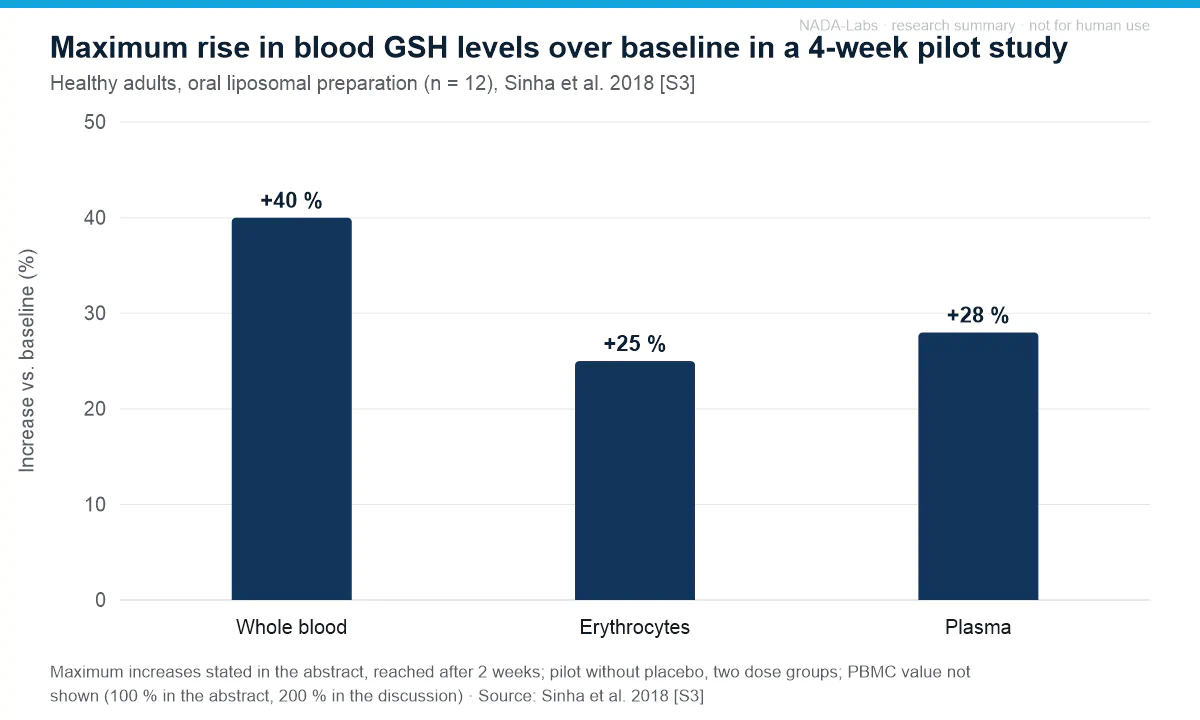
| Sinha 20183 | Human, healthy adults (n = 12) | 1-month pilot, oral liposomal preparation, two dose groups, no placebo arm | Maximum GSH increases after 2 weeks: whole blood +40 %, erythrocytes +25 %, plasma +28 % (P < 0.05); plasma 8-isoprostane -35 %; no differences between dose groups |
| Griese 20134 | Human, patients with cystic fibrosis aged 8 years and older (n = 153) | Randomised, double-blind, placebo-controlled, multicentre, inhaled, 6 months | Primary FEV1 end points not different from placebo (P = 0.180 and 0.205); GSH and metabolites increased in sputum; no change in markers of oxidation, proteolysis or inflammation |
| Hauser 20095 | Human, patients with Parkinson’s disease (n = 21) | Randomised, double-blind, placebo-controlled pilot, intravenous, 4 weeks plus 8 weeks follow-up | No significant UPDRS differences (P = 0.32 and 0.54); adverse events similar, no withdrawals because of adverse events |
| Mischley 20176 | Human, patients with Parkinson’s disease, Hoehn & Yahr stage 1-3 (n = 45) | Randomised, double-blind, saline placebo-controlled phase IIb, intranasal, three arms, 3 months plus 1-month washout | All arms improved, including placebo; neither dose group superior to placebo; one case of cardiomyopathy in the high-dose arm |
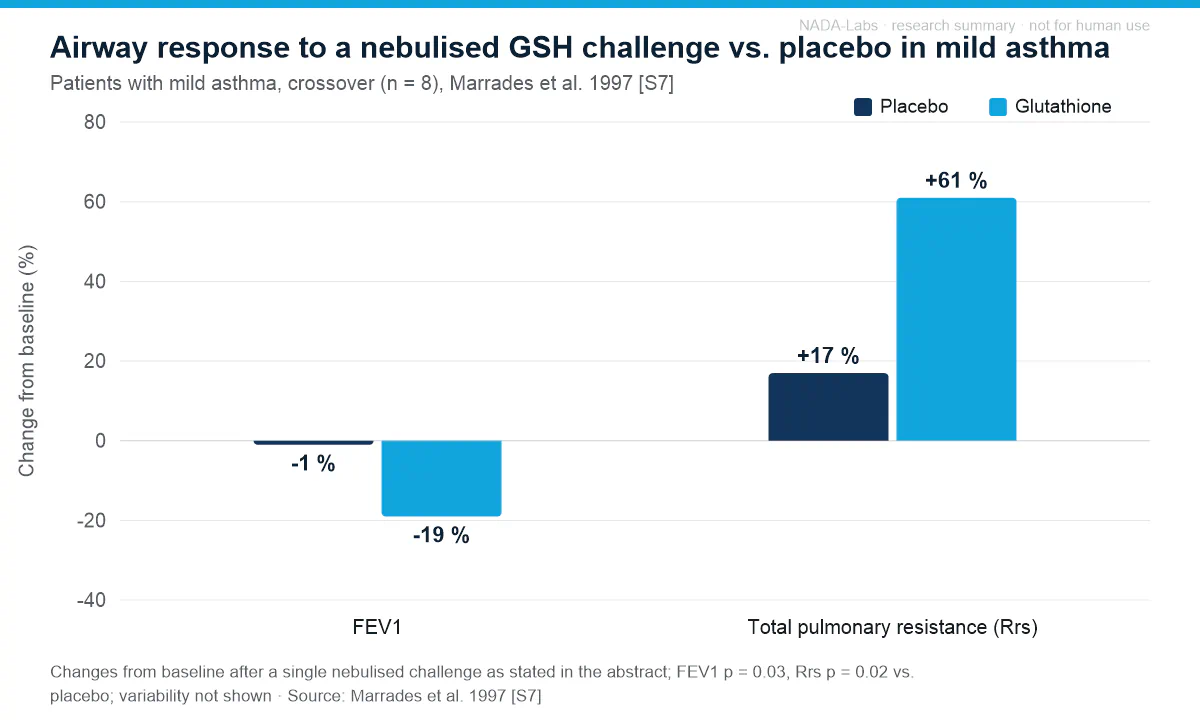
| Marrades 19977 | Human, patients with mild asthma (n = 8) | Randomised, double-blind, placebo-controlled crossover, single nebulised challenge per period, 1 week apart | FEV1 -19 % vs -1 % and Rrs +61 % vs +17 % from baseline (p = 0.03 and 0.02); cough in 4 and breathlessness in 3 patients |
Tolerability reported in the human studies
| Study | Population (n) | Route and design | Reported tolerability |
|---|---|---|---|
| Richie 20151 | Healthy non-smoking adults (n = 54) | Oral, 6 months, placebo-controlled | No adverse-event data in the abstract (full text not available) |
| Allen 20112 | Healthy adult volunteers (n = 40) | Oral, 4 weeks, placebo-controlled | No adverse-event data in the abstract (full text not available) |
| Sinha 20183 | Healthy adults (n = 12) | Oral liposomal, 1 month, no placebo | No serious adverse effects; all potential adverse events minor and none attributed to treatment; no withdrawals |
| Griese 20134 | Cystic fibrosis (n = 153) | Inhaled, 6 months, placebo-controlled | Adverse-event incidence similar to placebo |
| Hauser 20095 | Parkinson’s disease (n = 21) | Intravenous, 4 weeks, placebo-controlled | Well tolerated; adverse events similar to placebo; no withdrawals because of adverse events |
| Mischley 20176 | Parkinson’s disease (n = 45) | Intranasal, 3 months, placebo-controlled | One withdrawal with tachycardia and newly diagnosed cardiomyopathy (high-dose arm, relation unclear); one withdrawal each for puffiness under the eyes (low-dose arm) and for sinus irritation and headaches (placebo arm), attributed to the intervention |
| Marrades 19977 | Mild asthma (n = 8) | Nebulised, single challenge, placebo-controlled crossover | Bronchoconstriction (FEV1 -19 % vs -1 %); cough in 4 and breathlessness in 3 patients |
| Mischley 2015 (PMID 26230671) | Parkinson’s disease (n = 30) | Intranasal, 3 months, placebo-controlled | No substantial between-group differences in adverse events; all groups met tolerability criteria; one withdrawal for an adverse event attributed to the study medication |
| Mischley 2016 (PMID 28725693) | Parkinson’s disease (n = 15) | Intranasal, single administration, uncontrolled | One adverse reaction (cephalgic paresthesia) that resolved within 1 h |
Effects reported in the studies
- GSH body stores with oral administration over 6 months. In healthy non-smoking adults (n = 54), whole-blood GSH was above baseline after 1, 3 and 6 months in both dose groups; at 6 months the high-dose group showed mean increases of 30-35 % in erythrocytes, plasma and lymphocytes and of 260 % in buccal cells (P < 0.05), the low-dose group increases of 17 % in blood and 29 % in erythrocytes (P < 0.05; time point not stated in the abstract). Levels returned to baseline after a 1-month washout, the ratio of oxidised to reduced glutathione in whole blood fell in both dose groups after 6 months, and natural killer cell cytotoxicity increased more than twofold in the high-dose group versus placebo at 3 months (P < 0.05)1.
- No change in oxidative-stress biomarkers over 4 weeks. In 40 healthy adults, the changes in urinary F2-isoprostanes (0.0 ± 0.1 vs 0.0 ± 0.1 ng/mg creatinine, p = 0.38) and 8-OHdG (-0.2 ± 3.3 vs 1.0 ± 3.2 µg/g creatinine, p = 0.27) did not differ from placebo at week 4, and total reduced, oxidised and ratio measures of GSH status were also unchanged2. After a single oral administration, plasma glutathione, cysteine and glutamate did not increase significantly over 270 min in 7 healthy volunteers (Witschi 1992, PMID 1362956).
- Liposomal oral preparation in a pilot without placebo. In 12 healthy adults, GSH was elevated after 1 week, with maximum increases of 40 % in whole blood, 25 % in erythrocytes, 28 % in plasma and 100 % in peripheral blood mononuclear cells after 2 weeks (P < 0.05; the discussion gives 200 % for these cells); plasma 8-isoprostane fell by 35 % and the oxidised:reduced GSH ratio by 20 % (P < 0.05). Natural killer cell cytotoxicity rose by up to 400 % and lymphocyte proliferation by up to 60 % within 2 weeks (P < 0.05); no differences were observed between the two dose groups, with limited statistical power3.
- Airway delivery in cystic fibrosis. In 153 patients, the primary FEV1 end points did not differ from placebo over 6 months (P = 0.180 and P = 0.205); an exploratory analysis showed an FEV1 increase over placebo of 100 ml or 2.2 % predicted that was significant at 3 months but not later. Patients receiving glutathione had neither fewer pulmonary exacerbations nor better quality-of-life scores, and GSH and its metabolites increased in sputum without changes in markers of oxidation, proteolysis or inflammation4.
- Intravenous administration in Parkinson’s disease. In a pilot trial (n = 21), changes in UPDRS scores did not differ significantly from placebo: ADL plus motor scores improved by a mean of 2.8 units more in the GSH group over 4 weeks (P = 0.32) and worsened by a mean of 3.5 units more over the following 8 weeks (P = 0.54)5. An earlier open-label study in 9 patients had no control group (Sechi 1996, PMID 8938817).
- Intranasal administration in Parkinson’s disease. In the phase IIb trial (n = 45), all three arms improved during the 3-month intervention, including placebo; the high-dose group changed by -4.6 (SD 4.7) points in total UPDRS (P = 0.0025) and by -2.2 (SD 3.8) points in the motor subscore (P = 0.0485) from its own baseline, but neither dose group was superior to placebo, and the placebo arm improved by a mean of 3.4 (SD 6.2) points6. In an uncontrolled spectroscopy study (n = 15), brain GSH rose above baseline after a single intranasal administration (P < 0.001) — not at 8 min, but at all later time points over about 1 h (P < 0.01) (Mischley 2016, PMID 28725693).
Adverse effects and tolerability reported
- Bronchoconstriction after nebulisation in mild asthma. In a crossover challenge (n = 8), GSH lowered FEV1 by 19 % and raised total pulmonary resistance (Rrs) by 61 % from baseline, compared with -1 % and +17 % with saline placebo (p = 0.03 and p = 0.02), and induced cough in 4 and breathlessness in 3 patients. Neither the osmolarity nor the pH of the solution accounted for the effect, prior nebulised salbutamol blocked it, and the authors attribute it to sulfite formation7.
- Intravenous administration. In the Parkinson’s disease pilot (n = 21), glutathione was well tolerated, reported adverse events were similar in both groups, there were no withdrawals because of adverse events and no safety concerns were identified; one participant withdrew for personal reasons5.
- Inhalation over 6 months. In cystic fibrosis (n = 153), the incidence of adverse events was similar with glutathione and placebo; a breakdown by event type is not given in the abstract4.
- Intranasal administration. In the phase IIb trial, one participant in the high-dose arm withdrew with tachycardia and newly diagnosed cardiomyopathy — the authors state that a relation to the study medication is unclear and suggest screening for cardiac side effects in future trials — and one participant each in the low-dose arm (puffiness under the eyes) and in the saline placebo arm (chronically irritated sinuses and headaches) withdrew because of events attributed to the intervention6. In the phase I/IIa trial (n = 30), the number of adverse events did not differ substantially between groups, with one withdrawal for an adverse event attributed to the study medication (Mischley 2015, PMID 26230671); in the spectroscopy study, one cephalgic paresthesia resolved within 1 h (Mischley 2016, PMID 28725693).
- Liposomal oral pilot. No serious adverse effects were reported in either dose group; all potential adverse events were minor and none was attributed to either treatment group, and none of the 12 participants withdrew3.
- Missing safety data. The abstracts of the 6-month and the 4-week oral trials report no adverse-event data, and no full text was available for either trial1,2; none of the cited records reports safety data beyond 6 months.
Limitations of the evidence. The cited trials are small (n = 8 to 54, except n = 153 in cystic fibrosis), and several are pilots3,5. Oral results are inconsistent: GSH stores rose in the 6-month trial and in the liposomal pilot1,3, but not in the 4-week trial2, and a single oral administration did not significantly raise plasma glutathione (Witschi 1992, PMID 1362956). The liposomal pilot had no placebo arm3, and the placebo response in the phase IIb trial was larger than in earlier Parkinson’s disease studies6. The primary lung-function end points in cystic fibrosis and the symptom scores in Parkinson’s disease did not differ from placebo4,5,6. The studies used different routes and preparations, so results cannot be transferred from one to another, and no full text was available for five of the seven records, which limits the adverse-event detail1,2,4,5,7. None of the findings summarised here establish efficacy or safety for any use outside the described research models.
References
- Richie JP Jr, Nichenametla S, Neidig W, Calcagnotto A, Haley JS, Schell TD, Muscat JE (2015). Randomized controlled trial of oral glutathione supplementation on body stores of glutathione. European Journal of Nutrition. PMID 24791752 DOI human study
- Allen J, Bradley RD (2011). Effects of oral glutathione supplementation on systemic oxidative stress biomarkers in human volunteers. Journal of Alternative and Complementary Medicine. PMID 21875351 DOI human study
- Sinha R, Sinha I, Calcagnotto A, Trushin N, Haley JS, Schell TD, Richie JP Jr (2018). Oral supplementation with liposomal glutathione elevates body stores of glutathione and markers of immune function. European Journal of Clinical Nutrition. PMID 28853742 DOI human study
- Griese M, Kappler M, Eismann C, Ballmann M, Junge S, Rietschel E, van Koningsbruggen-Rietschel S, Staab D, Rolinck-Werninghaus C, Mellies U, Köhnlein T, Wagner T, König S, Teschler H, Heuer HE, Kopp M, Heyder S, Hammermann J, Küster P, Honer M, Mansmann U, Beck-Speier I, Hartl D, Fuchs C, Hector A; Glutathione Study Group (2013). Inhalation treatment with glutathione in patients with cystic fibrosis. A randomized clinical trial. American Journal of Respiratory and Critical Care Medicine. PMID 23631796 DOI human study
- Hauser RA, Lyons KE, McClain T, Carter S, Perlmutter D (2009). Randomized, double-blind, pilot evaluation of intravenous glutathione in Parkinson’s disease. Movement Disorders. PMID 19230029 DOI human study
- Mischley LK, Lau RC, Shankland EG, Wilbur TK, Padowski JM (2017). Phase IIb Study of Intranasal Glutathione in Parkinson’s Disease. Journal of Parkinson’s Disease. PMID 28436395 DOI human study
- Marrades RM, Roca J, Barberà JA, de Jover L, MacNee W, Rodriguez-Roisin R (1997). Nebulized glutathione induces bronchoconstriction in patients with mild asthma. American Journal of Respiratory and Critical Care Medicine. PMID 9279219 DOI human study
This section summarises findings published in the cited peer-reviewed literature for informational purposes. It is not a claim of efficacy or safety, contains no dosing or administration information by design, and does not constitute medical, veterinary or scientific advice. Results in cell cultures or animal models do not predict effects in humans.