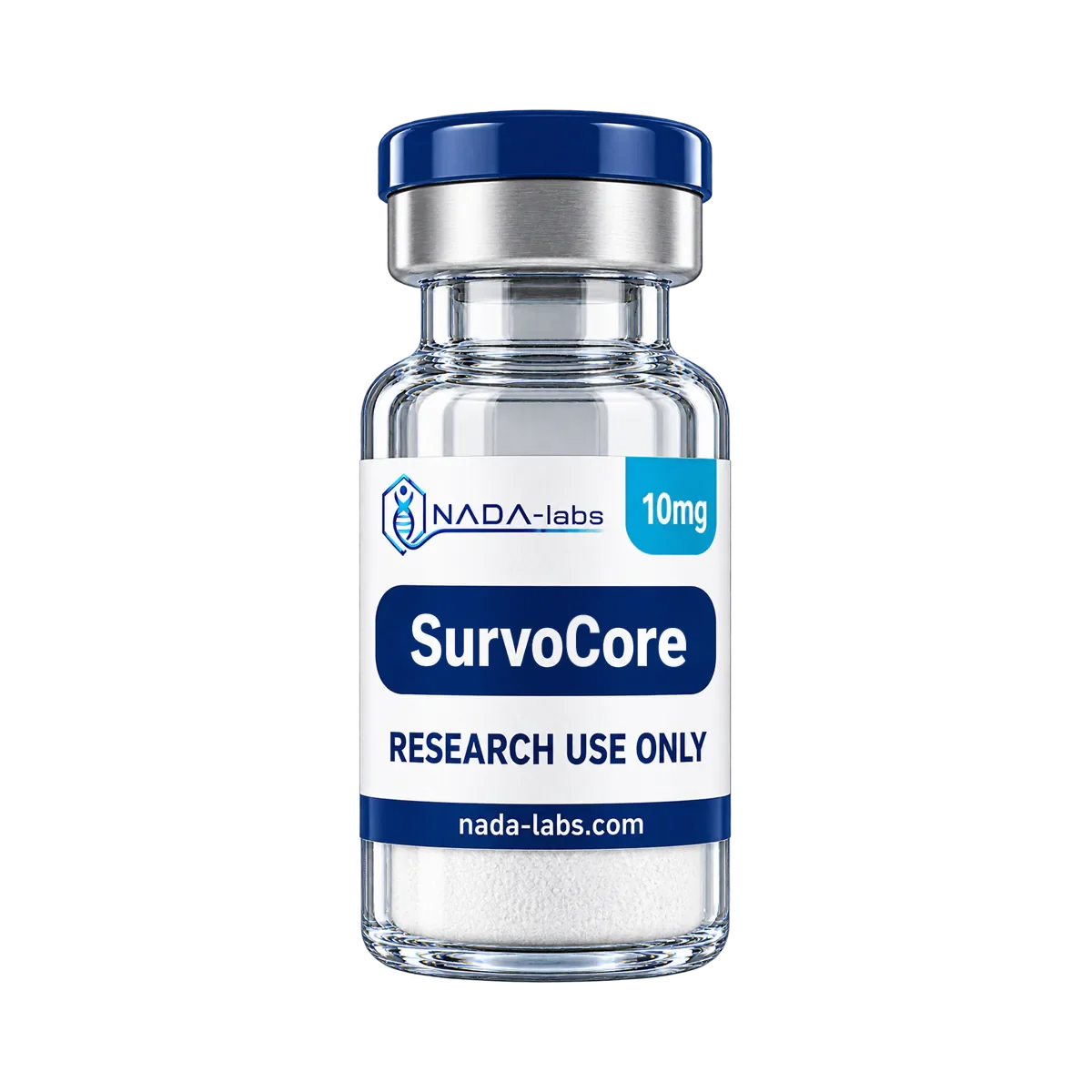
Description
SurvoCore (BI 456906) is a synthetic, acylated 29-residue peptide based on a modified glucagon sequence, with the non-coded amino acid 1-aminocyclobutane-1-carboxylic acid (Ac4c) at position 2, an amidated C-terminus and a C18 diacid attached to the lysine at position 24 through a glycine-serine linker; the acylation mediates albumin binding. The sequence contains no methionine or cysteine but one tryptophan; as with all lyophilised peptides, keep vials sealed, cold and away from light.
SurvoCore: what the published research shows
Compiled by NADA-Labs from the peer-reviewed literature cited below. No own study data.
SurvoCore (BI 456906) is a synthetic, acylated 29-amino-acid peptide derived from a modified human glucagon sequence: the non-coded amino acid Ac4c at position 2 and C-terminal amidation support proteolytic stability, and a glycine-serine linker at position 24 carries a C18 diacid that mediates albumin binding and extends the terminal half-life8. It was designed to engage the glucagon receptor (GCGR) and the GLP-1 receptor (GLP-1R) simultaneously; in CHO-K1 cells its EC50 was 0.33 nM at GLP-1R and 0.52 nM at GCGR8. The research literature attributes its effects on body weight in mice mainly to increased energy expenditure and reduced food intake8, with the suppression of food intake linked to GLP-1R and only minimal GCGR expression in feeding-related brain regions (Zimmermann 2026, PMID 41638399). It has been studied in cell assays, in diet-induced obese, knockout and reporter mice and in human phase 1 to phase 3 trials in obesity, type 2 diabetes, metabolic dysfunction-associated steatotic liver disease (MASLD), steatohepatitis (MASH) and cirrhosis1,2,3,4,5,6,7,8.
Evidence base: Seven human trials — three randomised, double-blind, placebo-controlled phase 3 trials (n = 725, 752 and 216)1,2,3, three randomised phase 2 trials (n = 386, 411 and 293), one of them with an open-label SemaCore arm4,5,6, and one non-randomised, open-label phase 1 study in cirrhosis (41 participants in the single-dose and 41 in the multiple-dose part)7 — plus the discovery and preclinical pharmacology paper with cell and mouse data8. Six of the seven human trials state funding by the developer (Boehringer Ingelheim), and all seven list authors affiliated with the developer; the preclinical data come from its research group, and no independent trial was identified. Further preclinical records describe the selection of the candidate from 19 dual agonists (Thomas 2024, PMID 38560764) and its central sites of action in mice (Zimmermann 2026, PMID 41638399). The longest treatment period is 76 weeks; the cardiovascular outcomes trial SYNCHRONIZE-CVOT (design: Kosiborod 2024, PMID 39453356) was described as ongoing in a 2026 publication3, and no results from it are among the cited records.
Key studies at a glance
| Study | Model | Design | Main result |
|---|---|---|---|
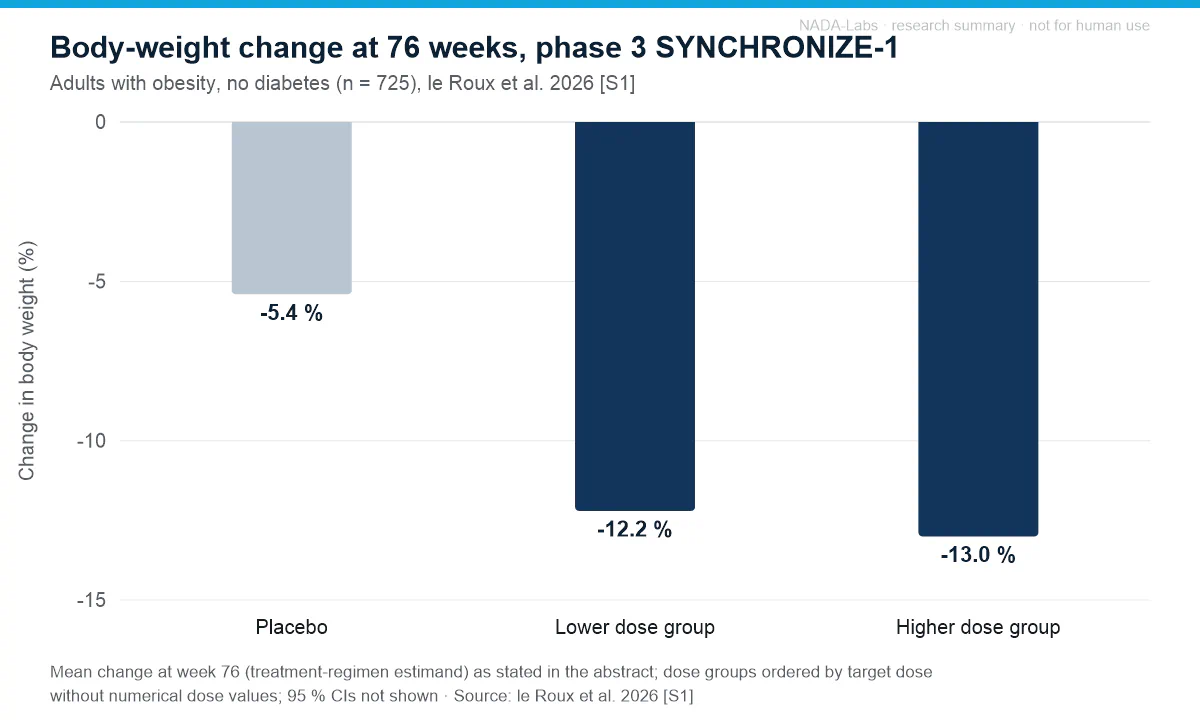
| le Roux 20261 | Adults with obesity, no diabetes (n = 725) | Phase 3 SYNCHRONIZE-1, randomised, double-blind, placebo-controlled, two dose groups, 76 weeks | Body weight -12.2 % and -13.0 % vs -5.4 % placebo at week 76; ≥ 5 % loss in 72.6 % and 71.9 % vs 46.3 % (P < 0.001) |
| Wharton 20262 | Adults with type 2 diabetes and BMI ≥ 27 (n = 752) | Phase 3 SYNCHRONIZE-2, randomised, double-blind, placebo-controlled, two dose groups, 76 weeks | Body weight -8.2 % and -9.8 % vs -3.9 % placebo; HbA1c -0.9 and -0.8 vs -0.2 percentage points |
| Kaplan 20263 | Adults with obesity and at-risk MASLD (n = 216) | Phase 3 SYNCHRONIZE-MASLD, randomised 2:1, double-blind, placebo-controlled, 48 weeks | ≥ 30 % liver-fat reduction in 68.5 % vs 28.6 %; body weight -8.7 % vs -1.4 % (primary treatment-regimen estimand; supplementary efficacy estimand: 84.2 % vs 24.3 % and -12.2 % vs -1.0 %; P < 0.0001 for all) |
| le Roux 20244 | Adults with BMI ≥ 27, no diabetes (n = 386 treated) | Phase 2, randomised, double-blind, placebo-controlled, four dose groups, 46 weeks | Body weight -6.2 % to -14.9 % (four dose groups) vs -2.8 % placebo at week 46 (planned treatment) |
| Blüher 20245 | Adults with type 2 diabetes on metformin (n = 411 treated) | Phase 2, randomised, double-blind, placebo-controlled, six dose groups plus an open-label SemaCore arm, 16 weeks | HbA1c -0.91 to -1.71 percentage points (baseline 8.07 %); body weight up to -8.7 % vs -5.3 % with SemaCore |
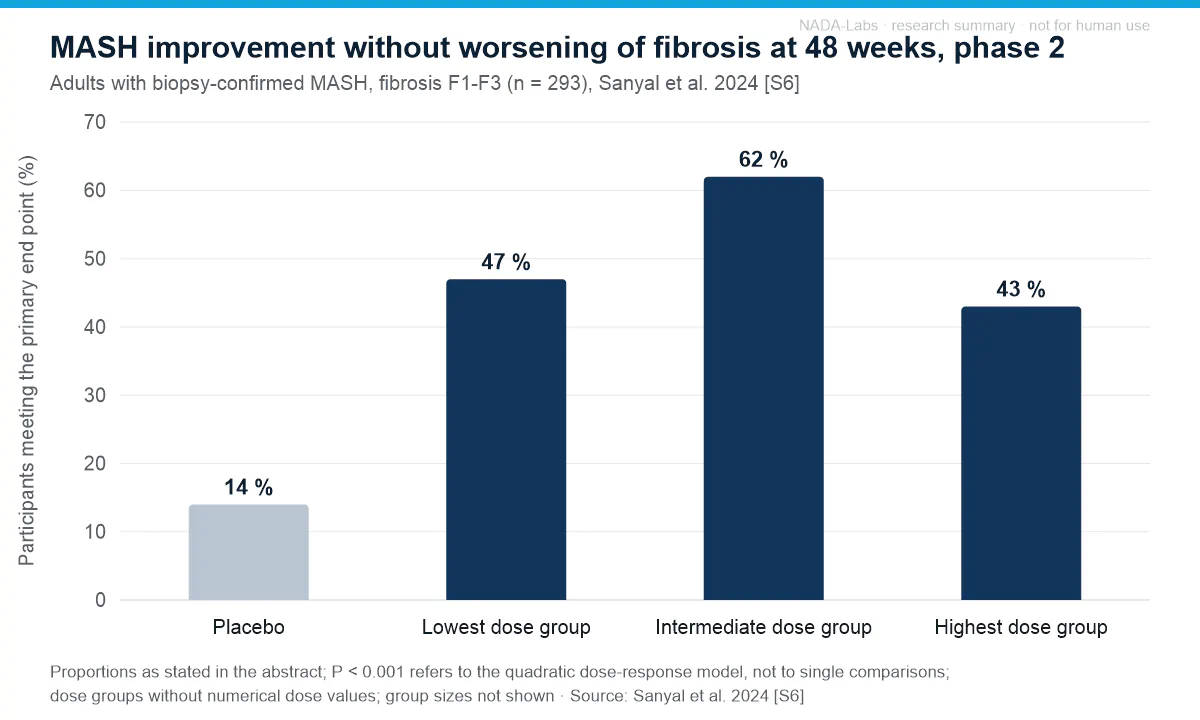
| Sanyal 20246 | Adults with biopsy-confirmed MASH, fibrosis F1-F3 (n = 293) | Phase 2, randomised, placebo-controlled, three dose groups, 48 weeks | MASH improvement without worsening of fibrosis in 43-62 % vs 14 % placebo; ≥ 30 % liver-fat decrease in 57-67 % vs 14 % |
| Lawitz 20247 | Single-dose part: people with cirrhosis (Child-Pugh A-C) and matched healthy individuals (n = 41); 28-week part: people with overweight/obesity with or without cirrhosis (Child-Pugh A or B, n = 41) | Phase 1, open-label, non-randomised; single dose, then a 28-week multiple-dose part | Exposure (AUC, Cmax) similar in cirrhosis and healthy individuals; liver fat, stiffness, volume and body weight generally reduced after 28 weeks (no effect sizes in abstract) |
| Zimmermann 20228 | In vitro (CHO-K1, MIN6, rat hepatocytes) and diet-induced obese, knockout and reporter mice | Discovery and preclinical pharmacology; cell assays, repeated administration over 28 days in DIO mice vs vehicle and SemaCore | EC50 0.33 nM (GLP-1R) and 0.52 nM (GCGR); body weight up to -32 % at day 28 vs -25 % and -27 % with SemaCore |
Adverse events reported in SYNCHRONIZE-MASLD (Kaplan 2026 [S3])
| Event | SurvoCore (n = 146) | Placebo (n = 70) |
|---|---|---|
| Any adverse event | 127 (87.0 %) | 55 (78.6 %) |
| Adverse event leading to treatment discontinuation | 34 (23.3 %) | 7 (10.0 %) |
| Nausea | 82 (56.2 %) | 10 (14.3 %) |
| Vomiting | 62 (42.5 %) | 5 (7.1 %) |
| Diarrhoea | 43 (29.5 %) | 7 (10.0 %) |
| Constipation | 41 (28.1 %) | 7 (10.0 %) |
| Decreased appetite | 17 (11.6 %) | 7 (10.0 %) |
| Upper respiratory tract infection | 16 (11.0 %) | 4 (5.7 %) |
| Fatigue | 15 (10.3 %) | 4 (5.7 %) |
| Headache | 11 (7.5 %) | 9 (12.9 %) |
| Abdominal distension | 11 (7.5 %) | 8 (11.4 %) |
| Serious adverse event | 14 (9.6 %) | 8 (11.4 %) |
| Adverse event leading to death | 0 (0.0 %) | 1 (1.4 %) |
Effects reported in the studies
- Body weight in obesity without diabetes. SYNCHRONIZE-1 (n = 725): -12.2 % and -13.0 % in the lower and higher dose group vs -5.4 % with placebo at week 76 (treatment-regimen estimand); a weight reduction of at least 5 % in 72.6 % and 71.9 % vs 46.3 % (P < 0.001 for all comparisons with placebo)1. In the phase 2 dose-finding trial (n = 386 treated): -6.2 % to -14.9 % from the lowest to the highest dose group vs -2.8 % with placebo at week 46 (planned-treatment analysis)4.
- Body weight and HbA1c in type 2 diabetes. SYNCHRONIZE-2 (n = 752, baseline HbA1c 7.4 %): body weight -8.2 % and -9.8 % vs -3.9 % with placebo at week 76; at least 5 % loss in 57.6 % and 64.5 % vs 35.1 % (P < 0.001); HbA1c -0.9 and -0.8 vs -0.2 percentage points2. Phase 2 (n = 411, 16 weeks, baseline HbA1c 8.07 %): HbA1c -0.91 to -1.71 percentage points across the six dose groups, a similar reduction with a low dose group (-1.46) and open-label SemaCore (-1.47), and a dose-dependent decrease in body weight of up to 8.7 % vs 5.3 % with SemaCore5.
- Liver fat and body weight in obesity with MASLD. SYNCHRONIZE-MASLD (n = 216, baseline liver fat content 16.9 % by MRI-PDFF): a reduction in liver fat content of at least 30 % in 68.5 % vs 28.6 % of participants with the primary treatment-regimen estimand and in 84.2 % vs 24.3 % with the supplementary efficacy estimand; body weight -8.7 % vs -1.4 % and -12.2 % vs -1.0 %, respectively (P < 0.0001 for all), in the 48-week trial3.
- Liver histology in MASH with fibrosis. Phase 2 (n = 293, fibrosis F1-F3): improvement in MASH with no worsening of fibrosis in 47 %, 62 % and 43 % of the lowest, intermediate and highest dose group vs 14 % with placebo (P < 0.001 for the quadratic dose-response model); a decrease in liver fat content of at least 30 % in 63 %, 67 % and 57 % vs 14 %; improvement in fibrosis by at least one stage in 34 %, 36 % and 34 % vs 22 % (no P values for this end point in the abstract)6.
- Liver markers and exposure in cirrhosis. In the open-label phase 1 study, exposure after a single dose (AUC and Cmax) was similar in people with Child-Pugh class A, B or C cirrhosis and in matched healthy individuals; after 28 weeks of once-weekly treatment in people with overweight/obesity with or without Child-Pugh class A or B cirrhosis, liver fat content, liver stiffness, liver volume, body weight and other hepatic and metabolic markers were generally reduced (no effect sizes in the abstract)7.
- Body weight and energy balance in obese mice. In diet-induced obese (DIO) mice, repeated administration reduced body weight dose-dependently by up to 32 % from baseline at day 28, more than SemaCore at maximally effective doses (25 % and 27 %; significant only against the lower of the two SemaCore doses); the authors attribute this to increased energy expenditure and reduced food intake8. In the candidate-selection study, SurvoCore lowered body weight in DIO mice by 25 % from baseline, and SurvoCore and a related candidate lowered glycated haemoglobin in db/db mice by 0.4-0.6 % (Thomas 2024, PMID 38560764).
- Receptor engagement in vitro and in mice. EC50 0.33 nM at GLP-1R and 0.52 nM at GCGR in CHO-K1 cells, about 10-fold lower potency than native GLP-1 (60 pM) and glucagon (20 pM); GLP-1R engagement was shown via glucose tolerance, food intake and gastric emptying (including GLP-1R knockout mice), GCGR engagement via liver Nnmt mRNA, plasma amino acids and FGF-218. In mice, fluorophore-labelled SurvoCore reached the circumventricular organs without evidence of uniformly crossing the blood-brain barrier and activated nuclei associated with the control of food intake; GCGR was barely detectable in the area postrema and arcuate nucleus, whereas GLP1R was expressed (Zimmermann 2026, PMID 41638399).
- Liver lipids in mice. In DIO mice, lower doses significantly reduced liver triglycerides, plasma cholesterol and ALT, despite smaller body-weight reductions than with SemaCore8.
Adverse effects and tolerability reported
- Gastrointestinal events in the phase 3 trials. They were the most common adverse events: 80.9 % and 89.7 % in the lower and higher dose group vs 47.9 % with placebo in SYNCHRONIZE-1, typically mild to moderate1, and 72.8 % and 77.7 % vs 38.6 % in SYNCHRONIZE-2, generally mild to moderate and transient2. In SYNCHRONIZE-MASLD, mainly nausea, vomiting, diarrhoea and constipation occurred, primarily during dose escalation and largely mild to moderate; the rates are listed in the table above3.
- Gastrointestinal events in the phase 2 trials (SurvoCore dose groups pooled). Obesity: adverse events in 91 % vs 75 % of participants, primarily gastrointestinal in 75 % vs 42 %4. MASH: nausea 66 % vs 23 %, diarrhoea 49 % vs 23 % and vomiting 41 % vs 4 % with SurvoCore vs placebo6. Type 2 diabetes: adverse events in 77.8 % (mainly gastrointestinal) vs 52.5 % with placebo and 52.0 % with SemaCore5.
- Treatment discontinuation. SYNCHRONIZE-MASLD: adverse events led to discontinuation in 23.3 % vs 10.0 %, gastrointestinal events in 19.9 % vs 4.3 %; discontinuation for any reason was similar (41.1 % vs 40.0 %)3. Phase 2 in type 2 diabetes: adverse events led to discontinuation in 15.9 % (SurvoCore dose groups pooled) vs 5.1 % (placebo) and 4.0 % (SemaCore); most of these discontinuations occurred within the first 6 weeks, during dose escalation, mainly because of gastrointestinal disorders such as nausea and vomiting5. Phase 2 in obesity: 60.4 % of participants completed the 46-week treatment period (61 % with SurvoCore, 60 % with placebo)4.
- Serious adverse events and deaths. SYNCHRONIZE-1: no deaths reported1; SYNCHRONIZE-MASLD: serious adverse events in 9.6 % vs 11.4 %, one adverse event leading to death in the placebo group (1.4 %) and none with SurvoCore3; MASH phase 2 trial: serious adverse events in 8 % vs 7 %6.
- Heart rate and blood glucose. In SYNCHRONIZE-MASLD, mean heart rate increased by 3.6 vs 0.8 beats per minute at week 52, without evidence of clinically relevant QTcF prolongation according to the authors; hypoglycaemia and hyperglycaemia events were reported more frequently in the placebo group3. Phase 2 in type 2 diabetes: mean increase after 16 weeks of 2.3-7.3 beats per minute across the SurvoCore dose groups vs 5.9 with SemaCore and 1.67 with placebo5.
- Tolerability in cirrhosis. Drug-related adverse events occurred in 25.0 % of healthy individuals and in up to 25.0 % of people with cirrhosis after single doses, and in the multiple-dose cohorts over 28 weeks in 82.4 % of participants without and 87.5 % of those with cirrhosis (open-label, small cohorts, no placebo)7.
- Missing safety data. The preclinical discovery paper reports no toxicology data8; long-term, cardiovascular and liver-outcome safety has not been established — the cardiovascular outcomes trial SYNCHRONIZE-CVOT (Kosiborod 2024, PMID 39453356) and the phase 3 programme LIVERAGE in MASH were described as ongoing in a 2026 publication3.
Limitations of the evidence. All cited human trials list authors affiliated with the developer (six also state its funding), and the preclinical data come from its research group1,2,3,4,5,6,7,8; no independent replication is among the cited records. Several results are taken from abstracts only1,2,4,6,7, so event rates beyond the abstracts are not reported here. Discontinuation was high in several trials (about 40 % in both arms of SYNCHRONIZE-MASLD and in the phase 2 obesity trial)3,4, and results depend on the estimand (84.2 % vs 68.5 % responders with SurvoCore)3. The MASH response was not monotonic across dose groups6, the SemaCore arm of the type 2 diabetes trial was open-label5, and the phase 1 study had no placebo group7. The longest treatment period was 76 weeks, and no results of dedicated cardiovascular-outcome or liver-outcome trials are among the cited records; such trials, including SYNCHRONIZE-CVOT (design: Kosiborod 2024, PMID 39453356), were described as ongoing in a 2026 publication3. Mouse and cell findings do not predict effects in humans8. None of the findings summarised here establish efficacy or safety for any use outside the described research models.
References
- le Roux CW, Wharton S, Startseva E, Kloer IM, Hussain SA, Unseld A, Bozkurt B, Ard JD, Bays HE, Bogdański P, Ekinci EI, Jastreboff AM, Ji L, Ogawa W, Pedersen SD, Pietiläinen KH, Sattar N, Seufert J, Stenlöf K, van Beek AP, Vangoitsenhoven R, Brueckmann M, Younes R, Kaplan LM; SYNCHRONIZE-1 Investigators (2026). Survodutide Once Weekly for the Treatment of Adults with Obesity. The New England Journal of Medicine. PMID 42253238 DOI human study
- Wharton S, le Roux CW, Startseva E, Kloer IM, Alhussein A, Hussain SA, Unseld A, Bozkurt B, Ard JD, Bays HE, Bogdański P, Butt JH, Ekinci EI, Jastreboff AM, Ji L, Schou M, Tinahones FJ, Kokkinos AD, Merkely B, Ogawa W, Pedersen SD, Pietiläinen KH, Quinn D, Sattar N, Seufert J, Stenlöf K, van Beek AP, Vangoitsenhoven R, Brueckmann M, Younes R, Kaplan LM; SYNCHRONIZE-2 Investigators (2026). Survodutide Once Weekly in Adults with Obesity and Type 2 Diabetes. The New England Journal of Medicine. PMID 42820639 DOI human study
- Kaplan LM, Startseva E, le Roux CW, Wharton S, Bozkurt B, Mazo DF, von Schlippenbach J, González Maldonado S, Ajaz Hussain S, Neff GW, Gonzalez Rojas Y, Smith C, Younes R, Sanyal AJ; SYNCHRONIZE-MASLD Investigators (2026). Survodutide in adults with obesity and metabolic dysfunction-associated steatotic liver disease: SYNCHRONIZE-MASLD, a randomized, double-blind, placebo-controlled phase 3 trial. Nature Medicine. PMID 42252333 DOI human study
- le Roux CW, Steen O, Lucas KJ, Startseva E, Unseld A, Hennige AM (2024). Glucagon and GLP-1 receptor dual agonist survodutide for obesity: a randomised, double-blind, placebo-controlled, dose-finding phase 2 trial. The Lancet Diabetes & Endocrinology. PMID 38330987 DOI human study
- Blüher M, Rosenstock J, Hoefler J, Manuel R, Hennige AM (2024). Dose-response effects on HbA1c and bodyweight reduction of survodutide, a dual glucagon/GLP-1 receptor agonist, compared with placebo and open-label semaglutide in people with type 2 diabetes: a randomised clinical trial. Diabetologia. PMID 38095657 DOI human study
- Sanyal AJ, Bedossa P, Fraessdorf M, Neff GW, Lawitz E, Bugianesi E, Anstee QM, Hussain SA, Newsome PN, Ratziu V, Hosseini-Tabatabaei A, Schattenberg JM, Noureddin M, Alkhouri N, Younes R; 1404-0043 Trial Investigators (2024). A Phase 2 Randomized Trial of Survodutide in MASH and Fibrosis. The New England Journal of Medicine. PMID 38847460 DOI human study
- Lawitz EJ, Fraessdorf M, Neff GW, Schattenberg JM, Noureddin M, Alkhouri N, Schmid B, Andrews CP, Takács I, Hussain SA, Fenske WK, Gane EJ, Hosseini-Tabatabaei A, Sanyal AJ, Mazo DF, Younes R; NCT05296733 Investigators (2024). Efficacy, tolerability and pharmacokinetics of survodutide, a glucagon/glucagon-like peptide-1 receptor dual agonist, in cirrhosis. Journal of Hepatology. PMID 38857788 DOI human study
- Zimmermann T, Thomas L, Baader-Pagler T, Haebel P, Simon E, Reindl W, Bajrami B, Rist W, Uphues I, Drucker DJ, Klein H, Santhanam R, Hamprecht D, Neubauer H, Augustin R (2022). BI 456906: Discovery and preclinical pharmacology of a novel GCGR/GLP-1R dual agonist with robust anti-obesity efficacy. Molecular Metabolism. PMID 36356832 DOI
This section summarises findings published in the cited peer-reviewed literature for informational purposes. It is not a claim of efficacy or safety, contains no dosing or administration information by design, and does not constitute medical, veterinary or scientific advice. Results in cell cultures or animal models do not predict effects in humans.