Description
PT-141 (bremelanotide) is a synthetic cyclic heptapeptide analogue of α-MSH. A lactam bridge between the side chains of aspartic acid and lysine closes the ring, norleucine takes the place of the native methionine, the N-terminus is acetylated and the C-terminus is a free carboxylic acid — the only structural difference from Melanotan II, which ends in a C-terminal amide. The sequence includes one tryptophan residue — keep vials sealed, cold and away from light.
PT-141: what the published research shows
Compiled by NADA-Labs from the peer-reviewed literature cited below. No own study data.
PT-141 (bremelanotide; Ac-Nle-cyclo[Asp-His-D-Phe-Arg-Trp-Lys]-OH) is a synthetic cyclic heptapeptide analogue of the endogenous neuropeptide α-melanocyte-stimulating hormone1, described as the carboxylate derivative of Melanotan II (King 2007, PMID 17584130). It is a melanocortin receptor agonist with activity at MC3R and MC4R6 and highest affinity for the MC4 receptor5; a cryo-EM structure of the human MC4R–Gs complex with bremelanotide bound has been published (Zhang 2021, PMID 34433901). The research literature attributes its effects mainly to central melanocortin receptors: systemic administration activated hypothalamic neurons in rats and produced penile erections in rats and non-human primates (Molinoff 2003, PMID 12851303), and in female rats it selectively increased solicitational behaviour8. It has been studied in rodents and in a clinical development programme of 43 completed studies with 3500 subjects4, mostly in premenopausal women with hypoactive sexual desire disorder (HSDD)1,2,3.
Evidence base: Mainly human data from one developer’s clinical programme: two identical 24-week phase 3 RCTs (RECONNECT; n = 1267 randomised)1 with a 52-week open-label extension (n = 684)2, a 12-week phase 2b RCT (n = 397)3 with an ambulatory blood-pressure analysis of the same trial5, and an integrated safety review4. Earlier work includes a crossover laboratory study in 18 women6, two phase 1 studies in men7, further early controlled studies in men (Rosen 2004, PMID 14999221; Diamond 2005, PMID 15833522) and a female-rat behavioural study8. The clinical trials were funded by the developer1,2,3,5; an independent meta-analytic re-analysis of the two phase 3 trials found similar results (Spielmans 2021, PMID 33678061). No primary in-vitro receptor potency panel for PT-141 was identified.
Key studies at a glance
| Study | Model | Design | Main result |
|---|---|---|---|
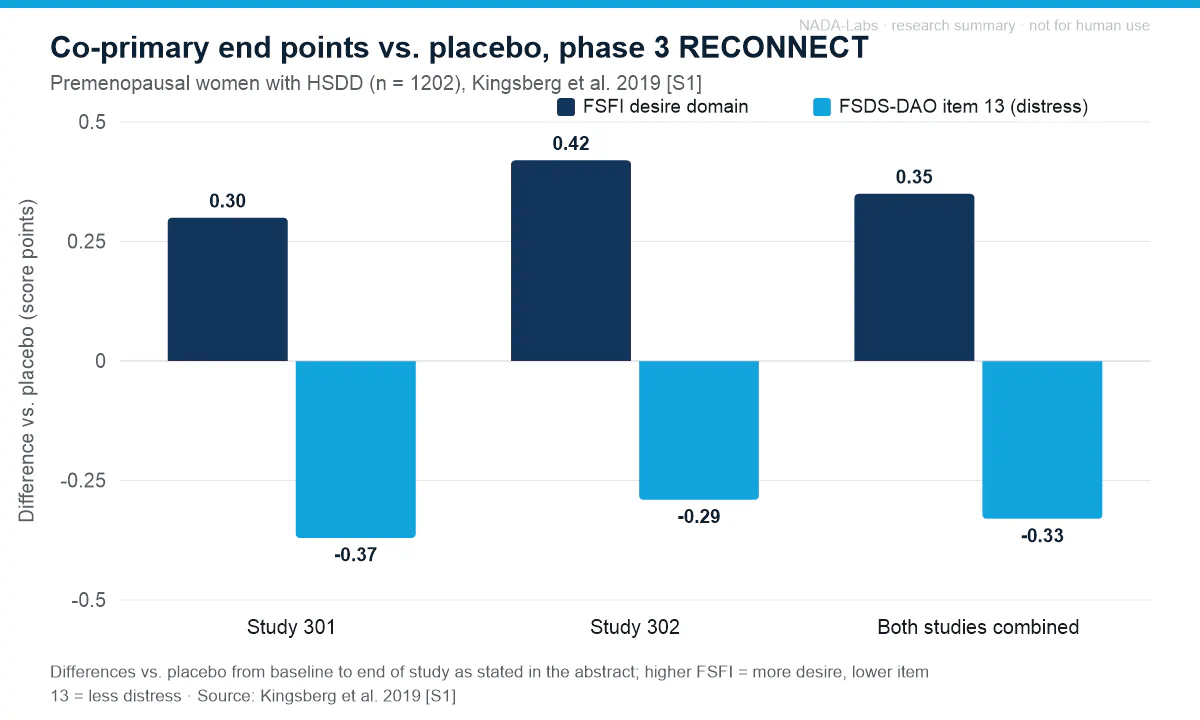
| Kingsberg 20191 | Human, premenopausal women with HSDD | Two identical phase 3 RCTs (RECONNECT), double-blind, placebo-controlled; n = 1267 randomised; 24 weeks | FSFI desire domain +0.35 and FSDS-DAO item 13 -0.33 vs. placebo (integrated, p < 0.001); satisfying sexual events not different (p = 0.630) |
| Simon 20192 | Human, women from the phase 3 core phase | Open-label extension without control group; n = 684 entered; 52 weeks; descriptive statistics | FSFI desire +1.25 to +1.30 and item 13 -1.4 to -1.7 from core-phase baseline (bremelanotide in the core phase); 272 completed |
| Clayton 20163 | Human, premenopausal women with female sexual arousal disorder (FSAD) and/or HSDD | Phase 2b RCT, double-blind, placebo-controlled, three dose groups; n = 397 randomised, 327 analysed; 12 weeks | Two higher dose groups pooled vs. placebo: satisfying sexual events +0.7 vs. +0.2/month (p = 0.0180), FSFI total +3.6 vs. +1.9 (p = 0.0017), FSDS-DAO total -11.1 vs. -6.8 (p = 0.0014) |
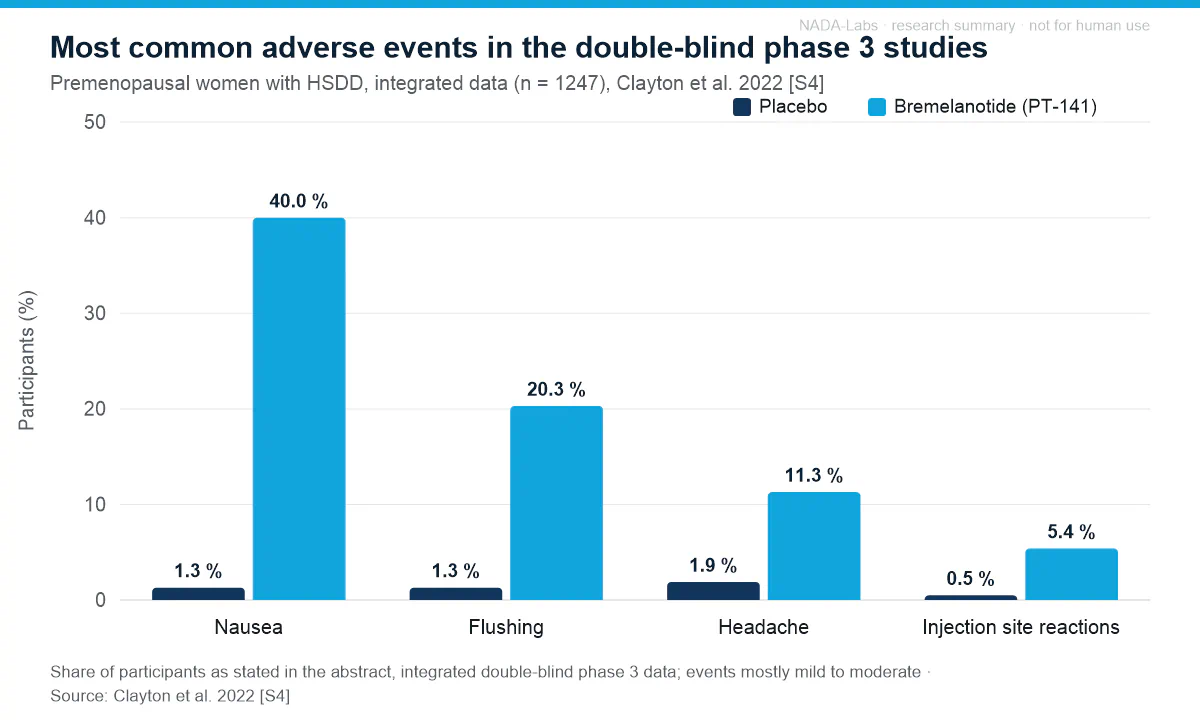
| Clayton 20224 | Human, integrated double-blind phase 3 data (N = 1247); programme of 43 studies with 3500 subjects | Integrated safety review of the development programme (phases 1-3) | Nausea 40.0 vs. 1.3 %, flushing 20.3 vs. 1.3 %, headache 11.3 vs. 1.9 %, injection-site reactions 5.4 vs. 0.5 %; focal hyperpigmentation in more than one third after daily administration on up to 16 consecutive days |
| White 20175 | Human, premenopausal women with female sexual dysfunction, normotensive or with controlled hypertension | RCT, double-blind, placebo-controlled, ambulatory blood-pressure monitoring (phase 2b trial of ref. 3); n = 397 | Systolic blood pressure +2.4 to +3.2 mmHg vs. placebo 0-4 h after administration, peaks typically < 15 min; heart rate -4.6 to -4.7 bpm (highest dose group) |
| Diamond 20066 | Human, premenopausal women with female sexual arousal disorder | Randomised, double-blind, placebo-controlled crossover, one intranasal administration per session; n = 18 | More women with moderate or high sexual desire after PT-141 (p = 0.0114); vaginal vasocongestion unchanged vs. placebo; no effect sizes in abstract |
| Diamond 20047 | Human, healthy men and men with mild-to-moderate erectile dysfunction | Two phase 1 double-blind, placebo-controlled studies, intranasal; RigiScan | Median Tmax 0.50 h, mean half-life 1.85-2.09 h; erectile response significant vs. placebo above a threshold dose, onset after approx. 30 min; group sizes not in abstract |
| Pfaus 20048 | Rat, female, in vivo | Controlled behavioural pharmacology, blinded testing | Solicitations increased selectively; lordosis, pacing, locomotor activity and sexual reward unchanged; no effect sizes in abstract |
Adverse events in the 12-week double-blind phase 2b trial (Clayton 2016 [S3])
| Event | Placebo (n = 97) | Lowest dose group (n = 100) | Middle dose group (n = 99) | Highest dose group (n = 98) |
|---|---|---|---|---|
| Any adverse event | 49 (51 %) | 64 (64 %) | 61 (62 %) | 67 (68 %) |
| Nausea | 3 (3 %) | 18 (18 %) | 22 (22 %) | 24 (24 %) |
| Flushing | 0 | 17 (17 %) | 14 (14 %) | 17 (17 %) |
| Headache | 3 (3 %) | 9 (9 %) | 9 (9 %) | 14 (14 %) |
| Injection-site pain | 3 (3 %) | 6 (6 %) | 6 (6 %) | 7 (7 %) |
| Upper respiratory tract infection | 4 (4 %) | 8 (8 %) | 5 (5 %) | 4 (4 %) |
| Injection-site pruritus | 0 | 4 (4 %) | 4 (4 %) | 6 (6 %) |
| Any adverse event leading to withdrawal (excluding the 26 blood-pressure-related withdrawals) | 2 (2 %) | 0 | 5 (5 %) | 6 (6 %) |
Effects reported in the studies
- Receptor binding and central activation (structure, rat, primate). PT-141 is described as an agonist at MC3R and MC4R6 with highest affinity for MC4R5; a cryo-EM structure of the human MC4R–Gs complex with bremelanotide bound shows, together with pharmacological studies, a conserved binding mode of peptide agonists (Zhang 2021, PMID 34433901). In rats, systemic administration increased c-Fos immunoreactivity in hypothalamic neurons, and administration to rats and non-human primates resulted in penile erections (Molinoff 2003, PMID 12851303).
- Desire and distress scores in two phase 3 trials. In premenopausal women with HSDD (efficacy population n = 1202), the FSFI desire domain changed by +0.30, +0.42 and +0.35 vs. placebo (study 301, study 302, integrated; each p < 0.001) and distress due to low desire (FSDS-DAO item 13) by -0.37, -0.29 and -0.33 (p ≤ 0.005); the integrated effect sizes were 0.39 and 0.271. An independent meta-analysis of the trial data found similar results (Spielmans 2021, PMID 33678061).
- Satisfying sexual events: phase 2b vs. phase 3. In phase 2b, the two higher dose groups pooled reached +0.7 vs. +0.2 satisfying sexual events per month with placebo (p = 0.0180), while the lowest dose group did not differ from placebo3; responder analyses of the same trial were significant for all seven end points in the highest dose group (p ≤ 0.03; Althof 2019, PMID 31277966). In phase 3, this key secondary end point was not met (integrated change 0.0 vs. -0.1, p = 0.630)1.
- 52-week open-label extension (descriptive). 684 of 856 eligible women entered the uncontrolled extension and 272 completed it. From core-phase baseline, the FSFI desire domain changed by +1.25 to +1.30 and FSDS-DAO item 13 by -1.4 to -1.7 in women who had received bremelanotide in the core phase (+0.70 to +0.77 and -0.9 after placebo in the core phase); all analyses were descriptive2.
- Single-dose crossover laboratory study in women with arousal disorder. In a crossover study in 18 premenopausal women with female sexual arousal disorder, more women reported moderate or high sexual desire after intranasal PT-141 than after placebo (p = 0.0114), and more of those who attempted intercourse within 24 hours were satisfied with their level of arousal (p = 0.0256); feelings of genital arousal showed a trend (p = 0.0833), and vaginal vasocongestion did not change significantly6.
- Erectile response and pharmacokinetics in men. After intranasal administration to healthy men, Cmax and AUC rose dose-dependently (median Tmax 0.50 h, mean half-life 1.85-2.09 h); in healthy men and in men with mild-to-moderate erectile dysfunction, the RigiScan erectile response was significant vs. placebo above a threshold dose, with onset after approximately 30 min7. Significant erectile responses were also reported after subcutaneous administration (Rosen 2004, PMID 14999221), and in 19 men co-administration with sildenafil gave a greater response than sildenafil alone (Diamond 2005, PMID 15833522).
- Sexual behaviour in female rodents. In female rats, PT-141 selectively increased solicitational behaviours without affecting lordosis, pacing or other sexual behaviours, caused no generalised motor activation and did not change the perception of sexual reward8. In female Syrian hamsters, bremelanotide changed neither melanocortin receptor mRNA in the mesolimbic dopamine system nor sexual reward in a conditioned place preference test (Borland 2025, PMID 39793696).
- Food intake and body weight (women with obesity). In the first of two phase 1 randomised, placebo-controlled trials in premenopausal women with a BMI above 30, the reduction in body weight after 16 days was greater than with placebo (least-squares mean difference -1.3 kg, 95 % CI -1.9 to -0.8; p < 0.0001), and caloric intake was approximately 400 kcal/day lower (p < 0.01) (Spana 2022, PMID 35170192).
Adverse effects and tolerability reported
- Nausea, flushing, headache and injection-site reactions (phase 3). In the integrated double-blind phase 3 data (N = 1247), the most common adverse events with bremelanotide vs. placebo were nausea (40.0 vs. 1.3 %), flushing (20.3 vs. 1.3 %), headache (11.3 vs. 1.9 %) and injection-site reactions (5.4 vs. 0.5 %), mostly mild to moderate4. Nausea began a median 30 minutes after administration, lasted a median 2.4 hours and was mild to moderate in approximately 98 % of cases; 3.5 % reported vomiting together with nausea1.
- Event frequencies in phase 2b and in early studies in men. In the double-blind phase of the phase 2b trial (all bremelanotide groups pooled), nausea (22 vs. 3 %), vomiting (4 % vs. none) and flushing (16 % vs. none) were more frequent than with placebo, and only nausea showed a slight dose dependence; injection-site reactions occurred in 24 vs. 7 %, mild in 94 % of affected participants on bremelanotide3. Flushing and nausea were also the most common adverse events in two phase 1 studies in men7.
- Discontinuations due to adverse events. In phase 3, 8.1 % of the bremelanotide group discontinued because of nausea1, the most common reason for discontinuation4. In the extension, adverse events led to discontinuation in 24.1-25.9 % of women switching from placebo and 10.8-18.5 % of women continuing bremelanotide2. An independent re-analysis reported that adverse-event-induced study discontinuation was substantially higher with bremelanotide (odds ratio 11.98, 95 % CI 3.74-38.37) and had not been reported in the primary publication (Spielmans 2021, PMID 33678061).
- Blood pressure and heart rate. In ambulatory monitoring of the phase 2b trial, systolic blood pressure rose by 2.4 to 3.2 mmHg vs. placebo in the 0-4 h interval after administration (middle and highest dose group; p = 0.006-0.076), with peaks typically lasting less than 15 min, similar diastolic increases and a heart-rate reduction of 4.6 to 4.7 bpm in the highest dose group (p < 0.001); 26 participants discontinued because of prespecified blood-pressure increases, in similar proportions in all four groups5. In phase 3, placebo-adjusted increases of approximately 3 mmHg systolic and 2 mmHg diastolic occurred 0-2 h after administration and resolved within 8-10 h1.
- Focal hyperpigmentation. Focal hyperpigmentation was rare under the standard administration conditions but occurred in more than one third of subjects after daily administration on up to 16 consecutive days; the abstract does not give the size of that study4. Sunburn was among the most common adverse events of the open-label extension2.
- Drug interactions. Most drug-drug interactions in the programme were not clinically significant, except for interactions that lowered plasma concentrations of indomethacin and naltrexone4. In a phase 1 crossover study in 24 healthy men and women, co-administration with ethanol showed no clinically significant pharmacokinetic interaction, no significant drug-related hypotensive effects and no increase in adverse events (Clayton 2017, PMID 28189361).
- Serious adverse events and safety measurements. In phase 3, seven bremelanotide patients reported 10 serious adverse events and three placebo patients four; no deaths occurred1. In the extension, three serious events (cerebrovascular accident, endometriosis, cholecystitis) were not considered related, and an independent expert panel judged one case of acute hepatitis unlikely to be due to bremelanotide but could not exclude a role2. In phase 2b, three participants on bremelanotide and one on placebo reported serious events, none attributed to bremelanotide3; the phase 1 studies in men found no clinically significant changes in vital signs, laboratory tests, ECGs or physical examinations7.
Limitations of the evidence. Almost all human evidence comes from the developer’s programme: the trials were funded by the developer1,2,3,5, the integrated safety review was co-authored by the developer and is summarised here from its abstract only4, and two authors of the rat study held stock in the developing company8. The efficacy end points of the HSDD trials are patient-reported questionnaire scores, the phase 3 key secondary end point was not met1, and according to an independent re-analysis 72.72 % of the protocol-listed outcomes were not reported in the primary publication (Spielmans 2021, PMID 33678061). The 52-week extension had no control group and included only women who had completed the core phase without serious adverse events2. References 3 and 5 report the same trial, and the abstract of the early studies in men gives no group sizes7. The animal data summarised here come from three publications: a female-rat behaviour study8, a report of penile erections in rats and non-human primates (Molinoff 2003, PMID 12851303) and a hamster study that found no effect on sexual reward (Borland 2025, PMID 39793696); no primary in-vitro receptor potency data were identified. None of the findings summarised here establish efficacy or safety for any use outside the described research models.
References
- Kingsberg SA, Clayton AH, Portman D, Williams LA, Krop J, Jordan R, Lucas J, Simon JA (2019). Bremelanotide for the Treatment of Hypoactive Sexual Desire Disorder: Two Randomized Phase 3 Trials. Obstetrics and Gynecology. PMID 31599840 DOI human study
- Simon JA, Kingsberg SA, Portman D, Williams LA, Krop J, Jordan R, Lucas J, Clayton AH (2019). Long-Term Safety and Efficacy of Bremelanotide for Hypoactive Sexual Desire Disorder. Obstetrics and Gynecology. PMID 31599847 DOI human study
- Clayton AH, Althof SE, Kingsberg S, DeRogatis LR, Kroll R, Goldstein I, Kaminetsky J, Spana C, Lucas J, Jordan R, Portman DJ (2016). Bremelanotide for female sexual dysfunctions in premenopausal women: a randomized, placebo-controlled dose-finding trial. Women’s Health. PMID 27181790 DOI human study
- Clayton AH, Kingsberg SA, Portman D, Sadiq A, Krop J, Jordan R, Lucas J, Simon JA (2022). Safety Profile of Bremelanotide Across the Clinical Development Program. Journal of Women’s Health. PMID 35147466 DOI human study
- White WB, Myers MG, Jordan R, Lucas J (2017). Usefulness of ambulatory blood pressure monitoring to assess the melanocortin receptor agonist bremelanotide. Journal of Hypertension. PMID 27977473 DOI human study
- Diamond LE, Earle DC, Heiman JR, Rosen RC, Perelman MA, Harning R (2006). An effect on the subjective sexual response in premenopausal women with sexual arousal disorder by bremelanotide (PT-141), a melanocortin receptor agonist. The Journal of Sexual Medicine. PMID 16839319 DOI human study
- Diamond LE, Earle DC, Rosen RC, Willett MS, Molinoff PB (2004). Double-blind, placebo-controlled evaluation of the safety, pharmacokinetic properties and pharmacodynamic effects of intranasal PT-141, a melanocortin receptor agonist, in healthy males and patients with mild-to-moderate erectile dysfunction. International Journal of Impotence Research. PMID 14963471 DOI human study
- Pfaus JG, Shadiack A, Van Soest T, Tse M, Molinoff P (2004). Selective facilitation of sexual solicitation in the female rat by a melanocortin receptor agonist. Proceedings of the National Academy of Sciences of the United States of America. PMID 15226502 DOI
This section summarises findings published in the cited peer-reviewed literature for informational purposes. It is not a claim of efficacy or safety, contains no dosing or administration information by design, and does not constitute medical, veterinary or scientific advice. Results in cell cultures or animal models do not predict effects in humans.