Description
TirzeCore (LY3298176) is a synthetic 39-residue peptide built on the GIP sequence, with α-aminoisobutyric acid (Aib) at positions 2 and 13, an amidated C-terminus and a C20 fatty diacid side chain attached to the lysine at position 20 through a linker of γ-glutamic acid and two 8-amino-3,6-dioxaoctanoic acid units; the acylation enables binding to albumin. The sequence contains no methionine or cysteine but one tryptophan; as with all lyophilised peptides, keep vials sealed, cold and away from light.
TirzeCore: what the published research shows
Compiled by NADA-Labs from the peer-reviewed literature cited below. No own study data.
TirzeCore (LY3298176) is a synthetic, fatty-acid-modified peptide developed by Eli Lilly that acts as an agonist at the receptors for glucose-dependent insulinotropic polypeptide (GIP) and glucagon-like peptide-1 (GLP-1); it was discovered by engineering GLP-1 activity into the GIP sequence (Willard 2020, PMID 32730231). The research literature attributes its effects mainly to imbalanced dual agonism weighted towards the GIP receptor — binding affinity comparable to native GIP at the GIP receptor, about 5-fold weaker than native GLP-1 at the GLP-1 receptor, minimal activity at the glucagon receptor8 — and to biased GLP-1-receptor signalling that favours cAMP generation over β-arrestin recruitment (Willard 2020, PMID 32730231). It has been studied in receptor assays, in wild-type, receptor-knockout and diet-induced obese mice, in phase 1 studies and in large randomised trials in type 2 diabetes, obesity with and without diabetes, obstructive sleep apnoea, heart failure with preserved ejection fraction and atherosclerotic cardiovascular disease1,2,3,4,5,6,7,8.
Evidence base: Seven phase 3 publications of randomised trials (n = 469 to 13,165) — five placebo-controlled1,3,4,5,6, one open-label against SemaCore2 and one double-blind outcome trial against dulaglutide7 — plus the discovery paper with in vitro, mouse and phase 1 data8, all funded by the developer (Eli Lilly) with Lilly employees among the authors. Further trials cover phase 2 in type 2 diabetes (Frias 2018, PMID 30293770), monotherapy (Rosenstock 2021, PMID 34186022), 3-year follow-up in prediabetes (Jastreboff 2025, PMID 39536238), a SemaCore comparison in obesity (Aronne 2025, PMID 40353578) and steatohepatitis (Loomba 2024, PMID 38856224). Preclinical work comes mainly from the developer’s laboratories, and mouse effect sizes are reported in figures rather than abstracts (Samms 2021, PMID 34003802).
Key studies at a glance
| Study | Model | Design | Main result |
|---|---|---|---|
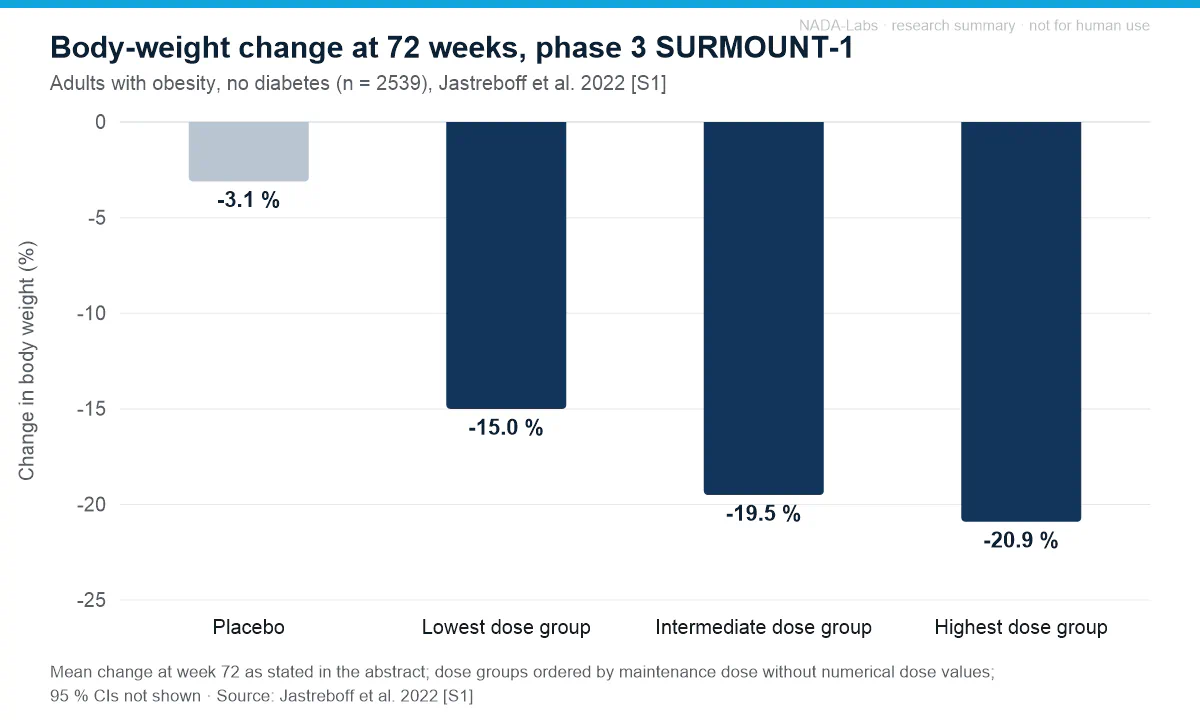
| Jastreboff 20221 | Adults with obesity, no diabetes (n = 2539) | Phase 3 SURMOUNT-1, randomised, double-blind, placebo-controlled, 72 weeks | Body weight -15.0 % to -20.9 % (three dose groups) vs -3.1 % placebo at 72 weeks; ≥ 20 % loss in up to 57 % vs 3 % |
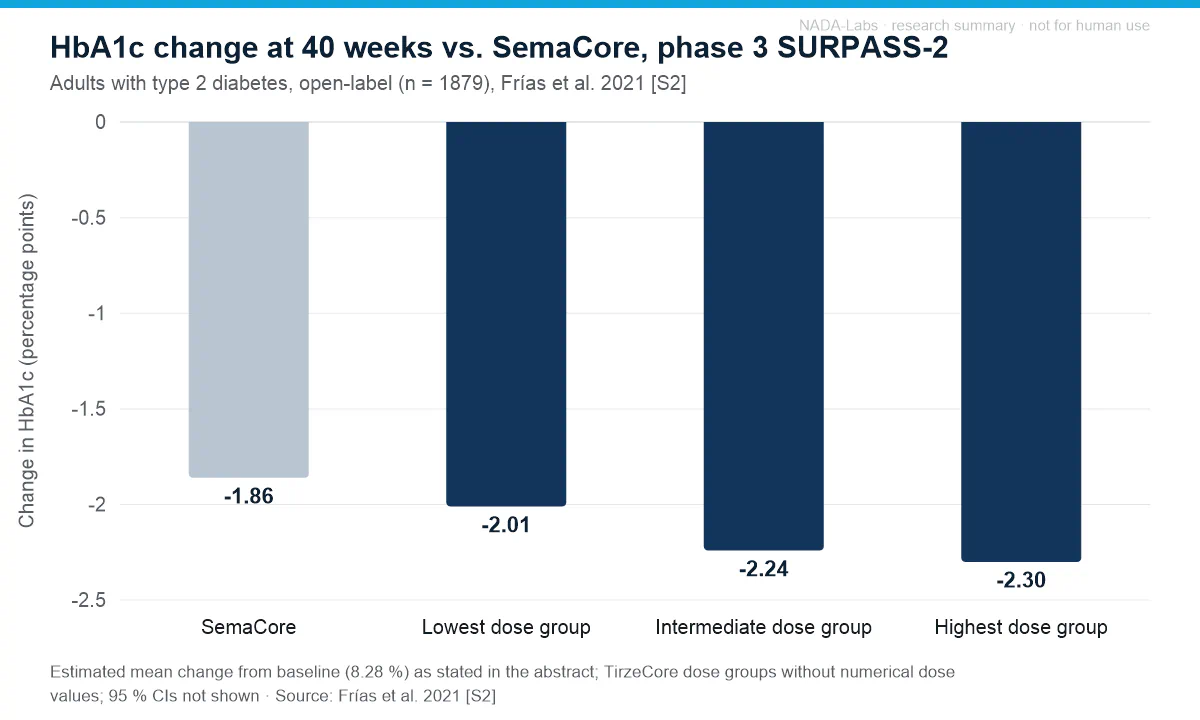
| Frías 20212 | Adults with type 2 diabetes (n = 1879) | Phase 3 SURPASS-2, randomised, open-label, SemaCore-controlled, 40 weeks | HbA1c -2.01 to -2.30 vs -1.86 percentage points with SemaCore; weight difference vs SemaCore -1.9 to -5.5 kg |
| Garvey 20233 | Adults with obesity or overweight and type 2 diabetes (n = 938) | Phase 3 SURMOUNT-2, randomised, double-blind, placebo-controlled, 72 weeks | Body weight -12.8 % and -14.7 % (two dose groups) vs -3.2 % placebo at 72 weeks; ≥ 5 % loss in 79-83 % vs 32 % |
| Aronne 20244 | Adults with obesity or overweight, no diabetes (n = 670 randomised) | Phase 3 SURMOUNT-4, 36-week open-label lead-in, then randomised double-blind withdrawal, 52 weeks | Lead-in loss 20.9 %; weeks 36-88: -5.5 % with continued TirzeCore vs +14.0 % after switch to placebo |
| Malhotra 20245 | Adults with obstructive sleep apnoea and obesity (n = 469, two trials) | Two phase 3 SURMOUNT-OSA trials, randomised, double-blind, placebo-controlled, 52 weeks | AHI -25.3 vs -5.3 and -29.3 vs -5.5 events/h; body weight -17.7 % and -19.6 % vs -1.6 % and -2.3 % |
| Packer 20256 | Adults with heart failure with preserved ejection fraction and obesity (n = 731) | Phase 3 SUMMIT, randomised, double-blind, placebo-controlled outcome trial, median follow-up 104 weeks | Cardiovascular death or worsening heart failure 9.9 % vs 15.3 % (HR 0.62); KCCQ-CSS +19.5 vs +12.7 points |
| Nicholls 20257 | Adults with type 2 diabetes and atherosclerotic cardiovascular disease (n = 13,165) | Phase 3 SURPASS-CVOT, randomised, double-blind, dulaglutide-controlled noninferiority outcome trial | MACE (cardiovascular death, myocardial infarction or stroke) 12.2 % vs 13.1 % (HR 0.92, 95.3 % CI 0.83-1.01): noninferior, superiority not shown |
| Coskun 20188 | In vitro receptors, mice, healthy volunteers and type 2 diabetes (n = 142 humans) | Discovery paper plus phase 1 single- and multiple-ascending-dose studies (healthy volunteers) and a 4-week phase 1b study (type 2 diabetes) | Dual GIPR/GLP-1R agonist weighted towards GIPR, minimal glucagon-receptor activity; greater weight loss than SemaCore in obese mice; half-life about 5 days |
Adverse events reported in SURMOUNT-OSA (Malhotra 2024 [S5])
| Event | Trial 1 TirzeCore (n = 114) | Trial 1 placebo (n = 120) | Trial 2 TirzeCore (n = 119) | Trial 2 placebo (n = 114) |
|---|---|---|---|---|
| At least one adverse event | 79.8 % | 76.7 % | 83.2 % | 72.8 % |
| Serious adverse events | 7.9 % | 5.8 % | 5.9 % | 10.5 % |
| Discontinuation due to adverse events | 4.4 % | 1.7 % | 3.4 % | 7.0 % |
| Diarrhoea | 26.3 % | 12.5 % | 21.8 % | 8.8 % |
| Nausea | 25.4 % | 10.0 % | 21.8 % | 5.3 % |
| Vomiting | 17.5 % | 4.2 % | 9.2 % | 0.9 % |
| Constipation | 15.8 % | 2.5 % | 15.1 % | 4.4 % |
| Injection-site reaction | 7.0 % | 0.8 % | 5.0 % | 0 % |
| Adjudication-confirmed acute pancreatitis | 0 % | 0 % | 1.7 % | 0 % |
| Deaths | 0 | 0 | 0 | 0 |
Effects reported in the studies
- Body-weight reduction in obesity without diabetes. SURMOUNT-1 (n = 2539): -15.0 %, -19.5 % and -20.9 % in the lowest, intermediate and highest dose group vs -3.1 % with placebo at 72 weeks (p < 0.001); a loss of 20 % or more in 50 % and 57 % of the two higher dose groups vs 3 %1. At 176 weeks in participants with prediabetes: -12.3 % to -19.7 % vs -1.3 % (Jastreboff 2025, PMID 39536238); open-label vs SemaCore: -20.2 % vs -13.7 % at 72 weeks (Aronne 2025, PMID 40353578).
- Weight maintenance and regain after withdrawal. After a mean loss of 20.9 % in a 36-week open-label lead-in, body weight changed by -5.5 % with continued TirzeCore vs +14.0 % after a switch to placebo from week 36 to 88 (p < 0.001); 89.5 % vs 16.6 % kept at least 80 % of the lead-in loss4.
- Body weight in obesity with type 2 diabetes. SURMOUNT-2 (n = 938): -12.8 % and -14.7 % in the two dose groups vs -3.2 % with placebo at 72 weeks (p < 0.0001); a loss of at least 5 % in 79-83 % vs 32 %3.
- Glycaemic control (HbA1c). SURPASS-2 (n = 1879, mean baseline HbA1c 8.28 %): -2.01, -2.24 and -2.30 percentage points vs -1.86 with SemaCore at 40 weeks, noninferior and superior in all three dose groups, with a 1.9-5.5 kg greater weight reduction2. As monotherapy: -1.87 to -2.07 percentage points vs +0.04 with placebo (Rosenstock 2021, PMID 34186022).
- Obstructive sleep apnoea. In two 52-week trials (n = 469) the apnoea-hypopnoea index (AHI) changed by -25.3 vs -5.3 events/h without and by -29.3 vs -5.5 events/h with positive airway pressure therapy (both p < 0.001); percent change in AHI -50.7 % and -58.7 % vs -3.0 % and -2.5 %; all prespecified key secondary end points improved significantly5.
- Heart-failure and cardiovascular outcomes. SUMMIT (heart failure with preserved ejection fraction, n = 731): cardiovascular death or worsening heart failure 9.9 % vs 15.3 % (hazard ratio 0.62, 95 % CI 0.41-0.95), cardiovascular death alone 2.2 % vs 1.4 % (hazard ratio 1.58, 95 % CI 0.52-4.83); KCCQ clinical summary score +19.5 vs +12.7 points at 52 weeks6. SURPASS-CVOT (n = 13,165): major adverse cardiovascular events 12.2 % vs 13.1 % with dulaglutide (hazard ratio 0.92), noninferior; superiority not shown (p = 0.09)7.
- Mechanism (receptor pharmacology, preclinical). In vitro: Ki 0.135 nM at the GIP receptor and 4.23 nM at the GLP-1 receptor; cAMP potency similar to native GIP and about 13-fold weaker than GLP-1. In obese mice, chronic administration lowered body weight and food intake significantly more than the GLP-1 receptor agonist SemaCore, mainly through loss of fat mass, whereas a long-acting GIP-receptor agonist alone did not change body weight8; GIP-receptor agonism contributed a weight-independent improvement in insulin sensitivity in obese mice (Samms 2021, PMID 34003802).
Adverse effects and tolerability reported
- Gastrointestinal events (nausea, diarrhoea, vomiting, constipation). They were the most common adverse events and mostly mild to moderate1,3,4,5, occurring mainly during dose escalation1,5. SURPASS-2: nausea 17-22 % vs 18 % with SemaCore, diarrhoea 13-16 % vs 12 %, vomiting 6-10 % vs 8 %2; SURMOUNT-OSA rates are listed in the table above5. They were dose-dependent in phase 1, where patients with type 2 diabetes had fewer gastrointestinal events than healthy participants8, and dose-related in phase 2 (Frias 2018, PMID 30293770).
- Treatment discontinuation due to adverse events. SURMOUNT-1: 4.3 %, 7.1 % and 6.2 % (lowest to highest dose group) vs 2.6 % with placebo1; SURMOUNT-2: few gastrointestinal events leading to discontinuation (fewer than 5 %)3; SUMMIT: 6.3 % vs 1.4 %, mainly because of gastrointestinal events6; phase 1: five participants (decreased appetite, vomiting, supraventricular tachycardia, diarrhoea, increased pancreatic enzymes)8.
- Serious adverse events and deaths. SURPASS-2: 5-7 % vs 3 % with SemaCore2; SURMOUNT-2: 7 % overall, with two deaths in one TirzeCore group judged unrelated to treatment by the investigator3; SURMOUNT-OSA: 7.5 % overall, similar in both groups, no deaths5; phase 1: no deaths8.
- Hypoglycaemia. SURPASS-2: blood glucose below 54 mg/dl was reported in 0.6 %, 0.2 % and 1.7 % (lowest to highest dose group) vs 0.4 % with SemaCore2; no clinically significant or severe hypoglycaemia with monotherapy (Rosenstock 2021, PMID 34186022) and no severe hypoglycaemia in phase 2 (Frias 2018, PMID 30293770).
- Pancreatitis and other events of special interest. SURMOUNT-OSA: two adjudication-confirmed cases of acute pancreatitis in the trial 2 TirzeCore group, no cases of medullary thyroid cancer, and no differences between TirzeCore and placebo in gallbladder-related, hepatic or renal events5.
- Cardiovascular safety. SURPASS-CVOT: incidence of adverse events similar to dulaglutide, but more gastrointestinal adverse events with TirzeCore7; SUMMIT: cardiovascular death numerically more frequent with TirzeCore (8 vs 5 patients, wide confidence interval)6.
Limitations of the evidence. All cited trials and the discovery paper were funded and co-authored by the developer1,2,3,4,5,6,7,8; no independent randomised trial is among the cited records. SURPASS-2 was open-label2, SURMOUNT-4 randomised only participants who had completed the lead-in4, and SURPASS-CVOT has no placebo arm and shows noninferiority to dulaglutide only7. Several full texts are not openly accessible, so event rates beyond the abstracts are not reported here, and preclinical effect sizes appear mainly in figures8. The results refer to adults in controlled clinical trials. None of the findings summarised here establish efficacy or safety for any use outside the described research models.
References
- Jastreboff AM, Aronne LJ, Ahmad NN, Wharton S, Connery L, Alves B, Kiyosue A, Zhang S, Liu B, Bunck MC, Stefanski A; SURMOUNT-1 Investigators (2022). Tirzepatide Once Weekly for the Treatment of Obesity. The New England Journal of Medicine. PMID 35658024 DOI human study
- Frías JP, Davies MJ, Rosenstock J, Pérez Manghi FC, Fernández Landó L, Bergman BK, Liu B, Cui X, Brown K; SURPASS-2 Investigators (2021). Tirzepatide versus Semaglutide Once Weekly in Patients with Type 2 Diabetes. The New England Journal of Medicine. PMID 34170647 DOI human study
- Garvey WT, Frias JP, Jastreboff AM, le Roux CW, Sattar N, Aizenberg D, Mao H, Zhang S, Ahmad NN, Bunck MC, Benabbad I, Zhang XM; SURMOUNT-2 investigators (2023). Tirzepatide once weekly for the treatment of obesity in people with type 2 diabetes (SURMOUNT-2): a double-blind, randomised, multicentre, placebo-controlled, phase 3 trial. Lancet. PMID 37385275 DOI human study
- Aronne LJ, Sattar N, Horn DB, Bays HE, Wharton S, Lin WY, Ahmad NN, Zhang S, Liao R, Bunck MC, Jouravskaya I, Murphy MA; SURMOUNT-4 Investigators (2024). Continued Treatment With Tirzepatide for Maintenance of Weight Reduction in Adults With Obesity: The SURMOUNT-4 Randomized Clinical Trial. JAMA. PMID 38078870 DOI human study
- Malhotra A, Grunstein RR, Fietze I, Weaver TE, Redline S, Azarbarzin A, Sands SA, Schwab RJ, Dunn JP, Chakladar S, Bunck MC, Bednarik J; SURMOUNT-OSA Investigators (2024). Tirzepatide for the Treatment of Obstructive Sleep Apnea and Obesity. The New England Journal of Medicine. PMID 38912654 DOI human study
- Packer M, Zile MR, Kramer CM, Baum SJ, Litwin SE, Menon V, Ge J, Weerakkody GJ, Ou Y, Bunck MC, Hurt KC, Murakami M, Borlaug BA; SUMMIT Trial Study Group (2025). Tirzepatide for Heart Failure with Preserved Ejection Fraction and Obesity. The New England Journal of Medicine. PMID 39555826 DOI human study
- Nicholls SJ, Pavo I, Bhatt DL, Buse JB, Del Prato S, Kahn SE, Lincoff AM, McGuire DK, Miller D, Nauck MA, Nishiyama H, Nissen SE, Sattar N, Weerakkody G, Wiese RJ, Zinman B, Zoungas S, Basile J, Davies MJ, Giorgino F, Kellerer M, Ji L, Varkonyi T, Menon V, Broder JC, Herschtal A, D’Alessio D; SURPASS-CVOT Investigators (2025). Cardiovascular Outcomes with Tirzepatide versus Dulaglutide in Type 2 Diabetes. The New England Journal of Medicine. PMID 41406444 DOI human study
- Coskun T, Sloop KW, Loghin C, Alsina-Fernandez J, Urva S, Bokvist KB, Cui X, Briere DA, Cabrera O, Roell WC, Kuchibhotla U, Moyers JS, Benson CT, Gimeno RE, D’Alessio DA, Haupt A (2018). LY3298176, a novel dual GIP and GLP-1 receptor agonist for the treatment of type 2 diabetes mellitus: From discovery to clinical proof of concept. Molecular Metabolism. PMID 30473097 DOI human study
This section summarises findings published in the cited peer-reviewed literature for informational purposes. It is not a claim of efficacy or safety, contains no dosing or administration information by design, and does not constitute medical, veterinary or scientific advice. Results in cell cultures or animal models do not predict effects in humans.