Description
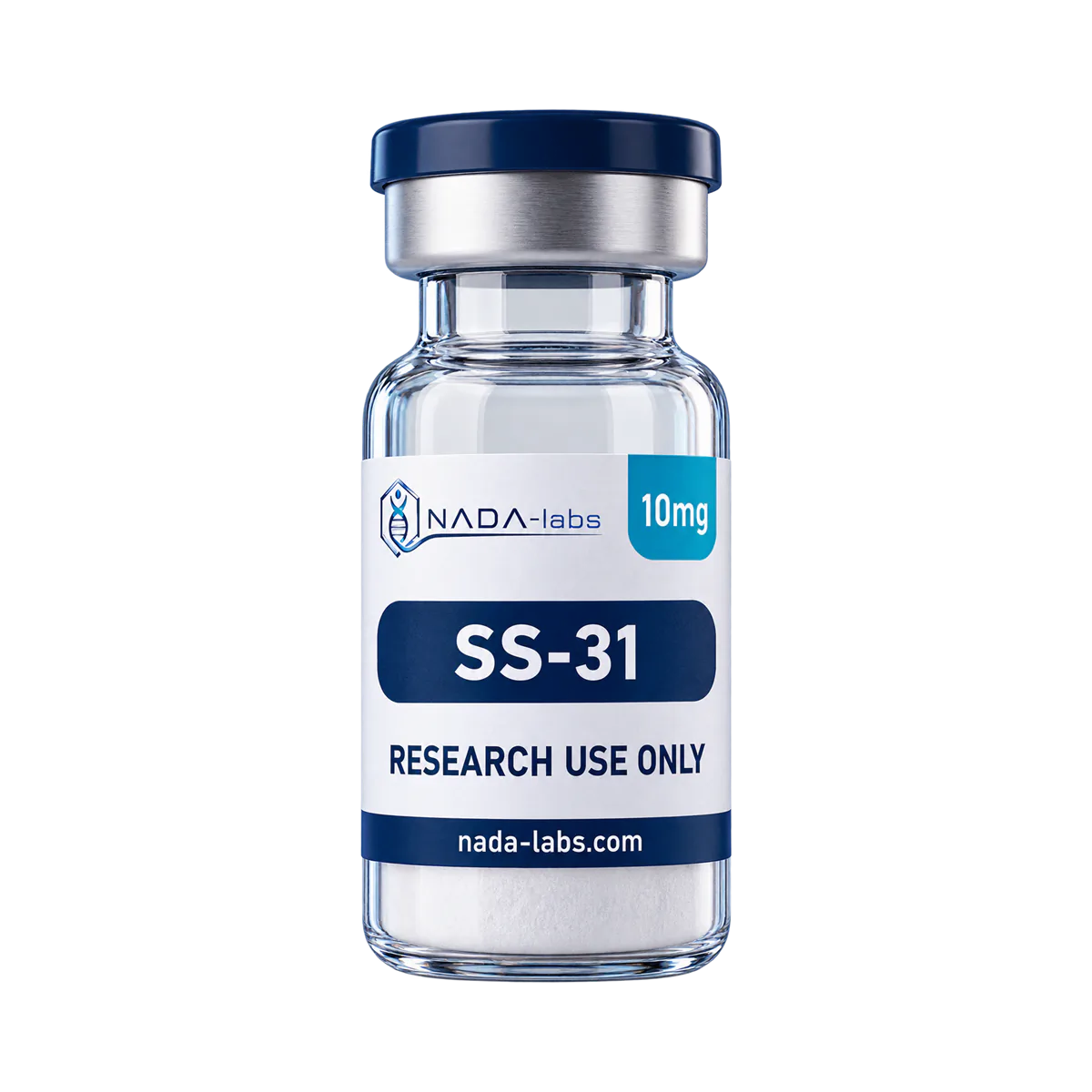
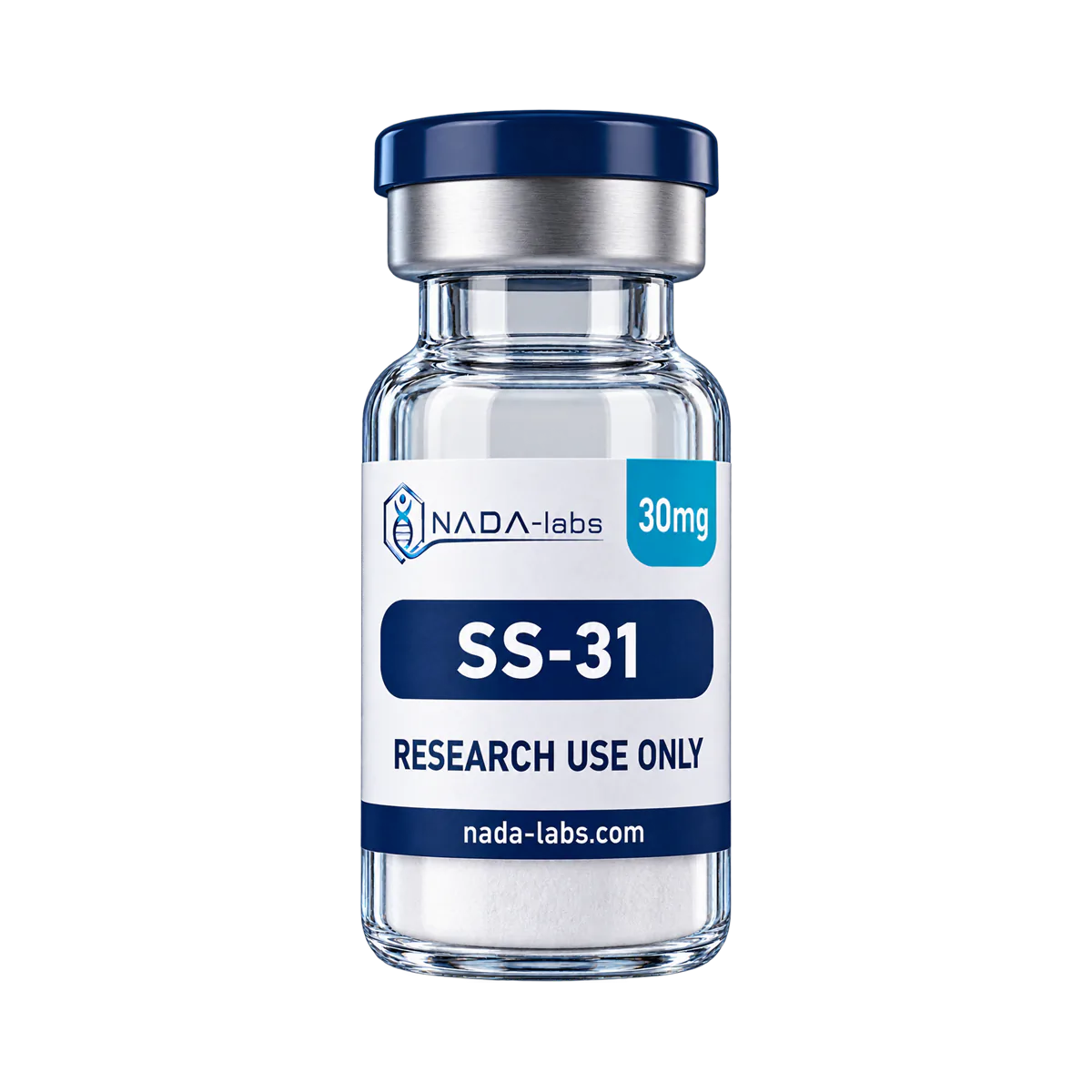
SS-31 (elamipretide) is a synthetic aromatic-cationic tetrapeptide, D-Arg-Dmt-Lys-Phe-NH₂, containing D-arginine, the synthetic amino acid 2′,6′-dimethyltyrosine (Dmt) and a C-terminal amide. It is water-soluble and strongly basic (formal charge +3 at neutral pH). The sequence contains no methionine, cysteine or tryptophan; as with all lyophilised peptides, keep vials sealed, cold and away from light.
SS-31: what the published research shows
Compiled by NADA-Labs from the peer-reviewed literature cited below. No own study data.
SS-31 (elamipretide, also MTP-131 and Bendavia; D-Arg-Dmt-Lys-Phe-NH₂) is a synthetic, water-soluble tetrapeptide combining natural amino acids with the synthetic 2′,6′-dimethyltyrosine in an alternating aromatic-cationic structure2,5. It belongs to the Szeto-Schiller (SS) peptides (Szeto 2014, PMID 24117165), a family introduced as cell-permeable antioxidants that concentrate in the inner mitochondrial membrane (Zhao 2004, PMID 15178689). The research literature attributes its effects mainly to high-affinity binding to cardiolipin, an anionic phospholipid of the inner mitochondrial membrane, and to preservation of cristae structure and ATP recovery under ischaemic stress1. It has been studied in vitro, in rat, mouse, dog, sheep, guinea-pig and rabbit models and in randomised human trials in mitochondrial, cardiac, renal, skeletal-muscle and ophthalmic settings.
Evidence base: Preclinical data come from in vitro membrane and mitochondrial studies and animal models (rat renal ischaemia, dog heart failure, ageing mice; sheep, guinea-pig and rabbit reperfusion models, Kloner 2012, PMID 23130143). Human data comprise eleven randomised placebo- or vehicle-controlled trials (both tables below) in primary mitochondrial myopathy, Barth syndrome, heart failure, ST-elevation myocardial infarction (STEMI), renal artery stenosis, ageing muscle and two eye diseases, plus open-label and natural-history follow-up in Barth syndrome (Hornby 2022, PMID 36056411). Most of these trials, including the phase 3 trial MMPOWER-3 (n = 218)4 and ReCLAIM-2 (n = 176; Ehlers 2025, PMID 39605874), missed their primary efficacy endpoint; supportive findings come from small or short trials, uncontrolled extensions, post hoc subgroups and nominal secondary endpoints.
Key studies at a glance
| Study | Model | Design | Main result |
|---|---|---|---|
| Birk 20131 | Cardiolipin assays (in vitro); rat renal ischaemia (in vivo) | Controlled; fluorescent SS-31 analogue; pretreatment | High-affinity cardiolipin binding; cytochrome c peroxidase inhibited; cristae preserved, faster ATP recovery; no effect sizes in abstract |
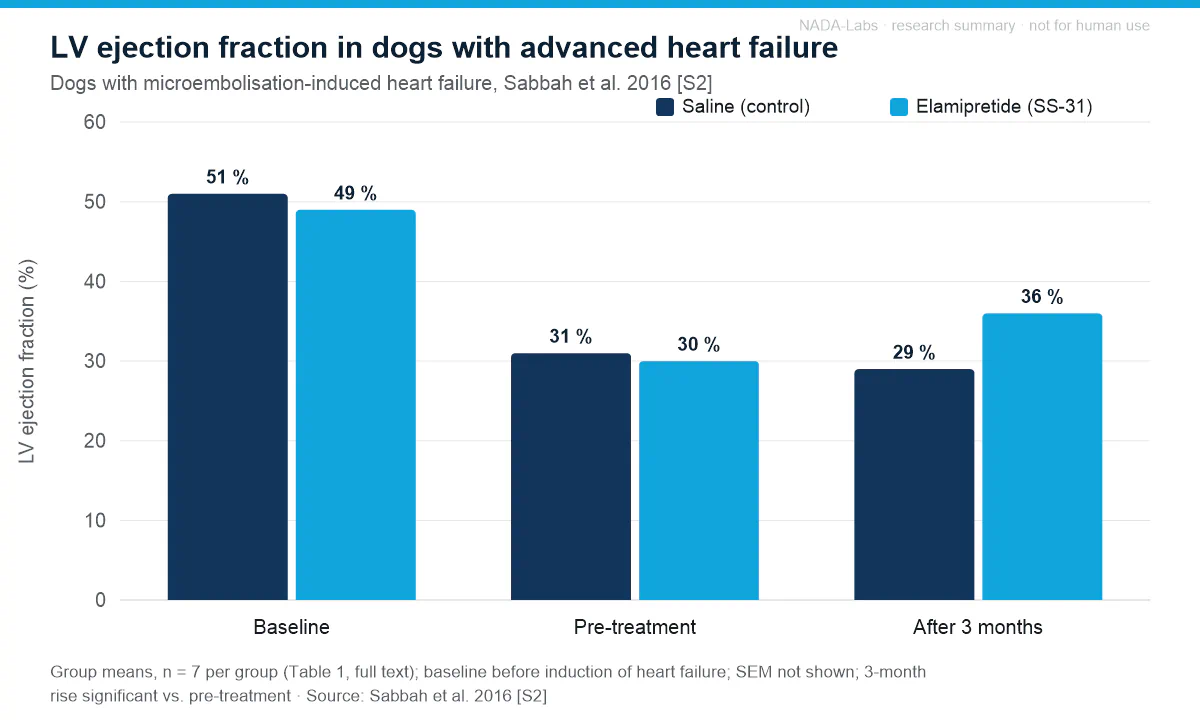
| Sabbah 20162 | Dogs with microembolisation-induced heart failure, in vivo | Randomised vs. saline; n = 7/group; 3 months subcutaneous | LVEF 30 -> 36 % vs. 31 -> 29 % (saline); NT-proBNP -774 vs. +88 pg/mL; mitochondrial ATP/ADP 1.16 vs. 0.38 |
| Karaa 20183 | Human, primary mitochondrial myopathy | Phase 1/2, randomised, double-blind, placebo-controlled, ascending dose; n = 36; 5 days intravenous | 6-minute walk test (6MWT) +64.5 m (highest-dose group) vs. +20.4 m (placebo), p = 0.053 |
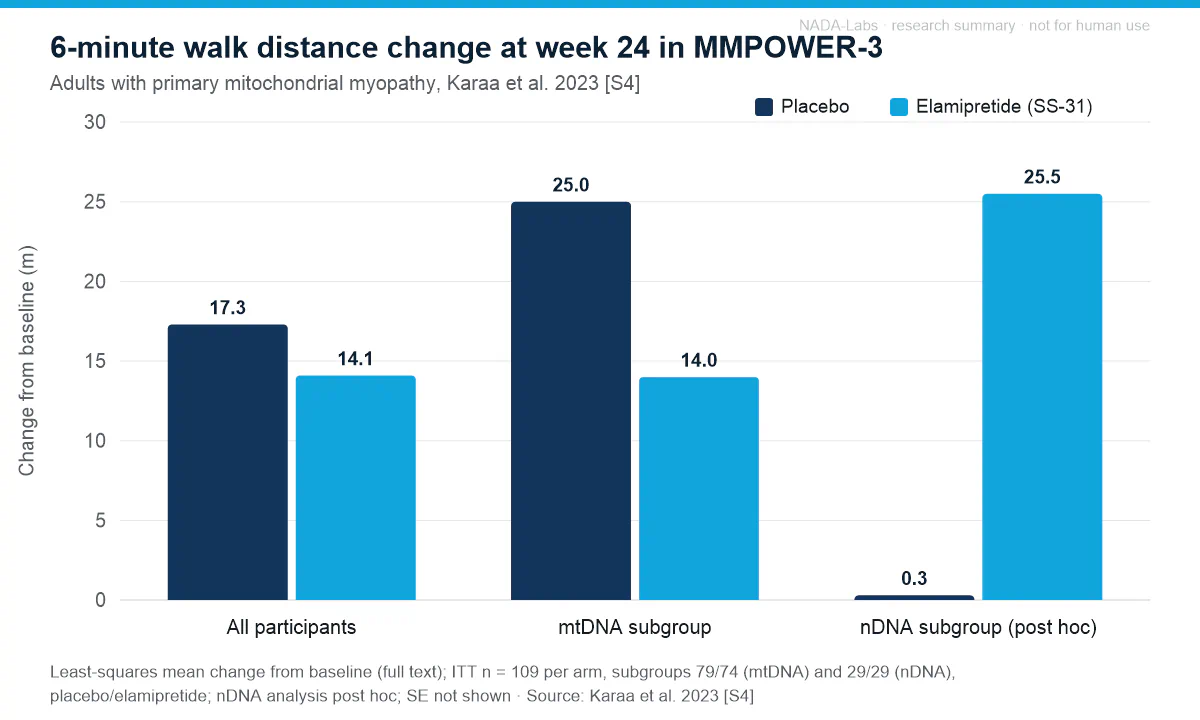
| Karaa 20234 | Human, primary mitochondrial myopathy | Phase 3, randomised, double-blind, placebo-controlled; n = 218; 24 weeks subcutaneous | Primary endpoints not met (6MWT -3.2 m, p = 0.69); nDNA subgroup +25.2 m (post hoc, p = 0.03) |
| Thompson 20215 | Human, Barth syndrome (age 12 years and older) | Randomised, double-blind, placebo-controlled crossover, n = 12, 2 x 12 weeks subcutaneous; open-label extension | Crossover: primary endpoints not met (6MWT -0.8 m, p = 0.97); open-label week 36 (n = 8): +95.9 m |
| Gibson 20166 | Human, first anterior STEMI undergoing primary PCI | Phase 2a, multicentre, randomised, double-blind, placebo-controlled; intravenous infusion | Infarct size (CK-MB AUC over 72 h) 5570 (MTP-131) vs. 5785 ng·h/mL (placebo), not significant; MRI, angiographic, ECG and clinical outcomes not improved |
| Daubert 20177 | Human, heart failure with reduced ejection fraction (EF ≤ 35 %) | Randomised, double-blind, placebo-controlled, ascending dose; n = 36; single intravenous infusion | Highest-dose cohort vs. placebo at end of infusion: LVEDV -18 mL (p = 0.009), LVESV -14 mL (p = 0.005) |
| Roshanravan 20218 | Human, healthy older adults (60-85 years) with poorly functioning muscle mitochondria | Randomised, double-blind, placebo-controlled; n = 39; single intravenous infusion; 31P-MRS | Maximal mitochondrial ATP production +27 % vs. +12 % (p = 0.045); no difference on day 7 |
Further randomised human trials of elamipretide
| Study | Population (n) | Design | Primary endpoint | Result |
|---|---|---|---|---|
| Karaa 2020, MMPOWER-2 (PMID 32096613) | Primary mitochondrial myopathy (30) | Double-blind, placebo-controlled crossover; 2 x 4 weeks subcutaneous | 6MWT distance | Not met: difference 19.8 m (p = 0.0833); patient-reported fatigue lower (nominal p = 0.0006) |
| Butler 2020, PROGRESS-HF (PMID 32068002) | Heart failure, LVEF ≤ 40 % (71) | Phase 2, double-blind, placebo-controlled; 4 weeks subcutaneous | LV end-systolic volume, cardiac MRI (stated objective) | Not met: no difference from placebo (p = 0.90 and p = 0.28 for the two dose groups); no significant difference in LVEF change either |
| Saad 2017 (PMID 28916603) | Renal artery stenosis undergoing stenting (14) | Phase 2a pilot, double-blind, placebo-controlled; intravenous infusion before and during stenting | Renal oxygenation, blood flow and function (study hypothesis) | Hypoxia at 24 h +47 % (placebo) vs. -6 %; stenotic-kidney blood flow 202 -> 262 mL/min (p = 0.04) with elamipretide only |
| Ehlers 2025, ReCLAIM-2 (PMID 39605874) | Dry age-related macular degeneration with geographic atrophy (176) | Phase 2, double-masked, placebo-controlled; 48 weeks subcutaneous | Low-luminance visual acuity; geographic-atrophy growth | Not met; nominal 43 % less progression of complete ellipsoid-zone loss (p = 0.0034) |
| Karanjia 2024 (PMID 37923251) | Leber hereditary optic neuropathy (12) | Phase 2, double-masked, vehicle-controlled; topical ophthalmic solution, 52 weeks | Adverse events; best-corrected visual acuity (efficacy) | Visual acuity not different from vehicle-treated eyes at any time point; no serious adverse events |
Effects reported in the studies
- Cardiolipin binding and mitochondrial structure (in vitro, rat). A fluorescent SS-31 analogue bound cardiolipin with high affinity and the SS-31/cardiolipin complex inhibited cytochrome c peroxidase activity; in rats pretreated before renal ischaemia, cristae were protected and ATP recovered promptly, with less renal dysfunction (no effect sizes in the abstract)1. In model membranes the polybasic peptide (formal charge +3 at neutral pH) bound in direct relation to surface charge (Mitchell 2020, PMID 32273339).
- Cardiac and mitochondrial function in canine heart failure. After 3 months of subcutaneous treatment, LV ejection fraction rose from 30 % to 36 % (p < 0.05) while it fell from 31 % to 29 % with saline; NT-proBNP fell by 774 pg/mL versus a rise of 88 pg/mL (p < 0.001), and the cardiomyocyte ATP/ADP ratio was 1.16 versus 0.38 (p < 0.001), with less interstitial fibrosis and cardiomyocyte hypertrophy2.
- Walking distance in primary mitochondrial myopathy (human). After 5 days of intravenous treatment the highest-dose group walked 64.5 m farther versus 20.4 m with placebo (p = 0.053), with no difference between the groups 2 days after stopping3; a 4-week crossover trial missed its walking endpoint (Karaa 2020, PMID 32096613). In the 24-week phase 3 trial (n = 218) the difference was -3.2 m (p = 0.69); a post hoc subgroup with nuclear-DNA defects showed +25.2 m versus placebo (p = 0.03), the mitochondrial-DNA subgroup -11.0 m (p = 0.21)4.
- Barth syndrome (human). The controlled crossover part (n = 12) showed no difference (6MWT -0.8 m, p = 0.97); in the uncontrolled extension the 8 participants reaching week 36 improved by 95.9 m (p = 0.024), a placebo effect not being excluded by the authors5. Later open-label and natural-history analyses reported +96.1 m at week 168 (Thompson 2024, PMID 38602181) and +79.7 m versus 19 untreated controls at week 64 (Hornby 2022, PMID 36056411).
- Heart failure and infarct size (human, animal). In patients with heart failure with reduced ejection fraction (n = 36), a single intravenous infusion lowered LV end-diastolic and end-systolic volumes by 18 and 14 mL versus placebo at end of infusion in the highest-dose cohort7, whereas 4 weeks of subcutaneous treatment in 71 such patients did not change LV end-systolic volume or ejection fraction compared with placebo (Butler 2020, PMID 32068002). In STEMI, infarct size was not reduced6, although postischaemic administration had reduced it by 15 % in sheep and by 38-42 % in ex vivo guinea-pig hearts (Kloner 2012, PMID 23130143).
- Muscle energetics in ageing (mouse, human). In 27-month-old mice a single treatment reversed age-related declines in mitochondrial ATP production and coupling within 1 h (Siegel 2013, PMID 23692570). In older adults (n = 39), maximal mitochondrial ATP production of a hand muscle rose by 27 % versus 12 % with placebo immediately after one infusion (p = 0.045), with no difference on day 7 and no significant effect on fatigue resistance in the protocol-specified analysis8.
Adverse effects and tolerability reported
- Injection-site reactions. They were the most common adverse events with subcutaneous use: in the Barth crossover, erythema occurred in 12 of 12 participants on elamipretide versus 3 of 12 on placebo and pain in 9 versus 45; in the phase 3 trial, adverse events occurred in 98.2 % versus 76.1 %, injection-site reactions being the most frequent4.
- Discontinuations. Adverse events led to discontinuation in 7.3 % versus 1.8 % in the phase 3 trial4, and 2 of 10 participants left the Barth extension because of injection-site reactions5.
- Serious adverse events. They occurred in 4.6 % versus 2.8 % in the phase 3 trial, were not judged treatment-related, and there were no deaths4; one unrelated serious event occurred in the Barth trial5, and none in the 5-day intravenous and single-infusion trials3,7.
- Intravenous administration. Headache (6 of 36 participants, 16.7 %) and dizziness (3 of 36, 8.3 %), counted across all groups including placebo, were the most common adverse events in the 5-day trial, with no differences between the elamipretide groups and the placebo group3; after a single infusion, blood pressure and heart rate remained stable and plasma concentrations were undetectable by 24 h7; the STEMI trial describes the infusion as safe and well tolerated6.
- Tolerability not reported in the animal studies. The dog study does not report tolerability data2, and the rat study does not address adverse effects in its abstract1.
Limitations of the evidence. Most randomised trials missed their primary efficacy endpoint, including the phase 3 myopathy trial, the controlled part of the Barth trial, the STEMI trial4,5,6 and PROGRESS-HF (Butler 2020, PMID 32068002). Positive human findings rest on small or short trials3,7,8, an uncontrolled extension5, post hoc subgroups4 and nominal secondary endpoints (Ehlers 2025, PMID 39605874), and injection-site reactions may compromise blinding (Karaa 2020, PMID 32096613). Differences seen after a single infusion or a 5-day course were absent 2-7 days later3,8, and infarct-size reductions in animals (Kloner 2012, PMID 23130143) did not translate to patients6. The myopathy, Barth syndrome and ageing-muscle trials and the dog study were funded wholly or in part by the developing company2,3,4,5,8. None of the findings summarised here establish efficacy or safety for any use outside the described research models.
References
- Birk AV, Liu S, Soong Y, Mills W, Singh P, Warren JD, Seshan SV, Pardee JD, Szeto HH (2013). The mitochondrial-targeted compound SS-31 re-energizes ischemic mitochondria by interacting with cardiolipin. Journal of the American Society of Nephrology. PMID 23813215 DOI
- Sabbah HN, Gupta RC, Kohli S, Wang M, Hachem S, Zhang K (2016). Chronic Therapy With Elamipretide (MTP-131), a Novel Mitochondria-Targeting Peptide, Improves Left Ventricular and Mitochondrial Function in Dogs With Advanced Heart Failure. Circulation: Heart Failure. PMID 26839394 DOI
- Karaa A, Haas R, Goldstein A, Vockley J, Weaver WD, Cohen BH (2018). Randomized dose-escalation trial of elamipretide in adults with primary mitochondrial myopathy. Neurology. PMID 29500292 DOI human study
- Karaa A, Bertini E, Carelli V, Cohen BH, Enns GM, Falk MJ, Goldstein A, Gorman GS, Haas R, Hirano M, Klopstock T, Koenig MK, Kornblum C, Lamperti C, Lehman A, Longo N, Molnar MJ, Parikh S, Phan H, Pitceathly RDS, Saneto R, Scaglia F, Servidei S, Tarnopolsky M, Toscano A, Van Hove JLK, Vissing J, Vockley J, Finman JS, Brown DA, Shiffer JA, Mancuso M, MMPOWER-3 Trial Investigators (2023). Efficacy and Safety of Elamipretide in Individuals With Primary Mitochondrial Myopathy: The MMPOWER-3 Randomized Clinical Trial. Neurology. PMID 37268435 DOI human study
- Reid Thompson W, Hornby B, Manuel R, Bradley E, Laux J, Carr J, Vernon HJ (2021). A phase 2/3 randomized clinical trial followed by an open-label extension to evaluate the effectiveness of elamipretide in Barth syndrome, a genetic disorder of mitochondrial cardiolipin metabolism. Genetics in Medicine. PMID 33077895 DOI human study
- Gibson CM, Giugliano RP, Kloner RA, Bode C, Tendera M, Jánosi A, Merkely B, Godlewski J, Halaby R, Korjian S, Daaboul Y, Chakrabarti AK, Spielman K, Neal BJ, Weaver WD (2016). EMBRACE STEMI study: a Phase 2a trial to evaluate the safety, tolerability, and efficacy of intravenous MTP-131 on reperfusion injury in patients undergoing primary percutaneous coronary intervention. European Heart Journal. PMID 26586786 DOI human study
- Daubert MA, Yow E, Dunn G, Marchev S, Barnhart H, Douglas PS, O’Connor C, Goldstein S, Udelson JE, Sabbah HN (2017). Novel Mitochondria-Targeting Peptide in Heart Failure Treatment: A Randomized, Placebo-Controlled Trial of Elamipretide. Circulation: Heart Failure. PMID 29217757 DOI human study
- Roshanravan B, Liu SZ, Ali AS, Shankland EG, Goss C, Amory JK, Robertson HT, Marcinek DJ, Conley KE (2021). In vivo mitochondrial ATP production is improved in older adult skeletal muscle after a single dose of elamipretide in a randomized trial. PLoS One. PMID 34264994 DOI human study
This section summarises findings published in the cited peer-reviewed literature for informational purposes. It is not a claim of efficacy or safety, contains no dosing or administration information by design, and does not constitute medical, veterinary or scientific advice. Results in cell cultures or animal models do not predict effects in humans.