Description
Melanotan II is a synthetic cyclic heptapeptide analogue of the α-MSH(4-10) fragment. A lactam bridge between the side chains of aspartic acid and lysine closes the ring, norleucine takes the place of the native methionine, and the chain is capped by an N-terminal acetyl group and a C-terminal amide. The sequence includes one tryptophan residue — keep vials sealed, cold and away from light.
Melanotan II: what the published research shows
Compiled by NADA-Labs from the peer-reviewed literature cited below. No own study data.
Melanotan II (MT-II or MTII; Ac-Nle-cyclo[Asp-His-D-Phe-Arg-Trp-Lys]-NH₂) is a synthetic, lactam-bridged cyclic analogue of α-MSH(4-10) from a molecular-dynamics-based design series of cyclic melanotropins7, with superpotent melanotropic activity in vitro1. It is a non-selective melanocortin agonist: the MC1, MC3, MC4 and MC5 receptors all recognise it, whereas MC2 primarily recognises only ACTH (Hruby 1995, PMID 7658432). The research literature attributes its effects mainly to central MC3/MC4 receptors in feeding5 and to brain and spinal melanocortin receptors in penile erection4; the melanocyte receptor MC1-R, which also recognises it, controls eumelanin synthesis5. It has been studied in vitro, in rodent models and in three small clinical studies in men1,2,3.
Evidence base: Mostly rodent pharmacology, in which the peptide is a widely used melanocortin agonist6, plus in-vitro bioassays. Human data consist of one single-blind, saline-controlled pilot phase-I study in three healthy men1 and two double-blind, placebo-controlled crossover studies in men with erectile dysfunction (n = 10 each)2,3, summarised in a further report (n = 20; Wessells 2000, PMID 11035391), all published between 1996 and 2000 by one group that included two of the peptide’s designers (Hadley, Hruby)7. No independent, larger or longer controlled human studies were identified. Other human data are case reports after unregulated use (Habbema 2017, PMID 28266027).
Key studies at a glance
| Study | Model | Design | Main result |
|---|---|---|---|
| Dorr 19961 | Human, healthy men | Single-blind, saline-controlled pilot phase I; n = 3; 2 weeks | Spontaneous erections 1-5 h after administration; increased skin pigmentation in 2 of 3 (reflectance); somnolence, mild nausea, yawning |
| Wessells 19982 | Human, psychogenic erectile dysfunction | Double-blind, placebo-controlled crossover; n = 10; 6-h RigiScan | Erections in 8 of 10 men; tip rigidity > 80 %: 38.0 vs. 3.0 min (p = 0.0045) |
| Wessells 20003 | Human, erectile dysfunction with organic risk factors | Double-blind, placebo-controlled crossover; n = 10; 6-h RigiScan | Erections after 12 of 19 peptide vs. 1 of 21 placebo administrations; tip rigidity > 80 %: 45.3 vs. 1.9 min (p = 0.047); higher sexual desire |
| Wessells 20034 | Rat, in vivo (central, spinal, intravenous and intracavernosal routes) | Controlled route comparison; antagonist SHU9119 | Dose-dependent erections, most efficacious intrathecally; intrathecal response blocked by spinal SHU9119; no effect of intracavernosal administration; no effect sizes in abstract |
| Fan 19975 | Mouse, four hyperphagia models, in vivo (intracerebroventricular) | Controlled; MC3/MC4 antagonist SHU9119 | Feeding inhibited in all four models, completely blocked by SHU9119; no effect sizes in abstract |
| Rinne 20126 | Mouse, conscious and anaesthetised, in vivo (peripheral) | Controlled dose-response; SHU9119, metoprolol, hexamethonium | Dose-dependent rise in blood pressure and heart rate in conscious mice, tachycardia more prominent; abolished by SHU9119; no effect sizes in abstract |
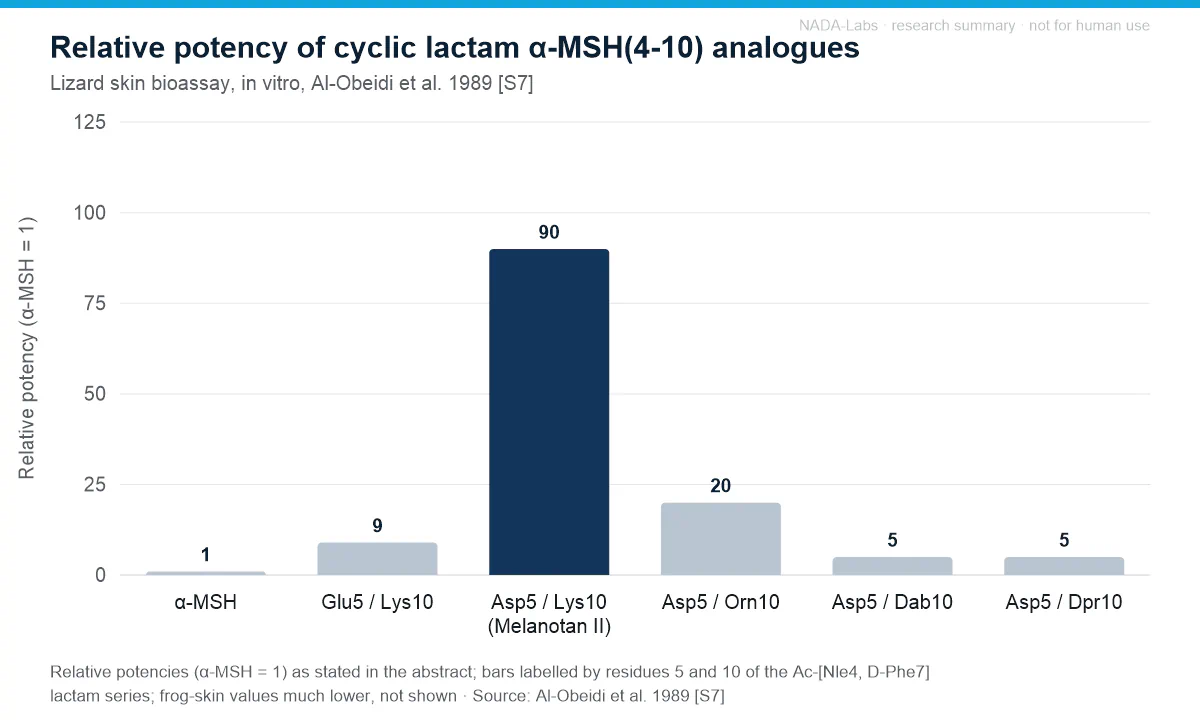
| Al-Obeidi 19897 | Lizard and frog skin bioassays, in vitro | Seven cyclic lactam analogues; potency vs. α-MSH = 1 | Melanotan II structure 90x α-MSH in lizard skin; 23-membered rings most potent, with prolonged activity; much lower potency in frog skin |
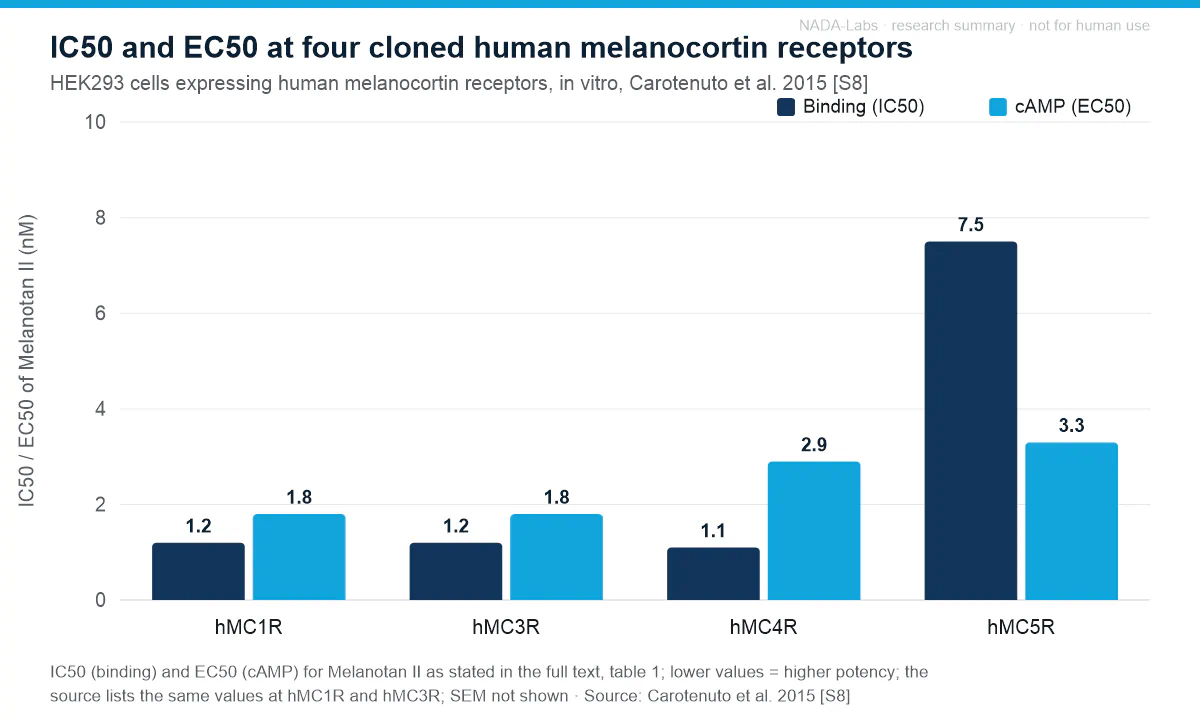
| Carotenuto 20158 | HEK293 cells expressing cloned human melanocortin receptors, in vitro | Competition binding and cAMP accumulation; Melanotan II as the reference compound | Melanotan II IC50 1.2 nM (hMC1R and hMC3R), 1.1 nM (hMC4R) and 7.5 nM (hMC5R); EC50 1.8, 1.8, 2.9 and 3.3 nM |
Placebo-controlled human study outcomes (Wessells 1998 [S2], Wessells 2000 [S3])
| Outcome | Psychogenic erectile dysfunction (n = 10) | Organic risk factors (n = 10) |
|---|---|---|
| Erections | 8 of 10 men (placebo figure not given in abstract) | after 12 of 19 peptide vs. 1 of 21 placebo administrations (subjectively reported) |
| Tip rigidity > 80 %, mean duration (peptide vs. placebo) | 38.0 vs. 3.0 min (p = 0.0045) | 45.3 vs. 1.9 min (p = 0.047) |
| Mean rigidity score of responders (0-10) | not given in abstract | 6.9 |
| Adverse effects | transient nausea, stretching/yawning and decreased appetite more frequent than with placebo; none required treatment | nausea and stretching/yawning more frequent; severe nausea after 4 of 19 administrations |
Effects reported in the studies
- Melanocortin receptor activation and potency (in vitro). In lizard skin bioassays the Asp5/Lys10 α-MSH(4-10) lactam with the Melanotan II structure was 90 times as potent as α-MSH; 23-membered rings were the most potent ring size, and all analogues were much less potent in frog skin7. The cyclic [4-10] analogue was more potent, longer acting and more stable against proteolytic enzymes than its linear counterpart (Hadley 1989, PMID 2557603).
- Erectile responses in men with erectile dysfunction. In two double-blind, placebo-controlled crossover studies (n = 10 each), the mean duration of tip rigidity above 80 % was 38.0 vs. 3.0 min with placebo in psychogenic erectile dysfunction (p = 0.0045)2 and 45.3 vs. 1.9 min in men with organic risk factors (p = 0.047)3. The summary report gives erections in 17 of 20 men in the absence of sexual stimulation (Wessells 2000, PMID 11035391).
- Central and spinal sites of action (rat, rabbit). In awake rats, intracerebroventricular, intrathecal and intravenous administration induced erections dose-dependently, most efficaciously at the lumbosacral spinal cord; spinal SHU9119 blocked the intrathecal response; in anaesthetised rats, intracavernosal injection neither raised intracavernous pressure nor enhanced nerve-stimulated erections4. In anaesthetised rabbits, pudendal nerve transection or nitric-oxide synthase inhibition abolished the peptide-induced rise in cavernosal pressure (Vemulapalli 2001, PMID 11739247).
- Sexual desire and proceptive behaviour. Men with organic risk factors reported significantly higher sexual desire after the peptide than after placebo3; the summary report gives increased desire after 13 of 19 (68 %) peptide vs. 4 of 21 (19 %) placebo administrations (p < 0.01; Wessells 2000, PMID 11035391). In ovariectomised female rats primed with oestradiol benzoate and progesterone, the peptide increased hops and darts and ear wiggling without changing pacing or lordosis, with no effect after oestradiol priming alone (Rössler 2006, PMID 17113634).
- Food intake and energy balance (rodents). Intracerebroventricular administration inhibited feeding in four mouse models of hyperphagia, including ob/ob and A(y) mice, an effect completely blocked by the MC3/MC4 antagonist SHU91195. In rats on a high-fat diet or standard chow (n = 6 each), a 10-day intracerebroventricular infusion decreased caloric intake by 32 and 25 kcal/day and lowered insulin by approximately 50 % (Silva 2006, PMID 16380516).
- Pigmentation endpoint (human pilot study). Two of the three pilot-study subjects showed increased pigmentation of the face, upper body and buttock by quantitative reflectance and visual assessment one week after the last administration; the abstract gives no values1.
Adverse effects and tolerability reported
- Nausea, stretching/yawning and reduced appetite (human crossover studies). In men with psychogenic erectile dysfunction, these transient effects were reported more often than with placebo, and none required treatment2; in men with organic risk factors 4 of 19 administrations were associated with severe nausea3, and the summary report gives severe nausea in 12.9 % of subjects at one dose level (Wessells 2000, PMID 11035391).
- Somnolence, fatigue and spontaneous erections (pilot phase I). In the three healthy volunteers, Grade II somnolence and fatigue occurred in one of two subjects at the highest dose level and mild nausea at most dose levels; a stretching and yawning complex appeared to accompany the onset of spontaneous erections that occurred intermittently for 1-5 hours after administration1.
- Blood pressure and heart rate (mouse, rat). In conscious mice, peripheral administration of Melanotan II or NDP-α-MSH raised blood pressure and heart rate dose-dependently, with tachycardia more prominent than the pressor effect; SHU9119 abolished these effects6. In rats on a high-fat diet or standard chow, a 10-day intracerebroventricular infusion raised mean arterial pressure by 7 ± 2 and 6 ± 1 mmHg (Silva 2006, PMID 16380516).
- Hypothermia (mouse). Intraperitoneal administration in mice caused a profound, transient hypothermia that persisted in mice lacking any one of the MC1, MC3, MC4 or MC5 receptors, was abolished in mast-cell-deficient mice and was greatly diminished by histamine H1-receptor blockade or ablation (Jain 2018, PMID 29812984).
- Rapid tolerance of the food-intake effect (rodents). In mice with diet-induced obesity, food intake returned to control levels at day 5 of repeated administration (Pierroz 2002, PMID 11978628); in rats, a 30 % reduction in food intake attenuated within 5 days, and hypothalamic MC4 receptor expression was diminished by 25 % (Zhang 2010, PMID 20034526).
- Case reports after unregulated use (human). A review links unregulated use of melanotan I and II with changes in existing moles and newly emerging (dysplastic) naevi and cites four case reports of melanomas arising from existing moles during or shortly after use, while noting that conclusive evidence of a causal link is lacking (Habbema 2017, PMID 28266027). Single case reports, which cannot establish causality, describe eruptive naevi and darkening of pre-existing naevi (Schulze 2014, PMID 24334249), systemic toxicity with sympathomimetic symptoms, rhabdomyolysis and renal dysfunction (Nelson 2012, PMID 23121206), ischaemic priapism (Mallory 2021, PMID 33460908) and renal infarction (Peters 2020, PMID 31953620).
Limitations of the evidence. Human evidence consists of three small, short studies (n = 3, 10 and 10) and a summary report, all published between 1996 and 2000 by one group that included two of the peptide’s designers; the abstracts give no variance, and the pigmentation finding comes from a single-blind pilot study without reported values. No independent replication and no long-term safety data were identified. Because the peptide is a non-selective agonist (Hruby 1995, PMID 7658432; Martin 2002, PMID 12409007), its effects in these models cannot be assigned to one receptor subtype, and its potency data come partly from amphibian and reptile skin assays7. After intraperitoneal administration in mice, brain concentrations were low relative to plasma (Hatziieremia 2007, PMID 17610239). None of the findings summarised here establish efficacy or safety for any use outside the described research models.
References
- Dorr RT, Lines R, Levine N, Brooks C, Xiang L, Hruby VJ, Hadley ME (1996). Evaluation of melanotan-II, a superpotent cyclic melanotropic peptide in a pilot phase-I clinical study. Life Sciences. PMID 8637402 DOI human study
- Wessells H, Fuciarelli K, Hansen J, Hadley ME, Hruby VJ, Dorr R, Levine N (1998). Synthetic melanotropic peptide initiates erections in men with psychogenic erectile dysfunction: double-blind, placebo controlled crossover study. The Journal of Urology. PMID 9679884 DOI human study
- Wessells H, Gralnek D, Dorr R, Hruby VJ, Hadley ME, Levine N (2000). Effect of an alpha-melanocyte stimulating hormone analog on penile erection and sexual desire in men with organic erectile dysfunction. Urology. PMID 11018622 DOI human study
- Wessells H, Hruby VJ, Hackett J, Han G, Balse-Srinivasan P, Vanderah TW (2003). Ac-Nle-c[Asp-His-DPhe-Arg-Trp-Lys]-NH2 induces penile erection via brain and spinal melanocortin receptors. Neuroscience. PMID 12710982 DOI
- Fan W, Boston BA, Kesterson RA, Hruby VJ, Cone RD (1997). Role of melanocortinergic neurons in feeding and the agouti obesity syndrome. Nature. PMID 8990120 DOI
- Rinne P, Tikka S, Mäkelä S, Streng T, Savontaus E (2012). Hemodynamic actions and mechanisms of systemically administered α-MSH analogs in mice. Peptides. PMID 22982611 DOI
- Al-Obeidi F, Castrucci AM, Hadley ME, Hruby VJ (1989). Potent and prolonged acting cyclic lactam analogues of alpha-melanotropin: design based on molecular dynamics. Journal of Medicinal Chemistry. PMID 2555512 DOI
- Carotenuto A, Merlino F, Cai M, Brancaccio D, Yousif AM, Novellino E, Hruby VJ, Grieco P (2015). Discovery of Novel Potent and Selective Agonists at the Melanocortin-3 Receptor. Journal of Medicinal Chemistry. PMID 26599352 DOI
This section summarises findings published in the cited peer-reviewed literature for informational purposes. It is not a claim of efficacy or safety, contains no dosing or administration information by design, and does not constitute medical, veterinary or scientific advice. Results in cell cultures or animal models do not predict effects in humans.