Description
A 29-residue growth-hormone-releasing-factor analogue with four substitutions that improve stability against enzymatic degradation, supplied without the drug affinity complex. The peptide is hygroscopic; keep the vial sealed until use and equilibrate to room temperature before opening to avoid condensation.
Also available as a blend: CJC-1295 (no DAC) + Ipamorelin.
CJC-1295 (no DAC): what the published research shows
Compiled by NADA-Labs from the peer-reviewed literature cited below. No own study data.
CJC-1295 without DAC (also referred to as Modified GRF(1-29) or "Mod GRF 1-29") is a synthetic 29-amino-acid analog of the N-terminal fragment of human growth hormone-releasing hormone, GRF(1-29), carrying four amino-acid substitutions (D-Ala2, Gln8, Ala15, Leu27) intended to resist dipeptidylpeptidase-IV (DPP-IV) cleavage, asparagine isomerisation and methionine oxidation. The proposed mechanism is agonism at the pituitary GHRH receptor with downstream release of endogenous growth hormone (GH) and, secondarily, IGF-I. The peer-reviewed literature published under the name CJC-1295 almost exclusively concerns the DAC form, i.e. the same tetrasubstituted peptide with an added C-terminal maleimidopropionamide-lysine group that binds covalently to serum albumin. Published work comprises cultured rat anterior pituitary cell assays, plasma stability assays, normal rats, pigs, GHRH-knockout mice and two small placebo-controlled trials in healthy adults; no peer-reviewed human or animal study of the non-DAC peptide itself was identified.
Evidence base: Non-DAC peptide: no peer-reviewed human or animal efficacy or safety study; a 2026 narrative review classifies it as evidence tier D (no peer-reviewed human studies, route and half-life not reported in any human study)7. DAC form: two small randomized, double-blind, placebo-controlled phase-I-type trials in healthy adults2,3, one rat study1 and one GHRH-knockout mouse study4; sample sizes are not stated in the abstracts and the author lists overlap (ConjuChem authors and L. A. Frohman appear on 1–4), so the human and rodent data derive largely from one sponsor/investigator network. Remaining evidence is in vitro and non-primate structure-activity work on individual substitutions5,6 using related but not identical analogues.
Key studies at a glance
| Study | Model | Design | Main result |
|---|---|---|---|
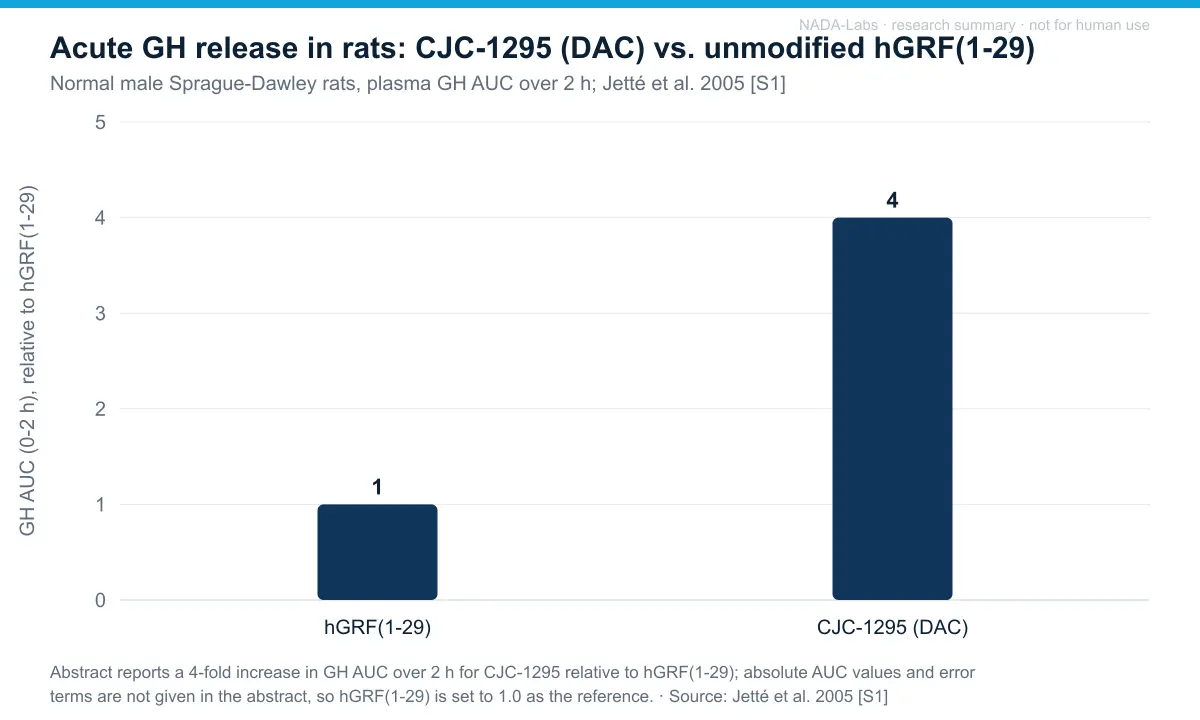
| Jetté 20051 | Cultured rat anterior pituitary cells; normal male rats (DAC form) | Controlled comparison of albumin-conjugated hGRF(1-29) derivatives vs. hGRF(1-29) | 4-fold higher GH AUC (0-2 h); present in plasma beyond 72 h; enhanced DPP-IV stability in vitro |
| Teichman 20062 | Healthy adults, 21-61 y (DAC form) | Two randomized, double-blind, placebo-controlled dose-escalation trials, 28 and 49 d | GH 2- to 10-fold for >= 6 d; IGF-I 1.5- to 3-fold for 9-11 d; t1/2 5.8-8.1 d; no serious adverse reactions reported |
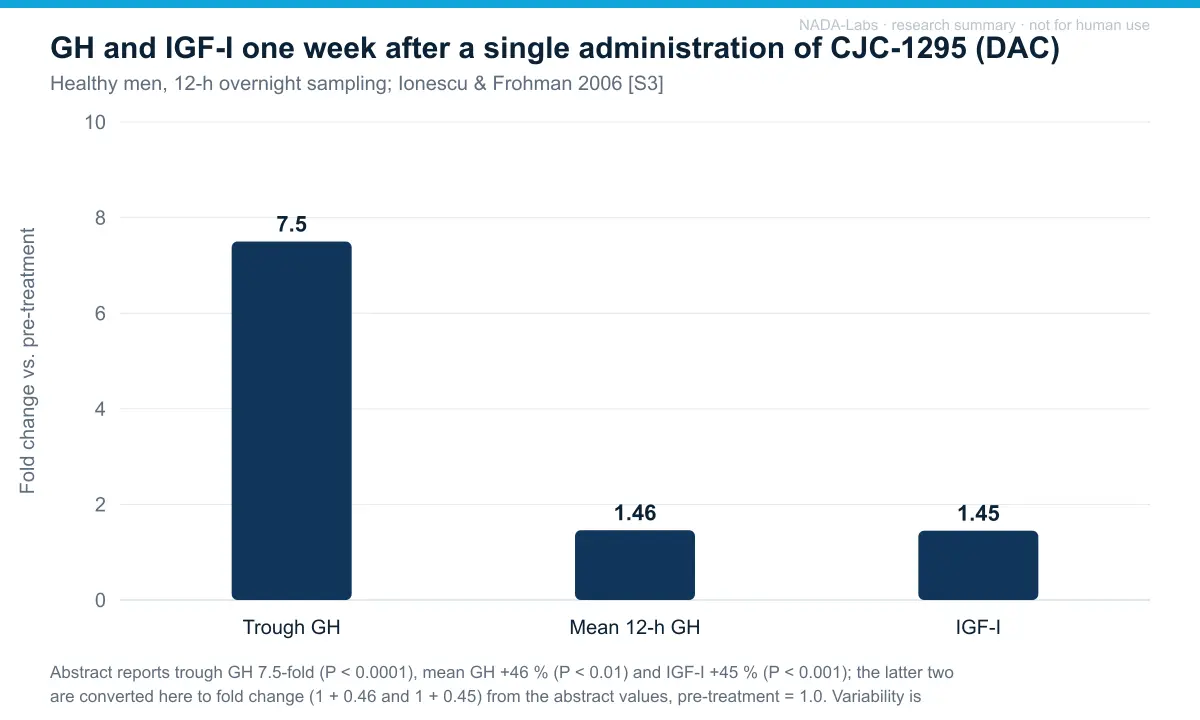
| Ionescu 20063 | Healthy men, 20-40 y (DAC form) | Within-subject 12-h GH profiling before and 1 week after a single administration | Trough GH 7.5-fold (P < 0.0001); mean GH +46 %; IGF-I +45 %; pulse frequency and magnitude unaltered |
| Alba 20064 | GHRH-knockout mice (DAC form) | Controlled, 5 weeks, three injection intervals vs. placebo and heterozygous controls | Shortest interval: normal body weight and length; normal lean and subcutaneous fat mass in all treated groups; increased pituitary GH mRNA |
| Campbell 19945 | Plasma and aqueous stability; rat pituitary cell culture; pigs | Structure-activity study of His1/Val2, residue-8, Ala15 and Leu27 substitutions | DPP-IV cleavage completely inhibited over 24 h; ~3-fold potency in vitro and 11- to 13-fold in pigs vs. hGRF(1-44) |
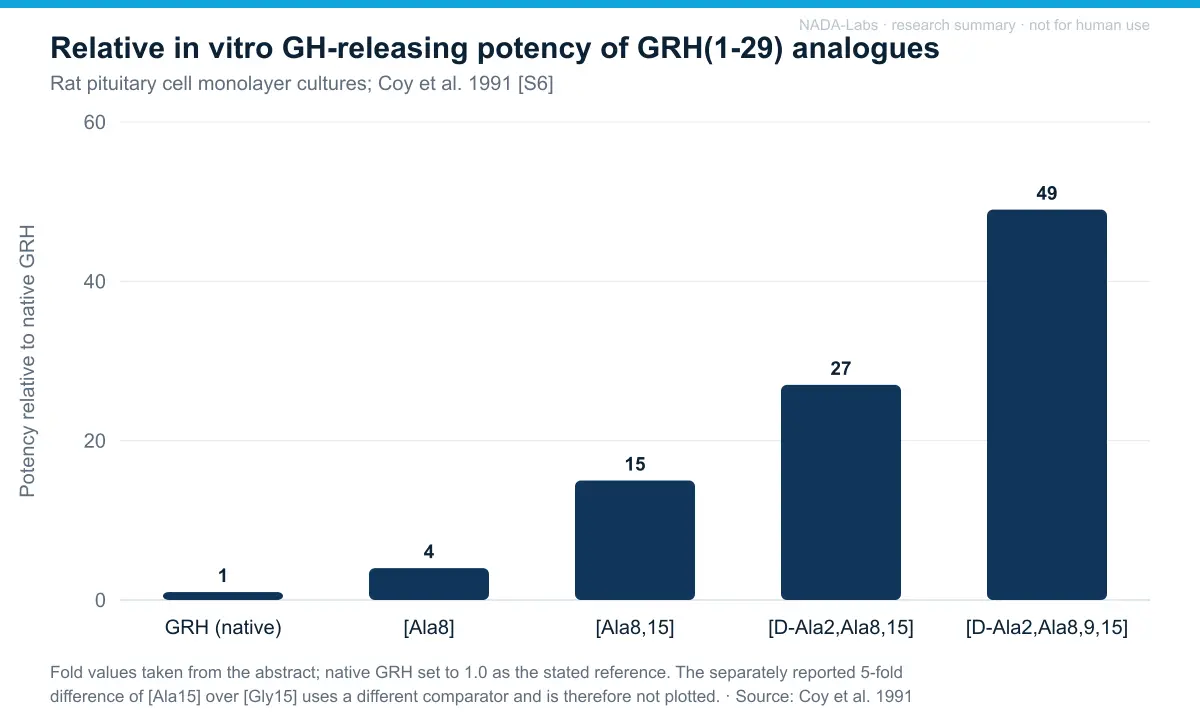
| Coy 19916 | Rat pituitary cell monolayer culture | Structure-activity study of helix-favouring substitutions in GRH(1-29)NH2 | Ala15 5-fold vs. Gly15; [D-Ala2,Ala8,Ala15] 27-fold and [D-Ala2,Ala8,9,15] 49-fold vs. GRH (additive) |
| Dominikowski 20267 | Narrative review of peer-reviewed human evidence | Evidence-tier classification (A-D), 1989-2026 | CJC-1295 with DAC: tier B; without DAC: tier D (no peer-reviewed human studies) |
Pharmacodynamic and pharmacokinetic observations in healthy adults (DAC form)
| Parameter | Observation | Duration | Study |
|---|---|---|---|
| Mean plasma GH, single administration | 2- to 10-fold increase, dose-dependent | >= 6 days | [2] |
| Mean plasma IGF-I, single administration | 1.5- to 3-fold increase | 9-11 days | [2] |
| Mean plasma IGF-I, repeated administration | remained above baseline; cumulative effect described | up to 28 days | [2] |
| Estimated plasma half-life | 5.8-8.1 days | – | [2] |
| Trough (basal) GH | 7.5-fold increase, P < 0.0001 | 1 week after administration | [3] |
| Mean 12-h GH | +46 %, P < 0.01 | 1 week after administration | [3] |
| IGF-I | +45 %, P < 0.001 | 1 week after administration | [3] |
| GH pulse frequency and magnitude | unaltered | 12-h profile | [3] |
| Serious adverse reactions | none reported | 28 and 49 days | [2] |
Effects reported in the studies
- Sustained increase in GH secretion (DAC form, humans). In healthy adults, a single subcutaneous administration of CJC-1295 with DAC increased mean plasma GH 2- to 10-fold for 6 days or more2. In a separate cohort of healthy men, trough GH 1 week after administration was 7.5-fold higher (P < 0.0001) and mean 12-h GH 46 % higher (P < 0.01) than before3.
- Preserved GH pulsatility despite continuous stimulation (DAC form, humans). Frequency and magnitude of GH secretory pulses were unaltered 1 week after a single administration; the overall increase in GH secretion was attributed to the rise in basal (trough) levels3.
- Increase in circulating IGF-I (DAC form, humans). Mean plasma IGF-I rose 1.5- to 3-fold for 9-11 days after a single administration and remained above baseline for up to 28 days after repeated administration2; in a separate cohort IGF-I was 45 % above baseline at 1 week (P < 0.001), without correlation to any measured GH secretion parameter3.
- Prolonged plasma residence conferred by the albumin-binding (DAC) group. Estimated half-life 5.8-8.1 days in healthy adults2; in rats the compound was present in plasma beyond 72 h, with an immunoreactive species co-migrating with serum albumin from 15 min to beyond 24 h1. This property depends on the maleimide (DAC) group and is not a property of the non-DAC peptide.
- Acute GH release in rats (DAC form). After subcutaneous administration in normal male Sprague-Dawley rats, CJC-1295 produced a 4-fold larger plasma GH area under the curve over 2 h than unmodified hGRF(1-29)1.
- Growth and body composition in GHRH-deficient mice (DAC form). Over 5 weeks of treatment, GHRHKO mice in the group with the shortest injection interval showed normal body weight and length; groups with longer intervals exceeded placebo-treated animals without full normalisation. Femur and tibia length remained normal in the two shorter-interval groups, relative lean mass and subcutaneous fat mass were normal in all treated groups, and total pituitary RNA and GH mRNA increased4.
- Enzymatic stability and receptor potency attributed to the individual substitutions. In rat pituitary cell cultures, Ala15 substitution raised GH-releasing potency 5-fold over Gly15, Ala8 4-fold, the combination 15-fold, and D-Ala2 with Ala8 and Ala15 27-fold, with additive effects6. N-terminal His1/Val2 substitution completely inhibited DPP-IV cleavage over 24 h and substitution at residue 8 (including Gln8) slowed isomerisation; the resulting analogues were approximately 3-fold more potent in vitro and 11- to 13-fold more potent in pigs than native hGRF(1-44)5. These data concern related analogues, not the Mod GRF 1-29 sequence itself.
- Absence of data for the non-DAC peptide. A 2026 narrative review reports that no controlled clinical study has evaluated CJC-1295 without DAC in humans, that route of administration and half-life have not been reported in any human study, and that statements about pulsatile GH release or body composition derive from extrapolation from GRF(1-29)/sermorelin and from non-academic sources; the compound is classified as evidence tier D7.
Adverse effects and tolerability reported
- No serious adverse reactions reported. Two randomized, double-blind, placebo-controlled trials in healthy adults (DAC form, 28 and 49 days); the authors describe the compound as safe and relatively well tolerated in the range tested; individual event rates are not given in the abstract
- Vasodilatory reactions and tachycardia. Reports cited by the FDA when listing CJC-1295 in Category 2 of the Bulk Drug Substances List, as reported in a 2026 narrative review; number of reports and setting are not specified
- Class effects of GH-IGF-1 axis stimulation. Endocrine and metabolic disturbances (appetite changes, dysglycaemia), fluid retention syndromes, myalgia/arthralgia and injection-site reactions reported across GH-IGF-1-axis peptides in humans; the review attributes prolactin and cortisol elevations mainly to ghrelin-mimetic GHRPs rather than GHRH analogues, and does not attribute these effects to CJC-1295 specifically
- Theoretical mitogenic concern. The review lists mitogenic GH/IGF-1 signalling as a theoretical oncologic concern for both CJC-1295 variants, with no established clinical carcinogenic signal and no long-term safety data; human data show IGF-I elevation persisting up to 28 days after repeated administration of the DAC form
- Somatotroph proliferation in a rodent model. Increased total pituitary RNA and GH mRNA after 5 weeks of treatment in GHRH-knockout mice, interpreted by the authors as somatotroph proliferation and reported as confirmed by immunohistochemistry; no lesion was reported
- No safety data for the non-DAC peptide. No peer-reviewed human study of CJC-1295 without DAC exists; the review assigns evidence tier D and notes that no adverse-effect profile specific to this variant has been characterised
Limitations of the evidence. All quantitative human and animal results listed here were obtained with CJC-1295 with DAC. The albumin-binding group accounts for the multi-day half-life and the sustained GH and IGF-I elevation, so these values cannot be transferred to the non-DAC peptide, which lacks that group; the 2026 review states that neither half-life nor route has been reported for the non-DAC form in any human study. No peer-reviewed study has evaluated Mod GRF 1-29 itself in humans or animals, and the structure-activity data5,6 concern related but not identical analogues tested in cell culture and pigs. The two human studies are small phase-I-type trials in healthy volunteers without efficacy endpoints, sample sizes are not reported in the abstracts, and the author lists of 1–4 overlap (ConjuChem authors and L. A. Frohman), so the evidence base is concentrated in one sponsor/investigator network. Long-term safety of sustained GH and IGF-I stimulation has not been studied for either variant.
References
- Jetté L, Léger R, Thibaudeau K, Benquet C, Robitaille M, Pellerin I, Paradis V, van Wyk P, Pham K, Bridon DP (2005). Human growth hormone-releasing factor (hGRF)1-29-albumin bioconjugates activate the GRF receptor on the anterior pituitary in rats: identification of CJC-1295 as a long-lasting GRF analog. Endocrinology. PMID 15817669 DOI
- Teichman SL, Neale A, Lawrence B, Gagnon C, Castaigne JP, Frohman LA (2006). Prolonged stimulation of growth hormone (GH) and insulin-like growth factor I secretion by CJC-1295, a long-acting analog of GH-releasing hormone, in healthy adults. Journal of Clinical Endocrinology and Metabolism. PMID 16352683 DOI human study
- Ionescu M, Frohman LA (2006). Pulsatile secretion of growth hormone (GH) persists during continuous stimulation by CJC-1295, a long-acting GH-releasing hormone analog. Journal of Clinical Endocrinology and Metabolism. PMID 17018654 DOI human study
- Alba M, Fintini D, Sagazio A, Lawrence B, Castaigne JP, Frohman LA, Salvatori R (2006). Once-daily administration of CJC-1295, a long-acting growth hormone-releasing hormone (GHRH) analog, normalizes growth in the GHRH knockout mouse. American Journal of Physiology – Endocrinology and Metabolism. PMID 16822960 DOI
- Campbell RM, Stricker P, Miller R, Bongers J, Liu W, Lambros T, Ahmad M, Felix AM, Heimer EP (1994). Enhanced stability and potency of novel growth hormone-releasing factor (GRF) analogues derived from rodent and human GRF sequences. Peptides. PMID 7937325 DOI
- Coy DH, Hocart SJ, Murphy WA (1991). Human growth hormone-releasing hormone analogues with much improved in vitro growth hormone-releasing potencies in rat pituitary cells. European Journal of Pharmacology. PMID 1806385 DOI
- Dominikowski A, Rękoś Z, Olejarz M, Szczepanek-Parulska E, Domin R, Ruchała M (2026). The emerging landscape of performance-enhancing peptides modulating GH-IGF1 axis: bridging the gap between clinical evidence and patient self-administration. Frontiers in Endocrinology (Lausanne). PMID 42395176 DOI human study
This section summarises findings published in the cited peer-reviewed literature for informational purposes. It is not a claim of efficacy or safety, contains no dosing or administration information by design, and does not constitute medical, veterinary or scientific advice. Results in cell cultures or animal models do not predict effects in humans.