Description
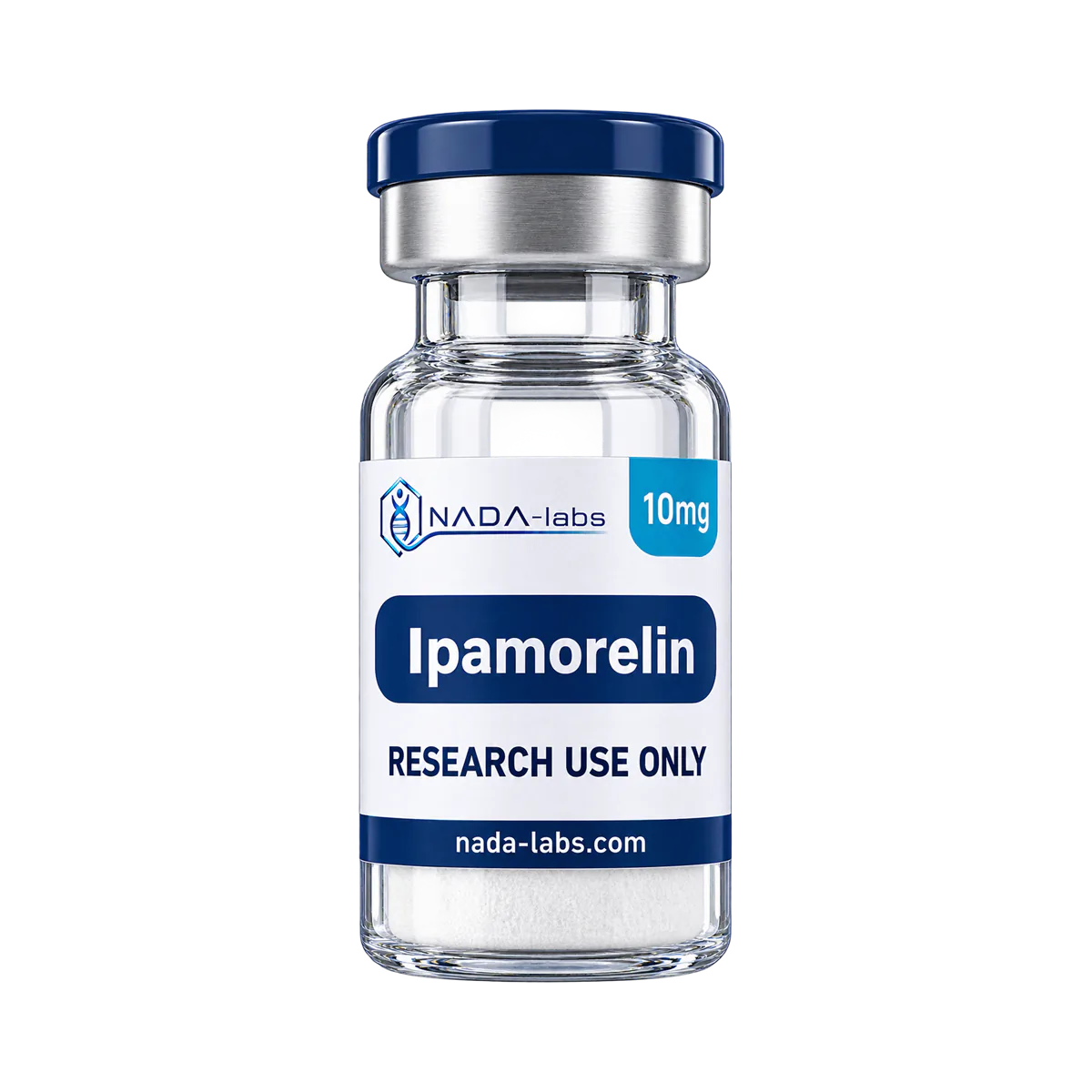
Ipamorelin is a synthetic pentapeptide carrying a C-terminal amide and two non-proteinogenic residues, Aib and D-2-naphthylalanine. It is supplied lyophilised and is stable for extended periods at 2–8 °C. Reconstituted solutions should be kept refrigerated and protected from light.
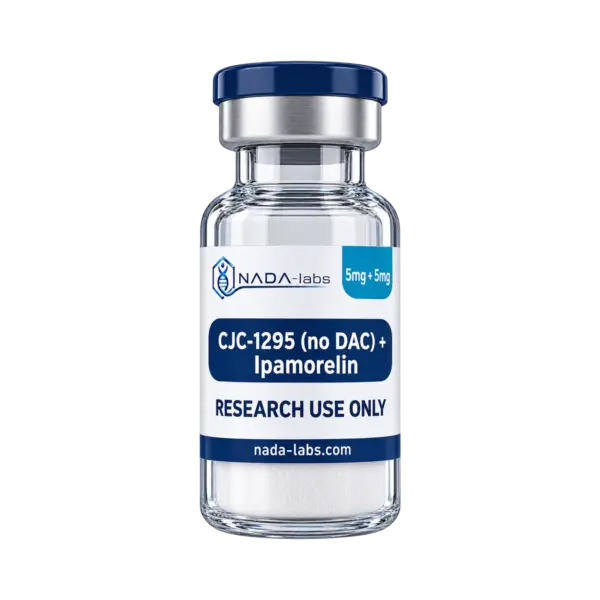
Also available as a blend: CJC-1295 (no DAC) + Ipamorelin.
Ipamorelin: what the published research shows
Compiled by NADA-Labs from the peer-reviewed literature cited below. No own study data.
Ipamorelin is a synthetic pentapeptide (Aib-His-D-2-Nal-D-Phe-Lys-NH2) developed at Novo Nordisk in the 1990s as a growth hormone secretagogue. It acts as an agonist at the GHRP/ghrelin receptor (GHS-R1a) and was characterised as the first GHRP-type ligand that releases growth hormone without a measurable rise in ACTH or cortisol. Published research covers primary rat pituitary cells, anaesthetised rats and conscious swine (GH release and hormone selectivity), longitudinal bone growth and bone mineral content in rats, glucocorticoid-induced catabolism in rats, gastrointestinal motility in a rodent postoperative-ileus model, and two human studies (a pharmacokinetic/pharmacodynamic study in healthy volunteers and a phase 2 randomized trial in bowel-resection patients).
Evidence base: Predominantly rodent in vivo models and in vitro pituitary/pancreas preparations, most from the 1998–2001 Novo Nordisk development programme or Novo-affiliated groups; gastrointestinal studies from one Oklahoma group with Helsinn Healthcare involvement. Two human studies: a dose-escalation PK/PD study in 40 healthy men without a placebo arm, and one multicentre double-blind placebo-controlled phase 2 trial (n = 114) that did not reach its efficacy endpoint.
Key studies at a glance
| Study | Model | Design | Main result |
|---|---|---|---|
| Raun 19981 | Rat pituitary cells; anaesthetised rats; conscious swine | Controlled pharmacology vs. GHRP-6, GHRP-2, GHRH | GH release comparable to GHRP-6 (Emax 85 % in vitro); no ACTH, cortisol, PRL, FSH, LH or TSH release |
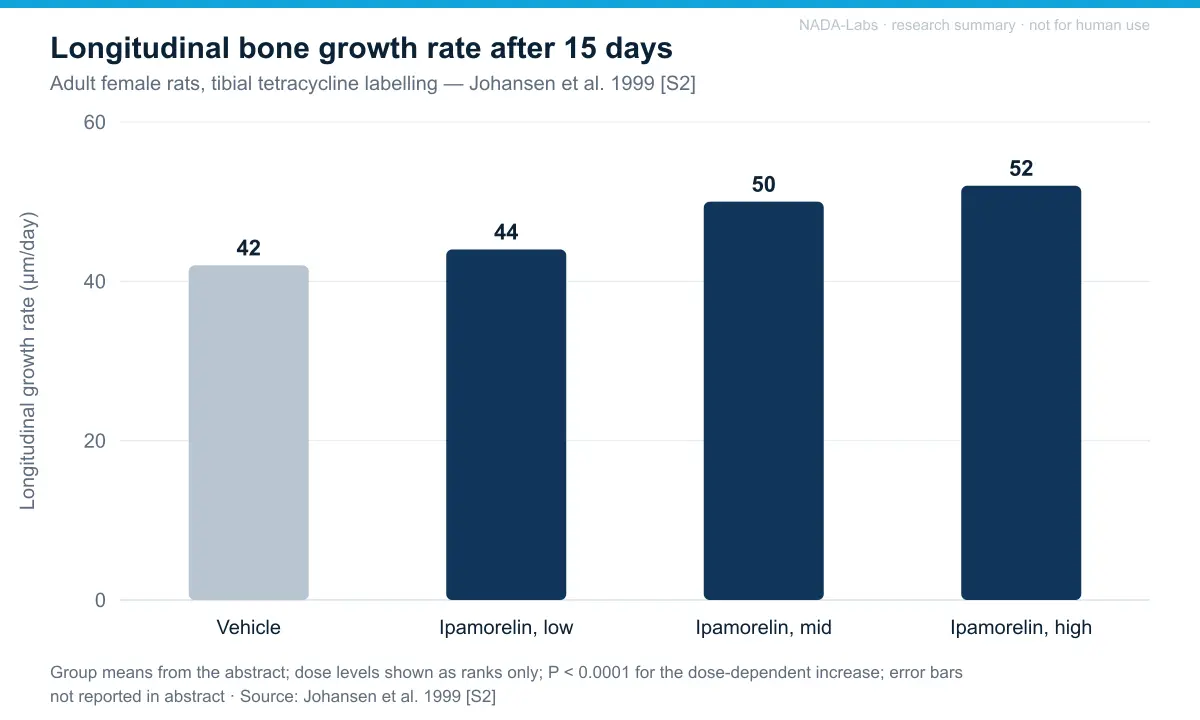
| Johansen 19992 | Adult female rats | Vehicle-controlled, 3 dose levels, 15 days | Tibial growth rate 42 → 44/50/52 µm/day (P < 0.0001); IGF-I unchanged |
| Svensson 20003 | Adult female rats (n = 7 ipamorelin) | Vehicle-controlled minipump infusion, 12 weeks, DXA/pQCT | Tibial and vertebral BMC and bone size increased; volumetric BMD unchanged |
| Andersen 20014 | Adult female rats, methylprednisolone catabolism | Controlled, 3 months | Periosteal bone formation rate four-fold vs. glucocorticoid alone; muscle tetanic tension increased |
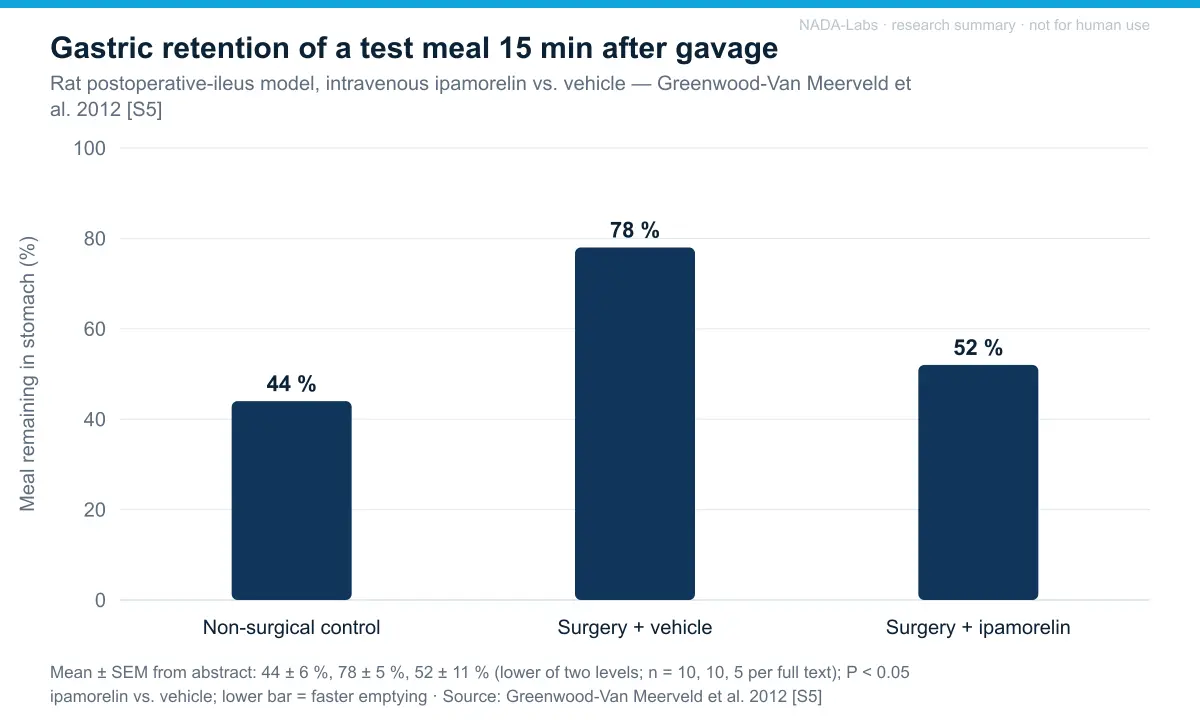
| Greenwood-Van Meerveld 20125 | Male rats, postoperative ileus | Vehicle-controlled, i.v., gastric emptying at 15 min | Meal retention 78 % → 52 % (P < 0.05), equal to non-surgical controls (44 %) |
| Beck 20146 | Humans after bowel resection (n = 114) | Multicentre double-blind RCT, up to 7 days i.v. | Time to first tolerated meal 25.3 vs. 32.6 h (p = 0.15, n.s.); TEAE 87.5 % vs. 94.8 % |
| Gobburu 19997 | Healthy men (n = 40) | Dose-escalation PK/PD, 5 infusion levels, no placebo | Half-life 2 h; single GH peak at 0.67 h; SC50 214 nmol/L |
Human data: phase 2 postoperative-ileus trial (Beck 2014 [S6])
| Outcome | Ipamorelin | Placebo | Statistic |
|---|---|---|---|
| Patients analysed (safety / mITT) | 114 total | — | 117 enrolled |
| Median time to first tolerated solid meal | 25.3 h | 32.6 h | p = 0.15 (not significant) |
| Any treatment-emergent adverse event | 87.5 % | 94.8 % | no significance test reported in abstract |
| Secondary efficacy endpoints | — | — | no significant differences |
Effects reported in the studies
- Growth hormone release with hormone selectivity. In rat pituitary cells ipamorelin reached 85 ± 5 % of the GHRP-6 maximal GH response, and peak plasma GH in anaesthetised rats (1545 ± 250 ng/ml) and conscious swine (65 ng/ml) was comparable to GHRP-6; unlike GHRP-6 and GHRP-2 it did not raise ACTH or cortisol beyond GHRH-stimulated levels and had no effect on FSH, LH, prolactin or TSH1. In healthy men each intravenous infusion produced a single GH peak at 0.67 h with a terminal half-life of 2 h7.
- Longitudinal bone growth and bone mineral content (rats). Fifteen days of treatment raised tibial longitudinal growth rate from 42 µm/day (vehicle) to 44, 50 and 52 µm/day across three dose levels (P < 0.0001) without changing IGF-I or bone turnover markers2. Twelve weeks of continuous infusion increased tibial and vertebral BMC and bone dimensions, but volumetric BMD and BMC per body weight were unchanged, i.e. bones grew larger rather than denser3.
- Counteraction of glucocorticoid-induced catabolism (rats). In rats receiving methylprednisolone for 3 months, co-administration of ipamorelin increased periosteal bone formation rate four-fold and significantly increased maximum tetanic tension of the calf muscles compared with glucocorticoid alone4.
- Gastric emptying and gastrointestinal motility (rodent postoperative ileus). After laparotomy and bowel manipulation 78 ± 5 % of a radiolabelled meal remained in the stomach at 15 min in vehicle-treated rats versus 52 ± 11 % after ipamorelin (P < 0.05), matching non-surgical controls (44 ± 6 %); the higher of two levels left < 25 %. Surgery-induced loss of gastric smooth-muscle contractility was normalised in organ-bath preparations5.
- Postoperative ileus in humans. In a double-blind phase 2 trial (n = 114) median time to a first tolerated solid meal was 25.3 h with ipamorelin vs. 32.6 h with placebo, a difference that was not statistically significant (p = 0.15); secondary endpoints were also not significantly different6. The rodent motility findings therefore did not translate into a significant clinical effect in this trial.
- Body weight gain (rats). Body weight gain was dose-dependently increased in rats over 15 days2 and increased by all active treatments over 12 weeks of infusion3; magnitudes are not given in the abstracts.
Adverse effects and tolerability reported
- Treatment-emergent adverse events (human trial). Phase 2 bowel-resection trial, up to 7 days intravenous: any TEAE in 87.5 % of ipamorelin vs. 94.8 % of placebo patients; described as well tolerated. Post-surgical population, so most events are surgery-related
- No ACTH/cortisol or prolactin release. Conscious swine: ACTH and cortisol not significantly above GHRH-stimulated levels, no change in FSH, LH, PRL, TSH — in contrast to GHRP-6 and GHRP-2
- Partial pituitary desensitisation. Adult female rats after 15 days: GH response to an ipamorelin challenge marginally reduced (P < 0.03); GHRH response and pituitary GH content unchanged
- Increased body fat and food intake (GH-independent). Mice, 2–9 weeks: ipamorelin produced a small (15 %) increase in body weight by 2 weeks, increased relative fat-pad weight and DEXA body fat in both GH-deficient (lit/lit) and GH-intact mice, and increased serum leptin and food intake in GH-intact mice, whereas GH itself reduced relative fat mass (Lall et al. 2001, PMID 11162489, DOI 10.1006/bbrc.2000.4065) — interpreted as a GH-independent, ghrelin-receptor-mediated effect
- Insulin release from pancreatic tissue. Isolated pancreatic fragments of normal and streptozotocin-diabetic rats: significant increase in insulin secretion (p < 0.04), inhibited by a calcium-channel blocker and adrenergic antagonists (p < 0.03) (Adeghate & Ponery 2004, PMID 15665799); relevance to glucose homeostasis in vivo not studied
- Class-level safety considerations. A review of clinical studies of GH secretagogues (Sigalos & Pastuszak 2018, PMID 28400207, DOI 10.1016/j.sxmr.2017.02.004) reports that the class is generally well tolerated but notes concern for increased blood glucose due to decreased insulin sensitivity, and that long-term safety including cancer incidence and mortality has not been evaluated. Long-term data for ipamorelin specifically do not exist: the longest exposures reported are 3 months in rats4 and up to 7 days in humans6
Limitations of the evidence. Almost all preclinical work originates from the Novo Nordisk development programme (1998–2001) or from a single Oklahoma group funded by Helsinn, and several abstracts do not state group sizes or effect magnitudes. Bone effects in rats reflect larger bone dimensions rather than higher volumetric density, and the one placebo-controlled human efficacy trial (postoperative ileus) did not reach statistical significance. Long-term human safety, effects on IGF-I in humans, and any outcome beyond acute GH release in humans have not been studied; the ghrelin-receptor-mediated increase in fat mass and food intake seen in mice has no human counterpart data.
References
- Raun K, Hansen BS, Johansen NL, Thøgersen H, Madsen K, Ankersen M, Andersen PH (1998). Ipamorelin, the first selective growth hormone secretagogue. European Journal of Endocrinology. PMID 9849822 DOI
- Johansen PB, Nowak J, Skjaerbaek C, Flyvbjerg A, Andreassen TT, Wilken M, Orskov H (1999). Ipamorelin, a new growth-hormone-releasing peptide, induces longitudinal bone growth in rats. Growth Hormone & IGF Research. PMID 10373343 DOI
- Svensson J, Lall S, Dickson SL, Bengtsson BA, Rømer J, Ahnfelt-Rønne I, Ohlsson C, Jansson JO (2000). The GH secretagogues ipamorelin and GH-releasing peptide-6 increase bone mineral content in adult female rats. Journal of Endocrinology. PMID 10828840 DOI
- Andersen NB, Malmlöf K, Johansen PB, Andreassen TT, Ørtoft G, Oxlund H (2001). The growth hormone secretagogue ipamorelin counteracts glucocorticoid-induced decrease in bone formation of adult rats. Growth Hormone & IGF Research. PMID 11735244 DOI
- Greenwood-Van Meerveld B, Tyler K, Mohammadi E, Pietra C (2012). Efficacy of ipamorelin, a ghrelin mimetic, on gastric dysmotility in a rodent model of postoperative ileus. Journal of Experimental Pharmacology. PMID 27186127 DOI
- Beck DE, Sweeney WB, McCarter MD; Ipamorelin 201 Study Group (2014). Prospective, randomized, controlled, proof-of-concept study of the Ghrelin mimetic ipamorelin for the management of postoperative ileus in bowel resection patients. International Journal of Colorectal Disease. PMID 25331030 DOI human study
- Gobburu JV, Agersø H, Jusko WJ, Ynddal L (1999). Pharmacokinetic-pharmacodynamic modeling of ipamorelin, a growth hormone releasing peptide, in human volunteers. Pharmaceutical Research. PMID 10496658 DOI human study
This section summarises findings published in the cited peer-reviewed literature for informational purposes. It is not a claim of efficacy or safety, contains no dosing or administration information by design, and does not constitute medical, veterinary or scientific advice. Results in cell cultures or animal models do not predict effects in humans.