Description
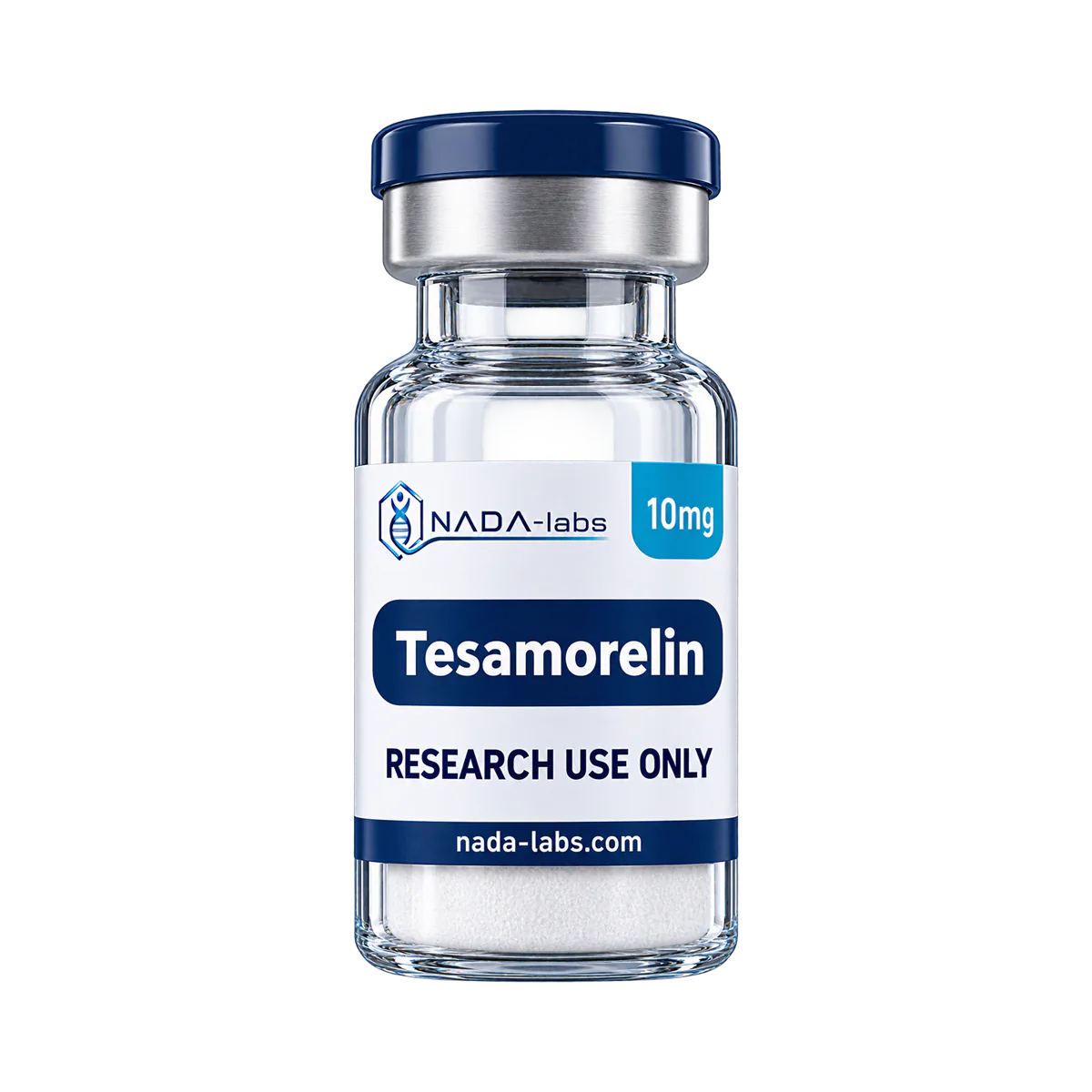
Tesamorelin is a 44-residue analogue of human growth-hormone-releasing factor carrying a trans-3-hexenoyl group on the N-terminus. The acyl group increases resistance to N-terminal degradation. Supplied lyophilised; dissolve slowly and avoid vortexing, which promotes aggregation in longer sequences.
Tesamorelin: what the published research shows
Compiled by NADA-Labs from the peer-reviewed literature cited below. No own study data.
Tesamorelin is a synthetic, stabilised analogue of human growth hormone-releasing hormone (GHRH 1-44). It acts on pituitary GHRH receptors to stimulate pulsatile growth hormone release and consequently raises circulating IGF-I. The published literature is almost entirely clinical: randomised placebo-controlled trials in HIV-associated abdominal fat accumulation (visceral adipose tissue by CT, lipids, glucose homeostasis), smaller trials on liver fat in HIV-associated NAFLD, one placebo-controlled cognition trial in older adults with and without mild cognitive impairment, an open-label neurocognition trial in HIV, and a glycaemic-safety trial in type 2 diabetes. Rodent data are sparse and largely qualitative.
Evidence base: Predominantly randomised, double-blind, placebo-controlled human trials (n = 50 to 806 per trial), several at phase 3; one placebo-controlled cognition trial (n = 152) and one open-label neurocognition trial in HIV (n = 73, no placebo, underpowered per authors); rodent data limited and largely qualitative. The HIV body-composition trials and the type 2 diabetes trial were sponsored by the manufacturer (Theratechnologies) and involve overlapping author groups (Falutz, Grinspoon, Stanley, Mamputu); the HIV-NAFLD trial was NIH-funded but senior authors report consulting and licensing ties to the manufacturer; the cognition (Baker) and neurocognition-in-HIV (Ellis) trials report no conflicts.
Key studies at a glance
| Study | Model | Design | Main result |
|---|---|---|---|
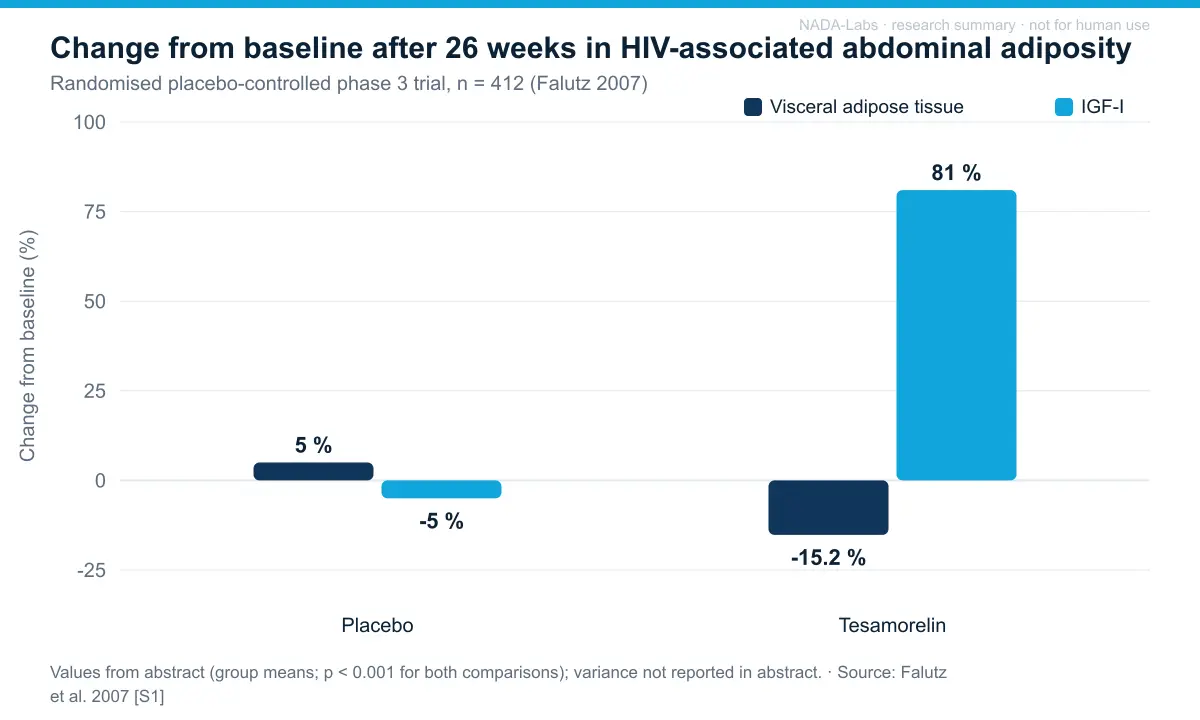
| Falutz 20071 | HIV, abdominal fat accumulation (n = 412) | RCT, double-blind, placebo, 26 wk | VAT -15.2 % vs +5.0 %; triglycerides -50 vs +9 mg/dL; IGF-I +81 % vs -5 % |
| Falutz 20102 | HIV, excess abdominal fat (pooled n = 806) | Pooled phase 3 RCTs, 26 wk + 26 wk extension | VAT -24 vs +2 cm² (treatment effect -15.4 %); -17.5 % at 52 wk; subcutaneous fat not significantly changed |
| Stanley 20143 | HIV, abdominal fat (n = 50) | RCT, double-blind, placebo, 6 mo | VAT -34 vs +8 cm²; liver fat -2.0 % vs +0.9 %; transient glucose rise at 2 wk |
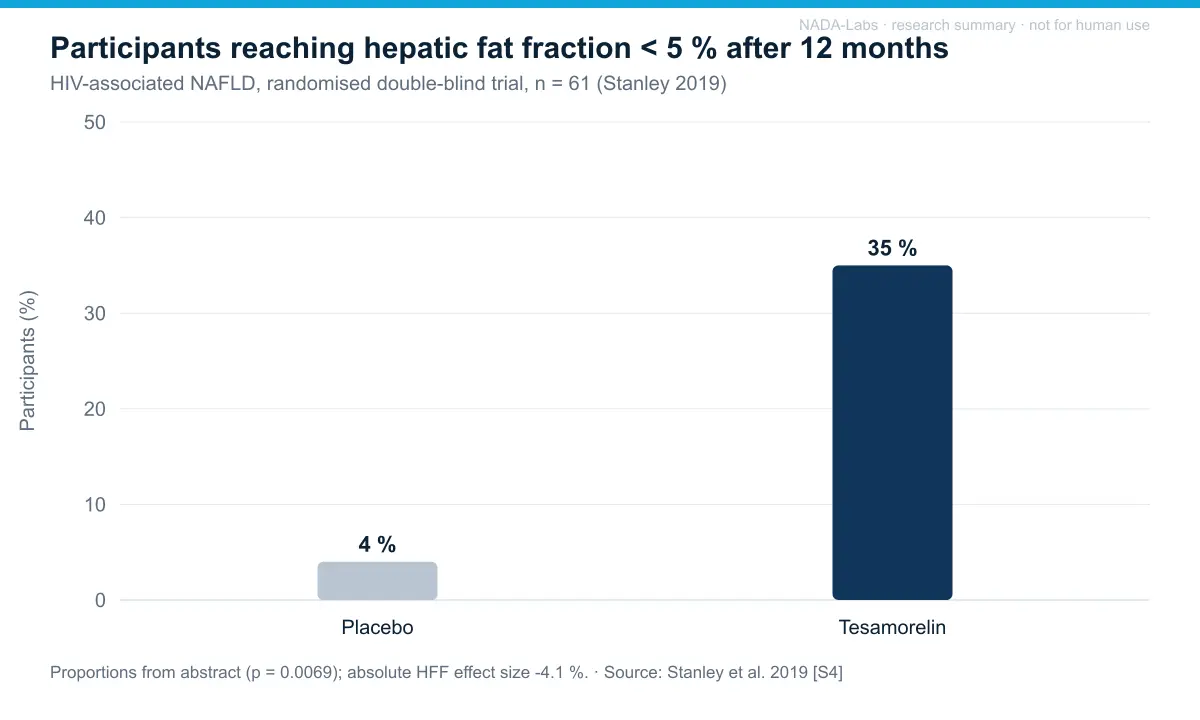
| Stanley 20194 | HIV with NAFLD (n = 61) | RCT, double-blind, placebo, 12 mo | Hepatic fat fraction -4.1 % absolute (-37 % relative); 35 % vs 4 % reached HFF < 5 % |
| Baker 20125 | Older adults, healthy and MCI (n = 152) | RCT, double-blind, placebo, 20 wk | Cognition favourable (ITT p = 0.03); executive function p = 0.005; IGF-I +117 %; body fat -7.4 % |
| Clemmons 20176 | Type 2 diabetes (n = 53) | RCT, placebo, 12 wk | No change in insulin response or HbA1c; total cholesterol -0.3 mmol/L (p < 0.05 vs placebo) |
| Ellis 20257 | HIV, abdominal obesity, neurocognitive impairment (n = 73) | Open-label RCT vs standard of care, 6 mo | No between-group cognitive difference (p = 0.673); waist -2.7 cm vs SOC |
Tolerability findings reported in controlled trials
| Finding | Setting | Reported figure | Study |
|---|---|---|---|
| Adverse events (mild) | Older adults, 20 wk | 68 % treated vs 36 % placebo | [5] |
| Withdrawal for adverse events | HIV, 26 wk | More frequent in tesamorelin arm; overall AE rates not different | [1] |
| Injection-site complaints | HIV with NAFLD, 12 mo | More than placebo; none serious | [4] |
| Fasting glucose | HIV, 6 mo | +7 mg/dL treatment effect at 2 wk; not significant at 6 mo | [3] |
| Fasting insulin | MCI subgroup, 20 wk | +35 % (within normal range); no change in healthy adults | [5] |
| Glycaemic control | Type 2 diabetes, 12 wk | Insulin response, fasting glucose, HbA1c unchanged | [6] |
Effects reported in the studies
- Visceral adipose tissue reduction. In HIV-associated abdominal adiposity VAT changed by -15.2 % vs +5.0 % with placebo over 26 weeks1; pooled phase 3 data showed -24 vs +2 cm² (treatment effect -15.4 %) at 26 weeks and -17.5 % at 52 weeks with continued treatment, while abdominal subcutaneous fat was not significantly changed2; a single-centre trial reported -34 vs +8 cm² over 6 months3.
- Liver fat reduction. Liver lipid-to-water fraction changed by -2.0 % vs +0.9 % (net -2.9 %) over 6 months3; in HIV-associated NAFLD hepatic fat fraction fell by an absolute 4.1 % (relative -37 %) over 12 months, and 35 % vs 4 % of participants reached HFF < 5 %4.
- IGF-I increase. IGF-I changed by +81 % vs -5 % with placebo1, by +108 vs -7 ng/mL2, and by +117 % in older adults, remaining within the physiological range5.
- Lipid profile. Triglycerides changed by -50 mg/dL vs +9 mg/dL1 and by -37 vs +6 mg/dL (treatment effect -12.3 %)2; total cholesterol/HDL ratio changed by -0.31 vs +0.211; in type 2 diabetes total and non-HDL cholesterol decreased by 0.3 mmol/L from baseline (p < 0.05 vs placebo)6.
- Cognition. A 20-week placebo-controlled trial in older adults found a favourable overall cognitive effect (ITT p = 0.03) with a positive effect on executive function (p = 0.005) in both MCI and healthy participants5; an open-label 6-month trial in people with HIV and neurocognitive impairment found no significant between-group difference (p = 0.673)7.
- Glucose homeostasis. Glycaemic measures did not differ from placebo at 26 or 52 weeks in HIV trials1,2; a transient +7 mg/dL fasting-glucose treatment effect at 2 weeks was not significant at 6 months3; in type 2 diabetes relative insulin response, fasting glucose and HbA1c were unchanged over 12 weeks6; fasting glucose and HbA1c did not differ at 12 months in HIV-NAFLD4.
Adverse effects and tolerability reported
- Higher overall adverse-event frequency (mild). Older adults, 20-week placebo-controlled trial: adverse events reported by 68 % of treated vs 36 % of placebo participants; events described as mild.
- Withdrawal due to adverse events. HIV phase 3 trial (n = 412): adverse-event rates not significantly different, but more withdrawals for adverse events in the tesamorelin group.
- Injection-site reactions. HIV-associated NAFLD trial (n = 61): more localised injection-site complaints than placebo; none judged serious.
- Transient fasting-glucose increase; fasting insulin increase. Fasting glucose +7 mg/dL treatment effect at 2 weeks, not significant at 6 months3; fasting insulin +35 % (within normal range) in MCI participants5; no change in glycaemic control in type 2 diabetes over 12 weeks6.
- Sustained IGF-I elevation. IGF-I increases of +81 % to +117 % are the intended pharmacological effect; the cognition trial reported levels remaining within the physiological range5. Long-term consequences of chronic IGF-I elevation were not assessed in these trials; the HIV-NAFLD trial authors call for further studies on long-term effects4.
Limitations of the evidence. Nearly all quantitative evidence comes from adults with HIV-associated abdominal fat accumulation, a specific population on antiretroviral therapy, and the pivotal trials were sponsored by the manufacturer with overlapping author groups. Maintenance of VAT reduction at 52 weeks is reported only for the continuously treated group; outcomes after switching to placebo are not given in the abstract. Liver-fat and cognition findings rest on single trials of 50 to 152 participants, and the one independent trial on cognition in HIV (open-label, no placebo, underpowered per the authors) found no between-group difference. Rodent data on tesamorelin are scarce and qualitative (e.g. Chege 2024, PMID 38416754, a diet/antiretroviral study in rats reporting reversal of metabolic changes by co-administered tesamorelin without tesamorelin-specific effect sizes in the abstract), so mechanistic conclusions beyond GHRH-receptor-mediated GH/IGF-I release are not supported by this literature. Long-term safety of sustained IGF-I elevation has not been characterised in these trials.
References
- Falutz J, Allas S, Blot K, Potvin D, Kotler D, Somero M, Berger D, Brown S, Richmond G, Fessel J, Turner R, Grinspoon S (2007). Metabolic effects of a growth hormone-releasing factor in patients with HIV. N Engl J Med. PMID 18057338 DOI human study
- Falutz J, Mamputu JC, Potvin D, Moyle G, Soulban G, Loughrey H, Marsolais C, Turner R, Grinspoon S (2010). Effects of tesamorelin (TH9507), a growth hormone-releasing factor analog, in human immunodeficiency virus-infected patients with excess abdominal fat: a pooled analysis of two multicenter, double-blind placebo-controlled phase 3 trials with safety extension data. J Clin Endocrinol Metab. PMID 20554713 DOI human study
- Stanley TL, Feldpausch MN, Oh J, Branch KL, Lee H, Torriani M, Grinspoon SK (2014). Effect of tesamorelin on visceral fat and liver fat in HIV-infected patients with abdominal fat accumulation: a randomized clinical trial. JAMA. PMID 25038357 DOI human study
- Stanley TL, Fourman LT, Feldpausch MN, Purdy J, Zheng I, Pan CS, Aepfelbacher J, Buckless C, Tsao A, Kellogg A, Branch K, Lee H, Liu CY, Corey KE, Chung RT, Torriani M, Kleiner DE, Hadigan CM, Grinspoon SK (2019). Effects of tesamorelin on non-alcoholic fatty liver disease in HIV: a randomised, double-blind, multicentre trial. Lancet HIV. PMID 31611038 DOI human study
- Baker LD, Barsness SM, Borson S, Merriam GR, Friedman SD, Craft S, Vitiello MV (2012). Effects of growth hormone-releasing hormone on cognitive function in adults with mild cognitive impairment and healthy older adults: results of a controlled trial. Arch Neurol. PMID 22869065 DOI human study
- Clemmons DR, Miller S, Mamputu JC (2017). Safety and metabolic effects of tesamorelin, a growth hormone-releasing factor analogue, in patients with type 2 diabetes: A randomized, placebo-controlled trial. PLoS One. PMID 28617838 DOI human study
- Ellis RJ, Vaida F, Hu K, Dube M, Henry B, Chow F, Heaton RK, Lee D, Sattler F (2025). Effects of Tesamorelin on Neurocognitive Impairment in Persons With HIV and Abdominal Obesity. J Infect Dis. PMID 39813152 DOI human study
This section summarises findings published in the cited peer-reviewed literature for informational purposes. It is not a claim of efficacy or safety, contains no dosing or administration information by design, and does not constitute medical, veterinary or scientific advice. Results in cell cultures or animal models do not predict effects in humans.