Description
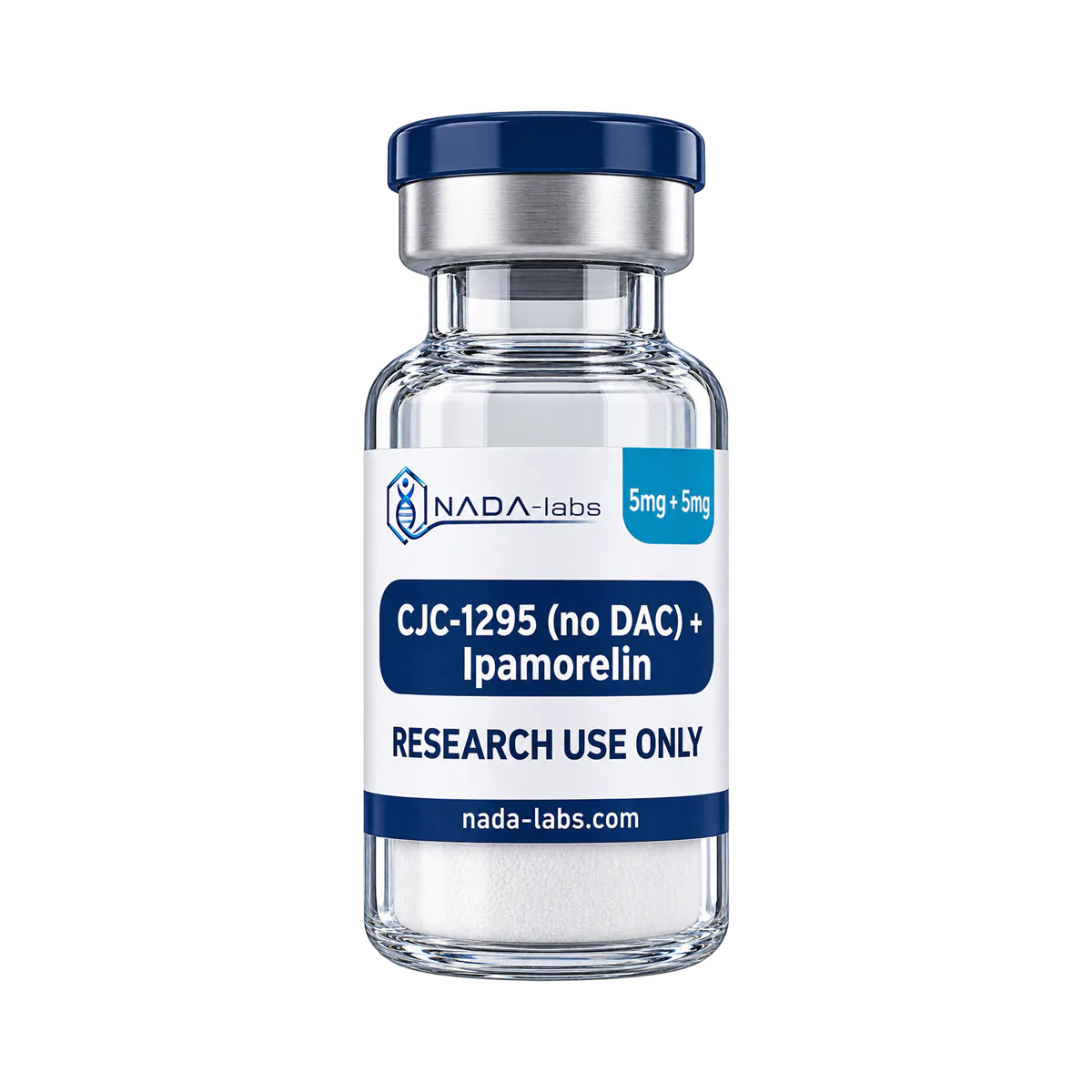
CJC-1295 (no DAC) and Ipamorelin co-lyophilised in a 1:1 mass ratio. Because the two sequences differ substantially in length, the blend is prepared from a homogenised bulk solution before filling to keep the ratio consistent vial to vial.
Components available individually: Ipamorelin, CJC-1295 (no DAC).
CJC-1295 (no DAC) + Ipamorelin: what the published research shows
Compiled by NADA-Labs from the peer-reviewed literature cited below. No own study data.
Ipamorelin is a synthetic pentapeptide (Aib-His-D-2-Nal-D-Phe-Lys-NH2) that stimulates growth hormone (GH) release through a GHRP-type receptor (the GH secretagogue receptor); it was developed at Novo Nordisk and was the first GHRP-class agonist reported to release GH without a measurable ACTH or cortisol response in swine. CJC-1295 is a synthetic analog of growth hormone-releasing hormone (GHRH) that binds covalently to endogenous albumin after injection, giving it a plasma half-life of several days; the peer-reviewed human data concern this albumin-binding (DAC) form. The two components act on different receptors of the same axis (GHRH receptor and GH secretagogue receptor). No peer-reviewed study has tested ipamorelin together with CJC-1295; the combination rationale rests on class-level studies in which a GHRH peptide was co-administered with a GHRP (GHRP-6 or GHRP-2) in healthy men, patients and rats, which report greater-than-additive GH release.
Evidence base: Component evidence: ipamorelin in rat pituitary cells, anaesthetised rats and conscious swine (one Novo Nordisk pharmacology paper) plus one human pharmacokinetic/pharmacodynamic study in 40 healthy men without placebo arm; CJC-1295 (DAC form) in two small placebo-controlled human trials and one within-subject pulsatility study, all with the same senior author. Combination evidence: none for CJC-1295 (no DAC) + Ipamorelin specifically; class-level GHRH + GHRP co-administration data from acute human studies (n = 18-26) and two rat studies. Most GHRP synergy work originates from the Bowers (Tulane) and Casanueva/Dieguez groups. Safety context is drawn from one narrative review and one meta-analysis.
- Ipamorelin. GHS-R agonist (GHRP class); CAS 170851-70-4; studies 1–2
- CJC-1295. Albumin-binding GHRH analog; CAS 863288-34-0; human data refer to the DAC form; studies 3–4
- GHRH + GHRP co-administration (class evidence). Studies 5–9 used GHRH(1-44) or GHRH with GHRP-6 or GHRP-2, not ipamorelin or CJC-1295; they document the receptor-level interaction on which the blend concept is based
Key studies at a glance
| Study | Component | Model | Design | Main result |
|---|---|---|---|---|
| Raun 19981 | Ipamorelin | Rat pituitary cells; anaesthetised rats; conscious swine | Controlled vs. GHRP-6, GHRP-2, GHRH | GH efficacy comparable to GHRP-6 (Emax 85 ± 5 % in vitro); no ACTH/cortisol rise in swine |
| Gobburu 19992 | Ipamorelin | Healthy men, n = 40 | Five-level IV infusion escalation, PK/PD, no placebo | Terminal half-life 2 h; single GH episode peaking at 0.67 h |
| Teichman 20063 | CJC-1295 (DAC) | Healthy adults 21-61 y | Two randomized placebo-controlled trials (28 / 49 d), SC | GH 2-10-fold for ≥ 6 d, IGF-I 1.5-3-fold for 9-11 d; t1/2 5.8-8.1 d; no serious adverse reactions |
| Ionescu 20064 | CJC-1295 (DAC) | Healthy men 20-40 y | 12-h GH profile before and 1 wk after single injection | Trough GH 7.5-fold, mean GH +46 %, IGF-I +45 %; pulsatility preserved |
| Bowers 19905 | GHRH + GHRP-6 | Healthy men, n = 18 | Placebo-controlled acute IV bolus | Peak GH 1.2 (placebo) to 68.7 µg/L (highest GHRP-6 level); synergy with GHRH (qualitative) |
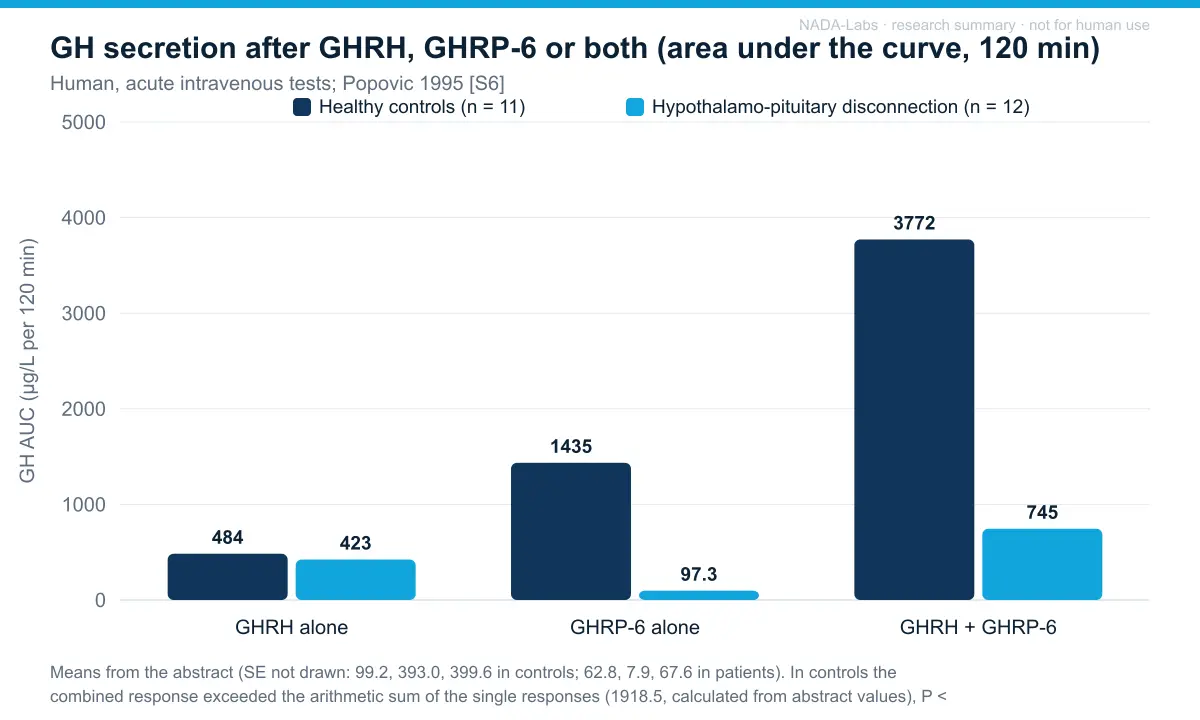
| Popovic 19956 | GHRH + GHRP-6 | 11 controls, 12 stalk-section patients | Three acute IV tests per subject | GH AUC 3771.5 combined vs. sum of singles 1918.5 (P < 0.05); no synergy without hypothalamic connection |
| Van den Berghe 19977 | GHRH + GHRP-2 | Critically ill adults, n = 26 | Randomized crossover, 21-h infusions | Combination: further 2-fold GH over GHRP-2 alone; IGF-I +61 % (GHRP-2) plus +40 % (combination) |
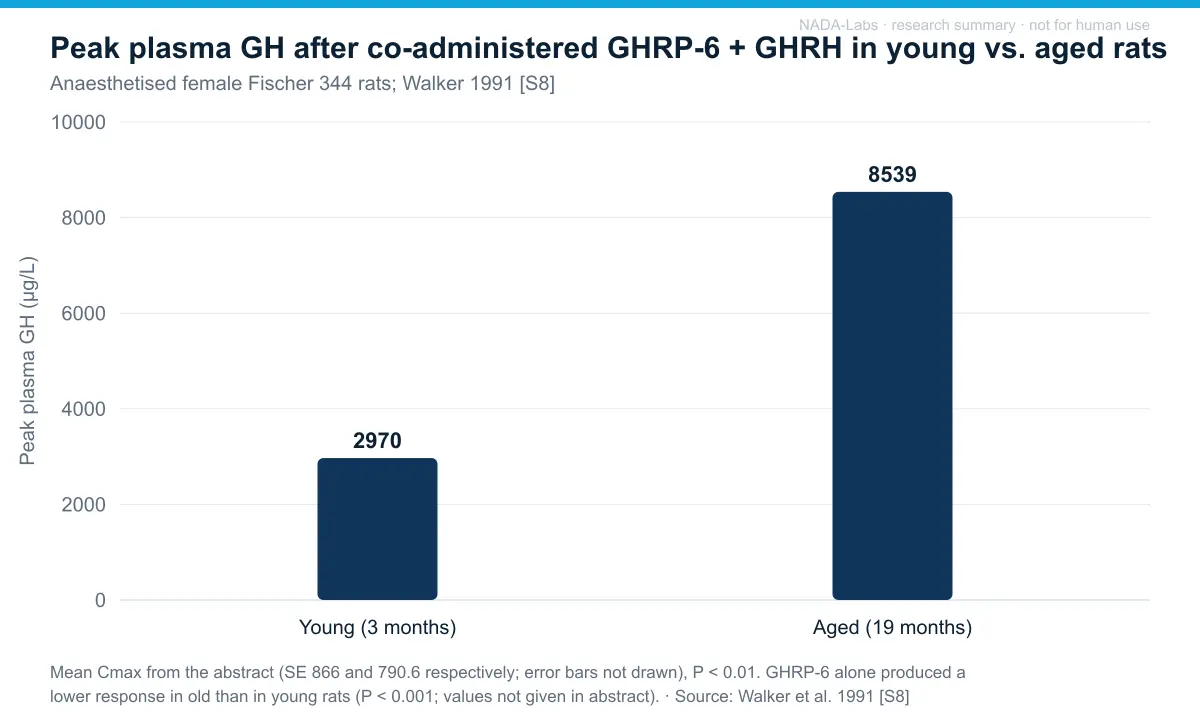
| Walker 19918 | GHRH + GHRP-6 | Young vs. aged rats | Controlled acute co-administration | Combined Cmax 8539 (old) vs. 2970 µg/L (young), P < 0.01 |
| Bercu 19929 | GHRH + GHRP-6 | Obese Zucker rats | Saline-controlled, 60 d repeated co-administration | Pituitary GH content up, glucose tolerance improved, cholesterol elevated (all qualitative) |
| Sigalos 201810 | Safety context | Review of human GHS studies | Narrative review | Well tolerated in available studies; insulin-sensitivity concern; long-term cancer/mortality data lacking |
| Renehan 200411 | Safety context | 3609 cases / 7137 controls | Meta-regression of 21 studies | High IGF-I: prostate cancer OR 1.49, premenopausal breast cancer OR 1.65 |
Human observations on the GH/IGF-I axis
| Study | Population | Stimulus | GH outcome | IGF-I outcome | Other hormones / tolerability |
|---|---|---|---|---|---|
| Gobburu 19992 | 40 healthy men | Ipamorelin IV infusion | Single episode, peak at 0.67 h, t1/2 2 h | not measured | not reported |
| Teichman 20063 | Healthy adults | CJC-1295 (DAC) SC, single or repeated | 2-10-fold for ≥ 6 d | 1.5-3-fold for 9-11 d; up to 28 d after repeats | No serious adverse reactions |
| Ionescu 20064 | Healthy men | CJC-1295 (DAC), single injection | Trough 7.5-fold, mean +46 %, pulses unchanged | +45 % | not reported |
| Bowers 19905 | 18 healthy men | GHRP-6 ± GHRH(1-44) IV bolus | Peak up to 68.7 ± 15.5 µg/L vs. 1.2 ± 0.3 placebo; synergy with GHRH | not measured | PRL/cortisol ~2-fold at highest level; flushing after GHRH |
| Popovic 19956 | 11 healthy controls | GHRH, GHRP-6, both IV | AUC 483.7 / 1434.8 / 3771.5 µg/L per 120 min | not measured | not reported |
| Van den Berghe 19977 | 26 critically ill adults | GHRH, GHRP-2, both, 21-h infusion | 2-3-fold / 4-6-fold / further 2-fold | +61 ± 13 % (GHRP-2); additional +40 ± 6 % (both) | Cortisol unchanged |
Effects reported in the studies
- Greater-than-additive GH release when a GHRH peptide and a GHRP are given together (class evidence). In healthy adults the GH area under the curve after GHRH + GHRP-6 (3771.5 ± 399.6 µg/L per 120 min) was about twice the arithmetic sum of the single responses (483.7 + 1434.8 = 1918.5), P < 0.056; in normal men submaximal GHRP-6 plus GHRH released GH synergistically (no values in abstract)5. The synergy was absent in patients with hypothalamo-pituitary disconnection6.
- Sustained GH and IGF-I elevation during continuous dual stimulation. During 21-h infusions in critically ill adults, GHRH raised mean GH 2- to 3-fold, GHRP-2 4- to 6-fold, and GHRH + GHRP-2 a further 2-fold over GHRP-2 alone; IGF-I rose 61 ± 13 % with GHRP-2 and an additional 40 ± 6 % with the combination within 24 h7.
- GH release by ipamorelin (GHRP component). Ipamorelin released GH with efficacy comparable to GHRP-6 in rat pituitary cells (Emax 85 ± 5 % of GHRP-6), anaesthetised rats (Emax 1545 ± 250 vs. 1167 ± 120 ng/ml) and swine (65 ± 0.2 vs. 74 ± 7 ng/ml)1; in healthy men each intravenous infusion produced a single GH episode peaking at 0.67 h, with a terminal half-life of 2 h2.
- Prolonged GH/IGF-I elevation by CJC-1295 (GHRH-analog component, DAC form). A single subcutaneous administration raised mean GH 2- to 10-fold for 6 days or more and IGF-I 1.5- to 3-fold for 9-11 days (estimated t1/2 5.8-8.1 days)3; one week after a single injection, trough GH was 7.5-fold higher, mean 12-h GH +46 % and IGF-I +45 %, with pulse frequency and magnitude unchanged4.
- Selectivity for GH over ACTH/cortisol (ipamorelin). In swine, ipamorelin did not raise ACTH or cortisol above the levels seen after GHRH, whereas GHRP-6 and GHRP-2 did; FSH, LH, PRL and TSH were unaffected by all secretagogues1. By contrast GHRP-6 roughly doubled PRL and cortisol at its highest level in men5.
- Dual stimulation produces a larger GH response in aged rats. Old rats responded less to GHRP-6 alone (P < 0.001) but more to GHRP-6 + GHRH than young rats (Cmax 8539 ± 790.6 vs. 2970 ± 866 µg/L, P < 0.01) despite lower pituitary GH content (257.0 ± 59.8 vs. 639.7 ± 149.2 µg/mg, P < 0.03)8.
- Repeated co-administration in obese rats. Sixty days of GHRH + GHRP-6 co-administration increased pituitary weight and GH content and improved glucose tolerance in obese Zucker rats versus saline, without altering food intake or body weight gain in mature animals; stimulated GH remained lower than in lean rats and plasma cholesterol was elevated9.
Adverse effects and tolerability reported
- No serious adverse reactions; relatively well tolerated. CJC-1295 (DAC) in healthy adults, two placebo-controlled trials; tolerability described as better at the lower exposure levels tested (industry-affiliated authorship)
- No adverse clinical effects or laboratory abnormalities after GHRP-6; transient facial flushing after GHRH. 18 healthy men; flushing of 1-3 min in 16/18 after GHRH(1-44)-NH2
- PRL and cortisol elevation with non-selective GHRPs. About 2-fold rise at the highest GHRP-6 level in men5; GHRP-6 and GHRP-2 raised ACTH and cortisol in swine, ipamorelin did not1
- Cortisol unchanged during continuous GHRH + GHRP-2. Critically ill adults with elevated baseline cortisol, 21-h infusion
- Elevated plasma cholesterol. Obese Zucker rats after 60 days of GHRH + GHRP-6 co-administration, not seen with saline
- Not reported. Ipamorelin human PK study2, CJC-1295 pulsatility study4, stalk-section study6 and aged-rat study8 give no tolerability data
- Class-level safety considerations (literature). A review of clinical GHS studies reports the compounds as well tolerated but notes concern about decreased insulin sensitivity and raised blood glucose, and states that long-term safety including cancer incidence and mortality has not been evaluated10. Sustained IGF-I elevation is the pharmacological aim of GHRH/GHRP combinations; in a meta-analysis of 21 epidemiological studies, higher circulating IGF-I was associated with prostate cancer (OR 1.49, 95 % CI 1.14-1.95) and premenopausal breast cancer (OR 1.65, 95 % CI 1.26-2.08)11. None of the studies 1–9 was designed or powered to detect such outcomes.
Limitations of the evidence. No peer-reviewed study has examined ipamorelin and CJC-1295 together; every co-administration result above was obtained with other GHRH peptides and other GHRPs (GHRP-6, GHRP-2), mostly after a single acute administration and in small groups (18-26 subjects). Human CJC-1295 data concern the albumin-bound DAC form from an industry development programme with a shared senior author, and the ipamorelin data come from the Novo Nordisk programme; the ipamorelin human study had no placebo arm. Whether acute synergy translates into sustained IGF-I effects, and what the long-term safety profile of repeated dual stimulation is, has not been studied; the only longer co-administration study (60 days) is in obese rats and reported raised cholesterol. The safety context (10, 11) is class-level and epidemiological, not specific to these two peptides.
References
- Raun K, Hansen BS, Johansen NL, Thøgersen H, Madsen K, Ankersen M, Andersen PH (1998). Ipamorelin, the first selective growth hormone secretagogue. European Journal of Endocrinology. PMID 9849822 DOI
- Gobburu JV, Agersø H, Jusko WJ, Ynddal L (1999). Pharmacokinetic-pharmacodynamic modeling of ipamorelin, a growth hormone releasing peptide, in human volunteers. Pharmaceutical Research. PMID 10496658 DOI human study
- Teichman SL, Neale A, Lawrence B, Gagnon C, Castaigne JP, Frohman LA (2006). Prolonged stimulation of growth hormone (GH) and insulin-like growth factor I secretion by CJC-1295, a long-acting analog of GH-releasing hormone, in healthy adults. Journal of Clinical Endocrinology and Metabolism. PMID 16352683 DOI human study
- Ionescu M, Frohman LA (2006). Pulsatile secretion of growth hormone (GH) persists during continuous stimulation by CJC-1295, a long-acting GH-releasing hormone analog. Journal of Clinical Endocrinology and Metabolism. PMID 17018654 DOI human study
- Bowers CY, Reynolds GA, Durham D, Barrera CM, Pezzoli SS, Thorner MO (1990). Growth hormone (GH)-releasing peptide stimulates GH release in normal men and acts synergistically with GH-releasing hormone. Journal of Clinical Endocrinology and Metabolism. PMID 2108187 DOI human study
- Popovic V, Damjanovic S, Micic D, Djurovic M, Dieguez C, Casanueva FF (1995). Blocked growth hormone-releasing peptide (GHRP-6)-induced GH secretion and absence of the synergic action of GHRP-6 plus GH-releasing hormone in patients with hypothalamopituitary disconnection: evidence that GHRP-6 main action is exerted at the hypothalamic level. Journal of Clinical Endocrinology and Metabolism. PMID 7883854 DOI human study
- Van den Berghe G, de Zegher F, Veldhuis JD, Wouters P, Awouters M, Verbruggen W, Schetz M, Verwaest C, Lauwers P, Bouillon R, Bowers CY (1997). The somatotropic axis in critical illness: effect of continuous growth hormone (GH)-releasing hormone and GH-releasing peptide-2 infusion. Journal of Clinical Endocrinology and Metabolism. PMID 9024260 DOI human study
- Walker RF, Yang SW, Bercu BB (1991). Robust growth hormone (GH) secretion in aged female rats co-administered GH-releasing hexapeptide (GHRP-6) and GH-releasing hormone (GHRH). Life Sciences. PMID 1943453 DOI
- Bercu BB, Yang SW, Masuda R, Hu CS, Walker RF (1992). Effects of coadministered growth hormone (GH)-releasing hormone and GH-releasing hexapeptide on maladaptive aspects of obesity in Zucker rats. Endocrinology. PMID 1446617 DOI
- Sigalos JT, Pastuszak AW (2018). The Safety and Efficacy of Growth Hormone Secretagogues. Sexual Medicine Reviews. PMID 28400207 DOI human study
- Renehan AG, Zwahlen M, Minder C, O’Dwyer ST, Shalet SM, Egger M (2004). Insulin-like growth factor (IGF)-I, IGF binding protein-3, and cancer risk: systematic review and meta-regression analysis. Lancet. PMID 15110491 DOI human study
This section summarises findings published in the cited peer-reviewed literature for informational purposes. It is not a claim of efficacy or safety, contains no dosing or administration information by design, and does not constitute medical, veterinary or scientific advice. Results in cell cultures or animal models do not predict effects in humans.