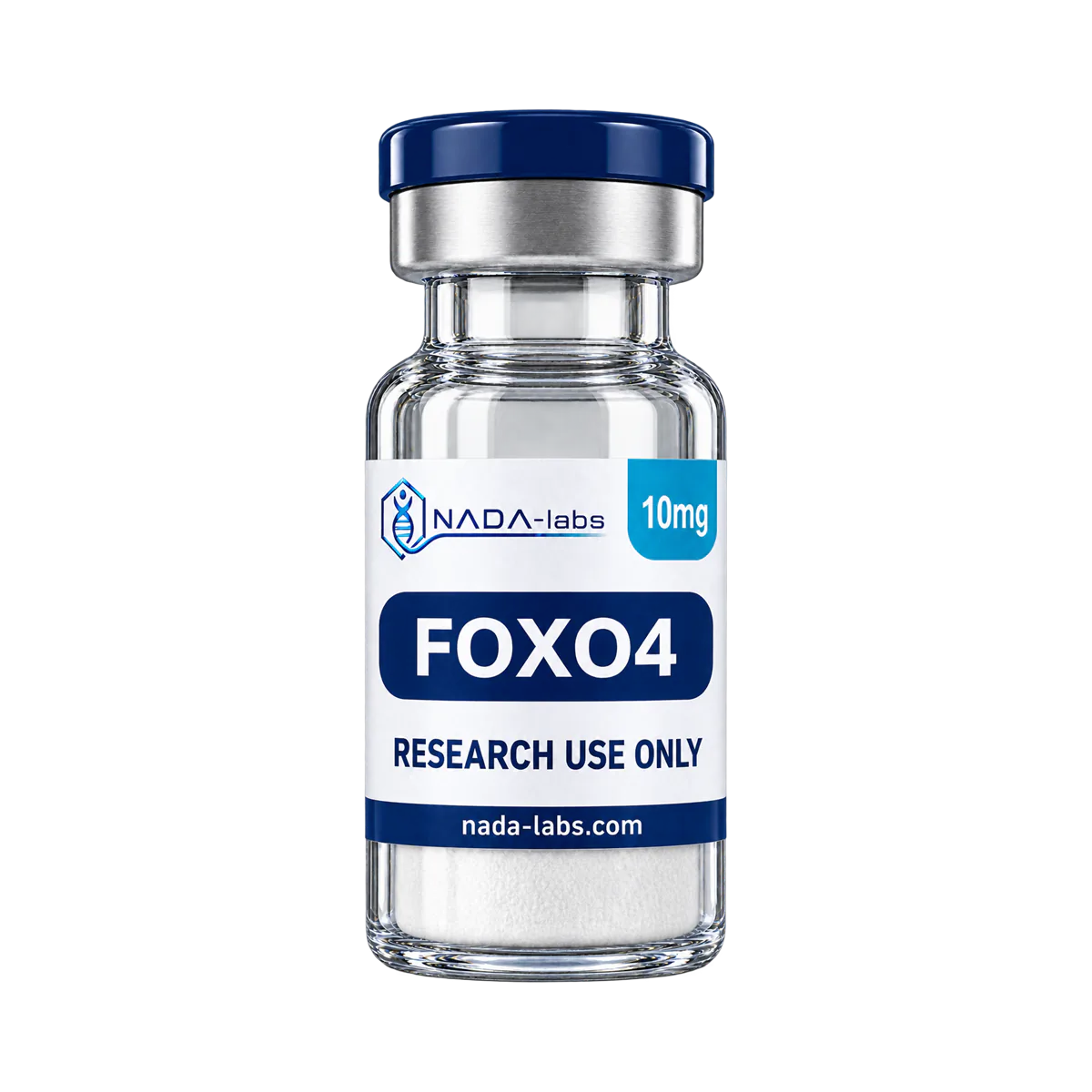
Description
FOXO4-DRI is a synthetic 46-residue peptide in retro-inverso form: the residue order is reversed relative to the parent sequence and every chiral residue is a D-amino acid (glycine is achiral). It joins a sequence derived from the transcription factor FOXO4 to the arginine-rich HIV-TAT sequence, so the peptide is strongly basic (10 arginine and 4 lysine residues). Keep vials sealed, cold and away from light, avoid repeated freeze–thaw cycles and prepare aqueous solutions fresh.
What the published research shows
In human IMR90 fibroblast cultures, FOXO4-DRI was investigated as an all-D retro-inverso peptide that interfered with FOXO4-p53 binding; the authors reported p53 nuclear exclusion and caspase-3/7-dependent apoptosis in senescent cells1. Subsequent studies examined mouse Leydig cells and aged mice2, expanded human chondrocytes3, fibroblast cultures and mouse tumour and pulmonary-fibrosis models4,5, and human keloid and normal-skin fibroblasts and keloid organ cultures6.
Findings differed across the preclinical models. In serotonin-transporter-overexpressing SM22-5-HTT+ mice, FOXO4-DRI was followed by adverse pulmonary haemodynamic changes and loss of pulmonary endothelial cells7. The cell-culture selectivity measurements below used different cell types, senescence models, exposure times and readouts and were not directly comparable1,3,4,6.
Evidence base: The evidence was limited to preclinical research. No clinical trial, human cohort or human tolerability study of FOXO4-DRI was identified in the recorded PubMed search of 6 November 2026. The seven selected publications described cell, tissue and animal experiments1,2,3,4,5,6,7. Human testicular and lung tissue was examined for markers only2,7; the human chondrocyte, fibroblast and organ-culture experiments were conducted in vitro1,3,6.
Key studies at a glance
| Study | Model | Design | Main result |
|---|---|---|---|
| Baar 20171 | Human IMR90 fibroblasts in vitro; doxorubicin-exposed, fast-ageing XpdTTD/TTD and naturally aged mice | Compared senescent and control cultures; examined apoptosis and p53 localisation, and compared mouse phenotypes with controls | Viability reduction showed an 11.73-fold difference between senescent and control IMR90 cells; senescent cells underwent apoptosis. Doxorubicin-exposed mice showed less body-weight loss and liver toxicity |
| Zhang 20202 | Hydrogen-peroxide-induced senescent mouse TM3 Leydig cells in vitro; naturally aged male C57BL/6 mice | Compared senescent and normal TM3 cultures and peptide-exposed and control mice; assessed apoptosis, serum testosterone and testicular markers | Apoptosis in senescent TM3 cells increased from 10 % to 27 %; serum testosterone increased in aged mice. Direct elimination of senescent Leydig cells in those mice was not demonstrated |
| Huang 20213 | Human chondrocytes at population doubling level (PDL) 9 or 3, in vitro; cartilage pellet cultures | Compared peptide-exposed and control cultures for cell number, senescence markers, gene expression and cartilage formation | More than half of PDL9 cells were removed; PDL3 cell number was not significantly affected. Chondrogenic potential did not increase |
| Meng 20214 | Cancer-associated fibroblast (CAF) cultures; non-small-cell lung cancer cell cultures; mouse tumour and radiation-induced pulmonary-fibrosis models | Compared senescence-like and non-senescent CAFs; examined tumour-cell radiation responses and pulmonary fibrosis in mice | The cell-culture selective index was 6.09. Tumour-cell radioresistance decreased in vitro and in mouse models; radiation-induced pulmonary fibrosis decreased in mice |
| Han 20225 | Mice with bleomycin-induced pulmonary fibrosis; mouse and human lung fibroblast and induced-myofibroblast cultures | Compared peptide, PBS and pirfenidone groups in mice; assessed lung histology, collagen, cell populations and gene-expression pathways | Senescent-cell counts, senescence-associated secretory phenotype (SASP) expression and collagen deposition decreased in mice; the myofibroblast proportion also decreased |
| Kong 20256 | Human keloid and normal-skin fibroblasts in vitro; human keloid organ cultures | Examined serum-limitation senescence models and non-senescent controls using apoptosis, cell-cycle and p53-localisation assays | Apoptosis increased in senescent fibroblasts from both keloids and normal skin, accompanied by nuclear exclusion of phosphorylated p53; G0/G1-phase proportions decreased |
| Born 20237 | Peptide-specific finding in SM22-5-HTT+ mice overexpressing the serotonin transporter | Compared senolytic interventions, including FOXO4-DRI, with relevant controls; assessed pulmonary haemodynamics and pulmonary endothelial cells | FOXO4-DRI was followed by adverse pulmonary haemodynamic changes and loss of pulmonary endothelial cells in these mice |
Selectivity for senescent cells reported in cell cultures (FOXO4-DRI)
| Cell model | Comparison | Reported result | Source |
|---|---|---|---|
| Human IMR90 fibroblasts in vitro | Senescent vs control cells | Viability reduction showed an 11.73-fold difference | Baar 20171 |
| Expanded human chondrocytes in vitro | PDL9 vs minimally expanded PDL3 | More than half of PDL9 cells were removed; PDL3 cell number was not significantly affected | Huang 20213 |
| Human chondrocytes, senescence staining in vitro | PDL9 before vs after exposure; PDL3 control | SA-β-gal-positive cells accounted for > 40 % before and < 5 % after exposure in PDL9 cultures; PDL3 cultures had < 17 % | Huang 20213 |
| Cancer-associated fibroblasts in vitro, in cell assays accompanying mouse experiments | Senescence-like vs non-senescent CAFs | The selective index was 6.09; non-senescent CAF viability remained > 80 % under the conditions examined | Meng 20214 |
| Human keloid and normal-skin fibroblasts in vitro | Senescent vs non-senescent cultures | IC50 was 34.19 vs 93.77 µM in keloid cultures and 61.53 vs 104.6 µM in normal-skin cultures | Kong 20256 |
Effects reported in the studies
- Viability and apoptosis in human fibroblast cultures. In senescent human IMR90 fibroblasts, FOXO4-DRI selectively reduced viability relative to control cells, with an 11.73-fold difference reported. In these cultures, interference with FOXO4-p53 binding was accompanied by movement of active p53 out of the nucleus and cell-intrinsic apoptosis through caspase-3/71.
- Apoptosis in human keloid and normal-skin fibroblasts. In serum-limitation senescence models, the reported apoptotic-cell percentages, with standard deviations, increased from 3.31 % ± 0.46 % to 18.6 % ± 9.44 % in human keloid fibroblasts (p = 0.04) and from 5.51 % ± 3.34 % to 25.42 % ± 5.82 % in fibroblasts from normal human skin (p = 0.01). In these cultures, apoptosis was accompanied by nuclear exclusion of phosphorylated p53 (p53-pS15)6.
- Cell numbers and senescence markers in human chondrocytes. In expanded human chondrocyte cultures, more than half of PDL9 cells were removed, while PDL3 cell number was not significantly affected. The proportion of SA-β-gal-positive human chondrocytes was > 40 % in PDL9 cultures before exposure and < 5 % afterwards, compared with < 17 % in PDL3 cultures. Cartilage formed from exposed PDL9 cells expressed fewer senescence-associated secretory factors, but their chondrogenic potential did not increase3.
- Leydig-cell apoptosis and testicular measurements in mice. In hydrogen-peroxide-induced senescent mouse TM3 Leydig cells, apoptosis increased from 10 % to 27 %. In naturally aged mice, serum testosterone and testicular 3β-HSD and CYP11A1 protein levels increased, while testicular IL-1β, IL-6 and TGF-β decreased. Direct elimination of senescent Leydig cells in those mice was not demonstrated2.
- Chemotoxicity and ageing-associated measurements in mice. In doxorubicin-exposed mice, the authors reported less body-weight loss and liver toxicity. In fast-ageing XpdTTD/TTD and naturally aged mice, the authors reported restoration of fitness, fur density and renal function, with plasma urea and creatinine used as renal markers1.
- Fibroblast and radiation responses in cell cultures and mice. In cancer-associated fibroblast cultures, FOXO4-DRI preferentially reduced the viability of senescence-like cells, with a selective index of 6.09. In non-small-cell lung cancer cultures and mouse tumour models, targeting these fibroblasts was associated with lower radioresistance; radiation-induced pulmonary fibrosis also decreased in mice4.
- Bleomycin-induced pulmonary fibrosis in mice. In mice with bleomycin-induced lung fibrosis, senescent-cell counts, SASP expression, morphological changes and collagen deposition decreased. In these mouse lungs, the proportions of type 2 alveolar epithelial cells and fibroblasts increased, while the myofibroblast proportion decreased; transcriptomic analysis identified downregulation of the extracellular-matrix receptor interaction pathway5.
Adverse effects and tolerability reported
- Worsened pulmonary haemodynamics in mice. In serotonin-transporter-overexpressing SM22-5-HTT+ mice, FOXO4-DRI was followed by adverse pulmonary haemodynamic changes and loss of pulmonary endothelial cells compared with relevant controls. From the animal experiments, the authors concluded that eliminating senescent pulmonary endothelial cells could worsen pulmonary haemodynamics7.
- No human tolerability data. No clinical trial, human cohort or human tolerability study of FOXO4-DRI was identified in the recorded PubMed search of 6 November 2026. The human-derived chondrocyte, fibroblast and organ-culture experiments did not assess systemic tolerability in people3,6.
- Tolerability in the originating mouse study. In wild-type and fast-ageing XpdTTD/TTD mice, total body weight and kidney weight relative to body weight did not change significantly. The authors described FOXO4-DRI as well tolerated under the conditions examined in mice, while explicitly calling for a more thorough analysis. Systematic toxicology and mortality data were not reported for these mouse experiments1.
- Limits of cell-culture selectivity. In human fibroblast cultures, apoptosis increased in senescent cells from normal skin as well as from keloids, so the response was not confined to keloid cells; the IC50 measurements also differed between senescent and non-senescent cultures6. In the cancer-associated fibroblast assays accompanying the mouse study, non-senescent CAF viability remained above 80 % under the selected experimental conditions4.
- Matrix-gene expression in human chondrocytes. Exposed human PDL9 chondrocytes expressed less COL2, and their chondrogenic potential did not increase. The number of minimally expanded human PDL3 chondrocytes was not significantly affected under the conditions examined3.
- Missing safety endpoints in mouse studies. The available reports on naturally aged mice, mouse tumour and radiation-induced lung-fibrosis models, and mice with bleomycin-induced fibrosis did not report body-weight, mortality, clinical-sign or laboratory-safety endpoints2,4,5.
Limitations of the evidence. The cell and animal evidence provided no clinical replication. Cell-culture results came from different senescence models and readouts, so selectivity values could not be compared directly across studies1,3,4,6. One plasma-urea analysis in wild-type and fast-ageing XpdTTD/TTD mice pooled three cohorts, with n = 7-8 mice per group in the pooled analysis1. In aged mice, direct elimination of senescent Leydig cells was not demonstrated, the mechanism of the testosterone increase remained unresolved, and its onset and duration were not assessed2. For the adverse pulmonary findings in SM22-5-HTT+ mice, the available information came from the Born et al. abstract only7. None of the findings from cell cultures or animal models established efficacy or safety outside the described research models.
References
- Baar MP, Brandt RMC, Putavet DA, Klein JDD, Derks KWJ, Bourgeois BRM, Stryeck S, Rijksen Y, van Willigenburg H, Feijtel DA, van der Pluijm I, Essers J, van Cappellen WA, van IJcken WF, Houtsmuller AB, Pothof J, de Bruin RWF, Madl T, Hoeijmakers JHJ, Campisi J, de Keizer PLJ (2017). Targeted Apoptosis of Senescent Cells Restores Tissue Homeostasis in Response to Chemotoxicity and Aging. Cell. PMID 28340339 DOI
- Zhang C, Xie Y, Chen H, Lv L, Yao J, Zhang M, Xia K, Feng X, Li Y, Liang X, Sun X, Deng C, Liu G (2020). FOXO4-DRI alleviates age-related testosterone secretion insufficiency by targeting senescent Leydig cells in aged mice. Aging. PMID 31959736 DOI
- Huang Y, He Y, Makarcyzk MJ, Lin H (2021). Senolytic Peptide FOXO4-DRI Selectively Removes Senescent Cells From in vitro Expanded Human Chondrocytes. Frontiers in Bioengineering and Biotechnology. PMID 33996787 DOI
- Meng J, Li Y, Wan C, Sun Y, Dai X, Huang J, Hu Y, Gao Y, Wu B, Zhang Z, Jiang K, Xu S, Lovell JF, Hu Y, Wu G, Jin H, Yang K (2021). Targeting senescence-like fibroblasts radiosensitizes non-small cell lung cancer and reduces radiation-induced pulmonary fibrosis. JCI Insight. PMID 34877934 DOI
- Han X, Yuan T, Zhang J, Shi Y, Li D, Dong Y, Fan S (2022). FOXO4 peptide targets myofibroblast ameliorates bleomycin-induced pulmonary fibrosis in mice through ECM-receptor interaction pathway. Journal of Cellular and Molecular Medicine. PMID 35510614 DOI
- Kong YX, Li ZS, Liu YB, Pan B, Fu X, Xiao R, Yan L (2025). FOXO4-DRI induces keloid senescent fibroblast apoptosis by promoting nuclear exclusion of upregulated p53-serine 15 phosphorylation. Communications Biology. PMID 39994346 DOI
- Born E, Lipskaia L, Breau M, Houssaini A, Beaulieu D, Marcos E, Pierre R, Do Cruzeiro M, Lefevre M, Derumeaux G, Bulavin DV, Delcroix M, Quarck R, Reen V, Gil J, Bernard D, Flaman JM, Adnot S, Abid S (2023). Eliminating Senescent Cells Can Promote Pulmonary Hypertension Development and Progression. Circulation. PMID 36515093 DOI
This section summarises findings published in the cited peer-reviewed literature for informational purposes. It is not a claim of efficacy or safety, contains no dosing or administration information by design, and does not constitute medical, veterinary or scientific advice. Results in cell cultures or animal models do not predict effects in humans.