Description
IGF-1 LR3 (Long R3 IGF-I) is a recombinant 83-residue analogue of human insulin-like growth factor I: a 13-residue N-terminal extension — the first 11 amino acids of methionyl porcine growth hormone followed by Val-Asn — precedes the 70-residue IGF-I sequence, in which Glu-3 is replaced by Arg. The chain contains three disulfide bonds and three methionine residues; keep vials sealed, cold and away from light, and avoid oxidising or reducing buffers.
IGF-1 LR3: what the published research shows
Compiled by NADA-Labs from the peer-reviewed literature cited below. No own study data.
IGF-1 LR3 — LR3IGF-I or Long [Arg3]-IGF-I in most cited papers — is a recombinant fusion analogue of human IGF-I with the first 11 amino acids of methionyl porcine growth hormone plus Val-Asn at the N-terminus and arginine instead of glutamate at position 38. The research literature attributes its effects mainly to very weak binding to the IGF-binding proteins (IGFBPs) — IGF-I has about 1000-fold higher affinity towards IGFBP-3, IGFBP-4 and rat plasma IGFBPs (Ballard 1993, PMID 7683526) — while binding to the type 1 IGF receptor is only about 3-fold weaker than that of IGF-I2. In rats, it therefore circulates mostly as free peptide and is cleared faster than IGF-I5, and in cell lines its apparent potency depends on whether the cells secrete IGFBPs8. It has been studied in cell assays, rats and pigs1,2,3,4,5,6,7,8; no study in humans was identified.
Evidence base: Animal and in vitro studies only; PubMed searches for the common spellings of the name found no study in which IGF-1 LR3 was given to humans. Cited are one acute study in pigs, whose marmoset arm did not include IGF-1 LR31, four controlled rat studies over 3 to 14 days2,3,4,6, a rat clearance study5, an acute haemodynamic study in anaesthetised rats7 and the cell-based study that describes the analogue8. Most of this work comes from one research consortium and was published between 1992 and 1997; the summaries rely on the abstracts, where group sizes, variability and statistics are largely missing. Further records cover diabetic rats (Tomas 1993, PMID 7683875), injection instead of infusion (Tomas 1996, PMID 8708565), pigs (Dunaiski 1997, PMID 9488001), guinea pigs (Conlon 1995, PMID 7561636) and a 7-month intranasal study in male 5XFAD mice (Engel 2025, PMID 39610283).
Key studies at a glance
| Study | Model | Design | Main result |
|---|---|---|---|
| Tomas 19971 | Pig and marmoset monkey, in vivo (IGF-1 LR3 tested in pigs only) | Acute bolus injection, blood sampled for 4 h; IGF-I vs. four IGFBP-poor variants and insulin | Variants 2-3x more potent than IGF-I for the glucose nadir; cumulative 4-h glucose suppression about 4-8x greater |
| Tomas 19922 | Rat, dexamethasone-induced catabolism, in vivo | Controlled, 7-day subcutaneous infusion; graded IGF-I doses vs. des(1-3)IGF-I and IGF-1 LR3, pair-fed controls | IGF-1 LR3 and des(1-3)IGF-I about 2.5x more potent than IGF-I; IGF-1 LR3 binds the type 1 IGF receptor 3x less well |
| Tomas 19933 | Rat, normal growing females, in vivo | Controlled, 14-day subcutaneous infusion; IGF-I dose range vs. IGF-1 LR3 and human GH | Highest IGF-I dose +18-26 % in weight gain, N retention and food conversion; IGF-1 LR3 similar at a much lower daily amount |
| Steeb 19954 | Rat, female, in vivo (n = 5-6/group) | Controlled, 3-day infusion; IGF-I vs. IGF-1 LR3 vs. vehicle or untreated controls | IGF-1 LR3 only: intestinal weight +20 %, crypt length +13 % (duodenum) and +22 % (ileum) |
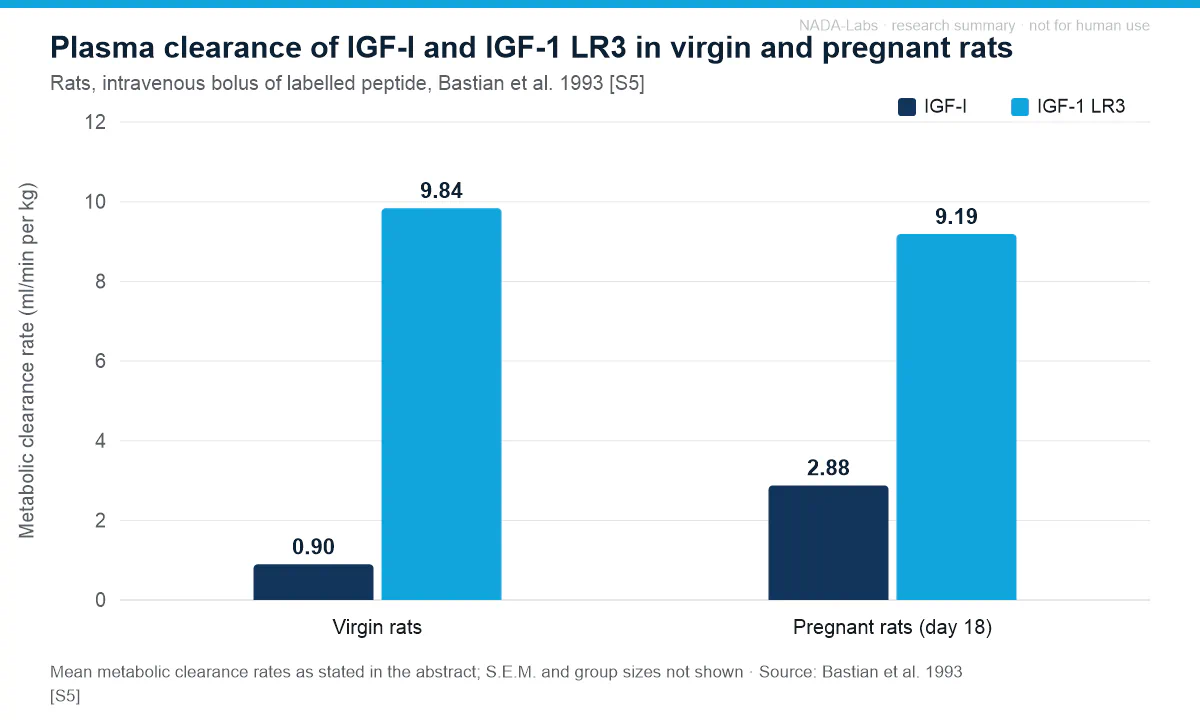
| Bastian 19935 | Rat, virgin and pregnant (day 18 of gestation), in vivo | Pharmacokinetic; intravenous bolus of radiolabelled IGF-I or IGF-1 LR3 | Metabolic clearance rate 9.84 (IGF-1 LR3) vs. 0.90 ml/min per kg (IGF-I) in virgin rats; IGF-1 LR3 mostly free peptide |
| Martin 19946 | Rat, acute renal failure after renal ischaemia, in vivo | Controlled, 7-day subcutaneous infusion of IGF-I, des(1-3)IGF-I or IGF-1 LR3 vs. vehicle; second 3-day experiment | Weight gain and N retention improved, renal function not (7 days); greater fall in GFR with IGF-1 LR3 in the 3-day experiment |
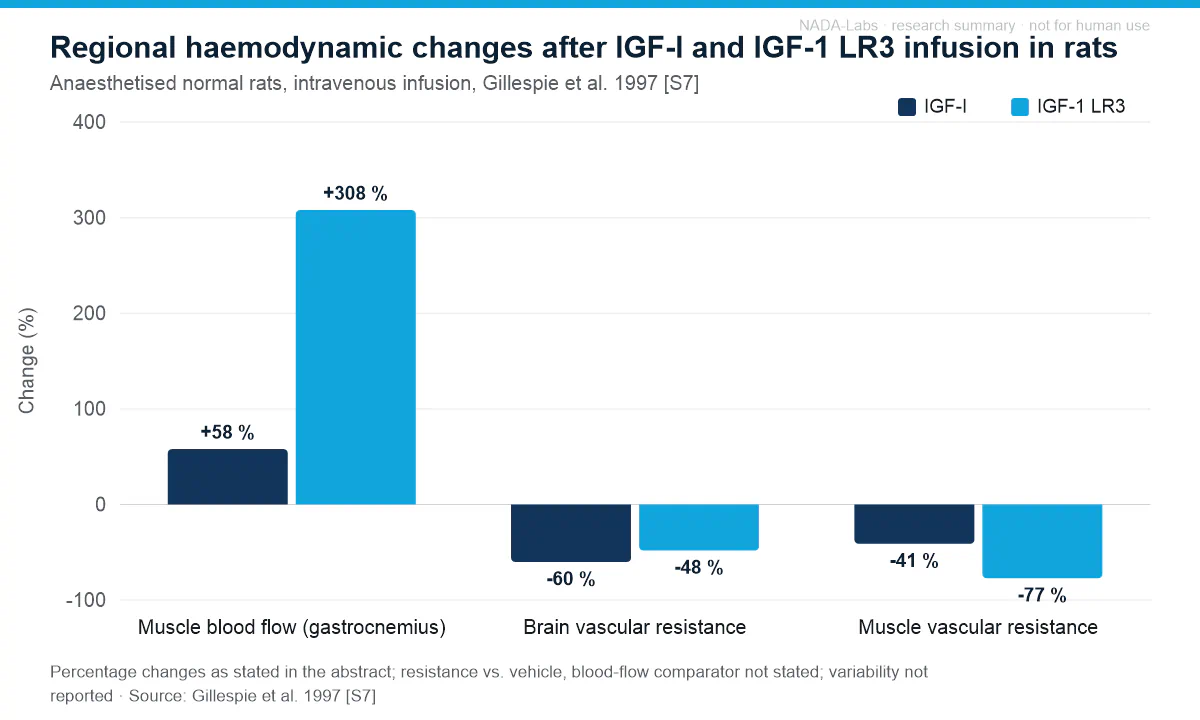
| Gillespie 19977 | Rat, normal, anaesthetised, in vivo | Two acute intravenous infusion studies (20 and 60 min), radioactive microspheres, vs. vehicle | Mean arterial pressure -15 % to -25 %; gastrocnemius blood flow +308 % (IGF-1 LR3) vs. +58 % (IGF-I) |
| Francis 19928 | In vitro: rat L6 myoblasts, rat H35 hepatoma cells, chicken embryo fibroblasts | Recombinant fusion analogues vs. IGF-I and des(1-3)IGF-I; protein and DNA synthesis, protein breakdown | Long [Arg3]-IGF-I most potent in IGFBP-secreting cells, less potent than IGF-I without IGFBPs; no effect sizes in abstract |
Potency of IGF-1 LR3 relative to IGF-I across study models
| Model | End point | IGF-1 LR3 vs. IGF-I | Source |
|---|---|---|---|
| IGFBP-secreting cell lines, in vitro | Biological potency | Most potent, with des(1-3)IGF-I | Francis 19928 |
| Chicken embryo fibroblasts without detectable IGFBPs | Biological potency | Less potent | Francis 19928 |
| L6 rat myoblasts, in vitro | Biological potency | 5-10x more potent | Ballard 1993, PMID 7683526 |
| Rat, dexamethasone-induced catabolism, 7 days | Anabolic responses | About 2.5x more potent | Tomas 19922 |
| Rat, normal females, 14 days | Growth | 6x more potent | Ballard 1993, PMID 7683526 |
| Rat, streptozotocin-diabetic, 7 days | Restoring growth | 2.5-3x more potent | Tomas 1993, PMID 7683875 |
| Rat, normal and catabolic, 7 days | Weight gain, organ weights, feed use | 1.5-2x more potent with infusion, advantage partly kept with injection | Tomas 1996, PMID 8708565 |
| Rat, acute renal failure, 7 days | Growth effects | No increased potency | Martin 19946 |
| Pig, single bolus injection | Plasma glucose nadir | 2-3x more potent (all IGFBP-poor variants) | Tomas 19971 |
| Pig, finisher, 4-day infusion | Daily gain and food intake | Decreased (IGF-I: unchanged) | Dunaiski 1997, PMID 9488001 |
Effects reported in the studies
- Reduced IGFBP binding and model-dependent potency (in vitro). In L6 rat myoblasts all long analogues stimulated protein and DNA synthesis and inhibited protein breakdown more potently than IGF-I; Long [Arg3]-IGF-I was among the most potent in IGFBP-secreting cell lines but less potent than IGF-I in chicken embryo fibroblasts, which secrete no detectable IGFBPs8. IGFBP-3 inhibited IGF-1 LR3-induced phosphorylation of the IGF-I receptor in a dose-dependent manner, in a concentration range similar to IGF-I (Devi 2001, PMID 11735239).
- Anabolic responses in catabolic rats. In dexamethasone-treated rats (7-day infusion), IGF-1 LR3 and des(1-3)IGF-I were about 2.5-fold more potent than IGF-I, although IGF-1 LR3 binds the type 1 IGF receptor 3-fold less well; at the highest IGF-I dose body weight changed by +6 g vs. -19 g with dexamethasone alone, and the gain in carcass weight reflected nitrogen rather than fat2. Part of the potency advantage remained with injection instead of infusion, but for reversal of carcass muscle loss IGF-1 LR3 was barely equipotent with IGF-I (Tomas 1996, PMID 8708565).
- Growth in normal and diabetic rats. In growing female rats (14-day infusion), the highest IGF-I dose raised weight gain, N retention and food conversion efficiency by 18-26 %, and a much lower daily amount of IGF-1 LR3 produced similar effects with body proportions maintained3; a companion report gives a 6-fold potency for growth (Ballard 1993, PMID 7683526). In streptozotocin-diabetic rats both variants (IGF-1 LR3 and des(1-3)IGF-I) were 2.5-3 times more potent than IGF-I in restoring growth, but the IGFs did not reduce glucosuria (Tomas 1993, PMID 7683875).
- Intestinal growth. After 3 days of infusion in female rats (n = 5-6/group), IGF-1 LR3 but not IGF-I increased intestinal wet weight by 20 % vs. controls, independent of food intake, and duodenal and ileal crypt length by 13 % and 22 %; thymidine labelling indices rose with both peptides (up to 14 %)4. After an intravenous bolus in preweaning and adult rats, labelled IGF-1 LR3 reached 37-50 % higher levels per gram of gastrointestinal tissue than labelled IGF-I (Shoubridge 2003, PMID 12697696).
- Plasma clearance and distribution. After an intravenous bolus, IGF-1 LR3 was cleared more rapidly than IGF-I (metabolic clearance rate 9.84 vs. 0.90 ml/min per kg in virgin rats) and was mostly free peptide, whereas in virgin rat plasma IGF-I was mainly associated with the 150 kDa complex; in pregnant rats (day 18), when plasma IGFBPs are markedly reduced, IGF-I clearance rose to 2.88 while that of IGF-1 LR3 stayed similar (9.19)5. More IGF-1 LR3 than IGF-I tracer was found in kidneys, ovaries and adrenals of virgin rats and in ovaries and adrenals of pregnant rats; more IGF-I than IGF-1 LR3 radioactivity was found in caecum, brain, liver and heart of both groups and, in pregnant rats, also in kidneys, placenta, fetus and fetal plasma5.
- Plasma glucose in pigs. After a single bolus injection, the IGFBP-poor variants including IGF-1 LR3 were 2- to 3-fold more potent than IGF-I in lowering plasma glucose to the nadir, with an about 4- to 8-fold greater cumulative suppression over 4 h; only IGF-1 LR3 was also more potent than IGF-I in lowering plasma amino acids1.
- Regional haemodynamics (anaesthetised rats). The gastrocnemius was the only vascular region with a significant increase in blood flow after infusion of IGF-1 LR3 (+308 %) or IGF-I (+58 %); vascular resistance fell compared with vehicle in the brain (-48 % and -60 %) and in skeletal muscle (-77 % and -41 %)7.
- Species and model differences. In finisher pigs, a 4-day infusion of IGF-1 LR3 decreased daily gain and food intake, while IGF-I did not (Dunaiski 1997, PMID 9488001); in guinea pigs, IGF-1 LR3 increased the fractional weights of adrenals, gut, kidneys and spleen without stimulating overall growth (Conlon 1995, PMID 7561636). In male 5XFAD mice, 7 months of intranasal IGF-1 LR3 did not significantly alter cognitive measures; in the cortex, the share of filamentous plaques fell, that of inert plaques rose and low-molecular-weight Aβ oligomers were reduced, while percent body fat tended to be lower than with vehicle (Engel 2025, PMID 39610283). After renal ischaemia in rats, the variants showed no potency advantage for growth effects6.
Adverse effects and tolerability reported
- No human data. No study in which IGF-1 LR3 was given to humans was identified; the findings below come from rats and pigs1,6,7.
- Hypoglycaemia. Plasma glucose lowering in pigs was dose-responsive and more prolonged with the IGFBP-poor variants, with an about 4- to 8-fold greater cumulative suppression over 4 h than with IGF-I1; in finisher pigs, a 4-day infusion left plasma glucose unaffected (Dunaiski 1997, PMID 9488001).
- Renal function after renal ischaemia. Rats given IGF-1 LR3 for 3 days after renal ischaemia showed a significantly greater fall in GFR than controls, lower urinary osmolality, higher fractional sodium excretion and more tubular epithelial calcification; the authors describe a deleterious effect on renal function in the early recovery period6.
- Blood pressure. In anaesthetised rats, mean arterial blood pressure fell by 15 % during a 20-min infusion of IGF-1 LR3 and by 25 % of baseline during 60-min infusions of IGF-I or IGF-1 LR3; the authors relate such vascular changes to side-effects reported during IGF-I administration in humans — a statement about IGF-I, not about IGF-1 LR37.
- Endocrine feedback. In finisher pigs, IGF-1 LR3 lowered the mean plasma GH concentration by 23 % and the area under the GH peaks by 60 %, and reduced plasma IGF-I, IGFBP-3 and insulin (Dunaiski 1997, PMID 9488001).
- Organ-selective growth. Gut weight rose by up to 45 % with IGF-I and especially the analogues in dexamethasone-treated rats2 and intestinal weight by 20 % within 3 days with IGF-1 LR3 in female rats4; the studies report this as an outcome, not as an adverse event.
- Tolerability not systematically reported. The abstracts of the rat infusion studies give no adverse-event counts, clinical signs or drop-outs2,3,4.
Limitations of the evidence. No human data were identified, and results in cells, rats, pigs, guinea pigs or mice do not predict effects in humans. Most of the cited work comes from one research consortium and was published between 1992 and 19971,2,3,4,5,6,7,8; independent studies are few (Engel 2025, PMID 39610283; Devi 2001, PMID 11735239), and Dunaiski 1997 (PMID 9488001) also comes from this consortium and shares two authors with Tomas 19971. The summaries rely on abstracts without full group sizes, variability or statistics. Doses are stated by mass, not in molar amounts2,3; most potency comparisons used continuous infusion, and with injection in rats the advantage was much reduced (Tomas 1996, PMID 8708565). Effects differed by species — growth was stimulated in rats but reduced in pigs (Dunaiski 1997, PMID 9488001) — and by model6. None of the findings summarised here establish efficacy or safety for any use outside the described research models.
References
- Tomas FM, Walton PE, Dunshea FR, Ballard FJ (1997). IGF-I variants which bind poorly to IGF-binding proteins show more potent and prolonged hypoglycaemic action than native IGF-I in pigs and marmoset monkeys. Journal of Endocrinology. PMID 9415072 DOI
- Tomas FM, Knowles SE, Owens PC, Chandler CS, Francis GL, Read LC, Ballard FJ (1992). Insulin-like growth factor-I (IGF-I) and especially IGF-I variants are anabolic in dexamethasone-treated rats. Biochemical Journal. PMID 1371669 DOI
- Tomas FM, Knowles SE, Chandler CS, Francis GL, Owens PC, Ballard FJ (1993). Anabolic effects of insulin-like growth factor-I (IGF-I) and an IGF-I variant in normal female rats. Journal of Endocrinology. PMID 8371075 DOI
- Steeb CB, Trahair JF, Read LC (1995). Administration of insulin-like growth factor-I (IGF-I) peptides for three days stimulates proliferation of the small intestinal epithelium in rats. Gut. PMID 8549937 DOI
- Bastian SE, Walton PE, Wallace JC, Ballard FJ (1993). Plasma clearance and tissue distribution of labelled insulin-like growth factor-I (IGF-I) and an analogue LR3IGF-I in pregnant rats. Journal of Endocrinology. PMID 7693845 DOI
- Martin AA, Gillespie CM, Moore L, Ballard FJ, Read LC (1994). Effects of insulin-like growth factor-I peptides in rats with acute renal failure. Journal of Endocrinology. PMID 8138750 DOI
- Gillespie CM, Merkel AL, Martin AA (1997). Effects of insulin-like growth factor-I and LR3IGF-I on regional blood flow in normal rats. Journal of Endocrinology. PMID 9415069 DOI
- Francis GL, Ross M, Ballard FJ, Milner SJ, Senn C, McNeil KA, Wallace JC, King R, Wells JR (1992). Novel recombinant fusion protein analogues of insulin-like growth factor (IGF)-I indicate the relative importance of IGF-binding protein and receptor binding for enhanced biological potency. Journal of Molecular Endocrinology. PMID 1378742 DOI
This section summarises findings published in the cited peer-reviewed literature for informational purposes. It is not a claim of efficacy or safety, contains no dosing or administration information by design, and does not constitute medical, veterinary or scientific advice. Results in cell cultures or animal models do not predict effects in humans.